 | wnc business & community directory |
|

This is an archived page that may contain outdated or incorrect information. Please visit www.Asheville.com for the latest news, events, and more.

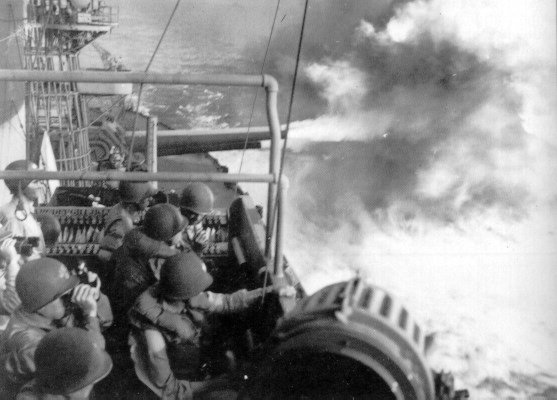
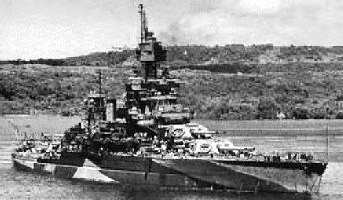 It happened just the way everyone says it did � it was early on a tropical Sunday morning the first week in December, and Frank Mitchell was below deck reading a magazine. Like everyone else, he heard some noise, but thinking it was some sort of drill, wasn't concerned at first. Quickly came the call to arms - and repeated shouts that "this is not a drill." Like his fellow crewmembers aboard the Battleship USS Maryland BB-46, a somewhat disbelieving Mitchell scrambled topside; he immediately manned one of the 5" guns, and began firing at the attacking Japanese planes that swarmed above Battleship Row in Pearl Harbor, Hawaii. For the United States, World War II had begun.
 The story of the USS Maryland and the stories of the other ships that came under fire at Pearl Harbor on December 7, 1941, have become a tragic and well-known part of our country's history. The men who served together on these battleships faced dangers and uncertainties that most people living today have not, through force of war, had to experience. Their bond is unmistakable, inevitable, and very human. And so they continue to meet each year, even all these years later, sharing their lives with each other as a result of friendships earned from crisis shared.
Frank Mitchell's story is fairly typical of the other sailors onboard that pivotal day at Pearl Harbor. A young, single guy from East Smithfield, Pennsylvania, he had been assigned to serve on the USS Maryland when he joined the Navy in 1940, but had already been accepted in submarine school, and was due to head back to the mainland for school. After the attack, his orders for submarine school were cancelled, and he ended up serving all six years of his required service on the USS Maryland fighting the Japanese in the Pacific.
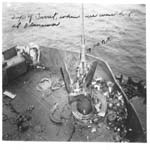
The USS Maryland and her crew served proudly throughout World War II. Following the attack, the Maryland put to sea, and engaged in various battles throughout the Pacific. She lent support to the carrier force involved in the important Battle of Midway. She supported Kinkaid's 7th Fleet and it's amphibious groups in several landings including the invasion of Okinawa, and participated at the Battle of Surigao Strait. She survived an aerial torpedo attack in June, 1944, and two Kamikaze hits (picture second from bottom shows damage from one Kamikaze attack), one in 1944, the other in 1945.
Four generations of the Mitchell family attended the battleship reunion. Frank, now 86, enjoys the reunions for the opportunity they give him to see old friends, but many of his old shipmates are passing away as the years go by, so each year becomes more precious than the one before.
Interestingly, the Battleship USS Missouri, the ship on which the Empire of Japan surrendered to the United States to end World War II, is permanently moored at the same quay at Pearl Harbor that once held the USS Maryland. It, along with other battleships, stands as a lasting tribute to those who died during the attack as well as those fortunate enough to survive. One regret that Mitchell says he shares with his shipmates from World War II is that the USS Maryland did not survive to be placed as a memorial. Sadly, following decades of valiant service (the ship was commissioned on July 21, 1921), the battleship was eventually towed and sold for scrap in California in the 1950s. But the ship's memory, all 624 feet of her with her 107 officers, 1,988 enlisted men and 67 marines, burns as bright and clear in the minds of her once-young crewmembers today as it did on that fateful Sunday morning so many years ago.
(All USS Maryland pictures provided by the official web site of the USS Maryland)
|

 The Pearl Harbor Survivors Association has a reunion every five years in Hawaii (the 60th reunion is scheduled for this year), but each battleship has annual reunions, held each year in a different state as the different groups choose. This year, the Battleship USS Maryland National Veterans Association reunion committee held their reunion in Asheville from September 6 - 10; it was hosted by a former crewmember who lives in Mount Ullo, NC. Some 120 people, both survivors and their families, traveled to Asheville to renew old acquaintances and share good times together. The group stayed at the Renaissance Hotel in downtown Asheville and traveled to various sites throughout the area, including the Biltmore Estate and the Thomas Wolfe Memorial, among others. A celebration banquet was also scheduled during their days in Asheville.
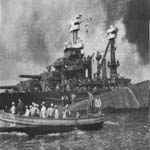 During the attack at Pearl Harbor, the Maryland was moored to the inside of the USS Oklahoma on Battleship Row; in fact, the two massive battleships were moored together. As a result of being moored on the outside of the two battleships, the USS Oklahoma shielded the USS Maryland from the torpedo attacks, but sustained tremendous damage (USS Oklahoma capsized in picture on right next to the USS Maryland), and was fatally crippled when repeatedly hit by six Japanese torpedo strikes. As the USS Oklahoma started to roll over, her mooring lines began to drag the Maryland with her. To save both the Maryland and her crew, the lines holding the two ships together had to be severed. Four men aboard the Maryland lost their lives that day, the result of a Japanese bomb that struck the ship.
 Frank Mitchell, a 3rd class coxswain during his years of service, was very fortunate never to be injured during his four years of combat, even though he was assigned to man one of the anti-aircraft guns during battle. He went on to marry his hometown sweetheart, Marian, and together, raised a large and loving family of four children. One of their sons, Cedric "Mitch" Mitchell, followed in his father's footsteps and went on to serve in the US Air Force, retiring in California after 24 years of service. The couple's other son, Jeffrey, who now lives in Alaska, also served, but in the US Army in Germany. After the war, Mitchell himself went back to the same creamery that he had worked at before the war, and continued to work there for 38 years; he also worked as a State Constable, retiring after 24 years.
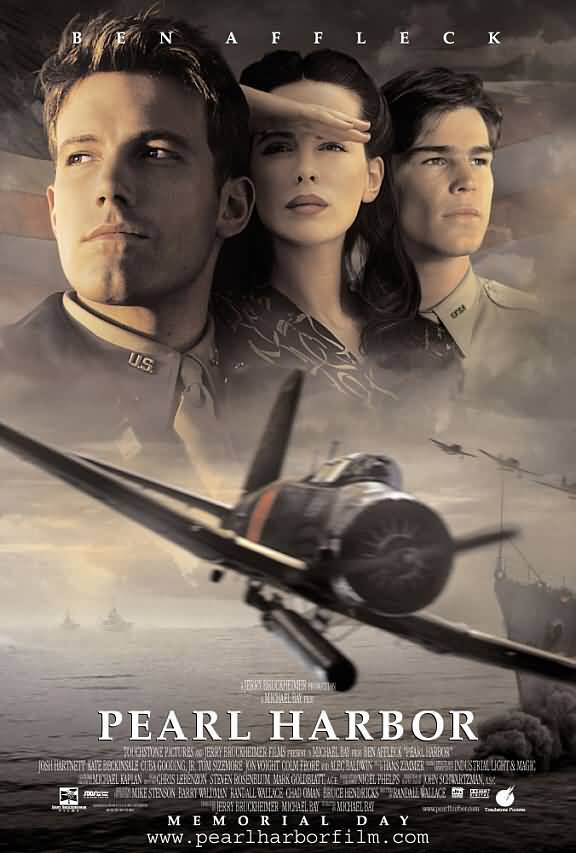 The tremendous popularity of the movie, "Pearl Harbor," has been fun for Mitchell and other Pearl Harbor survivors, although Mitchell says it is hard for Hollywood to recreate the true horror and human loss of that morning. When the movie opened in Mitchell's hometown, he and three other Pearl Harbor survivors who live in the area were invited to the premiere as special guests. They brought along with them a number of their mementos for other attendees to see, and the evening was a huge success. In the four weeks since its opening, "Pearl Harbor" has grossed over $160 million worldwide and has become one of the biggest box office hits of the summer.