 | wnc business & community directory |
|

This is an archived page that may contain outdated or incorrect information. Please visit www.Asheville.com for the latest news, events, and more.

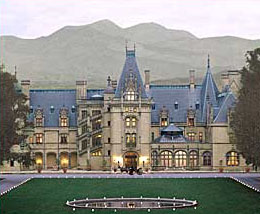 Guests typically comment that a visit to George Vanderbilt's turn-of-the-century French chateau, Biltmore House, is as close to a time machine journey as they can imagine. Once they enter the property, the modern world is, at least for a day, left behind.
 A large part of the fantasy is found in the architectural beauty of Biltmore House itself. But the magic of the 8,000-acre property can be attributed to the maturity of the plans of Frederick Law Olmsted (see second photo), the father of American landscape architecture and the genius behind Biltmore Estate's gardens and grounds. While many visitors are aware that Biltmore House is surrounded by elaborate home grounds and flower gardens - the Terraces, the Shrub Garden, the colorful four-acre Walled Garden - they are usually pleasantly surprised at the extensive woodlands, meadows, pasturelands, and agriculturally vibrant fields full of crops and livestock which comprise the present-day Estate.
"The Woodland Trails are a natural continuation of Olmsted's plans for the Estate," said Bill Alexander, Biltmore Estate Landscape Curator. "He intended the gardens surrounding Biltmore House to be less and less formal in design the further the distance from the mansion. At this location, where the trails begin, the 20-acre glen, now filled with native and hybrid azaleas, evolves into a natural woodland setting." "Our trails allow our guests to enjoy this natural setting firsthand," said Alexander. "Before, they only experienced the forests by car, along the Approach Road, and from a distance, surveying the forests from the Library Terrace. Now they can actually walk the woods as Vanderbilt did in his day."
 Michaelmas, Biltmore Estate's Fall Festival that is scheduled from September 28 through October 27, is an ideal time to enjoy the spectacle of fall color in Biltmore's gardens and woodlands. Several naturalist-led garden tours are offered Thursday through
Sunday at 2 PM covering a variety of subjects. Walks are offered from September 5 through October 26 for an additional fee at A Gardener's Place shop.
Michaelmas, Biltmore Estate's Fall Festival that is scheduled from September 28 through October 27, is an ideal time to enjoy the spectacle of fall color in Biltmore's gardens and woodlands. Several naturalist-led garden tours are offered Thursday through
Sunday at 2 PM covering a variety of subjects. Walks are offered from September 5 through October 26 for an additional fee at A Gardener's Place shop.If enjoying the crisp fall air and vibrant foliage on foot isn't exciting enough, guests can enjoy a variety of outdoor experiences through Explore Biltmore Estate's autumn offerings.
"He also hoped the location would be a site for foresters to study growth rates and timber production. He had plans for the property to house species of trees from all over the world." Olmsted's dreams for a Biltmore arboretum were never realized, although his legacy has been brought to life through the success of the North Carolina Arboretum, a state-owned and operated facility on the outskirts of Biltmore Estate (off of Highway 191 at the Blue Ridge Parkway). And Olmsted's vision for Biltmore continues to be nurtured by Alexander and the landscaping staff at the Estate. Today's guests can enjoy the rhododendron garden, a work still in progress, followed by an Adirondack-influenced rustic bridge over a small ravine. Wildflowers, such as trilliums, terrestrial orchids, and jack in the pulpit, have been planted along the trails and in the ravines. In the tradition of Mr. Olmsted, the trails are punctuated with naturalistic touches - moss-covered stumps and rocks, groupings of maidenhair ferns, and strategically placed steppingstones.
There is also history dating to before Vanderbilt's day apparent on the Woodland Trails. Below the spillway are foundations proving the existence of a working gristmill and a homestead. On the hill opposite the rhododendron garden, the path follows the remnants of an old wagon trail. As fall approaches, visitors to Biltmore Estate's Woodland Trails are encouraged to look for the following trees: White Chestnut and Scarlet Oaks, Tulip Tree, Dogwood, Red and Sugar Maples, Sourwood, Black Gum and Sweet Gum, Hickory, Black or Sweet Birch, and Beech. Bird lovers should keep their eyes open for the following: Around the Bass Pond - Canada Geese, Wood Ducks and Mallards, Great Blue Herons and Green Herons, Belted Kingfishers. Along the forested trails - Wild Turkey, Red-tailed, Red-shouldered, and Broad-winged Hawks, Pileated Woodpeckers, Finches, Sparrows and Wrens, Scarlet Tanagers, Chickadees, Nuthatches and Warblers, Cedar Waxwings. Along the meadows - Eastern Kingbirds, Flychatchers, Barn Swallows, Eastern Bluebirds, Phoebes, Northern Orioles, American Kestrels. For more information about Biltmore Estate, please call 828-274-6333 or toll-free at 800-543-2961, or visit their web site at www.biltmore.com. (photos provided by the Biltmore Estate)
|

 Modern day Estate visitors can experience the indigenous beauty of the Blue Ridge forests by exploring the Woodland Trails, first introduced to the public in 1995. It was the woodland that most fascinated Olmsted; it was through his encouragement that Vanderbilt established the first scientifically managed forest in America at Biltmore Estate. Strolling along the mottled, wooded paths through ravines, past a waterfall, across shaded wooden bridges and stone ledges, it is easy to see the allure.
 Vanderbilt took great pleasure in his various projects and experimentation with land management. Frequently he could be found on horseback or on foot, his favorite dog as companion, surveying the countryside surrounding his grand home. And after his only child, Cornelia, was born in 1900, the Asheville Daily Citizen reported that a tree - a cucumber magnolia still in existence within the Biltmore gardens - was planted in her honor, near the Bass Pond. The story read:
 The Woodland Trails offer a series of delightful sites and landmarks, according to Alexander, all of which are a direct acknowledgement of Olmsted's original plans and intentions. "Olmsted had planned for the Estate to be home to the most comprehensive arboretum in the country," he explained. "He knew the mountains of North Carolina could sustain rich plant diversity and that it could be a perfect spot for both scientific research as well as creative experimentation with various aspects of landscape design. He designed Arboretum Road on the Estate to be 10 miles long. That's a lot of plantings.
 There is also firm evidence that Olmsted's hand was directly involved in the area: exotic plantings of bamboo, a grove of hemlocks, the surprise of a huge Bald Cypress - normally found only in coastal areas - along a mountain stream. And, along the elaborately planned Bass Pond spillway, with its innovative flume system designed to prevent silt accumulation, brick and rockwork resemble an intricate puzzle that only the artistic Olmsted could have devised.