

Calendar of Events
Upcoming events and things to do in Asheville, NC. Below is a list of events for festivals, concerts, art exhibitions, group meetups and more.
Interested in adding an event to our calendar? Please click the green “Post Your Event” button below.

Featured Artists: Jude Stuecker (fiber) Erica Bailey (jewelry) Mary Dashiell (clay) Steve Miller (wood) Rex Redd (clay)

Floralia
Share this event:
From April 29 through June 20, 2022, North Carolina Glass Center will present Floralia, an exhibition to celebrate the birth of Spring. In ancient Rome, the celebration of Flora, the goddess of flowering plants, included games and festivities. Our seasonal show will capture the beauty of new beginnings with glass vessels, botanical sculpture and mixed media, all with a nature theme.
All displayed art is for sale. The purchase of art from Floralia will support local artists and the nonprofit North Carolina Glass Center.
Open daily 10am-5pm. Closed Tuesdays. Free admission.

Noel Yovovich will be demonstrating her jewelry making techniques using anodized titanium, silver, and wire; her work is delightfully dimensional.
Call ahead for the latest updates: 828-298-7928.

Rodney Leftwich will be demonstrating various pottery techniques, focusing on surface decoration, in the lobby of the Folk Art Center on the Blue Ridge Parkway.
Call ahead for the latest updates: 828-298-7928.
|
|
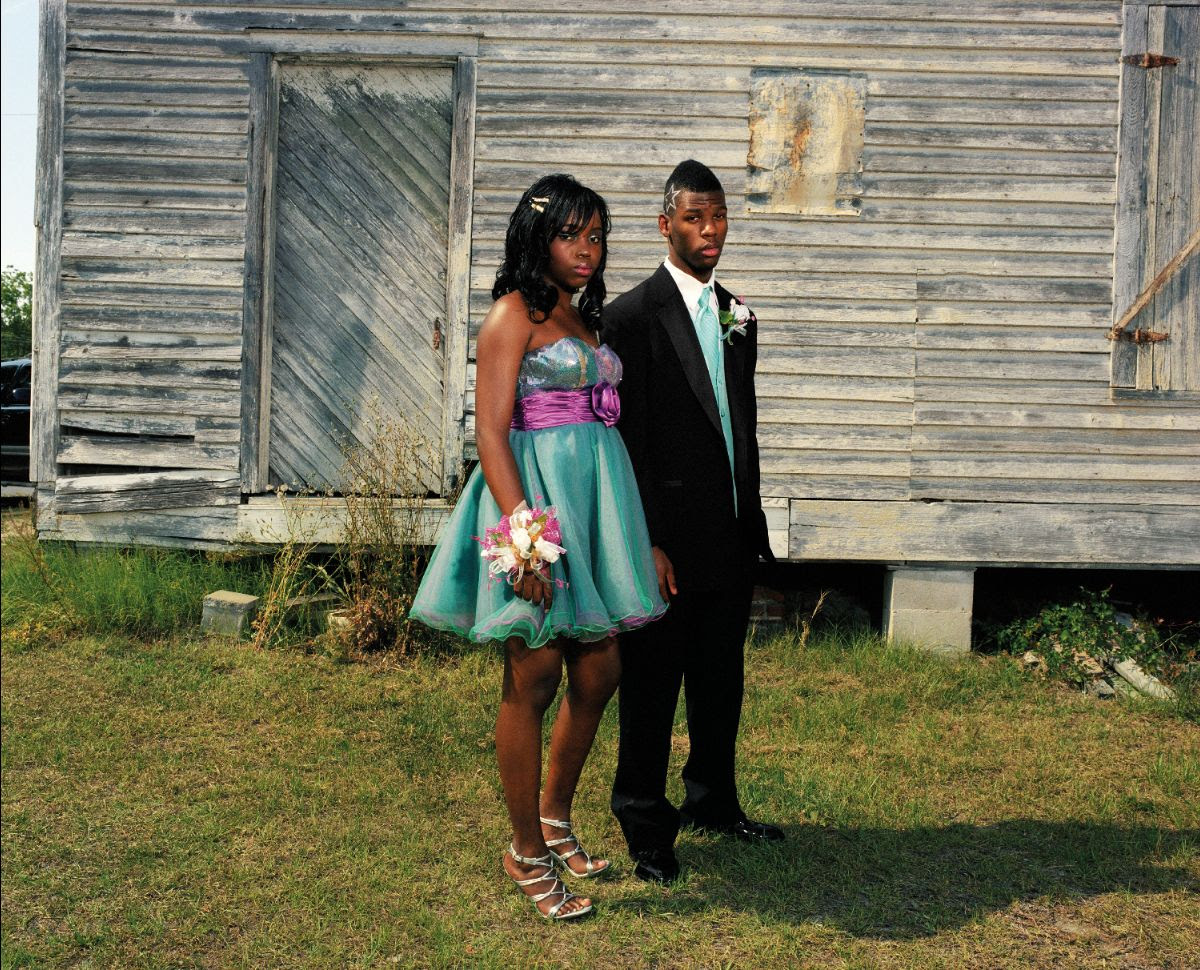 |
| Gillian Laub, Amber and Reggie, Mount Vernon, Georgia, 2011, inkjet print, 40 × 50 inches. © Gillian Laub, courtesy of Benrubi Gallery. |
American photographer Gillian Laub (born New York, 1975) has spent the last two decades investigating political conflicts, exploring family relationships, and challenging assumptions about cultural identity. In Southern Rites, Laub engages her skills as a photographer, filmmaker, and visual activist to examine the realities of racism and raise questions that are simultaneously painful and essential to understanding the American consciousness.
In 2002, Laub was sent on a magazine assignment to Mount Vernon, GA, to document the lives of teenagers in the American South. The town, nestled among fields of Vidalia onions, symbolized the archetype of pastoral, small town American life. The Montgomery County residents Laub encountered were warm, polite, protective of their neighbors, and proud of their history. Yet Laub learned that the joyful adolescent rites of passage celebrated in this rural countryside—high school homecomings and proms—were still racially segregated.
Laub continued to photograph Montgomery County over the following decade, returning even in the face of growing—and eventually violent—resistance from community members and local law enforcement. She documented a town held hostage by the racial tensions and inequities that scar much of the nation’s history. In 2009, a few months after Barack Obama’s first inauguration, Laub’s photographs of segregated proms were published in the New York Times Magazine. The story brought national attention to the town and the following year the proms were finally integrated. The power of her photographic images served as the catalyst and, for a moment, progress seemed inevitable.
Then, in early 2011, tragedy struck the town. Justin Patterson, a twenty-two-year-old unarmed African American man—whose segregated high school homecoming Laub had photographed—was shot and killed by a sixty-two-year-old white man. Laub’s project, which began as an exploration of segregated high school rituals, evolved into an urgent mandate to confront the painful realities of discrimination and structural racism. Laub continued to document the town over the following decade, during which the country re-elected its first African American president and the ubiquity of camera phones gave rise to citizen journalism exposing racially motivated violence. As the Black Lives Matter movement and national protests proliferated, Laub uncovered a complex story about adolescence, race, the legacy of slavery, and the deeply rooted practice of segregation in the American South.
Southern Rites is a specific story about 21st century young people in the American South, yet it poses a universal question about human experience: can a new generation liberate itself from a harrowing and traumatic past to create a different future?
Southern Rites is curated by Maya Benton and organized by the International Center of Photography.

Brighten your walls with with works from Artsville Collective’s upcoming exhibition, “In Living Color: At Home with Paint, Paper and Thread.” Allow these abstract pieces, in varying sizes and mediums, to light up your life. Collectively, the artwork’s tonal range is of blended neutrals and ventures into spring and fall palettes. Suit your design pleasures with pure color or wabi-sabi textural designs in a range of perspectives from three uniquely talented artists: Betsy Meyer, fibers; Karen Stastny, painting, and Michelle Wise, mixed media. Also showing: the Retro pop art of Daryl Slaton, which can be activated on your phone to reveal an animated story. For a softer approach, consider the mixed media art of Louise Glickman using paint, textiles, and natural plant materials.
Black Mountain College: Idea + Place
Lower Level Gallery with Companion Digital Exhibition
How can an idea inform a place? How can a place inform an idea? Would Black Mountain College have had the same identity and lifespan if it had been located in the urban Northeast, the desert Southwest, or coastal California? How did BMC’s rather isolated, rural, and mountainous setting during the era of the Great Depression and the Jim Crow South influence the college community’s decision-making and the evolution of ideas upon which it was based?
This exhibition seeks to delve into these questions and others by exploring the places of Black Mountain College: its two very different campuses, its influential predecessor the Bauhaus in Germany, and the post-BMC diaspora. Curated by Alice Sebrell, Director of Preservation
adVANCE! Modernism, Black Liberation + Black Mountain College
Upper Level Gallery with Companion Digital Exhibition
Featuring the work of contemporary sculptor Larry Paul King in conversation with Black Mountain College modernist masters including Jacob Lawrence, Gwendolyn Knight Lawrence, Josef Albers, Leo Krikorian, and Sewell Sillman. Premiering three Jacob Lawrence lithographs new to the BMCM+AC permanent collection. adVANCE! celebrates Black Mountain College’s role in early civil rights and the ongoing role of Black, modernist artists in the pursuit of liberation and justice.
Curated by Marie T. Cochran, Founder of the Affrilachian Artist Project


|
|
|
|
|
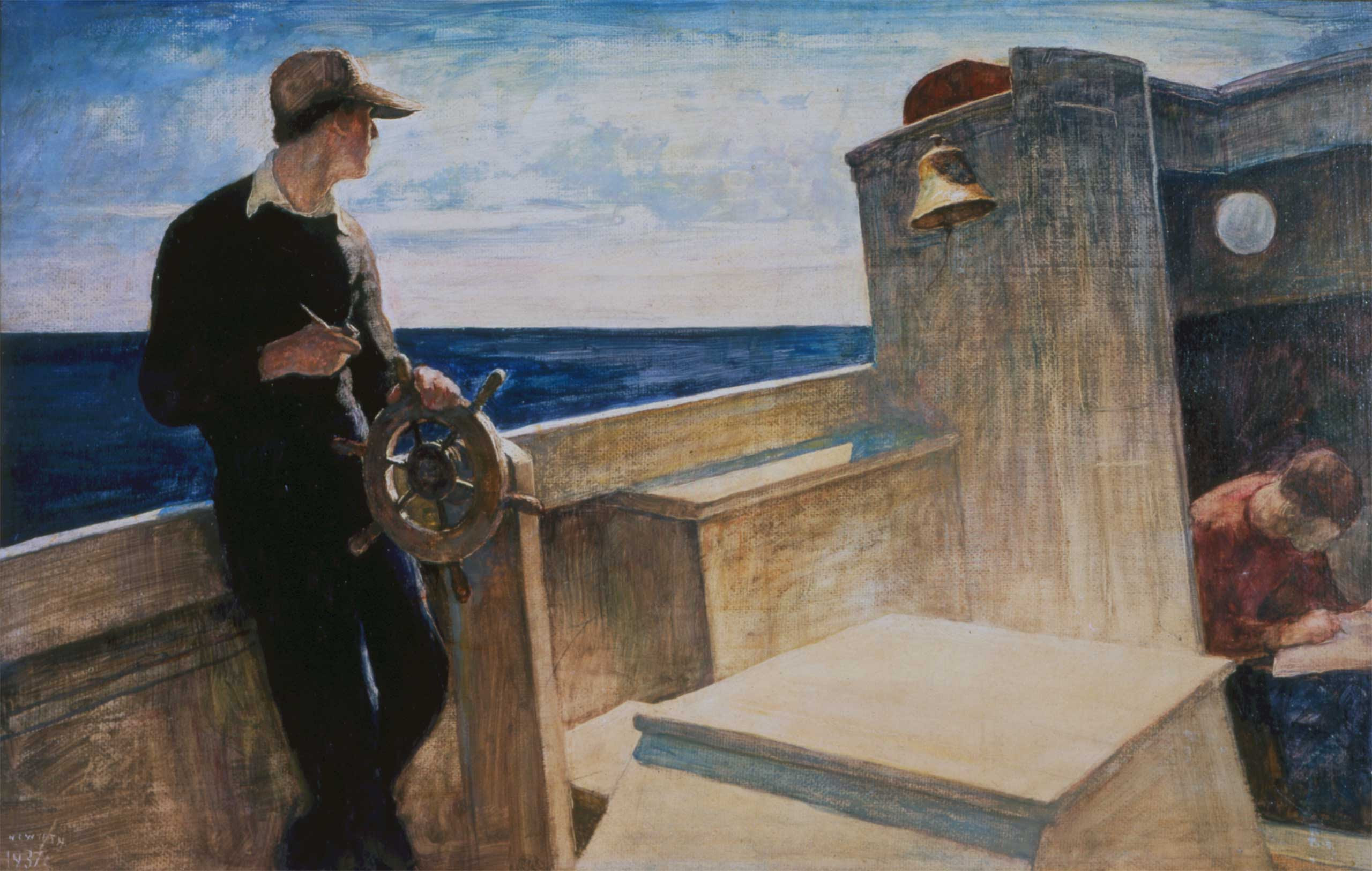 |
| N. C. Wyeth, Eight Bells (Clyde Stanley and Andrew Wyeth aboard Eight Bells), 1937, oil on hardboard, 20 × 30 inches. Bank of America Collection |
The Wyeths: Three Generations | Works from the Bank of America Collection provides a comprehensive survey of works by N. C. Wyeth, one of America’s finest illustrators; his son, Andrew, an important realist painter; his eldest daughter, Henriette, a realist painter; and Andrew’s son Jamie, a popular portraitist. Through the works of these artists from three generations of the Wyeth family, themes of American history, artistic techniques, and creative achievements can be explored. This exhibition will be on view in the Asheville Art Museum’s Explore Asheville Exhibition Hall February 12 through May 30, 2022.
N. C. Wyeth (1882–1945) has long been considered one of the nation’s leading illustrators. In the early 1900s, he studied with illustrator Howard Pyle in Delaware. In 1911, he built a house and studio in nearby Chadds Ford, PA. Later, he bought a sea captain’s house in Maine and in 1931 built a small studio, which he shared with his son, Andrew, and his daughters, Henriette and Carolyn. The exhibition includes illustrations for books by Robert Louis Stevenson and Washington Irving as well as historical scenes, seascapes, and landscapes.
Andrew Wyeth (1917–2009) is one of the United States’ most popular artists, and his paintings follow the American Realist tradition. He was influenced by the works of Winslow Homer, whose watercolor technique he admired, as well as by the art of Howard Pyle and his father, N. C. While Andrew painted recognizable images, his use of line and space often imbue his works with an underlying abstract quality. The exhibition includes important works from the 1970s and 1980s as well as recent paintings.
Henriette Wyeth (1907–1997) was the eldest daughter of N.C. Wyeth and an older sister to Andrew Wyeth. Like other members of her family, her painting style was realist in a time when Impressionism and Abstraction were popular in the early 20th century. She studied painting at the Pennsylvania Academy of the Fine Arts and was an acclaimed portraitist, though perhaps not as widely known as her father and brother. Most notably she painted the portrait of First Lady, Pat Nixon, which is in the collection of The White House.
Jamie Wyeth (born 1946), like his father and grandfather, paints subjects of everyday life, in particular the landscapes, animals, and people of Pennsylvania and Maine. In contrast to his father—who painted with watercolor, drybrush, and tempera—Jamie works in oil and mixed media, creating lush painterly surfaces. The 18 paintings in the exhibition represent all periods of his career.
This exhibition has been loaned through the Bank of America Art in our Communities® program.
|
|
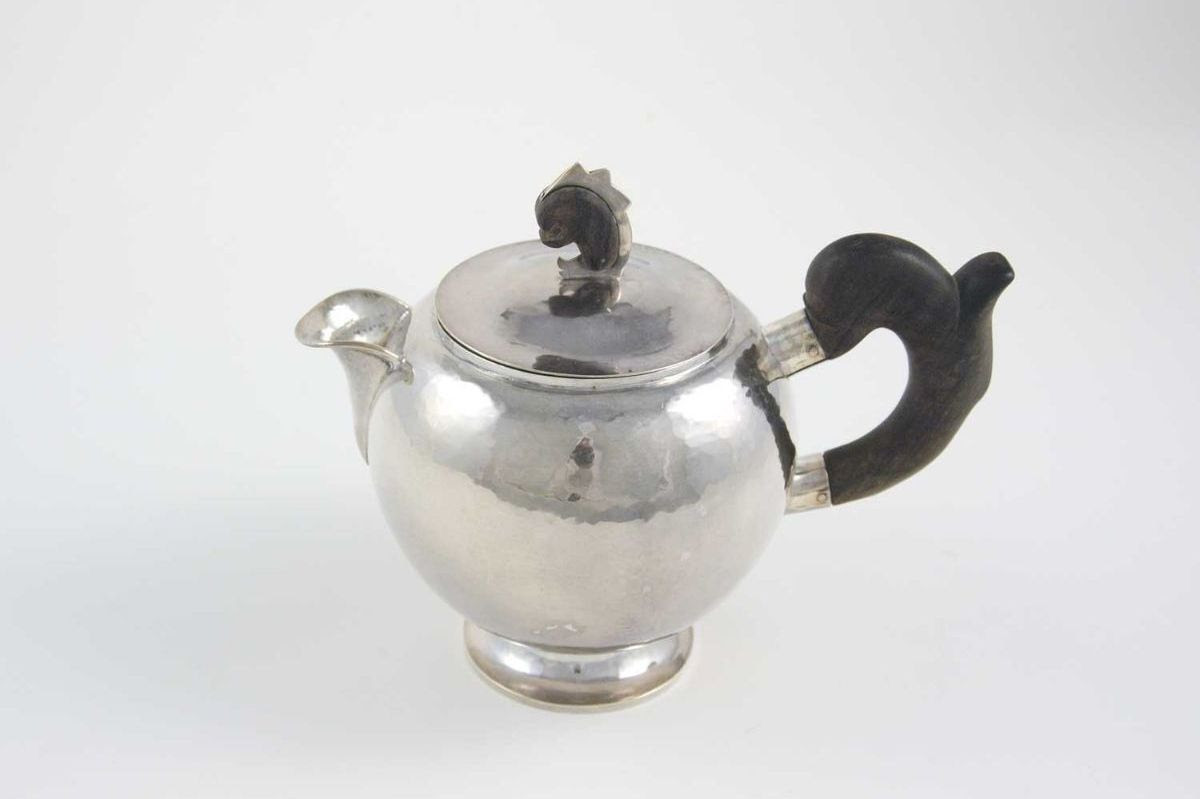
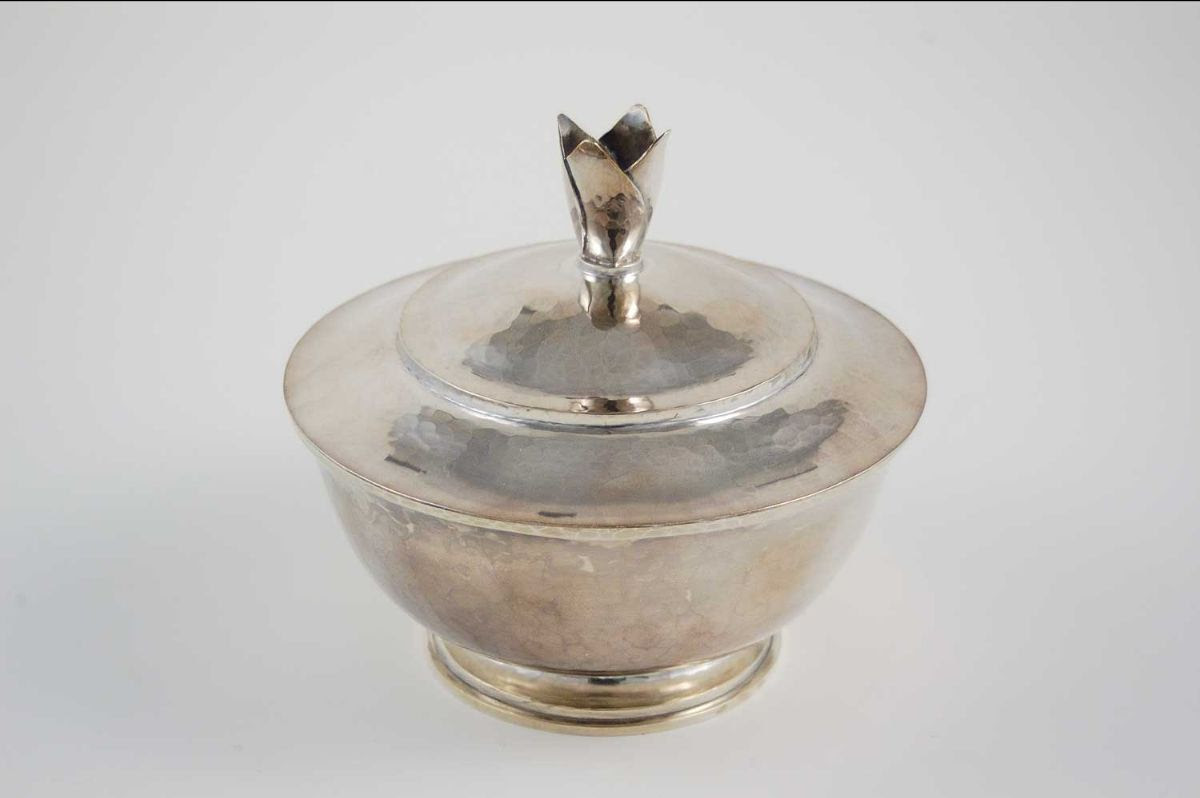
Useful and Beautiful: Silvercraft by William Waldo Dodge features a selection of functional silver works by Dodge drawn from the Museum’s Collection. Organized by the Asheville Art Museum and curated by Whitney Richardson, associate curator, this exhibition will be on view in the Debra McClinton Gallery at the Museum from February 23 through October 17, 2022.
William Waldo Dodge Jr. (Washington, DC 1895–1971 Asheville, NC) moved to Asheville in 1924 as a trained architect and a newly skilled silversmith. When he opened for business promoting his handwrought silver tableware, including plates, candlesticks, flatware (spoons, forks, and knives), and serving dishes, he did so in a true Arts and Crafts tradition. The aesthetics of the style were dictated by its philosophy: an artist’s handmade creation should reflect their hard work and skill, and the resulting artwork should highlight the material from which it was made. Dodge’s silver often displayed his hammer marks and inventive techniques, revealing the beauty of these useful household goods.
The Arts and Crafts style of England became popular in the United States in the early 1900s. Asheville was an early adopter of the movement because of the popularity and abundance of Arts and Crafts architecture in neighborhoods like Biltmore Forest, Biltmore Village, and the area around The Grove Park Inn. The title of this exhibition was taken from the famous quotation by one of the founding members of the English Arts and Crafts Movement, William Morris, who said, “have nothing in your house that you do not know to be useful or believe to be beautiful.” Not only did Dodge follow this suggestion; he contributed to American Arts and Crafts silver’s relevancy persisting almost halfway into the 20th century.
“It has been over 15 years since the Museum exhibited its collection of William Waldo Dodge silver and I am looking forward to displaying it in the new space with some new acquisitions added,” said Whitney Richardson, associate curator. Learn more at ashevilleart.org.
Wednesday evenings from 6:30-8:30pm at Story Parlor
April 13, April 20, April 27, May 4, May 11, May 18*
*Final class on May 18 runs from 6:30-9:30pm
Make up class reserved for May 25
Story Parlor presents Creativity Lab: a six-week exploration of the creative process, common blocks and obstacles, and ways to kickstart and sustain creative momentum.
Focused on the process and the act of doing, opposed to product or outcome, Creativity Lab explores ways to overcome fear, embrace curiosity, and channel our muse in all creative endeavors.
The six-week workshop is experiential, hands-on, and tactile. The Lab will utilize exercises to help cultivate imagination, innovation, and creativity. Each class will focus on a different part of the creativity process all while building a tool kit for dealing with obstacles in our way, creating positive habits for growth, and investigating the ways our personal narratives intersect with our work.
Registration Includes:
A guidebook with supplementary readings, exercises, and activities
A custom Story Parlor notebook
Access to Creativity Mixers
Who Should Attend:
Anyone looking to kickstart or follow-through with a creative project
Anyone wanting to discover more about their habits and approach to creativity
Anyone hoping to learn more about the process of being creative
Anyone wishing to make creativity a part of their daily life
Anyone looking to explore the intersection of art and the human condition
Anyone interested in identifying their core values’ intersection with creative goals and aspirations
Anyone wanting a creative community in which to play, explore, and experiment
NC State Parks’ Year of the Tree continues with a celebration of spring trees. Break out your camera and capture the transformation of trees from winter to spring as they show off their gorgeous blooms throughout the next few months. You may even win a prize for your efforts!
GREAT PRIZES WILL BE AWARDED TO 3 WINNING ENTRIES
1st Prize: The winning photo will be our Facebook cover photo for two weeks, and the photographer will receive two annual passes to Chimney Rock State Park, two boat tour tickets from Lake Lure Tours, and dinner for two at the Old Rock Café.
2nd Prize: After the first place photo, the second place photo will be our Facebook cover photo for one week. The photographer will receive two annual passes to Chimney Rock State Park and dinner for two at the Old Rock Café.
3rd Prize: The third place photographer will receive two adult day passes (or one family pack of day passes) to Chimney Rock State Park and dinner for two at the Old Rock Café.
CONTEST RULES:
- There is no fee to enter the contest. All photographs must be taken of Chimney Rock at Chimney Rock State Park only in areas accessible to guests between April 1, 2022 – May 31, 2022.
The contest is open to amateur and professional photographers. - Up to three photos per person can be submitted via any of the following ways to be eligible to win:
- Facebook: First, like the Chimney Rock at Chimney Rock State Park page. Next, send us a private message including your contact information specified in rule #3.
- E-mail: If you don’t have access to social media, you may email your digital photo with your contact information specified in rule #3 to [email protected].
- Every entry should be clearly labeled with the photographer’s name, city & state, a brief photo caption, an email address and the best phone number to reach you.
- Photos should be available at a minimum resolution of 1200 x 1600 pixels (1 MB minimum) to be eligible to win. Photos taken via smart phones, tablets and other mobile devices are welcome if they meet minimum requirements.
- For entries showing human faces, you must list their name(s) and have written permission from any photographed person(s) to use their image.
- Entries should reflect the photographer’s interpretation of the theme. Emphasis will be placed on quality, composition and creativity. All entries may be used in promotions of Chimney Rock and park-related activities.
- Digital images can be optimized but not dramatically altered with photo editing software. Black and white photographs are welcome.
- Finalists will be chosen by Chimney Rock staff and the winner will be voted on by the public. Decisions regarding winners are final.
Winners will be notified personally and announced on Chimney Rock’s social media. For more information, call 1-828-625-9611, ext. 1812 or email us at [email protected].

Featured Artists: Guild Members from the WNC Fiber Handweavers Guild

Featured Artists: Judi Harwood (clay) Colin Richmond (clay) Cori Saraceni (mixed media) Lyn Lyndall (leather) Lauren Faulkenberry (paper)
Featured Artists: Jude Stuecker (fiber) Erica Bailey (jewelry) Mary Dashiell (clay) Steve Miller (wood) Rex Redd (clay)
Floralia
Share this event:
From April 29 through June 20, 2022, North Carolina Glass Center will present Floralia, an exhibition to celebrate the birth of Spring. In ancient Rome, the celebration of Flora, the goddess of flowering plants, included games and festivities. Our seasonal show will capture the beauty of new beginnings with glass vessels, botanical sculpture and mixed media, all with a nature theme.
All displayed art is for sale. The purchase of art from Floralia will support local artists and the nonprofit North Carolina Glass Center.
Open daily 10am-5pm. Closed Tuesdays. Free admission.
Rodney Leftwich will be demonstrating various pottery techniques, focusing on surface decoration, in the lobby of the Folk Art Center on the Blue Ridge Parkway.
Call ahead for the latest updates: 828-298-7928.
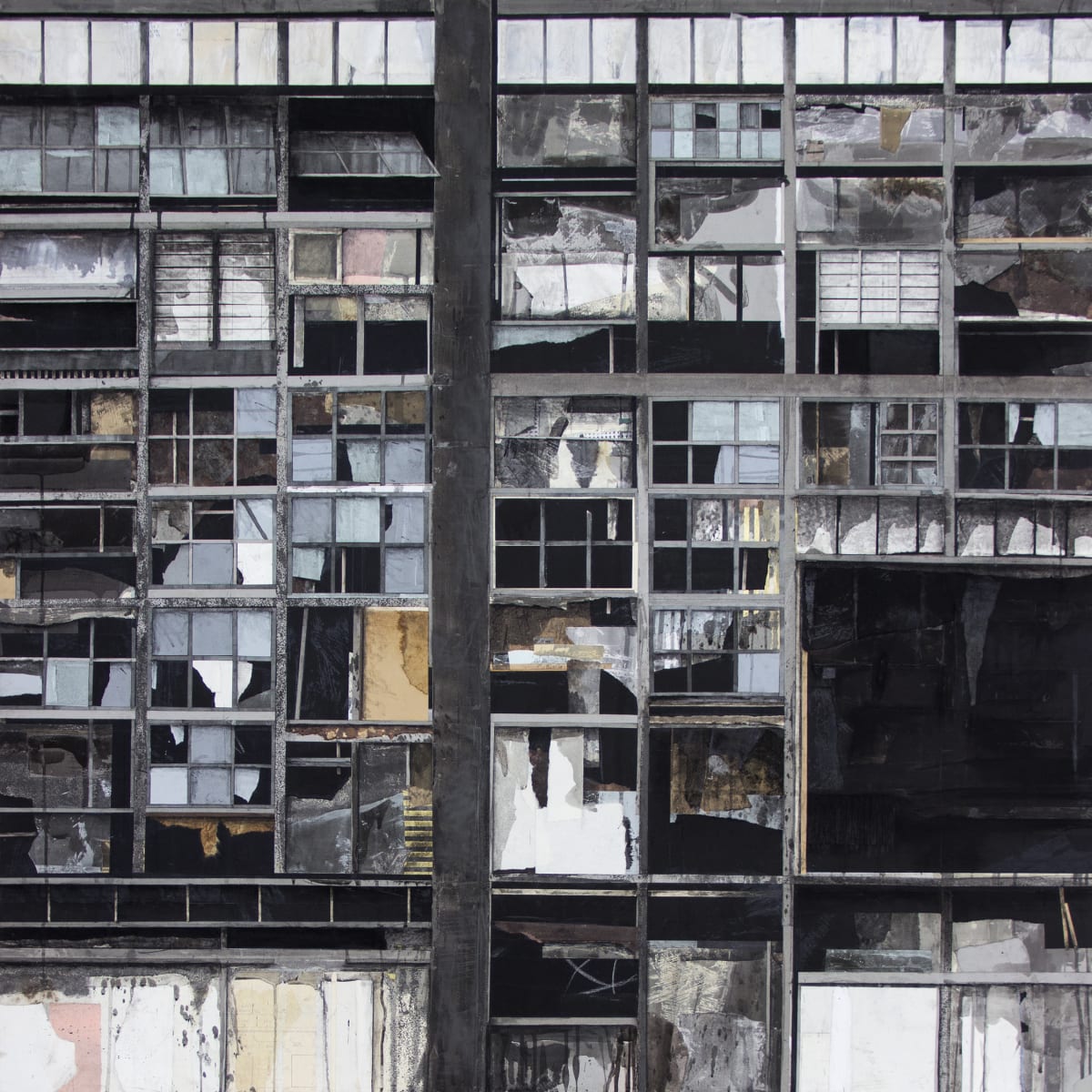
“My work focuses on deteriorating architecture. These structures, designed to be huge forces of permanence, are continually being challenged, destroyed and forgotten. I see an inherent honesty in the face of my subject. Among all of the clutter—the shards of wood and layers of rubble—there remains a gentle resolve. As I work, I study these structures incessantly. The buildings, often on the brink of ruin, have something very energized and present trying to escape from their fragmented reality.” –Seth Clark
This first solo show of Seth’s work at Momentum’s new space features large-scale works from his Barn, Ghost, and Aerial View Series. The collection also includes some of the artist’s sculptural objects in wood. Abstract works, which still reference weathered architecture, such as Lath Study and Vinyl Study, round out the exhibition.
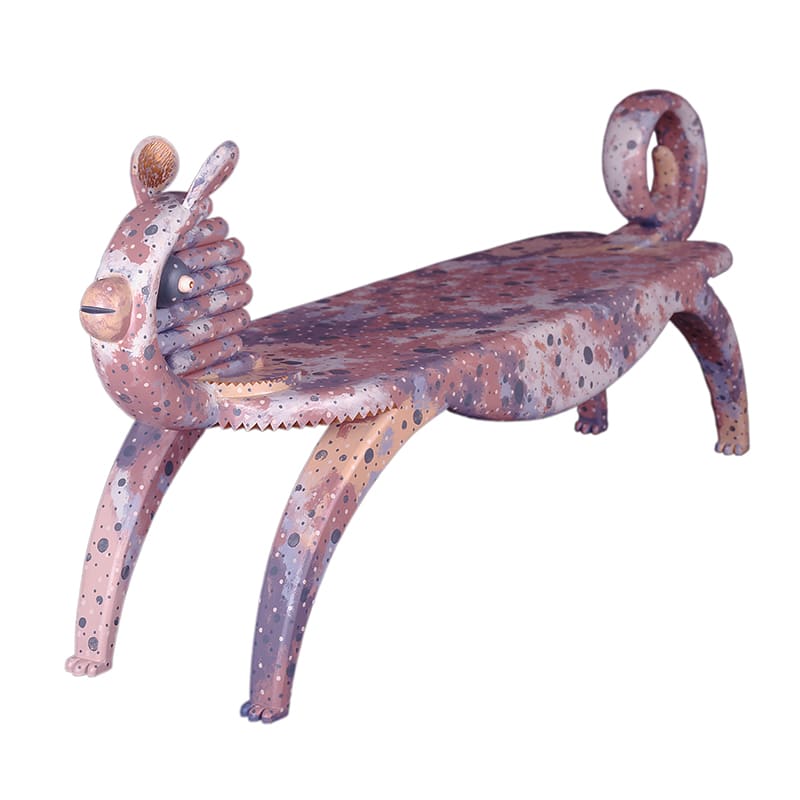
Simpson is an imaginist who has worked in nearly every medium, including woodworking, painting, printmaking, ceramics, bookmaking, jewelry, and writing. Whether it’s a painting or sculptural object, in each of Simpson’s works there is an identifiable style that puzzles together the artist’s personal and cultural references into a signature blend of joyfulness and subtle commentary. On describing Simpson’s sensibility, Karen S. Chambers comments, “It’s whimsical and wry, naive yet saavy, inteligent but not cerebral.” Edward S. Cooke, Jr. (Yale University) wrote, “Simpson is simply a maker who deftly blends utility, memory, irony, and spirituality in his accomplishments. Fundemental to his life has been a conviction that ‘art can be meaningful and still give joy.’ He makes faciful, whimsical objects that incorporate verbal and visual puns and probe the meanings of cultural icons, but undertakes such commentary wthin comfortable settings. His works possess an engaging tension that employs friendly humor or familiar details and conventions to inspire long-lasting thoughtfulness.”
The collection presented at Momentum spans the past 30 years, and focuses on Simpson’s sculptural furniture including cabinets, clocks, and benches, paintings, whimsical wood sculptures, pottery, and works on paper. Tommy Simpson’s work is included in numerous public collections including the Renwick Gallery and the American Art Museum at the Smithsonian Institute, DC; and the Museum of Art and Design, NY.
|
|
|
| Gillian Laub, Amber and Reggie, Mount Vernon, Georgia, 2011, inkjet print, 40 × 50 inches. © Gillian Laub, courtesy of Benrubi Gallery. |
American photographer Gillian Laub (born New York, 1975) has spent the last two decades investigating political conflicts, exploring family relationships, and challenging assumptions about cultural identity. In Southern Rites, Laub engages her skills as a photographer, filmmaker, and visual activist to examine the realities of racism and raise questions that are simultaneously painful and essential to understanding the American consciousness.
In 2002, Laub was sent on a magazine assignment to Mount Vernon, GA, to document the lives of teenagers in the American South. The town, nestled among fields of Vidalia onions, symbolized the archetype of pastoral, small town American life. The Montgomery County residents Laub encountered were warm, polite, protective of their neighbors, and proud of their history. Yet Laub learned that the joyful adolescent rites of passage celebrated in this rural countryside—high school homecomings and proms—were still racially segregated.
Laub continued to photograph Montgomery County over the following decade, returning even in the face of growing—and eventually violent—resistance from community members and local law enforcement. She documented a town held hostage by the racial tensions and inequities that scar much of the nation’s history. In 2009, a few months after Barack Obama’s first inauguration, Laub’s photographs of segregated proms were published in the New York Times Magazine. The story brought national attention to the town and the following year the proms were finally integrated. The power of her photographic images served as the catalyst and, for a moment, progress seemed inevitable.
Then, in early 2011, tragedy struck the town. Justin Patterson, a twenty-two-year-old unarmed African American man—whose segregated high school homecoming Laub had photographed—was shot and killed by a sixty-two-year-old white man. Laub’s project, which began as an exploration of segregated high school rituals, evolved into an urgent mandate to confront the painful realities of discrimination and structural racism. Laub continued to document the town over the following decade, during which the country re-elected its first African American president and the ubiquity of camera phones gave rise to citizen journalism exposing racially motivated violence. As the Black Lives Matter movement and national protests proliferated, Laub uncovered a complex story about adolescence, race, the legacy of slavery, and the deeply rooted practice of segregation in the American South.
Southern Rites is a specific story about 21st century young people in the American South, yet it poses a universal question about human experience: can a new generation liberate itself from a harrowing and traumatic past to create a different future?
Southern Rites is curated by Maya Benton and organized by the International Center of Photography.
Brighten your walls with with works from Artsville Collective’s upcoming exhibition, “In Living Color: At Home with Paint, Paper and Thread.” Allow these abstract pieces, in varying sizes and mediums, to light up your life. Collectively, the artwork’s tonal range is of blended neutrals and ventures into spring and fall palettes. Suit your design pleasures with pure color or wabi-sabi textural designs in a range of perspectives from three uniquely talented artists: Betsy Meyer, fibers; Karen Stastny, painting, and Michelle Wise, mixed media. Also showing: the Retro pop art of Daryl Slaton, which can be activated on your phone to reveal an animated story. For a softer approach, consider the mixed media art of Louise Glickman using paint, textiles, and natural plant materials.
Black Mountain College: Idea + Place
Lower Level Gallery with Companion Digital Exhibition
How can an idea inform a place? How can a place inform an idea? Would Black Mountain College have had the same identity and lifespan if it had been located in the urban Northeast, the desert Southwest, or coastal California? How did BMC’s rather isolated, rural, and mountainous setting during the era of the Great Depression and the Jim Crow South influence the college community’s decision-making and the evolution of ideas upon which it was based?
This exhibition seeks to delve into these questions and others by exploring the places of Black Mountain College: its two very different campuses, its influential predecessor the Bauhaus in Germany, and the post-BMC diaspora. Curated by Alice Sebrell, Director of Preservation
adVANCE! Modernism, Black Liberation + Black Mountain College
Upper Level Gallery with Companion Digital Exhibition
Featuring the work of contemporary sculptor Larry Paul King in conversation with Black Mountain College modernist masters including Jacob Lawrence, Gwendolyn Knight Lawrence, Josef Albers, Leo Krikorian, and Sewell Sillman. Premiering three Jacob Lawrence lithographs new to the BMCM+AC permanent collection. adVANCE! celebrates Black Mountain College’s role in early civil rights and the ongoing role of Black, modernist artists in the pursuit of liberation and justice.
Curated by Marie T. Cochran, Founder of the Affrilachian Artist Project
|
|
|
|
|
|
| N. C. Wyeth, Eight Bells (Clyde Stanley and Andrew Wyeth aboard Eight Bells), 1937, oil on hardboard, 20 × 30 inches. Bank of America Collection |
The Wyeths: Three Generations | Works from the Bank of America Collection provides a comprehensive survey of works by N. C. Wyeth, one of America’s finest illustrators; his son, Andrew, an important realist painter; his eldest daughter, Henriette, a realist painter; and Andrew’s son Jamie, a popular portraitist. Through the works of these artists from three generations of the Wyeth family, themes of American history, artistic techniques, and creative achievements can be explored. This exhibition will be on view in the Asheville Art Museum’s Explore Asheville Exhibition Hall February 12 through May 30, 2022.
N. C. Wyeth (1882–1945) has long been considered one of the nation’s leading illustrators. In the early 1900s, he studied with illustrator Howard Pyle in Delaware. In 1911, he built a house and studio in nearby Chadds Ford, PA. Later, he bought a sea captain’s house in Maine and in 1931 built a small studio, which he shared with his son, Andrew, and his daughters, Henriette and Carolyn. The exhibition includes illustrations for books by Robert Louis Stevenson and Washington Irving as well as historical scenes, seascapes, and landscapes.
Andrew Wyeth (1917–2009) is one of the United States’ most popular artists, and his paintings follow the American Realist tradition. He was influenced by the works of Winslow Homer, whose watercolor technique he admired, as well as by the art of Howard Pyle and his father, N. C. While Andrew painted recognizable images, his use of line and space often imbue his works with an underlying abstract quality. The exhibition includes important works from the 1970s and 1980s as well as recent paintings.
Henriette Wyeth (1907–1997) was the eldest daughter of N.C. Wyeth and an older sister to Andrew Wyeth. Like other members of her family, her painting style was realist in a time when Impressionism and Abstraction were popular in the early 20th century. She studied painting at the Pennsylvania Academy of the Fine Arts and was an acclaimed portraitist, though perhaps not as widely known as her father and brother. Most notably she painted the portrait of First Lady, Pat Nixon, which is in the collection of The White House.
Jamie Wyeth (born 1946), like his father and grandfather, paints subjects of everyday life, in particular the landscapes, animals, and people of Pennsylvania and Maine. In contrast to his father—who painted with watercolor, drybrush, and tempera—Jamie works in oil and mixed media, creating lush painterly surfaces. The 18 paintings in the exhibition represent all periods of his career.
This exhibition has been loaned through the Bank of America Art in our Communities® program.
|
|
Useful and Beautiful: Silvercraft by William Waldo Dodge features a selection of functional silver works by Dodge drawn from the Museum’s Collection. Organized by the Asheville Art Museum and curated by Whitney Richardson, associate curator, this exhibition will be on view in the Debra McClinton Gallery at the Museum from February 23 through October 17, 2022.
William Waldo Dodge Jr. (Washington, DC 1895–1971 Asheville, NC) moved to Asheville in 1924 as a trained architect and a newly skilled silversmith. When he opened for business promoting his handwrought silver tableware, including plates, candlesticks, flatware (spoons, forks, and knives), and serving dishes, he did so in a true Arts and Crafts tradition. The aesthetics of the style were dictated by its philosophy: an artist’s handmade creation should reflect their hard work and skill, and the resulting artwork should highlight the material from which it was made. Dodge’s silver often displayed his hammer marks and inventive techniques, revealing the beauty of these useful household goods.
The Arts and Crafts style of England became popular in the United States in the early 1900s. Asheville was an early adopter of the movement because of the popularity and abundance of Arts and Crafts architecture in neighborhoods like Biltmore Forest, Biltmore Village, and the area around The Grove Park Inn. The title of this exhibition was taken from the famous quotation by one of the founding members of the English Arts and Crafts Movement, William Morris, who said, “have nothing in your house that you do not know to be useful or believe to be beautiful.” Not only did Dodge follow this suggestion; he contributed to American Arts and Crafts silver’s relevancy persisting almost halfway into the 20th century.
“It has been over 15 years since the Museum exhibited its collection of William Waldo Dodge silver and I am looking forward to displaying it in the new space with some new acquisitions added,” said Whitney Richardson, associate curator. Learn more at ashevilleart.org.

Bridgeway Capital’s Creative Business Accelerator is working in partnership with the Land of Sky Regional Council and stakeholders across Western North Carolina to develop a Creative Manufacturing Sector Development Plan for the region. To better understand the opportunities and challenges faced by creative entrepreneurs in the region, and to get your thoughts on how to move Western North Carolina’s creative economy forward, we’re hosting a series of listening sessions in early May.
To provide context, we are defining creative manufacturing as “creative manufacturers use traditional handwork processes and industrial production technologies to transform raw and/or reclaimed materials into finished goods with utility, durability, and distinctive design.” Finished goods from creative manufacturers are wide ranging and include, but are not limited to, furniture, hardware, decor, textiles, wall coverings, apparel, hollowware, home goods, lighting, musical instruments, beauty care, etc.
AGENDA
- Introductions
- Small and full group discussions:
-What are the primary assets this region has as it relates to the creative sector and/or creative manufacturing?
-What are the primary challenges creatives in this region face as it relates to the creative sector and/or creative manufacturing?
-In 10 years, how would you like Western NC’s creative sector and creative economy to look?
- Next steps in the creative manufacturing planning process
Questions? Please contact Katie Johnson – [email protected]
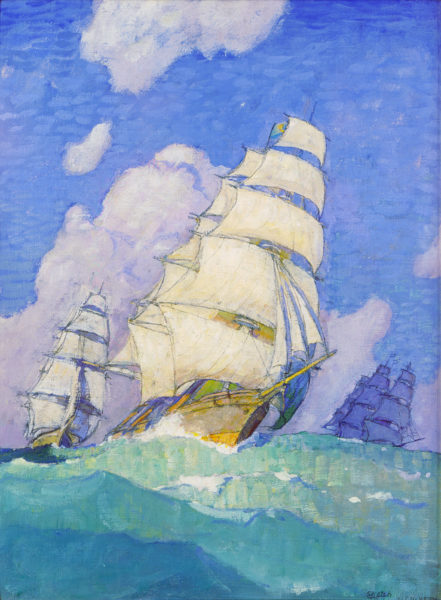
N. C. Wyeth, The Clippers presentation painting, 1923, oil on canvas, 21 × 15 inches. Bank of America Collection.
In this Art Break, Bank of America Collection Manager Mary Edith Alexander will share how this group of artwork by the Wyeths came into the bank’s collection and how it came to be put together for the exhibition. The discussion will cover points of interest about specific pieces in the show as well as insights into caring for this type of collection. Curiosity and questions are welcome and encouraged.
ART BREAKS
Drop in to one of our afternoon Art Breaks! Taking place on selected Fridays and Sundays, these informal gallery talks and presentations both educate and engage you in dialogue with our staff, docents, or special guests.

Tommy Simpson has worked in nearly every medium including woodworking, painting, printmaking, ceramics, bookmaking, jewelry, and writing. Whether it’s a painting or sculptural object, each of Simpson’s works possesses an identifiable style that puzzles together the artist’s personal and cultural references into a signature blend of joyfulness and subtle commentary. Edward S. Cooke, Jr. (Yale University) wrote, “Simpson is simply a maker who deftly blends utility, memory, irony, and spirituality in his accomplishments. Fundamental to his life has been a conviction that ‘art can be meaningful and still give joy.’”
The collection presented at Momentum spans the past 30 years, focusing on Simpson’s sculptural furniture including cabinets, clocks, and benches, paintings, whimsical wood sculptures, pottery, and works on paper. Tommy Simpson’s work is included in numerous public collections including the Renwick Gallery and the American Art Museum at the Smithsonian Institute, DC; and the Museum of Art and Design, NY.
“The ultimate goal is to bring the artwork to life, so that the viewer can identify the human spirit behind the work, and experience its poetry.”
|
|
|

— Tommy Simpson