

Calendar of Events
Upcoming events and things to do in Asheville, NC. Below is a list of events for festivals, concerts, art exhibitions, group meetups and more.
Interested in adding an event to our calendar? Please click the green “Post Your Event” button below.
Thursday, May
4, 2023
Spring Photo Contest: “Spring Trails”
Exhibition on Display: Attributes
 Biltmore Estate: Ciao! From Italy Sculptural Postcard Display
An Abundance of Riches
Exhibition: NEO MINERALIA
Biltmore Estate: Ciao! From Italy Sculptural Postcard Display
An Abundance of Riches
Exhibition: NEO MINERALIA
.jpg) Exhibition: Something earned, Something left behind
Exhibition: Something earned, Something left behind
 Exhibition: Crafting Denim
 Italian Renaissance Alive
Art Exhibit: RAUSCHENBERG: A Gift in Your Pocket
Italian Renaissance Alive
Art Exhibit: RAUSCHENBERG: A Gift in Your Pocket
 Flower Power – Asheville Gallery of Art
Luzene Hill: Revelate
Pulp Potential: Works in Handmade Paper
Flower Power – Asheville Gallery of Art
Luzene Hill: Revelate
Pulp Potential: Works in Handmade Paper
Stained with Glass: Vitreograph Prints from the Studio of Harvey K. Littleton Exhibition
Too Much Is Just Right: The Legacy of Pattern and Decoration
Open Studio at Different Wrld
Speakeasy Improv Presents: Improv Jams
NC State Parks’ Year of the Trail continues with a celebration of how our trails transform each spring. Bring your camera on your next excursion in the park and capture budding wildflowers, spring hikers, or whatever you encounter along the way. You may even win a prize for your efforts!
GREAT PRIZES WILL BE AWARDED TO 3 WINNING ENTRIES
1st Prize: The winning photo will be our Facebook cover photo for two weeks, and the photographer will receive two annual passes to Chimney Rock State Park and lunch for four at the Old Rock Café.
2nd Prize: After the first place photo, the second place photo will be our Facebook cover photo for one week. The photographer will receive one annual pass to Chimney Rock State Park and lunch for two at the Old Rock Café.
3rd Prize: The third place photographer will receive two adult day passes (or one family pack of day passes) to Chimney Rock State Park and lunch for two at the Old Rock Café.
Michelle Tway – fiber
Timothy Bridges – fiber
Martine House – mixed media
Noel Yovovich – metal
Deb Herman – fiber
The Focus Gallery is located on the second level of the Folk Art Center. The Folk Art Center is located at Milepost 382 of the Blue Ridge Parkway, just north of the Highway 70 entrance in east Asheville, NC.
This exhibition is hosted by the Southern Highland Craft Guild. The Guild is a non-profit, educational organization established in 1930 to cultivate the crafts and makers of the Southern Highlands for the purpose of shared resources, education, marketing, and conservation. The Southern Highland Craft Guild is an authorized concessioner of the National Park Service, Department of the Interior.
Included with admission
Embark on a scenic journey across George Vanderbilt’s Italy with a large-scale outdoor display that combines brilliant botanical designs with authentic messages written by Vanderbilt himself.
Beautifully handcrafted of natural elements, each sculptural postcard depicts a location or landmark Vanderbilt visited more than a century ago. This captivating complement to Biltmore’s Italian Renaissance Alive exhibition reveals Vanderbilt’s passions for travel, culture, architecture, and art as well as his personal experience of such renowned Italian cities as Milan, Florence, Venice, Pisa, and Vatican City.
Adding to the charm and visual appeal of Ciao! From Italy—sure to be a hit among kids of all ages—is the G-scale model train that travels in and out of each postcard in this enlightening display!

Andrea Rich’s intricately designed, carved, and printed woodcuts draw viewers in for an up-close look.
Some of the artist’s earliest memories are of drawing animals. Childhood encounters with pets, livestock, and wildlife, including birds, deer, and toads, created a lasting connection to the natural world. Through encounters with creatures both tame and wild, Rich developed a fascination and a compassion for animals integral to her art.
“My prints are a visual record of the intriguing creatures that have enriched my life. The woodcut process challenges me to focus on the essence of my subjects. At the same time, I am drawn to the smell of the wood, its texture and grain, and the pleasure I experience while carving. I begin working on a block of wood and realize later that hours have passed without notice.”
Rich uses a centuries-old medium that requires one carved wood panel for each color – varying from one to sixteen – necessary to develop the composition. These panels are painstakingly aligned one atop another sequentially and pulled through a printing press to create the final woodcut.
The subjects of Rich’s woodcuts range from the wilderness of the Australian outback and the lush tropical Amazon forests to the roaring rivers of Yellowstone Park. Rich has traveled worldwide to study wildlife habitats and these varied firsthand experiences are reflected in her work.
Among Rich’s many achievements are international recognition for her woodcut prints, including a 2009 Award of Excellence from the Society of Animal Artists and a 2009 Medal of Excellence from the Artists for Conservation Foundation. She was named Master Artist by the Leigh Yawkey Woodson Art Museum in 2006. In 2010 her work was featured in a solo exhibition at the Mass Audubon Visual Arts Center, Canton, Massachusetts. Rich is a member of the California Society of Printmakers, Artists for Nature Foundation, the Society of Animal Artists, and Society of Wildlife Artists.
In 2000 Rich designated the Woodson Art Museum as the repository for her artistic oeuvre. An Abundance of Riches is drawn from these holdings, which include an example of each of her woodcuts created since the mid-1980s.
Photo credit:
Sae Honda. Courtesy of the Artist.
NEO MINERALIA suggests that recent rock formations no longer fit within the traditional groups: Igneous, Metamorphic, and Sedimentary. Instead, the Anthropocene, the era of human influence on the climate and environment, has introduced two post-natural rocks: Synthetic and Digital.
NEO MINERALIA presents a selection of new geological specimens crafted by ten international artists exploring rocks as reflections of our effects on human and nonhuman ecologies. By embedding synthetic materials (plastics, e-waste) and layers of data points (critical, financial, social) into the craftsmanship of these artifacts, the artists transgress the definition of rocks, turning them from passive aggregates of minerals into metaphorical aggregates of data. Within their apparent “rockness” we can decode hopes, warnings, and speculative future scenarios.
The featured works stemming from places as varied as Mexico, Japan, Poland, and Australia (including a curated artists’ books library), collectively signal a new era of planetary and geological consciousness where we are asked to read, feel, and listen to rocks in new ways.
Photo credit:
J Diamond, “Pony II,” 2022. Courtesy of the Artist
Something earned, Something left behind is an exhibition of objecthood; a critical analysis of the transactional and political languages of everyday and culturally significant objects. This exhibition challenges a history of exclusion and inclusion of People of Color (POC) and their narratives from the canon of craft based on subject matter. It dissects this history’s origins and precedent as an economic transaction to gain access to white spaces.
Racial and ethnic identity influences the way individuals perceive themselves, the way others perceive them, and the way they choose to behave. For this reason, People of Color are expected to perform certain roles in order to fit into hegemonic institutions. These roles can be an active shrinking of themselves and the racialized part of them, or a personal exploitation of their racialized selves. This exhibition addresses and redresses the ways narrowed populations have been included, and the ways in which they have been asked to participate.
Together, this work creates space for and legitimizes POC narratives with depth and care. The exhibiting artists’ practices work against institutionalized expectations of POC work, expanding discourse and inserting new subjectivity into the canon of craft art. It engages with a community hungry for the revitalization and resuscitation of non-Western voices within art spaces. This exhibition challenges the expectations of art from artists of marginalized backgrounds and embraces a new subjectivity of interrogating one’s inherited experiences.
Photo credit:
Photograph by Bowery Blue Makers
Jeans – with their standardized pockets, rivets, and denim – are so much a part of everyday wardrobes that they are easy to overlook. Yet, in workshops across the nation, independent makers are reevaluating the garment and creating jeans by hand, using antiquated equipment and denim woven on midcentury looms. Crafting Denim explores how and why jeans have come to exist at the intersections of industry and craft, modernity, and tradition.
A product of industrial factory production for over a century, jeans are being recast by a new cohort of small-scale makers including craftspeople like Ryan Martin of W.H. Ranch Dungarees, Takayuki Echigoya of Bowery Blue Makers, and Sarah Yarborough and Victor Lytvinenko of Raleigh Denim, who favor choice materials and small-batch fabrication. The jeans they make merge craft traditions with industry and extend the conversation between hand and machine.
Each maker creates a distinctive product but shares a deep appreciation for materials, tools, history, and denim. These jeans are in dialogue with the past and in line with contemporary interests in sustainability. The small workshops featured here are sites of innovation and preservation, and visitors are invited to take a close look at an everyday item and imagine alternative contexts for making and living in our own clothes.
Explore Biltmore House with an Audio Guide that introduces you to the Vanderbilt family and their magnificent home’s history, architecture, and collections of fine art and furnishings.
PLUS: Immersive, multi-sensory Italian Renaissance Alive exhibition created by Grande Experiences
PLUS: FREE next-day access to Biltmore’s Gardens and Grounds
This visit includes access to:
- Italian Renaissance Alive at Amherst at Deerpark®
- 8,000 Acres of Gardens and Grounds for two consecutive days
- Antler Hill Village & Winery
- Complimentary Wine Tastings at the Winery
- Tastings require a Day-of-Visit Reservation, which can be made by:
- Scanning the QR Code found in your Estate Guide
- Visiting any Guest Services location
- Complimentary parking
Art Exhibition: Italian Renaissance Alive
This fascinating experience takes you on a spellbinding tour of Italy, fully immersing you in the beauty and brilliance of iconic masterworks from the greatest artistic period in history
Robert Rauschenberg, Autobiography, 1968
In the late 70s, Bradley Jeffries had a chance meeting with Robert Rauschenberg outside his home on Captiva Island, and they bonded immediately. Bradley was hired to be the artist’s business and life manager. Her employment with him for over 30 years, until his death in 2008, involved many roles on the Board of Directors of Change, Inc and The Rauschenberg Foundation. Bradley’s travels with Rauschenberg took her on incredible adventures all over the world and exposed her to extraordinary opportunities. Throughout their friendship and work together, Rauschenberg gifted Bradley with many of his original artworks.
The family and friends of Bradley Jeffries will use her expansive and never previously exhibited Rauschenberg collection as a means of memorializing Bradley through this traveling exhibition. “Rauschenberg: A Gift in Your Pocket” opens on April 25, 2022 at the Bob Rauschenberg Gallery at Florida Southwestern State College in Ft. Myers for display throughout the summer. After which her collection will travel to The University of Kentucky Art Museum followed by its culminating exhibition at BMCM+AC.
Once her collection of Rauschenberg’s artwork completes its planned memorial exhibitions, pieces will be donated to each of the involved institutions in an ongoing memorial to Bradley and her legacy of promoting the arts and artists.
Curated by Jade Dellinger, Director of the Bob Rauschenberg Gallery at Florida Southwestern State College.
Asheville Gallery of Art’s May show, “Flower Power,” introduces three new Gallery members: Nick Colquitt, Jean-Pierre Dubreuil, and Yvonne McCabe. This delightful exhibition takes its audience on a journey through the mountains of North Carolina, showcasing the mysterious beauty they display within their natural terrain. The show runs May 1-31 during Gallery hours, 11am-6pm daily.
An enrolled member of the Eastern Band of Cherokee Indians, Luzene Hill advocates for Indigenous sovereignty—linguistically, culturally, and individually. Revelate builds upon Hill’s investigation of pre-contact cultures. This has led Hill to incorporate the idea of Ollin, the Nahuatl word for the natural rhythms of the universe, in Aztec cosmology in her work. Before Europeans arrived in North America, Indigenous societies were predominantly matrilineal. Women were considered sacred, involved in the decision-making process, and thrived within communities holding a worldview based on equilibrium.
Ollin emphasizes that we are in constant state of motion and discovery. Adopted as an educational framework, particularly in social justice and ethnic studies, Ollin guides individuals through a process of reflection, action, reconciliation, and transformation. This exhibition combines Hill’s use of mylar safety blankets alongside recent drawings. Capes constructed of mylar burst with energy and rustle with subtle sound, the shining material a signifier of care, awareness, displacement, and presence. Though Hill works primarily in sculpture, drawing has increasingly become an essential part of her practice as she seeks to communicate themes of feminine and Indigenous power across her entire body of work. The energy within her drawings extends to the bursts of light reflecting from her capes or the accumulation of materials in other installation works.
Luzene Hill was born in Atlanta, GA, in 1946. She received her bachelor of fine art and master of fine art from Western Carolina University. She lives and works on the Qualla Boundary, Cherokee, NC.
 |
|
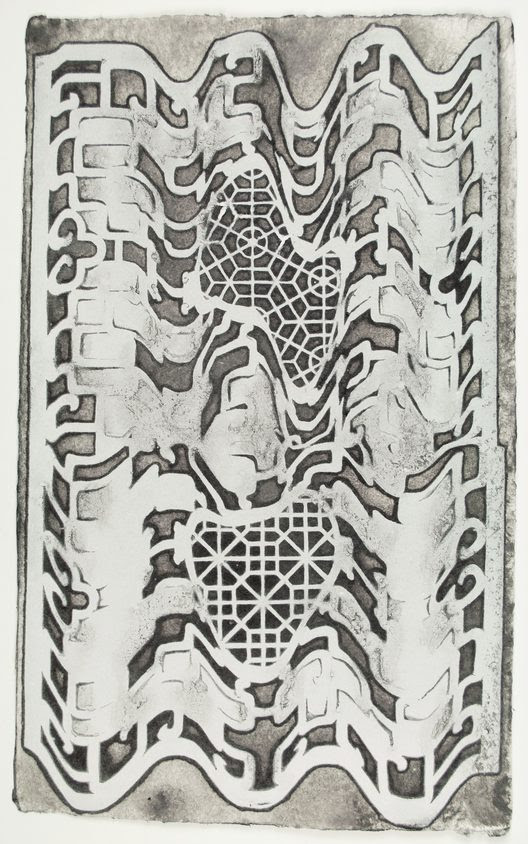
Paul Wong, Carbon, silver and gold, 2016, pigmented linen and cotton pulp, publisher: Dieu Donné, New York, edition 3/25, 18 × 11 inches. Gift of Dieu Donné, New York, 2022.27.06. © Paul Wong. |
On View March 8 through July 24, 2023
The Van Winkle Law Firm Gallery • Level 1
Paper is an essential part of the art-making process for many artists, serving as the base for drawing, painting, printmaking, and other forms of art. As a substrate, paper can vary in weight, absorbency, color, size, and other aspects. Since industrialization, paper has primarily been produced through mechanical means that allow for consistency and affordability.
What happens, then, when an artist chooses to return to the foundations of paper, wherein it is made by hand using pulps, fibers, and dyes that reflect the human element through variations, inconsistencies, flaws, and surprises? Certain artists have sought out these qualities and embraced them, making paper not just a support on which to work, but fully a medium in and of itself.
Pulp Potential: Works in Handmade Paper is organized by the Asheville Art Museum and curated by Hilary Schroeder, former assistant curator, with assistance from Alexis Meldrum, curatorial assistant. Special thanks to Dieu Donné, New York, NY.
|
|
|
|
|
In the past 50 years in the United States and beyond, artists have sought to break down social and political hierarchies that include issues of identity, gender, power, race, authority, and authenticity. Unsurprisingly, these decades generated a reconsideration of the idea of pattern and decoration as a third option to figuration and abstraction in art. From 1972 to 1985, artists in the Pattern and Decoration movement worked to expand the visual vocabulary of contemporary art to include ethnically and culturally diverse options that eradicated the barriers between fine art and craft and questioned the dominant minimalist aesthetic. These artists did so by incorporating opulence and bold intricacies garnered from such wide-ranging inspirations as United States quilt-making and Islamic architecture.
Too Much Is Just Right: The Legacy of Pattern and Decoration features more than 70 artworks in an array of media from both the original time frame of the Pattern and Decoration movement, as well as contemporary artworks created between 1985 and the present. The artworks in this exhibition demonstrate the vibrant and varied approaches to pattern and decoration in art. Artworks from the 21st century elucidate contemporary perspectives on the employment of pattern to inform visual vocabularies and investigations of diverse themes in the present day.
Artworks drawn from the Asheville Art Museum’s Collection join select major loans and feature Pattern and Decoration artists Valerie Jaudon, Joyce Kozloff, Robert Kushner, and Miriam Schapiro, as well as Anni Albers, Elizabeth Alexander, Sanford Biggers, Tawny Chatmon, Margaret Curtis, Mary Engel, Cathy Fussell, Samantha Hennekke, John Himmelfarb, Anne Lemanski, Rashaad Newsome, Peter Olson, Don Reitz, Sarah Sense, Billie Ruth Sudduth, Mickalene Thomas, Shoku Teruyama, Anna Valdez, Kehinde Wiley, and more.
This exhibition is organized by the Asheville Art Museum and guest curated by Marilyn Laufer & Tom Butler.
Come have a drink and experiment with art materials while connecting with your community! Asheville Art Museum will host Open Studio at Different Wrld on the the first Thursday evening of each month throughout the year.
This free drop-in program, which is facilitated by the Asheville Art Museum and hosted at Different Wrld, aims to expose and engage participants with the Museum’s Collection and changing exhibitions. Attendees must be 21 or older to participate. The Asheville Art Museum will provide all instruction, supplies, and materials.
Come out the third Thursday night for these FREE monthly improv jam sessions. What better place to test out your improv skills than in a low stakes setting among friends.
Friday, May
5, 2023
Exhibition on Display: Attributes
Biltmore Estate: Ciao! From Italy Sculptural Postcard Display
An Abundance of Riches
Exhibition: NEO MINERALIA
Exhibition: Something earned, Something left behind
Exhibition: Crafting Denim
Italian Renaissance Alive
Art Exhibit: RAUSCHENBERG: A Gift in Your Pocket
Flower Power – Asheville Gallery of Art
Luzene Hill: Revelate
Pulp Potential: Works in Handmade Paper
Stained with Glass: Vitreograph Prints from the Studio of Harvey K. Littleton Exhibition
Too Much Is Just Right: The Legacy of Pattern and Decoration
Opening Reception MYSTIC RIVER OF DREAMS ART EXHIBITION
Michelle Tway – fiber
Timothy Bridges – fiber
Martine House – mixed media
Noel Yovovich – metal
Deb Herman – fiber
The Focus Gallery is located on the second level of the Folk Art Center. The Folk Art Center is located at Milepost 382 of the Blue Ridge Parkway, just north of the Highway 70 entrance in east Asheville, NC.
This exhibition is hosted by the Southern Highland Craft Guild. The Guild is a non-profit, educational organization established in 1930 to cultivate the crafts and makers of the Southern Highlands for the purpose of shared resources, education, marketing, and conservation. The Southern Highland Craft Guild is an authorized concessioner of the National Park Service, Department of the Interior.
Included with admission
Embark on a scenic journey across George Vanderbilt’s Italy with a large-scale outdoor display that combines brilliant botanical designs with authentic messages written by Vanderbilt himself.
Beautifully handcrafted of natural elements, each sculptural postcard depicts a location or landmark Vanderbilt visited more than a century ago. This captivating complement to Biltmore’s Italian Renaissance Alive exhibition reveals Vanderbilt’s passions for travel, culture, architecture, and art as well as his personal experience of such renowned Italian cities as Milan, Florence, Venice, Pisa, and Vatican City.
Adding to the charm and visual appeal of Ciao! From Italy—sure to be a hit among kids of all ages—is the G-scale model train that travels in and out of each postcard in this enlightening display!
Andrea Rich’s intricately designed, carved, and printed woodcuts draw viewers in for an up-close look.
Some of the artist’s earliest memories are of drawing animals. Childhood encounters with pets, livestock, and wildlife, including birds, deer, and toads, created a lasting connection to the natural world. Through encounters with creatures both tame and wild, Rich developed a fascination and a compassion for animals integral to her art.
“My prints are a visual record of the intriguing creatures that have enriched my life. The woodcut process challenges me to focus on the essence of my subjects. At the same time, I am drawn to the smell of the wood, its texture and grain, and the pleasure I experience while carving. I begin working on a block of wood and realize later that hours have passed without notice.”
Rich uses a centuries-old medium that requires one carved wood panel for each color – varying from one to sixteen – necessary to develop the composition. These panels are painstakingly aligned one atop another sequentially and pulled through a printing press to create the final woodcut.
The subjects of Rich’s woodcuts range from the wilderness of the Australian outback and the lush tropical Amazon forests to the roaring rivers of Yellowstone Park. Rich has traveled worldwide to study wildlife habitats and these varied firsthand experiences are reflected in her work.
Among Rich’s many achievements are international recognition for her woodcut prints, including a 2009 Award of Excellence from the Society of Animal Artists and a 2009 Medal of Excellence from the Artists for Conservation Foundation. She was named Master Artist by the Leigh Yawkey Woodson Art Museum in 2006. In 2010 her work was featured in a solo exhibition at the Mass Audubon Visual Arts Center, Canton, Massachusetts. Rich is a member of the California Society of Printmakers, Artists for Nature Foundation, the Society of Animal Artists, and Society of Wildlife Artists.
In 2000 Rich designated the Woodson Art Museum as the repository for her artistic oeuvre. An Abundance of Riches is drawn from these holdings, which include an example of each of her woodcuts created since the mid-1980s.
Photo credit:
Sae Honda. Courtesy of the Artist.
NEO MINERALIA suggests that recent rock formations no longer fit within the traditional groups: Igneous, Metamorphic, and Sedimentary. Instead, the Anthropocene, the era of human influence on the climate and environment, has introduced two post-natural rocks: Synthetic and Digital.
NEO MINERALIA presents a selection of new geological specimens crafted by ten international artists exploring rocks as reflections of our effects on human and nonhuman ecologies. By embedding synthetic materials (plastics, e-waste) and layers of data points (critical, financial, social) into the craftsmanship of these artifacts, the artists transgress the definition of rocks, turning them from passive aggregates of minerals into metaphorical aggregates of data. Within their apparent “rockness” we can decode hopes, warnings, and speculative future scenarios.
The featured works stemming from places as varied as Mexico, Japan, Poland, and Australia (including a curated artists’ books library), collectively signal a new era of planetary and geological consciousness where we are asked to read, feel, and listen to rocks in new ways.
Photo credit:
J Diamond, “Pony II,” 2022. Courtesy of the Artist
Something earned, Something left behind is an exhibition of objecthood; a critical analysis of the transactional and political languages of everyday and culturally significant objects. This exhibition challenges a history of exclusion and inclusion of People of Color (POC) and their narratives from the canon of craft based on subject matter. It dissects this history’s origins and precedent as an economic transaction to gain access to white spaces.
Racial and ethnic identity influences the way individuals perceive themselves, the way others perceive them, and the way they choose to behave. For this reason, People of Color are expected to perform certain roles in order to fit into hegemonic institutions. These roles can be an active shrinking of themselves and the racialized part of them, or a personal exploitation of their racialized selves. This exhibition addresses and redresses the ways narrowed populations have been included, and the ways in which they have been asked to participate.
Together, this work creates space for and legitimizes POC narratives with depth and care. The exhibiting artists’ practices work against institutionalized expectations of POC work, expanding discourse and inserting new subjectivity into the canon of craft art. It engages with a community hungry for the revitalization and resuscitation of non-Western voices within art spaces. This exhibition challenges the expectations of art from artists of marginalized backgrounds and embraces a new subjectivity of interrogating one’s inherited experiences.
Photo credit:
Photograph by Bowery Blue Makers
Jeans – with their standardized pockets, rivets, and denim – are so much a part of everyday wardrobes that they are easy to overlook. Yet, in workshops across the nation, independent makers are reevaluating the garment and creating jeans by hand, using antiquated equipment and denim woven on midcentury looms. Crafting Denim explores how and why jeans have come to exist at the intersections of industry and craft, modernity, and tradition.
A product of industrial factory production for over a century, jeans are being recast by a new cohort of small-scale makers including craftspeople like Ryan Martin of W.H. Ranch Dungarees, Takayuki Echigoya of Bowery Blue Makers, and Sarah Yarborough and Victor Lytvinenko of Raleigh Denim, who favor choice materials and small-batch fabrication. The jeans they make merge craft traditions with industry and extend the conversation between hand and machine.
Each maker creates a distinctive product but shares a deep appreciation for materials, tools, history, and denim. These jeans are in dialogue with the past and in line with contemporary interests in sustainability. The small workshops featured here are sites of innovation and preservation, and visitors are invited to take a close look at an everyday item and imagine alternative contexts for making and living in our own clothes.
Explore Biltmore House with an Audio Guide that introduces you to the Vanderbilt family and their magnificent home’s history, architecture, and collections of fine art and furnishings.
PLUS: Immersive, multi-sensory Italian Renaissance Alive exhibition created by Grande Experiences
PLUS: FREE next-day access to Biltmore’s Gardens and Grounds
This visit includes access to:
- Italian Renaissance Alive at Amherst at Deerpark®
- 8,000 Acres of Gardens and Grounds for two consecutive days
- Antler Hill Village & Winery
- Complimentary Wine Tastings at the Winery
- Tastings require a Day-of-Visit Reservation, which can be made by:
- Scanning the QR Code found in your Estate Guide
- Visiting any Guest Services location
- Complimentary parking
Art Exhibition: Italian Renaissance Alive
This fascinating experience takes you on a spellbinding tour of Italy, fully immersing you in the beauty and brilliance of iconic masterworks from the greatest artistic period in history
Robert Rauschenberg, Autobiography, 1968
In the late 70s, Bradley Jeffries had a chance meeting with Robert Rauschenberg outside his home on Captiva Island, and they bonded immediately. Bradley was hired to be the artist’s business and life manager. Her employment with him for over 30 years, until his death in 2008, involved many roles on the Board of Directors of Change, Inc and The Rauschenberg Foundation. Bradley’s travels with Rauschenberg took her on incredible adventures all over the world and exposed her to extraordinary opportunities. Throughout their friendship and work together, Rauschenberg gifted Bradley with many of his original artworks.
The family and friends of Bradley Jeffries will use her expansive and never previously exhibited Rauschenberg collection as a means of memorializing Bradley through this traveling exhibition. “Rauschenberg: A Gift in Your Pocket” opens on April 25, 2022 at the Bob Rauschenberg Gallery at Florida Southwestern State College in Ft. Myers for display throughout the summer. After which her collection will travel to The University of Kentucky Art Museum followed by its culminating exhibition at BMCM+AC.
Once her collection of Rauschenberg’s artwork completes its planned memorial exhibitions, pieces will be donated to each of the involved institutions in an ongoing memorial to Bradley and her legacy of promoting the arts and artists.
Curated by Jade Dellinger, Director of the Bob Rauschenberg Gallery at Florida Southwestern State College.
Asheville Gallery of Art’s May show, “Flower Power,” introduces three new Gallery members: Nick Colquitt, Jean-Pierre Dubreuil, and Yvonne McCabe. This delightful exhibition takes its audience on a journey through the mountains of North Carolina, showcasing the mysterious beauty they display within their natural terrain. The show runs May 1-31 during Gallery hours, 11am-6pm daily.
An enrolled member of the Eastern Band of Cherokee Indians, Luzene Hill advocates for Indigenous sovereignty—linguistically, culturally, and individually. Revelate builds upon Hill’s investigation of pre-contact cultures. This has led Hill to incorporate the idea of Ollin, the Nahuatl word for the natural rhythms of the universe, in Aztec cosmology in her work. Before Europeans arrived in North America, Indigenous societies were predominantly matrilineal. Women were considered sacred, involved in the decision-making process, and thrived within communities holding a worldview based on equilibrium.
Ollin emphasizes that we are in constant state of motion and discovery. Adopted as an educational framework, particularly in social justice and ethnic studies, Ollin guides individuals through a process of reflection, action, reconciliation, and transformation. This exhibition combines Hill’s use of mylar safety blankets alongside recent drawings. Capes constructed of mylar burst with energy and rustle with subtle sound, the shining material a signifier of care, awareness, displacement, and presence. Though Hill works primarily in sculpture, drawing has increasingly become an essential part of her practice as she seeks to communicate themes of feminine and Indigenous power across her entire body of work. The energy within her drawings extends to the bursts of light reflecting from her capes or the accumulation of materials in other installation works.
Luzene Hill was born in Atlanta, GA, in 1946. She received her bachelor of fine art and master of fine art from Western Carolina University. She lives and works on the Qualla Boundary, Cherokee, NC.
|
|
Paul Wong, Carbon, silver and gold, 2016, pigmented linen and cotton pulp, publisher: Dieu Donné, New York, edition 3/25, 18 × 11 inches. Gift of Dieu Donné, New York, 2022.27.06. © Paul Wong. |
On View March 8 through July 24, 2023
The Van Winkle Law Firm Gallery • Level 1
Paper is an essential part of the art-making process for many artists, serving as the base for drawing, painting, printmaking, and other forms of art. As a substrate, paper can vary in weight, absorbency, color, size, and other aspects. Since industrialization, paper has primarily been produced through mechanical means that allow for consistency and affordability.
What happens, then, when an artist chooses to return to the foundations of paper, wherein it is made by hand using pulps, fibers, and dyes that reflect the human element through variations, inconsistencies, flaws, and surprises? Certain artists have sought out these qualities and embraced them, making paper not just a support on which to work, but fully a medium in and of itself.
Pulp Potential: Works in Handmade Paper is organized by the Asheville Art Museum and curated by Hilary Schroeder, former assistant curator, with assistance from Alexis Meldrum, curatorial assistant. Special thanks to Dieu Donné, New York, NY.
|
|
|
|
|
In the past 50 years in the United States and beyond, artists have sought to break down social and political hierarchies that include issues of identity, gender, power, race, authority, and authenticity. Unsurprisingly, these decades generated a reconsideration of the idea of pattern and decoration as a third option to figuration and abstraction in art. From 1972 to 1985, artists in the Pattern and Decoration movement worked to expand the visual vocabulary of contemporary art to include ethnically and culturally diverse options that eradicated the barriers between fine art and craft and questioned the dominant minimalist aesthetic. These artists did so by incorporating opulence and bold intricacies garnered from such wide-ranging inspirations as United States quilt-making and Islamic architecture.
Too Much Is Just Right: The Legacy of Pattern and Decoration features more than 70 artworks in an array of media from both the original time frame of the Pattern and Decoration movement, as well as contemporary artworks created between 1985 and the present. The artworks in this exhibition demonstrate the vibrant and varied approaches to pattern and decoration in art. Artworks from the 21st century elucidate contemporary perspectives on the employment of pattern to inform visual vocabularies and investigations of diverse themes in the present day.
Artworks drawn from the Asheville Art Museum’s Collection join select major loans and feature Pattern and Decoration artists Valerie Jaudon, Joyce Kozloff, Robert Kushner, and Miriam Schapiro, as well as Anni Albers, Elizabeth Alexander, Sanford Biggers, Tawny Chatmon, Margaret Curtis, Mary Engel, Cathy Fussell, Samantha Hennekke, John Himmelfarb, Anne Lemanski, Rashaad Newsome, Peter Olson, Don Reitz, Sarah Sense, Billie Ruth Sudduth, Mickalene Thomas, Shoku Teruyama, Anna Valdez, Kehinde Wiley, and more.
This exhibition is organized by the Asheville Art Museum and guest curated by Marilyn Laufer & Tom Butler.
Art on 7th will present its May 2023 Exhibition titled “The Mystic River of Dreams.” The show runs May 18 through May 28 and will kick off with a wine and cheese reception on May 18 from 4:00 p.m. to 6:00 p.m. All are welcome to attend.
Many of the gallery artists will present work interpreting the exhibition theme, which promises a variety of imagery from the creative minds of contemporary abstract artists. Participating artists include Laurie Adams, Amy Casteel, Stephen Hackley, Courtney Hoelscher, Barbara Jones, Michelle Marra, Robin Pedrero, Christopher Peterson and Julie Wilmot. Paintings, sculptures, and copper are on the list of works planned for the exhibition.
According to gallery owner Julie Wilmot, “These pieces of art won’t be river scenes typically represented in WNC galleries. As a contemporary art gallery, it’s fun to take what might be a classic theme and give it a contemporary twist. Art on 7th has a number of landscapes, waterfalls, and mountain scenes on our walls, but none of it is representational artwork.” Identifying the gallery’s audience Wilmot says, “Art on 7th sells contemporary art that is in harmony with our clients’ mountain lifestyles. And there are plenty of people in the area who love the nature and mountains of WNC but aren’t necessarily intent on carrying a literal design and décor representation, as such, into their homes.”