

Calendar of Events
Upcoming events and things to do in Asheville, NC. Below is a list of events for festivals, concerts, art exhibitions, group meetups and more.
Interested in adding an event to our calendar? Please click the green “Post Your Event” button below.
Join us throughout February as we celebrate Black Legacy Month with programs and events for all ages! In addition to the programs listed below, we will have special story times and exhibits at most of our libraries.
- Bright Star Touring Theatre: African Folktales – February 1 at 4pm at the Weaverville Library (for children ages 3 and up)
- Book Club: Jazz by Toni Morrison – Thursday, February 2 a 3pm at the Weaverville Library
- Book Club: The Vanishing Half by Brit Bennett – Tuesday, February 7 at 6pm
- Book Club: The Personal Librarian by Marie Benedict Tuesday, February 14 at 1pm at the Leicester Library
- Book Club: Life in Motion: An Unlikely Ballerina by Misty Copeland – February 16 at 2:30pm at the Skyland/South Buncombe Library
- Book Club: The Vanishing Half by Brit Bennett – February 21 at 7pm at the Fairview Library
- Black Experience Book Club: The Furrows by Namwali Serpell – February 23 at 6:30pm at the Noir Collective, co-sponsored by the East Asheville library
Drop by your local library and check us out. Email or call if you have any questions.
Our librarians have also put together a Black Legacy Month reading list for all ages.
Black Legacy Month Reading List 2023
Books for Adults
Adult Fiction
- Parable of the Sower by Octavia Butler
- On Girlhood: 15 Stories from the Well-Read Black Girl Library edited by Glory Edim
- What the Fireflies Knew by Kai Harries
- Black Leopard, Red Wolf by Marlon James
- The Love Songs of W.E.B. Dubois by Honoree Fannone Jeffers
- How Long ‘Til Black Future Month? by N.K. Jemison
- Deacon King Kong by James McBride
- Take My Hand by Dolen Perkins-Valdez
- Black Bottom Saints by Alice Randall
- The Violin Conspiracy by Brendan Slocumb
- Harlem Shuffle by Colson Whitehead
- Seven Days in June by Tia Williams
- Red at the Bone by Jacqueline Woodson
Adult nonfiction
- Uncomfortable Conversations with a Black Man by Emmanuel Acho
- Carefree Black Girls: A Celebration of Black women in Popular Culture by Zeba Blay
- The 1619 Project edited by Nikole Hannah-Jones
- Rest is Resistance by Tricia Hersey
- Wow, No Thank You by Samantha Irby*
- The Sum of Us by Heather McGhee
- All That She Carried by Tiya Miles
- Please Don’t Sit On My Bed In Your Outside Clothes by Phoebe Robinson*
- You’ll Never Believe What Happened to Lacey by Amber Ruffin*
- Counting Descent by Clint Smith
- The Body Is Not an Apology by Sonya Renee Taylor
- Here For It by R. Eric Thomas*
- Koshersoul: the faith and food journey of an African American Jew by Michael W. Twitty
*especially good on audio because the authors read their work!
Picture books for families to share
- My Heart Flies Open by Omileye Achikeobi-Lewis
- Only the Best: The Exceptional Life and Fashion of Ann Lowe by Kate Messner
- My N.C. From A to Z by Michelle Lanier
- Shhh! The Baby’s Asleep by JaNay Brown-Wood
- Curls by Ruth Forman
- Fly by Brittany J. Thurman
- Opal Lee and What it Means to be Free: The True Story of the Grandmother of Juneteenth by Alice Faye Duncan
- Build a House by Rhiannon Giddens
- Bright Brown Baby, A Treasury by Andrea Davis Pinkney
- Born on the Water by Nikole Hannah-Jones and Renee Watson
Chapter books for older kids
- Isaiah Dunn is My Hero by Kelly J. BaptistBlended by Sharon Draper
- Ikenga by Nnedi Okorafor
- Stamped: Racism, Antiracism, and You by Jason Reynolds and Ibram X. Kendi
- Tristan Strong Trilogy (Tristan Strong Punches a Hole in the Sky, Tristan Strong Destroys the World, and Tristan Strong Keeps Punching) by Kwame Mbalia
- From the Desk of Zoe Washington by Janae Marks
- Black Boy Joy: 17 Stories Celebrating Black Boyhood edited by Kwame Mbalia
- Freewater by Amina Luqman-Dawson
- Operation Sisterhood by Olugbemisola Rhuday-Perkovich
- The Door of No Return by Alexander Kwame
Books for teens
- Quincredible by Rodney Barnes
- The Legendborn Cycle (Legendborn and Bloodmarked) by Tracy Deonn
- All Boys Aren’t Blue by George M. Johnson
- You Should See Me in a Crown by Leah Johnson
- Survive the Dome by Kosoko Jackson
- Revolution in Our Time: The Black Panther’s Promise to the People by Kekla Magoon
- Ain’t Burned All the Bright by Jason Reynolds
- Bitter by Akwaeke Emezi
- On the Come Up by Angie Thomas
- Okoye to the People by Ibi Zoboi
|

Presenter: Bruce Appeldoorn – Appeldoorn Landscape Nursery
Bruce Appeldoorn, a life-long nurseryman and the owner of Appeldoorn Landscape Nursery, will share with us some of the best conifers for Western North Carolina gardens. You will see his favorite low-maintenance, long-lived choices based on his 45 years of nursery experience.
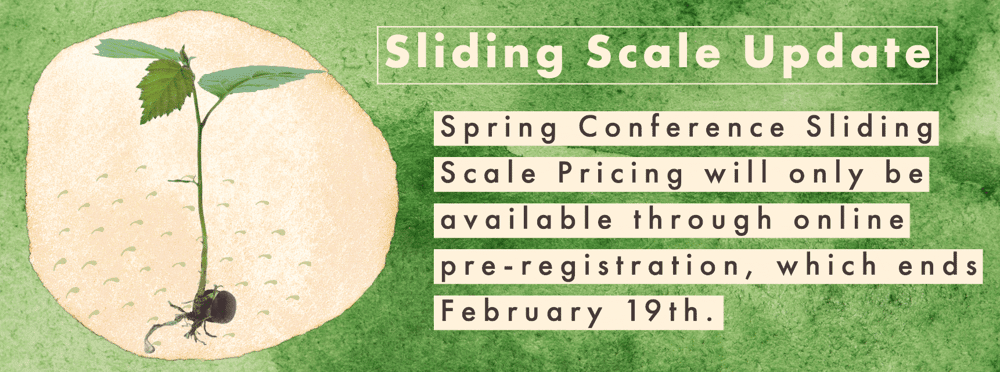
For the past 30 years, the Organic Growers School Spring Conference has served as a gathering place for growers in Appalachia to connect, learn from one another, and deepen connections to land and community. The Spring Conference began as an entirely volunteer-run and free event and has expanded to support an organization of ten staff with year-round programming. As we have grown, we have experimented with different approaches to keeping the event affordable and accessible while also working on compensation for our speakers and supporting our growing staff. We encourage you to check out our recent blog post exploring this in more depth. This year, we are excited to be experimenting with sliding scale ticket pricing for the first time, and we wanted to take some time to explain how this works and why we decided to implement it this year.
Looking beyond scholarships
Over the past several years, we have started implementing different scholarship options. We have set aside around $3000 in our internal budget for scholarships, and we have increased our outreach to other groups in the area who have funding to support individuals to attend conferences. We also offer work-trade opportunities for people who are interested in helping out with our event in exchange for attendance. We have around 100 work-traders access the conference each year through these opportunities, but we have never used up our entire scholarship fund for the event. We know that there are many individuals in our community that we are not reaching through our scholarship opportunities. We began to wonder if scholarship applications were creating a barrier to participation and started researching other options, landing eventually on sliding scale as our preferred model.
How alternative pricing models address accessibility
The sliding scale model, which offers the opportunity for participants to select a price to pay for their ticket, meets several of the parameters we were looking for in an accessible pricing model. Most importantly, it is a seamless way for attendees to access the price that meets their needs. So many things are means-tested in our society, and it can be exhausting to justify why one needs a more affordable price point. While many of our community members need financial support, there are also members of this community who have more than enough to share and are excited about supporting their fellow co-learners. These attendees can select the higher end of the sliding scale, which will be set at a price to offset the lower price paid by other attendees. We trust our attendees to select the option that best works for them while also considering how their selection would affect the ability of other participants to access a lower price point.
Accessibility is a priority for OGS, and implementing it is a risk for us as a small non-profit, given that we rely on our large events like the Spring Conference to support our year-round programming and staff salaries. This will certainly be an experimental year, and if we are not able to secure enough income through sliding-scale registrations, we will have to rethink our approach to pricing. We trust that our community will be thoughtful in thinking about the value that this conference has to them and about what they are able to pay for at this time. Thank you for being on this journey of discovery with us!
After six years of hard work, the dream of using The Learning Garden as a hub for public gardening education is finally a reality. The Learning Garden, located at the Extension Office, 49 Mt. Carmel Road, is offering the public the opportunity to Visit and Learn in the garden on selected 2nd and 4th Thursdays, February – October. The Thursday in-person programs will consist of five garden-specific series. Visitors can walk around before or after the program and soak in our lovely gardens. Our gardens will open at 9:00 a.m. and all the demonstration programs run between 10-11:30 a.m. To ensure a good learning experience, attendance will be limited and registration will be required.

Dahlia Series
February 23 – Getting Your Dahlias Ready for Planting
August 3 – Disbudding Dahlias for Better Blooms
October 26 – Dividing and Storing Dahlias

Dye Garden Series
May 4 – Planning Your Dye Garden
June 22 – Introduction to Natural Dyeing
July 27 – Fresh Indigo
August 24 – Botanical Printing: Printing with Leaves and Flowers
September 28 – Dyeing with Hopi Black Sunflower
November 9 – The Magic of Indigo
 Rose Garden Series
March 9 – Pruning Roses
April 6 – Climbing Roses
April 13 – Rose Pests and Pathogens
May 20 – Growing Beautiful Roses (Saturday Seminar)
 Sun & Shade Garden Series
May 11 – Planting a Native Butterfly Host Plant Garden
June 29 – Foodscaping Edible Plants in Flower Beds
August 31 – Dealing with “the Good, the Bad, and the Ugly” Plants
Sept 14 – Native Butterfly Life Cycles in the Fall Garden
 Vegetable Garden Series
March 23 – Building an ADA Compliant Raised Garden
April 26 – Planting Root Crops: Leeks, Onions, Carrots, Parsnips
May 25 – Planting a Seed Saving Garden
June 8 – Common Vegetable Garden Pests
July 13 – Kid Friendly Gardening
August 10 – Preserving Your Vegetable Harvest
In addition to the Thursday programs listed above, The Learning Garden will present a series of ninety minute (+/-) hands-on seminars covering various gardening topics. These in-person programs will be held at The Learning Garden on selected Saturday mornings, February – September.
Saturday Seminars
February 18 – Tool Selection and Sharpening
March 18 – Pruning Trees and Shrubs
April 22 – Gardening for the Birds
May 20 – Growing Beautiful Roses
June 17 – Pollinator Plants in The Learning Garden
September 16 – Bulbs for All Seasons
Each of the programs in The Learning Garden will be announced individually through this blog and on our website two weeks before each program. Each announcement will include instructions on how to register. Mark your calendar and register to attend as many as you can.
Presenters: Alan Wagner and James Wade, Extension Master GardenerSM Volunteers
Gardening tools are key to successful pruning. You need the right tool for the right job, and you need to correctly maintain those tools. Are you sure, for example, when to use your anvil pruners or your bypass pruners instead? This workshop will cover the different kinds of pruning tools, their uses, and their care as well as gardening tools like shovels and hoes. Ergonomic pruners and other tools will also be covered.
Bring your pruners, loppers and shovels to learn how to clean and sharpen them.
This live streamed virtual event is free but registration is required. Please click here to register. The link required to attend will be emailed to registrants prior to the event.
If you decide to attend and to purchase books, we ask that you purchase from Malaprop’s. When you do this you make it possible for us to continue hosting author events and you keep more dollars in our community. You may also support our work by purchasing a gift card or making a donation of any amount below. Thank you!
The Shamshine Blind
A beguiling blend of noir detective story and science fiction perfect for fans of Michael Chabon and Emily St. John Mandel, this unputdownable debut imagines a world where emotions have been weaponized, and a small-town law enforcement agent uncovers a conspiracy to take down what’s left of American democracy.
In an alternate 2009, the United States has been a second-rate power for a quarter of a century, ever since Argentina’s victory in the Falkland’s War thanks to their development of “psychopigments.” Created as weapons, these colorful chemicals can produce almost any human emotion upon contact, and they have been embraced in the US as both pharmaceutical cure-alls and popular recreational drugs. Black market traders illegally sell everything from Blackberry Purple (which causes terror) to Sunshine Yellow (which delivers happiness).
Psychopigment Enforcement Agent Kay Curtida works a beat in Daly City, just outside the ruins of San Francisco, chasing down smalltime crooks. But when an old friend shows up with a tantalizing lead on a career-making case, Curtida’s humdrum existence suddenly gets a boost. Little does she know that this case will send her down a tangled path of conspiracy and lead to an overdue reckoning with her family and with the truth of her own emotions.
Told in the voice of a funny, brooding, Latinx Sam Spade, The Shamshine Blind is “a rip-roaring beautifully crafted mash-up of cop noir, sci-fi, and alt-history that left me dazzled by its prescience and literary zing” (Leah Hampton, author of F*ckface).
Paz Pardo is an Argentine-American award-winning playwright and novelist. She received her MFA from the Michener Center for Writers, her undergraduate degree from Stanford University, and is the recipient of a Fulbright scholarship. Raised in America, she currently lives in Argentina. The Shamshine Blind is her first novel. Find out more at PazSays.com.
Leah Hampton writes about Appalachia, corpses, ecoanxiety, and smart women. She currently serves as the Environmental Humanities Fellow in Residence at the University of Idaho. Her debut collection, F*ckface and Other Stories, was released by Henry Holt and was named one of the best books of 2020 by The Paris Review, the New York Public Library, Slate, and others. A graduate of the Michener Center for Writers, she has been awarded multiple prizes and fellowships including UT-Austin’s Keene Prize for Literature and the Phillip Roth residency at the Stadler Center for Poetry. Her work has appeared in Ecotone, Guernica, McSweeneys, Electric Literature, storySouth, LitHub, and many other elsewheres. She lives in the Blue Ridge Mountains near the Great Smoky Mountains National Park. Learn more at leahkhampton.com
Join us throughout February as we celebrate Black Legacy Month with programs and events for all ages! In addition to the programs listed below, we will have special story times and exhibits at most of our libraries.
- Bright Star Touring Theatre: African Folktales – February 1 at 4pm at the Weaverville Library (for children ages 3 and up)
- Book Club: Jazz by Toni Morrison – Thursday, February 2 a 3pm at the Weaverville Library
- Book Club: The Vanishing Half by Brit Bennett – Tuesday, February 7 at 6pm
- Book Club: The Personal Librarian by Marie Benedict Tuesday, February 14 at 1pm at the Leicester Library
- Book Club: Life in Motion: An Unlikely Ballerina by Misty Copeland – February 16 at 2:30pm at the Skyland/South Buncombe Library
- Book Club: The Vanishing Half by Brit Bennett – February 21 at 7pm at the Fairview Library
- Black Experience Book Club: The Furrows by Namwali Serpell – February 23 at 6:30pm at the Noir Collective, co-sponsored by the East Asheville library
Drop by your local library and check us out. Email or call if you have any questions.
Our librarians have also put together a Black Legacy Month reading list for all ages.
Black Legacy Month Reading List 2023
Books for Adults
Adult Fiction
- Parable of the Sower by Octavia Butler
- On Girlhood: 15 Stories from the Well-Read Black Girl Library edited by Glory Edim
- What the Fireflies Knew by Kai Harries
- Black Leopard, Red Wolf by Marlon James
- The Love Songs of W.E.B. Dubois by Honoree Fannone Jeffers
- How Long ‘Til Black Future Month? by N.K. Jemison
- Deacon King Kong by James McBride
- Take My Hand by Dolen Perkins-Valdez
- Black Bottom Saints by Alice Randall
- The Violin Conspiracy by Brendan Slocumb
- Harlem Shuffle by Colson Whitehead
- Seven Days in June by Tia Williams
- Red at the Bone by Jacqueline Woodson
Adult nonfiction
- Uncomfortable Conversations with a Black Man by Emmanuel Acho
- Carefree Black Girls: A Celebration of Black women in Popular Culture by Zeba Blay
- The 1619 Project edited by Nikole Hannah-Jones
- Rest is Resistance by Tricia Hersey
- Wow, No Thank You by Samantha Irby*
- The Sum of Us by Heather McGhee
- All That She Carried by Tiya Miles
- Please Don’t Sit On My Bed In Your Outside Clothes by Phoebe Robinson*
- You’ll Never Believe What Happened to Lacey by Amber Ruffin*
- Counting Descent by Clint Smith
- The Body Is Not an Apology by Sonya Renee Taylor
- Here For It by R. Eric Thomas*
- Koshersoul: the faith and food journey of an African American Jew by Michael W. Twitty
*especially good on audio because the authors read their work!
Picture books for families to share
- My Heart Flies Open by Omileye Achikeobi-Lewis
- Only the Best: The Exceptional Life and Fashion of Ann Lowe by Kate Messner
- My N.C. From A to Z by Michelle Lanier
- Shhh! The Baby’s Asleep by JaNay Brown-Wood
- Curls by Ruth Forman
- Fly by Brittany J. Thurman
- Opal Lee and What it Means to be Free: The True Story of the Grandmother of Juneteenth by Alice Faye Duncan
- Build a House by Rhiannon Giddens
- Bright Brown Baby, A Treasury by Andrea Davis Pinkney
- Born on the Water by Nikole Hannah-Jones and Renee Watson
Chapter books for older kids
- Isaiah Dunn is My Hero by Kelly J. BaptistBlended by Sharon Draper
- Ikenga by Nnedi Okorafor
- Stamped: Racism, Antiracism, and You by Jason Reynolds and Ibram X. Kendi
- Tristan Strong Trilogy (Tristan Strong Punches a Hole in the Sky, Tristan Strong Destroys the World, and Tristan Strong Keeps Punching) by Kwame Mbalia
- From the Desk of Zoe Washington by Janae Marks
- Black Boy Joy: 17 Stories Celebrating Black Boyhood edited by Kwame Mbalia
- Freewater by Amina Luqman-Dawson
- Operation Sisterhood by Olugbemisola Rhuday-Perkovich
- The Door of No Return by Alexander Kwame
Books for teens
- Quincredible by Rodney Barnes
- The Legendborn Cycle (Legendborn and Bloodmarked) by Tracy Deonn
- All Boys Aren’t Blue by George M. Johnson
- You Should See Me in a Crown by Leah Johnson
- Survive the Dome by Kosoko Jackson
- Revolution in Our Time: The Black Panther’s Promise to the People by Kekla Magoon
- Ain’t Burned All the Bright by Jason Reynolds
- Bitter by Akwaeke Emezi
- On the Come Up by Angie Thomas
- Okoye to the People by Ibi Zoboi
|
Presenter: Bruce Appeldoorn – Appeldoorn Landscape Nursery
Bruce Appeldoorn, a life-long nurseryman and the owner of Appeldoorn Landscape Nursery, will share with us some of the best conifers for Western North Carolina gardens. You will see his favorite low-maintenance, long-lived choices based on his 45 years of nursery experience.
The upcoming Journeyperson course is now available AT NO COST! Due to some timely grant funding, we can offer this in-depth farmer training for farmers in years 3-7 with no associated tuition fee! The course consists of monthly cohort meet-ups and 2-3 in-depth workshops, plus mentorship!
In addition, a select number of participants will also receive matched FUNDS for your farm savings account (Savings Incentive Program) and money to spend on a professional development opportunity of your choosing! Want to attend a workshop on livestock management? OGS will contribute towards that fee! Are you saving money for a farm asset? OGS will contribute up to a certain amount to that investment.
The Journeyperson Program is for farmers who have been independently farming for three or more years and are serious about operating farm businesses in the Southern Appalachian region.
|
|
For the past 30 years, the Organic Growers School Spring Conference has served as a gathering place for growers in Appalachia to connect, learn from one another, and deepen connections to land and community. The Spring Conference began as an entirely volunteer-run and free event and has expanded to support an organization of ten staff with year-round programming. As we have grown, we have experimented with different approaches to keeping the event affordable and accessible while also working on compensation for our speakers and supporting our growing staff. We encourage you to check out our recent blog post exploring this in more depth. This year, we are excited to be experimenting with sliding scale ticket pricing for the first time, and we wanted to take some time to explain how this works and why we decided to implement it this year.
Looking beyond scholarships
Over the past several years, we have started implementing different scholarship options. We have set aside around $3000 in our internal budget for scholarships, and we have increased our outreach to other groups in the area who have funding to support individuals to attend conferences. We also offer work-trade opportunities for people who are interested in helping out with our event in exchange for attendance. We have around 100 work-traders access the conference each year through these opportunities, but we have never used up our entire scholarship fund for the event. We know that there are many individuals in our community that we are not reaching through our scholarship opportunities. We began to wonder if scholarship applications were creating a barrier to participation and started researching other options, landing eventually on sliding scale as our preferred model.
How alternative pricing models address accessibility
The sliding scale model, which offers the opportunity for participants to select a price to pay for their ticket, meets several of the parameters we were looking for in an accessible pricing model. Most importantly, it is a seamless way for attendees to access the price that meets their needs. So many things are means-tested in our society, and it can be exhausting to justify why one needs a more affordable price point. While many of our community members need financial support, there are also members of this community who have more than enough to share and are excited about supporting their fellow co-learners. These attendees can select the higher end of the sliding scale, which will be set at a price to offset the lower price paid by other attendees. We trust our attendees to select the option that best works for them while also considering how their selection would affect the ability of other participants to access a lower price point.
Accessibility is a priority for OGS, and implementing it is a risk for us as a small non-profit, given that we rely on our large events like the Spring Conference to support our year-round programming and staff salaries. This will certainly be an experimental year, and if we are not able to secure enough income through sliding-scale registrations, we will have to rethink our approach to pricing. We trust that our community will be thoughtful in thinking about the value that this conference has to them and about what they are able to pay for at this time. Thank you for being on this journey of discovery with us!
|
Land of the Sky 101 is a community learning circle for those who are interested in an introduction to the history of Asheville, Buncombe County and Western North Carolina. A nine -part series of readings and discussions is modeled after the themes of the exhibit “An Incomplete History of Buncombe County” mounted in the BCSC reading room. From October 2022 through July 2023 (with a break in December) participants will explore the history of our region focusing on themes ranging from ancient history to the late 20th century revitalization of the Downtown area. Read Learn Discuss Registration is limited and required. Sessions for the 2022-2023 cohort will be held at 10:30 am on the third Saturday of each month at Pack Memorial Library. Sessions run from October 2022 until July 2023. Your registration will reserve your place for all nine sessions, and we hope participants will plan to attend each meeting. If you cannot attend a session, please let us know in advance so we may allow those on the waiting list to participate.
|
|
|
Presenter: Bruce Appeldoorn – Appeldoorn Landscape Nursery
Bruce Appeldoorn, a life-long nurseryman and the owner of Appeldoorn Landscape Nursery, will share with us some of the best conifers for Western North Carolina gardens. You will see his favorite low-maintenance, long-lived choices based on his 45 years of nursery experience.
The upcoming Journeyperson course is now available AT NO COST! Due to some timely grant funding, we can offer this in-depth farmer training for farmers in years 3-7 with no associated tuition fee! The course consists of monthly cohort meet-ups and 2-3 in-depth workshops, plus mentorship!
In addition, a select number of participants will also receive matched FUNDS for your farm savings account (Savings Incentive Program) and money to spend on a professional development opportunity of your choosing! Want to attend a workshop on livestock management? OGS will contribute towards that fee! Are you saving money for a farm asset? OGS will contribute up to a certain amount to that investment.
The Journeyperson Program is for farmers who have been independently farming for three or more years and are serious about operating farm businesses in the Southern Appalachian region.
|
|
For the past 30 years, the Organic Growers School Spring Conference has served as a gathering place for growers in Appalachia to connect, learn from one another, and deepen connections to land and community. The Spring Conference began as an entirely volunteer-run and free event and has expanded to support an organization of ten staff with year-round programming. As we have grown, we have experimented with different approaches to keeping the event affordable and accessible while also working on compensation for our speakers and supporting our growing staff. We encourage you to check out our recent blog post exploring this in more depth. This year, we are excited to be experimenting with sliding scale ticket pricing for the first time, and we wanted to take some time to explain how this works and why we decided to implement it this year.
Looking beyond scholarships
Over the past several years, we have started implementing different scholarship options. We have set aside around $3000 in our internal budget for scholarships, and we have increased our outreach to other groups in the area who have funding to support individuals to attend conferences. We also offer work-trade opportunities for people who are interested in helping out with our event in exchange for attendance. We have around 100 work-traders access the conference each year through these opportunities, but we have never used up our entire scholarship fund for the event. We know that there are many individuals in our community that we are not reaching through our scholarship opportunities. We began to wonder if scholarship applications were creating a barrier to participation and started researching other options, landing eventually on sliding scale as our preferred model.
How alternative pricing models address accessibility
The sliding scale model, which offers the opportunity for participants to select a price to pay for their ticket, meets several of the parameters we were looking for in an accessible pricing model. Most importantly, it is a seamless way for attendees to access the price that meets their needs. So many things are means-tested in our society, and it can be exhausting to justify why one needs a more affordable price point. While many of our community members need financial support, there are also members of this community who have more than enough to share and are excited about supporting their fellow co-learners. These attendees can select the higher end of the sliding scale, which will be set at a price to offset the lower price paid by other attendees. We trust our attendees to select the option that best works for them while also considering how their selection would affect the ability of other participants to access a lower price point.
Accessibility is a priority for OGS, and implementing it is a risk for us as a small non-profit, given that we rely on our large events like the Spring Conference to support our year-round programming and staff salaries. This will certainly be an experimental year, and if we are not able to secure enough income through sliding-scale registrations, we will have to rethink our approach to pricing. We trust that our community will be thoughtful in thinking about the value that this conference has to them and about what they are able to pay for at this time. Thank you for being on this journey of discovery with us!
Join us throughout February as we celebrate Black Legacy Month with programs and events for all ages! In addition to the programs listed below, we will have special story times and exhibits at most of our libraries.
- Bright Star Touring Theatre: African Folktales – February 1 at 4pm at the Weaverville Library (for children ages 3 and up)
- Book Club: Jazz by Toni Morrison – Thursday, February 2 a 3pm at the Weaverville Library
- Book Club: The Vanishing Half by Brit Bennett – Tuesday, February 7 at 6pm
- Book Club: The Personal Librarian by Marie Benedict Tuesday, February 14 at 1pm at the Leicester Library
- Book Club: Life in Motion: An Unlikely Ballerina by Misty Copeland – February 16 at 2:30pm at the Skyland/South Buncombe Library
- Book Club: The Vanishing Half by Brit Bennett – February 21 at 7pm at the Fairview Library
- Black Experience Book Club: The Furrows by Namwali Serpell – February 23 at 6:30pm at the Noir Collective, co-sponsored by the East Asheville library
Drop by your local library and check us out. Email or call if you have any questions.
Our librarians have also put together a Black Legacy Month reading list for all ages.
Black Legacy Month Reading List 2023
Books for Adults
Adult Fiction
- Parable of the Sower by Octavia Butler
- On Girlhood: 15 Stories from the Well-Read Black Girl Library edited by Glory Edim
- What the Fireflies Knew by Kai Harries
- Black Leopard, Red Wolf by Marlon James
- The Love Songs of W.E.B. Dubois by Honoree Fannone Jeffers
- How Long ‘Til Black Future Month? by N.K. Jemison
- Deacon King Kong by James McBride
- Take My Hand by Dolen Perkins-Valdez
- Black Bottom Saints by Alice Randall
- The Violin Conspiracy by Brendan Slocumb
- Harlem Shuffle by Colson Whitehead
- Seven Days in June by Tia Williams
- Red at the Bone by Jacqueline Woodson
Adult nonfiction
- Uncomfortable Conversations with a Black Man by Emmanuel Acho
- Carefree Black Girls: A Celebration of Black women in Popular Culture by Zeba Blay
- The 1619 Project edited by Nikole Hannah-Jones
- Rest is Resistance by Tricia Hersey
- Wow, No Thank You by Samantha Irby*
- The Sum of Us by Heather McGhee
- All That She Carried by Tiya Miles
- Please Don’t Sit On My Bed In Your Outside Clothes by Phoebe Robinson*
- You’ll Never Believe What Happened to Lacey by Amber Ruffin*
- Counting Descent by Clint Smith
- The Body Is Not an Apology by Sonya Renee Taylor
- Here For It by R. Eric Thomas*
- Koshersoul: the faith and food journey of an African American Jew by Michael W. Twitty
*especially good on audio because the authors read their work!
Picture books for families to share
- My Heart Flies Open by Omileye Achikeobi-Lewis
- Only the Best: The Exceptional Life and Fashion of Ann Lowe by Kate Messner
- My N.C. From A to Z by Michelle Lanier
- Shhh! The Baby’s Asleep by JaNay Brown-Wood
- Curls by Ruth Forman
- Fly by Brittany J. Thurman
- Opal Lee and What it Means to be Free: The True Story of the Grandmother of Juneteenth by Alice Faye Duncan
- Build a House by Rhiannon Giddens
- Bright Brown Baby, A Treasury by Andrea Davis Pinkney
- Born on the Water by Nikole Hannah-Jones and Renee Watson
Chapter books for older kids
- Isaiah Dunn is My Hero by Kelly J. BaptistBlended by Sharon Draper
- Ikenga by Nnedi Okorafor
- Stamped: Racism, Antiracism, and You by Jason Reynolds and Ibram X. Kendi
- Tristan Strong Trilogy (Tristan Strong Punches a Hole in the Sky, Tristan Strong Destroys the World, and Tristan Strong Keeps Punching) by Kwame Mbalia
- From the Desk of Zoe Washington by Janae Marks
- Black Boy Joy: 17 Stories Celebrating Black Boyhood edited by Kwame Mbalia
- Freewater by Amina Luqman-Dawson
- Operation Sisterhood by Olugbemisola Rhuday-Perkovich
- The Door of No Return by Alexander Kwame
Books for teens
- Quincredible by Rodney Barnes
- The Legendborn Cycle (Legendborn and Bloodmarked) by Tracy Deonn
- All Boys Aren’t Blue by George M. Johnson
- You Should See Me in a Crown by Leah Johnson
- Survive the Dome by Kosoko Jackson
- Revolution in Our Time: The Black Panther’s Promise to the People by Kekla Magoon
- Ain’t Burned All the Bright by Jason Reynolds
- Bitter by Akwaeke Emezi
- On the Come Up by Angie Thomas
- Okoye to the People by Ibi Zoboi
|
Presenter: Bruce Appeldoorn – Appeldoorn Landscape Nursery
Bruce Appeldoorn, a life-long nurseryman and the owner of Appeldoorn Landscape Nursery, will share with us some of the best conifers for Western North Carolina gardens. You will see his favorite low-maintenance, long-lived choices based on his 45 years of nursery experience.
After six years of hard work, the dream of using The Learning Garden as a hub for public gardening education is finally a reality. The Learning Garden, located at the Extension Office, 49 Mt. Carmel Road, is offering the public the opportunity to Visit and Learn in the garden on selected 2nd and 4th Thursdays, February – October. The Thursday in-person programs will consist of five garden-specific series. Visitors can walk around before or after the program and soak in our lovely gardens. Our gardens will open at 9:00 a.m. and all the demonstration programs run between 10-11:30 a.m. To ensure a good learning experience, attendance will be limited and registration will be required.
Dahlia Series
February 23 – Getting Your Dahlias Ready for Planting
August 3 – Disbudding Dahlias for Better Blooms
October 26 – Dividing and Storing Dahlias
Dye Garden Series
May 4 – Planning Your Dye Garden
June 22 – Introduction to Natural Dyeing
July 27 – Fresh Indigo
August 24 – Botanical Printing: Printing with Leaves and Flowers
September 28 – Dyeing with Hopi Black Sunflower
November 9 – The Magic of Indigo
Rose Garden Series
March 9 – Pruning Roses
April 6 – Climbing Roses
April 13 – Rose Pests and Pathogens
May 20 – Growing Beautiful Roses (Saturday Seminar)
Sun & Shade Garden Series
May 11 – Planting a Native Butterfly Host Plant Garden
June 29 – Foodscaping Edible Plants in Flower Beds
August 31 – Dealing with “the Good, the Bad, and the Ugly” Plants
Sept 14 – Native Butterfly Life Cycles in the Fall Garden
Vegetable Garden Series
March 23 – Building an ADA Compliant Raised Garden
April 26 – Planting Root Crops: Leeks, Onions, Carrots, Parsnips
May 25 – Planting a Seed Saving Garden
June 8 – Common Vegetable Garden Pests
July 13 – Kid Friendly Gardening
August 10 – Preserving Your Vegetable Harvest
In addition to the Thursday programs listed above, The Learning Garden will present a series of ninety minute (+/-) hands-on seminars covering various gardening topics. These in-person programs will be held at The Learning Garden on selected Saturday mornings, February – September.
Saturday Seminars
February 18 – Tool Selection and Sharpening
March 18 – Pruning Trees and Shrubs
April 22 – Gardening for the Birds
May 20 – Growing Beautiful Roses
June 17 – Pollinator Plants in The Learning Garden
September 16 – Bulbs for All Seasons
Each of the programs in The Learning Garden will be announced individually through this blog and on our website two weeks before each program. Each announcement will include instructions on how to register. Mark your calendar and register to attend as many as you can.
New or early retiree? Young entrepreneur? Like to work outside and with your hands? Learn about farming with the Small Farm Boot Camp!
Objectives for Season Extension:
Understand the advantages and disadvantages of season extension.
Recognize different types of season extension .
Develop base knowledge in management practices (irrigation, fertilization, weeds).
Become familiar with the resources on obtaining and implementing season extension.
Join us throughout February as we celebrate Black Legacy Month with programs and events for all ages! In addition to the programs listed below, we will have special story times and exhibits at most of our libraries.
- Bright Star Touring Theatre: African Folktales – February 1 at 4pm at the Weaverville Library (for children ages 3 and up)
- Book Club: Jazz by Toni Morrison – Thursday, February 2 a 3pm at the Weaverville Library
- Book Club: The Vanishing Half by Brit Bennett – Tuesday, February 7 at 6pm
- Book Club: The Personal Librarian by Marie Benedict Tuesday, February 14 at 1pm at the Leicester Library
- Book Club: Life in Motion: An Unlikely Ballerina by Misty Copeland – February 16 at 2:30pm at the Skyland/South Buncombe Library
- Book Club: The Vanishing Half by Brit Bennett – February 21 at 7pm at the Fairview Library
- Black Experience Book Club: The Furrows by Namwali Serpell – February 23 at 6:30pm at the Noir Collective, co-sponsored by the East Asheville library
Drop by your local library and check us out. Email or call if you have any questions.
Our librarians have also put together a Black Legacy Month reading list for all ages.
Black Legacy Month Reading List 2023
Books for Adults
Adult Fiction
- Parable of the Sower by Octavia Butler
- On Girlhood: 15 Stories from the Well-Read Black Girl Library edited by Glory Edim
- What the Fireflies Knew by Kai Harries
- Black Leopard, Red Wolf by Marlon James
- The Love Songs of W.E.B. Dubois by Honoree Fannone Jeffers
- How Long ‘Til Black Future Month? by N.K. Jemison
- Deacon King Kong by James McBride
- Take My Hand by Dolen Perkins-Valdez
- Black Bottom Saints by Alice Randall
- The Violin Conspiracy by Brendan Slocumb
- Harlem Shuffle by Colson Whitehead
- Seven Days in June by Tia Williams
- Red at the Bone by Jacqueline Woodson
Adult nonfiction
- Uncomfortable Conversations with a Black Man by Emmanuel Acho
- Carefree Black Girls: A Celebration of Black women in Popular Culture by Zeba Blay
- The 1619 Project edited by Nikole Hannah-Jones
- Rest is Resistance by Tricia Hersey
- Wow, No Thank You by Samantha Irby*
- The Sum of Us by Heather McGhee
- All That She Carried by Tiya Miles
- Please Don’t Sit On My Bed In Your Outside Clothes by Phoebe Robinson*
- You’ll Never Believe What Happened to Lacey by Amber Ruffin*
- Counting Descent by Clint Smith
- The Body Is Not an Apology by Sonya Renee Taylor
- Here For It by R. Eric Thomas*
- Koshersoul: the faith and food journey of an African American Jew by Michael W. Twitty
*especially good on audio because the authors read their work!
Picture books for families to share
- My Heart Flies Open by Omileye Achikeobi-Lewis
- Only the Best: The Exceptional Life and Fashion of Ann Lowe by Kate Messner
- My N.C. From A to Z by Michelle Lanier
- Shhh! The Baby’s Asleep by JaNay Brown-Wood
- Curls by Ruth Forman
- Fly by Brittany J. Thurman
- Opal Lee and What it Means to be Free: The True Story of the Grandmother of Juneteenth by Alice Faye Duncan
- Build a House by Rhiannon Giddens
- Bright Brown Baby, A Treasury by Andrea Davis Pinkney
- Born on the Water by Nikole Hannah-Jones and Renee Watson
Chapter books for older kids
- Isaiah Dunn is My Hero by Kelly J. BaptistBlended by Sharon Draper
- Ikenga by Nnedi Okorafor
- Stamped: Racism, Antiracism, and You by Jason Reynolds and Ibram X. Kendi
- Tristan Strong Trilogy (Tristan Strong Punches a Hole in the Sky, Tristan Strong Destroys the World, and Tristan Strong Keeps Punching) by Kwame Mbalia
- From the Desk of Zoe Washington by Janae Marks
- Black Boy Joy: 17 Stories Celebrating Black Boyhood edited by Kwame Mbalia
- Freewater by Amina Luqman-Dawson
- Operation Sisterhood by Olugbemisola Rhuday-Perkovich
- The Door of No Return by Alexander Kwame
Books for teens
- Quincredible by Rodney Barnes
- The Legendborn Cycle (Legendborn and Bloodmarked) by Tracy Deonn
- All Boys Aren’t Blue by George M. Johnson
- You Should See Me in a Crown by Leah Johnson
- Survive the Dome by Kosoko Jackson
- Revolution in Our Time: The Black Panther’s Promise to the People by Kekla Magoon
- Ain’t Burned All the Bright by Jason Reynolds
- Bitter by Akwaeke Emezi
- On the Come Up by Angie Thomas
- Okoye to the People by Ibi Zoboi
|
Presenter: Bruce Appeldoorn – Appeldoorn Landscape Nursery
Bruce Appeldoorn, a life-long nurseryman and the owner of Appeldoorn Landscape Nursery, will share with us some of the best conifers for Western North Carolina gardens. You will see his favorite low-maintenance, long-lived choices based on his 45 years of nursery experience.
The upcoming Journeyperson course is now available AT NO COST! Due to some timely grant funding, we can offer this in-depth farmer training for farmers in years 3-7 with no associated tuition fee! The course consists of monthly cohort meet-ups and 2-3 in-depth workshops, plus mentorship!
In addition, a select number of participants will also receive matched FUNDS for your farm savings account (Savings Incentive Program) and money to spend on a professional development opportunity of your choosing! Want to attend a workshop on livestock management? OGS will contribute towards that fee! Are you saving money for a farm asset? OGS will contribute up to a certain amount to that investment.
The Journeyperson Program is for farmers who have been independently farming for three or more years and are serious about operating farm businesses in the Southern Appalachian region.
|
|
This live streamed virtual event is free but registration is required. Please click here to register. The link required to attend will be emailed to registrants prior to the event.
If you decide to attend and to purchase books, we ask that you purchase from Malaprop’s. When you do this you make it possible for us to continue hosting author events and you keep more dollars in our community. You may also support our work by purchasing a gift card or making a donation of any amount below. Thank you!
YOURS TRULY
Someday, your life story is likely to be boiled down to a few lines. If you leave things to chance, your obituary is almost sure to be solemn, formulaic, and full of errors—an obligatory final chapter written in haste by others. James R. Hagerty, longtime obit writer for The Wall Street Journal, knows how to get the job done right: Do it yourself, starting now, while you still can. In this heartfelt and reassuring guide, Hagerty explains how to preserve your personal history—from crafting a brief obituary for newspapers and websites, to a more thoughtful and detailed mini-memoir for those close to you. Through his personal stories, on-the-job anecdotes, and insights, you will learn what to include, what to leave out, and how to provide historical context, record oral histories and make the most of details, all with candor and wit. Best of all, you’ll find that reviewing your life story helps you think about what you’re doing with your time on Earth and whether you’re on the right path. It isn’t too late to improve the narrative with a stronger ending. Telling your story your way can be the best gift you ever give to friends and loved ones—and yourself.
James R. (Bob) Hagerty, who grew up in North Dakota, has been a staff reporter and editor for The Wall Street Journal for more than 40 years in the U.S., Europe and Asia. For the past seven years, he has written nearly 1,000 obituaries as the WSJ’s lead obituary writer. His guide to writing life stories, Yours Truly, grew out of that work as he noticed that many telling details and anecdotes are lost when people die. His advice: Don’t leave it to friends and families to sum up your life. For all their good intentions, they’re almost certain to make a hash of it. He also urges people to help others preserve their stories before it’s too late.
Join us throughout February as we celebrate Black Legacy Month with programs and events for all ages! In addition to the programs listed below, we will have special story times and exhibits at most of our libraries.
- Bright Star Touring Theatre: African Folktales – February 1 at 4pm at the Weaverville Library (for children ages 3 and up)
- Book Club: Jazz by Toni Morrison – Thursday, February 2 a 3pm at the Weaverville Library
- Book Club: The Vanishing Half by Brit Bennett – Tuesday, February 7 at 6pm
- Book Club: The Personal Librarian by Marie Benedict Tuesday, February 14 at 1pm at the Leicester Library
- Book Club: Life in Motion: An Unlikely Ballerina by Misty Copeland – February 16 at 2:30pm at the Skyland/South Buncombe Library
- Book Club: The Vanishing Half by Brit Bennett – February 21 at 7pm at the Fairview Library
- Black Experience Book Club: The Furrows by Namwali Serpell – February 23 at 6:30pm at the Noir Collective, co-sponsored by the East Asheville library
Drop by your local library and check us out. Email or call if you have any questions.
Our librarians have also put together a Black Legacy Month reading list for all ages.
Black Legacy Month Reading List 2023
Books for Adults
Adult Fiction
- Parable of the Sower by Octavia Butler
- On Girlhood: 15 Stories from the Well-Read Black Girl Library edited by Glory Edim
- What the Fireflies Knew by Kai Harries
- Black Leopard, Red Wolf by Marlon James
- The Love Songs of W.E.B. Dubois by Honoree Fannone Jeffers
- How Long ‘Til Black Future Month? by N.K. Jemison
- Deacon King Kong by James McBride
- Take My Hand by Dolen Perkins-Valdez
- Black Bottom Saints by Alice Randall
- The Violin Conspiracy by Brendan Slocumb
- Harlem Shuffle by Colson Whitehead
- Seven Days in June by Tia Williams
- Red at the Bone by Jacqueline Woodson
Adult nonfiction
- Uncomfortable Conversations with a Black Man by Emmanuel Acho
- Carefree Black Girls: A Celebration of Black women in Popular Culture by Zeba Blay
- The 1619 Project edited by Nikole Hannah-Jones
- Rest is Resistance by Tricia Hersey
- Wow, No Thank You by Samantha Irby*
- The Sum of Us by Heather McGhee
- All That She Carried by Tiya Miles
- Please Don’t Sit On My Bed In Your Outside Clothes by Phoebe Robinson*
- You’ll Never Believe What Happened to Lacey by Amber Ruffin*
- Counting Descent by Clint Smith
- The Body Is Not an Apology by Sonya Renee Taylor
- Here For It by R. Eric Thomas*
- Koshersoul: the faith and food journey of an African American Jew by Michael W. Twitty
*especially good on audio because the authors read their work!
Picture books for families to share
- My Heart Flies Open by Omileye Achikeobi-Lewis
- Only the Best: The Exceptional Life and Fashion of Ann Lowe by Kate Messner
- My N.C. From A to Z by Michelle Lanier
- Shhh! The Baby’s Asleep by JaNay Brown-Wood
- Curls by Ruth Forman
- Fly by Brittany J. Thurman
- Opal Lee and What it Means to be Free: The True Story of the Grandmother of Juneteenth by Alice Faye Duncan
- Build a House by Rhiannon Giddens
- Bright Brown Baby, A Treasury by Andrea Davis Pinkney
- Born on the Water by Nikole Hannah-Jones and Renee Watson
Chapter books for older kids
- Isaiah Dunn is My Hero by Kelly J. BaptistBlended by Sharon Draper
- Ikenga by Nnedi Okorafor
- Stamped: Racism, Antiracism, and You by Jason Reynolds and Ibram X. Kendi
- Tristan Strong Trilogy (Tristan Strong Punches a Hole in the Sky, Tristan Strong Destroys the World, and Tristan Strong Keeps Punching) by Kwame Mbalia
- From the Desk of Zoe Washington by Janae Marks
- Black Boy Joy: 17 Stories Celebrating Black Boyhood edited by Kwame Mbalia
- Freewater by Amina Luqman-Dawson
- Operation Sisterhood by Olugbemisola Rhuday-Perkovich
- The Door of No Return by Alexander Kwame
Books for teens
- Quincredible by Rodney Barnes
- The Legendborn Cycle (Legendborn and Bloodmarked) by Tracy Deonn
- All Boys Aren’t Blue by George M. Johnson
- You Should See Me in a Crown by Leah Johnson
- Survive the Dome by Kosoko Jackson
- Revolution in Our Time: The Black Panther’s Promise to the People by Kekla Magoon
- Ain’t Burned All the Bright by Jason Reynolds
- Bitter by Akwaeke Emezi
- On the Come Up by Angie Thomas
- Okoye to the People by Ibi Zoboi
|
After six years of hard work, the dream of using The Learning Garden as a hub for public gardening education is finally a reality. The Learning Garden, located at the Extension Office, 49 Mt. Carmel Road, is offering the public the opportunity to Visit and Learn in the garden on selected 2nd and 4th Thursdays, February – October. The Thursday in-person programs will consist of five garden-specific series. Visitors can walk around before or after the program and soak in our lovely gardens. Our gardens will open at 9:00 a.m. and all the demonstration programs run between 10-11:30 a.m. To ensure a good learning experience, attendance will be limited and registration will be required.
Dahlia Series
February 23 – Getting Your Dahlias Ready for Planting
August 3 – Disbudding Dahlias for Better Blooms
October 26 – Dividing and Storing Dahlias
Dye Garden Series
May 4 – Planning Your Dye Garden
June 22 – Introduction to Natural Dyeing
July 27 – Fresh Indigo
August 24 – Botanical Printing: Printing with Leaves and Flowers
September 28 – Dyeing with Hopi Black Sunflower
November 9 – The Magic of Indigo
Rose Garden Series
March 9 – Pruning Roses
April 6 – Climbing Roses
April 13 – Rose Pests and Pathogens
May 20 – Growing Beautiful Roses (Saturday Seminar)
Sun & Shade Garden Series
May 11 – Planting a Native Butterfly Host Plant Garden
June 29 – Foodscaping Edible Plants in Flower Beds
August 31 – Dealing with “the Good, the Bad, and the Ugly” Plants
Sept 14 – Native Butterfly Life Cycles in the Fall Garden
Vegetable Garden Series
March 23 – Building an ADA Compliant Raised Garden
April 26 – Planting Root Crops: Leeks, Onions, Carrots, Parsnips
May 25 – Planting a Seed Saving Garden
June 8 – Common Vegetable Garden Pests
July 13 – Kid Friendly Gardening
August 10 – Preserving Your Vegetable Harvest
In addition to the Thursday programs listed above, The Learning Garden will present a series of ninety minute (+/-) hands-on seminars covering various gardening topics. These in-person programs will be held at The Learning Garden on selected Saturday mornings, February – September.
Saturday Seminars
February 18 – Tool Selection and Sharpening
March 18 – Pruning Trees and Shrubs
April 22 – Gardening for the Birds
May 20 – Growing Beautiful Roses
June 17 – Pollinator Plants in The Learning Garden
September 16 – Bulbs for All Seasons
Each of the programs in The Learning Garden will be announced individually through this blog and on our website two weeks before each program. Each announcement will include instructions on how to register. Mark your calendar and register to attend as many as you can.