Calendar of Events
Upcoming events and things to do in Asheville, NC. Below is a list of events for festivals, concerts, art exhibitions, group meetups and more.
Interested in adding an event to our calendar? Please click the green “Post Your Event” button below.
Extension Master GardenerSM Volunteers of Buncombe County are happy to announce for the sixteenth year we are offering School Garden Grants to Asheville City and Buncombe County public schools, including state charter schools.

We provide a notice of the application period along with instructions to all school principals, elementary through senior high. Additional information is available on our website, buncombemastergardener.org, where you can learn more about the guidelines for receiving a grant and get online access to the 2023 School Garden Grants Application.
All applications must be completed online. Completed applications will be accepted beginning January 9, 2023, and must be submitted no later than 9 p.m. on February 3, 2023. If you have any questions, please call the Extension Office at 828-255-5522.
We are proud of our partnership with Asheville City and Buncombe County Schools. Since 2007, we have awarded 52 School Garden Grants totaling over $45,000. These grants have involved more than 16,500 students and hundreds of teachers, parents, and community volunteers.
School gardens grow more than plants. They grow imagination and creativity. They make math and science come alive, and they build community. We hope your school will join us in 2023.
Click on the link below to review the guidelines for school garden grants:
Guidelines for 2023 School Garden Grants

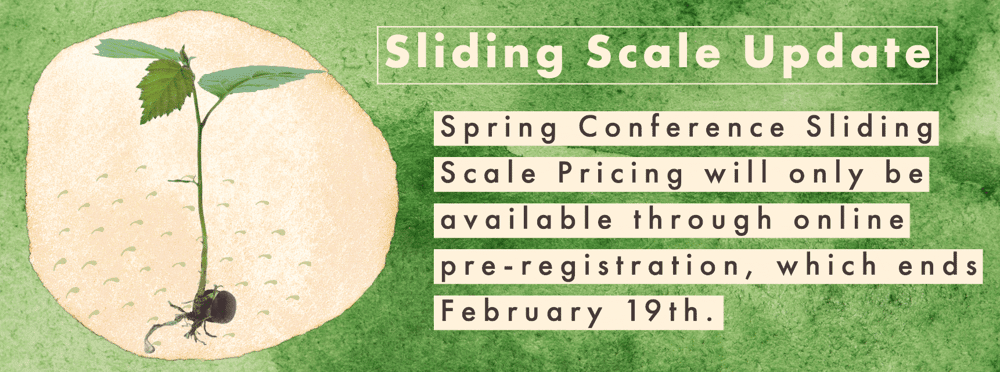
For the past 30 years, the Organic Growers School Spring Conference has served as a gathering place for growers in Appalachia to connect, learn from one another, and deepen connections to land and community. The Spring Conference began as an entirely volunteer-run and free event and has expanded to support an organization of ten staff with year-round programming. As we have grown, we have experimented with different approaches to keeping the event affordable and accessible while also working on compensation for our speakers and supporting our growing staff. We encourage you to check out our recent blog post exploring this in more depth. This year, we are excited to be experimenting with sliding scale ticket pricing for the first time, and we wanted to take some time to explain how this works and why we decided to implement it this year.
Looking beyond scholarships
Over the past several years, we have started implementing different scholarship options. We have set aside around $3000 in our internal budget for scholarships, and we have increased our outreach to other groups in the area who have funding to support individuals to attend conferences. We also offer work-trade opportunities for people who are interested in helping out with our event in exchange for attendance. We have around 100 work-traders access the conference each year through these opportunities, but we have never used up our entire scholarship fund for the event. We know that there are many individuals in our community that we are not reaching through our scholarship opportunities. We began to wonder if scholarship applications were creating a barrier to participation and started researching other options, landing eventually on sliding scale as our preferred model.
How alternative pricing models address accessibility
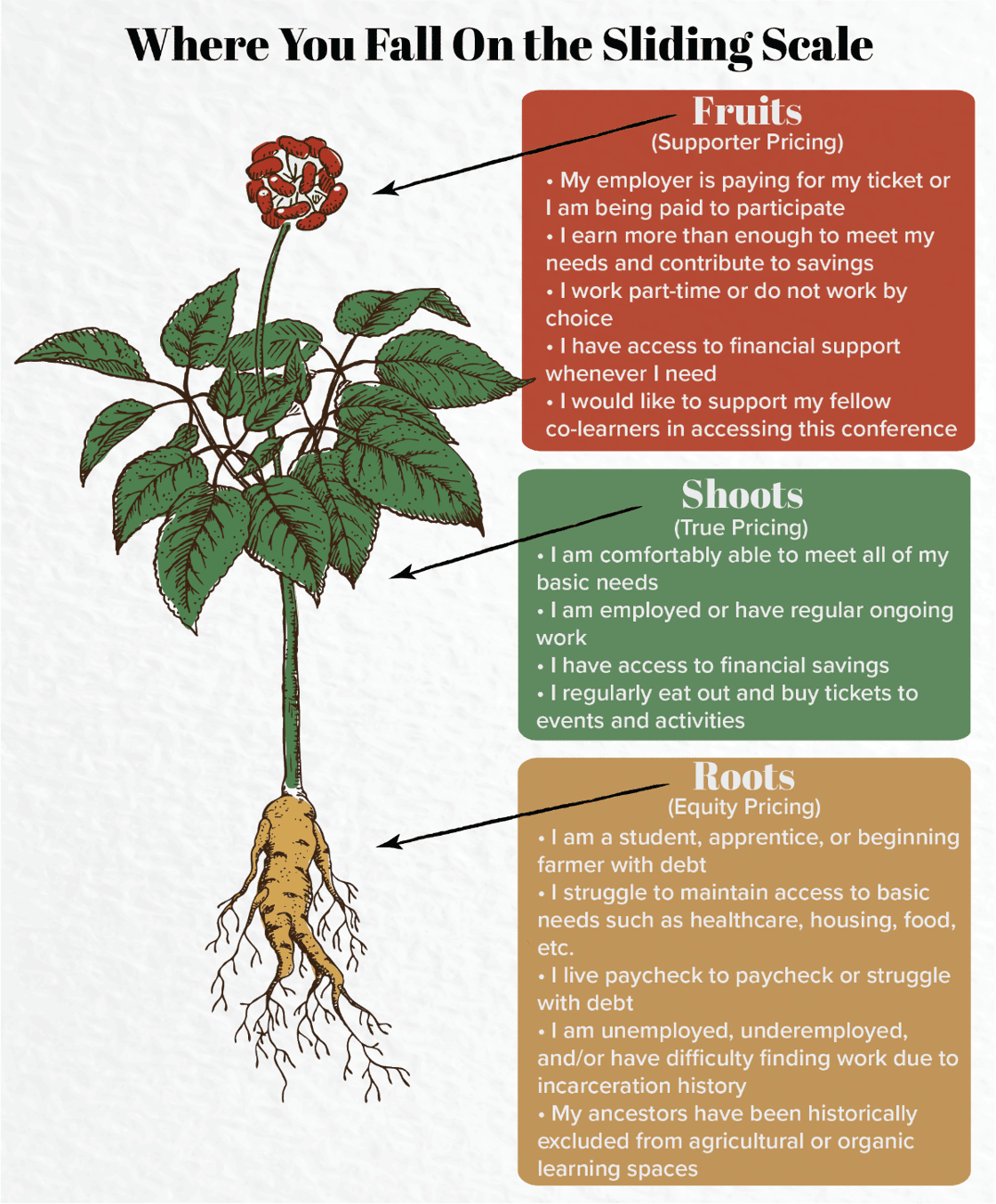
The sliding scale model, which offers the opportunity for participants to select a price to pay for their ticket, meets several of the parameters we were looking for in an accessible pricing model. Most importantly, it is a seamless way for attendees to access the price that meets their needs. So many things are means-tested in our society, and it can be exhausting to justify why one needs a more affordable price point. While many of our community members need financial support, there are also members of this community who have more than enough to share and are excited about supporting their fellow co-learners. These attendees can select the higher end of the sliding scale, which will be set at a price to offset the lower price paid by other attendees. We trust our attendees to select the option that best works for them while also considering how their selection would affect the ability of other participants to access a lower price point.
Accessibility is a priority for OGS, and implementing it is a risk for us as a small non-profit, given that we rely on our large events like the Spring Conference to support our year-round programming and staff salaries. This will certainly be an experimental year, and if we are not able to secure enough income through sliding-scale registrations, we will have to rethink our approach to pricing. We trust that our community will be thoughtful in thinking about the value that this conference has to them and about what they are able to pay for at this time. Thank you for being on this journey of discovery with us!
Extension Master GardenerSM Volunteers of Buncombe County are happy to announce for the sixteenth year we are offering School Garden Grants to Asheville City and Buncombe County public schools, including state charter schools.

We provide a notice of the application period along with instructions to all school principals, elementary through senior high. Additional information is available on our website, buncombemastergardener.org, where you can learn more about the guidelines for receiving a grant and get online access to the 2023 School Garden Grants Application.
All applications must be completed online. Completed applications will be accepted beginning January 9, 2023, and must be submitted no later than 9 p.m. on February 3, 2023. If you have any questions, please call the Extension Office at 828-255-5522.
We are proud of our partnership with Asheville City and Buncombe County Schools. Since 2007, we have awarded 52 School Garden Grants totaling over $45,000. These grants have involved more than 16,500 students and hundreds of teachers, parents, and community volunteers.
School gardens grow more than plants. They grow imagination and creativity. They make math and science come alive, and they build community. We hope your school will join us in 2023.
Click on the link below to review the guidelines for school garden grants:
Guidelines for 2023 School Garden Grants
The upcoming Journeyperson course is now available AT NO COST! Due to some timely grant funding, we can offer this in-depth farmer training for farmers in years 3-7 with no associated tuition fee! The course consists of monthly cohort meet-ups and 2-3 in-depth workshops, plus mentorship!
In addition, a select number of participants will also receive matched FUNDS for your farm savings account (Savings Incentive Program) and money to spend on a professional development opportunity of your choosing! Want to attend a workshop on livestock management? OGS will contribute towards that fee! Are you saving money for a farm asset? OGS will contribute up to a certain amount to that investment.
The Journeyperson Program is for farmers who have been independently farming for three or more years and are serious about operating farm businesses in the Southern Appalachian region.
|
|

For the past 30 years, the Organic Growers School Spring Conference has served as a gathering place for growers in Appalachia to connect, learn from one another, and deepen connections to land and community. The Spring Conference began as an entirely volunteer-run and free event and has expanded to support an organization of ten staff with year-round programming. As we have grown, we have experimented with different approaches to keeping the event affordable and accessible while also working on compensation for our speakers and supporting our growing staff. We encourage you to check out our recent blog post exploring this in more depth. This year, we are excited to be experimenting with sliding scale ticket pricing for the first time, and we wanted to take some time to explain how this works and why we decided to implement it this year.
Looking beyond scholarships
Over the past several years, we have started implementing different scholarship options. We have set aside around $3000 in our internal budget for scholarships, and we have increased our outreach to other groups in the area who have funding to support individuals to attend conferences. We also offer work-trade opportunities for people who are interested in helping out with our event in exchange for attendance. We have around 100 work-traders access the conference each year through these opportunities, but we have never used up our entire scholarship fund for the event. We know that there are many individuals in our community that we are not reaching through our scholarship opportunities. We began to wonder if scholarship applications were creating a barrier to participation and started researching other options, landing eventually on sliding scale as our preferred model.
How alternative pricing models address accessibility
The sliding scale model, which offers the opportunity for participants to select a price to pay for their ticket, meets several of the parameters we were looking for in an accessible pricing model. Most importantly, it is a seamless way for attendees to access the price that meets their needs. So many things are means-tested in our society, and it can be exhausting to justify why one needs a more affordable price point. While many of our community members need financial support, there are also members of this community who have more than enough to share and are excited about supporting their fellow co-learners. These attendees can select the higher end of the sliding scale, which will be set at a price to offset the lower price paid by other attendees. We trust our attendees to select the option that best works for them while also considering how their selection would affect the ability of other participants to access a lower price point.
Accessibility is a priority for OGS, and implementing it is a risk for us as a small non-profit, given that we rely on our large events like the Spring Conference to support our year-round programming and staff salaries. This will certainly be an experimental year, and if we are not able to secure enough income through sliding-scale registrations, we will have to rethink our approach to pricing. We trust that our community will be thoughtful in thinking about the value that this conference has to them and about what they are able to pay for at this time. Thank you for being on this journey of discovery with us!
Extension Master GardenerSM Volunteers of Buncombe County are happy to announce for the sixteenth year we are offering School Garden Grants to Asheville City and Buncombe County public schools, including state charter schools.

We provide a notice of the application period along with instructions to all school principals, elementary through senior high. Additional information is available on our website, buncombemastergardener.org, where you can learn more about the guidelines for receiving a grant and get online access to the 2023 School Garden Grants Application.
All applications must be completed online. Completed applications will be accepted beginning January 9, 2023, and must be submitted no later than 9 p.m. on February 3, 2023. If you have any questions, please call the Extension Office at 828-255-5522.
We are proud of our partnership with Asheville City and Buncombe County Schools. Since 2007, we have awarded 52 School Garden Grants totaling over $45,000. These grants have involved more than 16,500 students and hundreds of teachers, parents, and community volunteers.
School gardens grow more than plants. They grow imagination and creativity. They make math and science come alive, and they build community. We hope your school will join us in 2023.
Click on the link below to review the guidelines for school garden grants:
Guidelines for 2023 School Garden Grants
The upcoming Journeyperson course is now available AT NO COST! Due to some timely grant funding, we can offer this in-depth farmer training for farmers in years 3-7 with no associated tuition fee! The course consists of monthly cohort meet-ups and 2-3 in-depth workshops, plus mentorship!
In addition, a select number of participants will also receive matched FUNDS for your farm savings account (Savings Incentive Program) and money to spend on a professional development opportunity of your choosing! Want to attend a workshop on livestock management? OGS will contribute towards that fee! Are you saving money for a farm asset? OGS will contribute up to a certain amount to that investment.
The Journeyperson Program is for farmers who have been independently farming for three or more years and are serious about operating farm businesses in the Southern Appalachian region.
|
|

For the past 30 years, the Organic Growers School Spring Conference has served as a gathering place for growers in Appalachia to connect, learn from one another, and deepen connections to land and community. The Spring Conference began as an entirely volunteer-run and free event and has expanded to support an organization of ten staff with year-round programming. As we have grown, we have experimented with different approaches to keeping the event affordable and accessible while also working on compensation for our speakers and supporting our growing staff. We encourage you to check out our recent blog post exploring this in more depth. This year, we are excited to be experimenting with sliding scale ticket pricing for the first time, and we wanted to take some time to explain how this works and why we decided to implement it this year.
Looking beyond scholarships
Over the past several years, we have started implementing different scholarship options. We have set aside around $3000 in our internal budget for scholarships, and we have increased our outreach to other groups in the area who have funding to support individuals to attend conferences. We also offer work-trade opportunities for people who are interested in helping out with our event in exchange for attendance. We have around 100 work-traders access the conference each year through these opportunities, but we have never used up our entire scholarship fund for the event. We know that there are many individuals in our community that we are not reaching through our scholarship opportunities. We began to wonder if scholarship applications were creating a barrier to participation and started researching other options, landing eventually on sliding scale as our preferred model.
How alternative pricing models address accessibility
The sliding scale model, which offers the opportunity for participants to select a price to pay for their ticket, meets several of the parameters we were looking for in an accessible pricing model. Most importantly, it is a seamless way for attendees to access the price that meets their needs. So many things are means-tested in our society, and it can be exhausting to justify why one needs a more affordable price point. While many of our community members need financial support, there are also members of this community who have more than enough to share and are excited about supporting their fellow co-learners. These attendees can select the higher end of the sliding scale, which will be set at a price to offset the lower price paid by other attendees. We trust our attendees to select the option that best works for them while also considering how their selection would affect the ability of other participants to access a lower price point.
Accessibility is a priority for OGS, and implementing it is a risk for us as a small non-profit, given that we rely on our large events like the Spring Conference to support our year-round programming and staff salaries. This will certainly be an experimental year, and if we are not able to secure enough income through sliding-scale registrations, we will have to rethink our approach to pricing. We trust that our community will be thoughtful in thinking about the value that this conference has to them and about what they are able to pay for at this time. Thank you for being on this journey of discovery with us!
Extension Master GardenerSM Volunteers of Buncombe County are happy to announce for the sixteenth year we are offering School Garden Grants to Asheville City and Buncombe County public schools, including state charter schools.

We provide a notice of the application period along with instructions to all school principals, elementary through senior high. Additional information is available on our website, buncombemastergardener.org, where you can learn more about the guidelines for receiving a grant and get online access to the 2023 School Garden Grants Application.
All applications must be completed online. Completed applications will be accepted beginning January 9, 2023, and must be submitted no later than 9 p.m. on February 3, 2023. If you have any questions, please call the Extension Office at 828-255-5522.
We are proud of our partnership with Asheville City and Buncombe County Schools. Since 2007, we have awarded 52 School Garden Grants totaling over $45,000. These grants have involved more than 16,500 students and hundreds of teachers, parents, and community volunteers.
School gardens grow more than plants. They grow imagination and creativity. They make math and science come alive, and they build community. We hope your school will join us in 2023.
Click on the link below to review the guidelines for school garden grants:
Guidelines for 2023 School Garden Grants

For the past 30 years, the Organic Growers School Spring Conference has served as a gathering place for growers in Appalachia to connect, learn from one another, and deepen connections to land and community. The Spring Conference began as an entirely volunteer-run and free event and has expanded to support an organization of ten staff with year-round programming. As we have grown, we have experimented with different approaches to keeping the event affordable and accessible while also working on compensation for our speakers and supporting our growing staff. We encourage you to check out our recent blog post exploring this in more depth. This year, we are excited to be experimenting with sliding scale ticket pricing for the first time, and we wanted to take some time to explain how this works and why we decided to implement it this year.
Looking beyond scholarships
Over the past several years, we have started implementing different scholarship options. We have set aside around $3000 in our internal budget for scholarships, and we have increased our outreach to other groups in the area who have funding to support individuals to attend conferences. We also offer work-trade opportunities for people who are interested in helping out with our event in exchange for attendance. We have around 100 work-traders access the conference each year through these opportunities, but we have never used up our entire scholarship fund for the event. We know that there are many individuals in our community that we are not reaching through our scholarship opportunities. We began to wonder if scholarship applications were creating a barrier to participation and started researching other options, landing eventually on sliding scale as our preferred model.
How alternative pricing models address accessibility
The sliding scale model, which offers the opportunity for participants to select a price to pay for their ticket, meets several of the parameters we were looking for in an accessible pricing model. Most importantly, it is a seamless way for attendees to access the price that meets their needs. So many things are means-tested in our society, and it can be exhausting to justify why one needs a more affordable price point. While many of our community members need financial support, there are also members of this community who have more than enough to share and are excited about supporting their fellow co-learners. These attendees can select the higher end of the sliding scale, which will be set at a price to offset the lower price paid by other attendees. We trust our attendees to select the option that best works for them while also considering how their selection would affect the ability of other participants to access a lower price point.
Accessibility is a priority for OGS, and implementing it is a risk for us as a small non-profit, given that we rely on our large events like the Spring Conference to support our year-round programming and staff salaries. This will certainly be an experimental year, and if we are not able to secure enough income through sliding-scale registrations, we will have to rethink our approach to pricing. We trust that our community will be thoughtful in thinking about the value that this conference has to them and about what they are able to pay for at this time. Thank you for being on this journey of discovery with us!
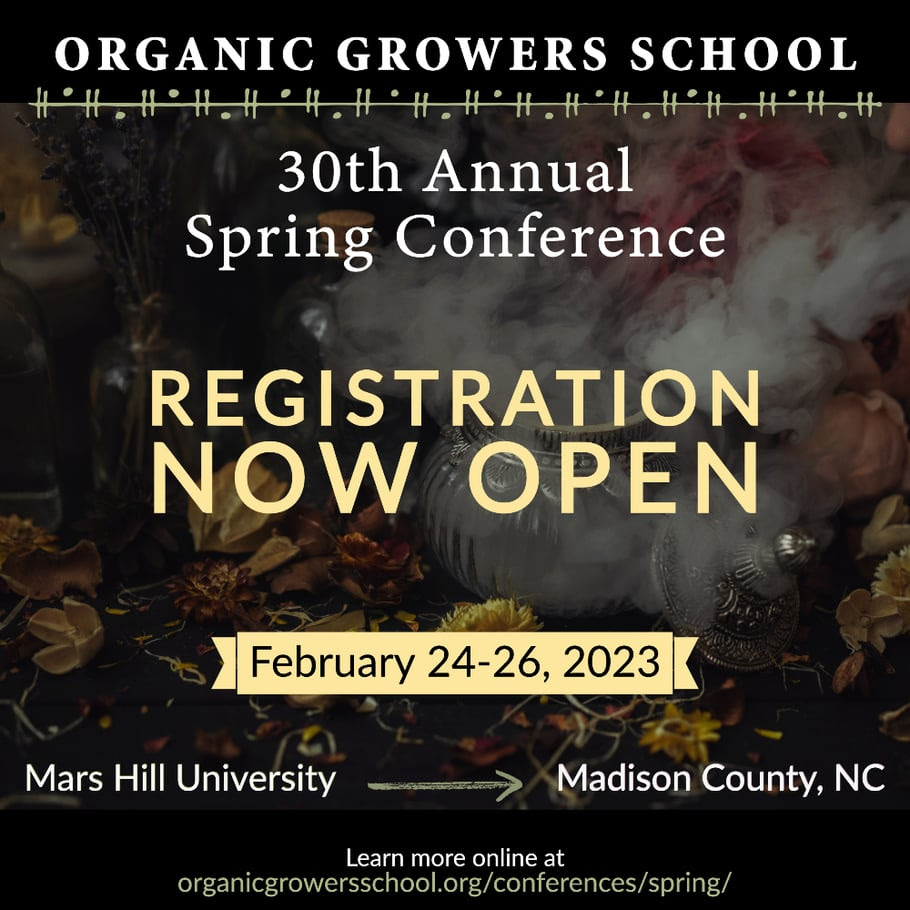
Registration is OPEN!
30th Annual Spring Conference at Mars Hill University
You’re in for a fun-filled weekend of learning and community building. This year our Tracks include Cooking, Food Justice, Farming Business + Production, Herbs, Mushrooms, Forest Farming, Gardening, Holistic Forestry, Livestock & Poultry, Living on the Land, Permaculture, Pests & Pollinators, Soils, & Sustainable Living!For each Track subject, there are 4 different classes to choose from taught by expert educators. There will also be 8 half-day workshops to choose from if you want to dive deep into subjects like Fermentation, Spirulina Cultivation, Invasive Vine Basketry, and more!
View the full Spring Conference schedule here.
Sliding Scale Pricing for Spring Conference
OGS is implementing a Sliding Scale Price model for 2023
So many things are means-tested in our society, and it can be exhausting to justify why one needs a more affordable price point. The sliding scale model, which allows participants to select a price to pay for their ticket, meets several of the parameters we were looking for in an accessible pricing model.
While many of our community members need financial support, some of these community members have more than enough to share and are excited about supporting their fellow co-learners. These attendees can select the higher end of the sliding scale, which will be set at a price to offset the lower price paid by other attendees. We trust our attendees to select the option that best works for them while also considering how their selection would affect the ability of other participants to access a lower price point.
Accessibility is a priority for OGS, and implementing it is a risk for us as a small non-profit, given that we rely on our large events like the Spring Conference to support our year-round programming and staff salaries. This will certainly be an experimental year, and if we cannot secure enough income through sliding-scale registrations, we will have to rethink our approach to pricing. We trust that our community will be thoughtful in thinking about the value this conference has for them and what they can pay for at this time.
Science Fiction Book Club
Join host and former Malaprop’s Bookseller Allison to dive into the wreck of the wily and wonderful world of science fiction, fantasy, weird fiction, speculative fiction, and literary horror with a healthy mix of underappreciated classic and contemporary books. Meets the last Monday of every month at 7pm on Zoom. Also meets the second Monday of every month at 7pm to discuss the film adaptations of the books we read. To learn more or join the club, email [email protected].
Extension Master GardenerSM Volunteers of Buncombe County are happy to announce for the sixteenth year we are offering School Garden Grants to Asheville City and Buncombe County public schools, including state charter schools.

We provide a notice of the application period along with instructions to all school principals, elementary through senior high. Additional information is available on our website, buncombemastergardener.org, where you can learn more about the guidelines for receiving a grant and get online access to the 2023 School Garden Grants Application.
All applications must be completed online. Completed applications will be accepted beginning January 9, 2023, and must be submitted no later than 9 p.m. on February 3, 2023. If you have any questions, please call the Extension Office at 828-255-5522.
We are proud of our partnership with Asheville City and Buncombe County Schools. Since 2007, we have awarded 52 School Garden Grants totaling over $45,000. These grants have involved more than 16,500 students and hundreds of teachers, parents, and community volunteers.
School gardens grow more than plants. They grow imagination and creativity. They make math and science come alive, and they build community. We hope your school will join us in 2023.
Click on the link below to review the guidelines for school garden grants:
Guidelines for 2023 School Garden Grants
Join us throughout February as we celebrate Black Legacy Month with programs and events for all ages! In addition to the programs listed below, we will have special story times and exhibits at most of our libraries.
- Bright Star Touring Theatre: African Folktales – February 1 at 4pm at the Weaverville Library (for children ages 3 and up)
- Book Club: Jazz by Toni Morrison – Thursday, February 2 a 3pm at the Weaverville Library
- Book Club: The Vanishing Half by Brit Bennett – Tuesday, February 7 at 6pm
- Book Club: The Personal Librarian by Marie Benedict Tuesday, February 14 at 1pm at the Leicester Library
- Book Club: Life in Motion: An Unlikely Ballerina by Misty Copeland – February 16 at 2:30pm at the Skyland/South Buncombe Library
- Book Club: The Vanishing Half by Brit Bennett – February 21 at 7pm at the Fairview Library
- Black Experience Book Club: The Furrows by Namwali Serpell – February 23 at 6:30pm at the Noir Collective, co-sponsored by the East Asheville library
Drop by your local library and check us out. Email or call if you have any questions.
Our librarians have also put together a Black Legacy Month reading list for all ages.
Black Legacy Month Reading List 2023
Books for Adults
Adult Fiction
- Parable of the Sower by Octavia Butler
- On Girlhood: 15 Stories from the Well-Read Black Girl Library edited by Glory Edim
- What the Fireflies Knew by Kai Harries
- Black Leopard, Red Wolf by Marlon James
- The Love Songs of W.E.B. Dubois by Honoree Fannone Jeffers
- How Long ‘Til Black Future Month? by N.K. Jemison
- Deacon King Kong by James McBride
- Take My Hand by Dolen Perkins-Valdez
- Black Bottom Saints by Alice Randall
- The Violin Conspiracy by Brendan Slocumb
- Harlem Shuffle by Colson Whitehead
- Seven Days in June by Tia Williams
- Red at the Bone by Jacqueline Woodson
Adult nonfiction
- Uncomfortable Conversations with a Black Man by Emmanuel Acho
- Carefree Black Girls: A Celebration of Black women in Popular Culture by Zeba Blay
- The 1619 Project edited by Nikole Hannah-Jones
- Rest is Resistance by Tricia Hersey
- Wow, No Thank You by Samantha Irby*
- The Sum of Us by Heather McGhee
- All That She Carried by Tiya Miles
- Please Don’t Sit On My Bed In Your Outside Clothes by Phoebe Robinson*
- You’ll Never Believe What Happened to Lacey by Amber Ruffin*
- Counting Descent by Clint Smith
- The Body Is Not an Apology by Sonya Renee Taylor
- Here For It by R. Eric Thomas*
- Koshersoul: the faith and food journey of an African American Jew by Michael W. Twitty
*especially good on audio because the authors read their work!
Picture books for families to share
- My Heart Flies Open by Omileye Achikeobi-Lewis
- Only the Best: The Exceptional Life and Fashion of Ann Lowe by Kate Messner
- My N.C. From A to Z by Michelle Lanier
- Shhh! The Baby’s Asleep by JaNay Brown-Wood
- Curls by Ruth Forman
- Fly by Brittany J. Thurman
- Opal Lee and What it Means to be Free: The True Story of the Grandmother of Juneteenth by Alice Faye Duncan
- Build a House by Rhiannon Giddens
- Bright Brown Baby, A Treasury by Andrea Davis Pinkney
- Born on the Water by Nikole Hannah-Jones and Renee Watson
Chapter books for older kids
- Isaiah Dunn is My Hero by Kelly J. BaptistBlended by Sharon Draper
- Ikenga by Nnedi Okorafor
- Stamped: Racism, Antiracism, and You by Jason Reynolds and Ibram X. Kendi
- Tristan Strong Trilogy (Tristan Strong Punches a Hole in the Sky, Tristan Strong Destroys the World, and Tristan Strong Keeps Punching) by Kwame Mbalia
- From the Desk of Zoe Washington by Janae Marks
- Black Boy Joy: 17 Stories Celebrating Black Boyhood edited by Kwame Mbalia
- Freewater by Amina Luqman-Dawson
- Operation Sisterhood by Olugbemisola Rhuday-Perkovich
- The Door of No Return by Alexander Kwame
Books for teens
- Quincredible by Rodney Barnes
- The Legendborn Cycle (Legendborn and Bloodmarked) by Tracy Deonn
- All Boys Aren’t Blue by George M. Johnson
- You Should See Me in a Crown by Leah Johnson
- Survive the Dome by Kosoko Jackson
- Revolution in Our Time: The Black Panther’s Promise to the People by Kekla Magoon
- Ain’t Burned All the Bright by Jason Reynolds
- Bitter by Akwaeke Emezi
- On the Come Up by Angie Thomas
- Okoye to the People by Ibi Zoboi
The upcoming Journeyperson course is now available AT NO COST! Due to some timely grant funding, we can offer this in-depth farmer training for farmers in years 3-7 with no associated tuition fee! The course consists of monthly cohort meet-ups and 2-3 in-depth workshops, plus mentorship!
In addition, a select number of participants will also receive matched FUNDS for your farm savings account (Savings Incentive Program) and money to spend on a professional development opportunity of your choosing! Want to attend a workshop on livestock management? OGS will contribute towards that fee! Are you saving money for a farm asset? OGS will contribute up to a certain amount to that investment.
The Journeyperson Program is for farmers who have been independently farming for three or more years and are serious about operating farm businesses in the Southern Appalachian region.
|
|

For the past 30 years, the Organic Growers School Spring Conference has served as a gathering place for growers in Appalachia to connect, learn from one another, and deepen connections to land and community. The Spring Conference began as an entirely volunteer-run and free event and has expanded to support an organization of ten staff with year-round programming. As we have grown, we have experimented with different approaches to keeping the event affordable and accessible while also working on compensation for our speakers and supporting our growing staff. We encourage you to check out our recent blog post exploring this in more depth. This year, we are excited to be experimenting with sliding scale ticket pricing for the first time, and we wanted to take some time to explain how this works and why we decided to implement it this year.
Looking beyond scholarships
Over the past several years, we have started implementing different scholarship options. We have set aside around $3000 in our internal budget for scholarships, and we have increased our outreach to other groups in the area who have funding to support individuals to attend conferences. We also offer work-trade opportunities for people who are interested in helping out with our event in exchange for attendance. We have around 100 work-traders access the conference each year through these opportunities, but we have never used up our entire scholarship fund for the event. We know that there are many individuals in our community that we are not reaching through our scholarship opportunities. We began to wonder if scholarship applications were creating a barrier to participation and started researching other options, landing eventually on sliding scale as our preferred model.
How alternative pricing models address accessibility
The sliding scale model, which offers the opportunity for participants to select a price to pay for their ticket, meets several of the parameters we were looking for in an accessible pricing model. Most importantly, it is a seamless way for attendees to access the price that meets their needs. So many things are means-tested in our society, and it can be exhausting to justify why one needs a more affordable price point. While many of our community members need financial support, there are also members of this community who have more than enough to share and are excited about supporting their fellow co-learners. These attendees can select the higher end of the sliding scale, which will be set at a price to offset the lower price paid by other attendees. We trust our attendees to select the option that best works for them while also considering how their selection would affect the ability of other participants to access a lower price point.
Accessibility is a priority for OGS, and implementing it is a risk for us as a small non-profit, given that we rely on our large events like the Spring Conference to support our year-round programming and staff salaries. This will certainly be an experimental year, and if we are not able to secure enough income through sliding-scale registrations, we will have to rethink our approach to pricing. We trust that our community will be thoughtful in thinking about the value that this conference has to them and about what they are able to pay for at this time. Thank you for being on this journey of discovery with us!
This is a hybrid event, meaning there is an option to attend virtually and a limited number of seats are available to attend the event in-store. The event is free but registration is required for both in-person and virtual attendance.
Please click here to register for the VIRTUAL event. The link required to attend will be emailed to registrants prior to the event.
Please click here to register for the IN-PERSON event. Note the important event details on the RSVP form.
This event includes a book signing. If you would like a signed book but can’t attend in person, use the order comments field when you order below to request a signed copy and tell us to whom the book should be personalized.
If you decide to attend and to purchase books, we ask that you purchase from Malaprop’s. When you do this you make it possible for us to continue hosting author events and you keep more dollars in our community. You may also support our work by purchasing a gift card or making a donation of any amount below. Thank you!
In (Don’t) Stop Me If You’ve Heard This Before, Peter Turchi combines personal narrative and close reading of a wide range of stories and novels to reveal how writers create the fiction that matters to us. Building on his much-loved Maps of the Imagination: The Writer as Cartographer, Turchi leads readers and writers to an understanding of how the intricate mechanics of storytelling–including shifts in characters’ authority, the subtle manipulation of images, careful attention to point of view, the strategic release of information, and even digressing from the (apparent) story–can create powerful effects.
Using examples from Dickens, Chekhov, and Salinger, and Twain to more contemporary writers including Toni Morrison, Alice Munro, E. L. Doctorow, Jenny Erpenbeck, Adam Johnson, Mohsin Hamid, Jai Chakrabarti, Yoko Ogawa, Richard Powers, Deborah Eisenberg, Olga Tokarczuk, Rachel Cusk, and Colson Whitehead, Turchi offers illuminating insights into the inner workings of fiction as well as practical advice for writers looking to explore their craft from a fresh angle beyond the fundamentals of character and setting, plot, and scene.
While these essays draw from decades of teaching undergraduate and graduate students, they also speak to writers working on their own. In “Out of the Workshop, into the Laboratory,” Turchi discusses how anyone can make the most of discussions of stories or novels in progress, and in “Reading Like a Writer” he provides guidelines for learning from writing you admire. Perhaps best of all, these essays by a writer the Houston Chronicle has called “one of the country’s foremost thinkers on the art of writing” are as entertaining as they are edifying, always reminding us of the power and pleasure of storytelling.
Peter Turchi has written and coedited several books on writing fiction, including Maps of the Imagination: The Writer as Cartographer, A Muse and a Maze: Writing as Puzzle, Mystery, and Magic, A Kite in the Wind: Fiction Writers on Their Craft, and (Don’t) Stop Me if You’ve Heard This Before and Other Essays on Writing Fiction. His stories have appeared in Ploughshares, Story, the Alaska Quarterly Review, Puerto del Sol, and the Colorado Review, among other journals. He has received numerous accolades, including fellowships from the National Endowment for the Arts and the John Simon Guggenheim Memorial Foundation. He is a professor of creative writing at the University of Houston.
The club will meet virtually for now.
Meetings will take place at 7:00 PM ET on the last Tuesday of each month via Zoom. Please visit the Romance Bookclub page for the monthly selection, and email Samantha at [email protected] for the link to join.
Romance Book Club is a space to celebrate love in literature. Whether it’s set in early 1800s London, a distant planet years into the future, a fantasy world of magic, or our own contemporary universe, we are here for the stories that end with a happily-ever-after (or at least a happily-for-now).
Meetings will take place at 7:00 PM ET on the last Tuesday of each month via Zoom. Please visit the Romance Bookclub page for the monthly selection, and email Samantha at [email protected] for the link to join.
Extension Master GardenerSM Volunteers of Buncombe County are happy to announce for the sixteenth year we are offering School Garden Grants to Asheville City and Buncombe County public schools, including state charter schools.

We provide a notice of the application period along with instructions to all school principals, elementary through senior high. Additional information is available on our website, buncombemastergardener.org, where you can learn more about the guidelines for receiving a grant and get online access to the 2023 School Garden Grants Application.
All applications must be completed online. Completed applications will be accepted beginning January 9, 2023, and must be submitted no later than 9 p.m. on February 3, 2023. If you have any questions, please call the Extension Office at 828-255-5522.
We are proud of our partnership with Asheville City and Buncombe County Schools. Since 2007, we have awarded 52 School Garden Grants totaling over $45,000. These grants have involved more than 16,500 students and hundreds of teachers, parents, and community volunteers.
School gardens grow more than plants. They grow imagination and creativity. They make math and science come alive, and they build community. We hope your school will join us in 2023.
Click on the link below to review the guidelines for school garden grants:
Guidelines for 2023 School Garden Grants
Join us throughout February as we celebrate Black Legacy Month with programs and events for all ages! In addition to the programs listed below, we will have special story times and exhibits at most of our libraries.
- Bright Star Touring Theatre: African Folktales – February 1 at 4pm at the Weaverville Library (for children ages 3 and up)
- Book Club: Jazz by Toni Morrison – Thursday, February 2 a 3pm at the Weaverville Library
- Book Club: The Vanishing Half by Brit Bennett – Tuesday, February 7 at 6pm
- Book Club: The Personal Librarian by Marie Benedict Tuesday, February 14 at 1pm at the Leicester Library
- Book Club: Life in Motion: An Unlikely Ballerina by Misty Copeland – February 16 at 2:30pm at the Skyland/South Buncombe Library
- Book Club: The Vanishing Half by Brit Bennett – February 21 at 7pm at the Fairview Library
- Black Experience Book Club: The Furrows by Namwali Serpell – February 23 at 6:30pm at the Noir Collective, co-sponsored by the East Asheville library
Drop by your local library and check us out. Email or call if you have any questions.
Our librarians have also put together a Black Legacy Month reading list for all ages.
Black Legacy Month Reading List 2023
Books for Adults
Adult Fiction
- Parable of the Sower by Octavia Butler
- On Girlhood: 15 Stories from the Well-Read Black Girl Library edited by Glory Edim
- What the Fireflies Knew by Kai Harries
- Black Leopard, Red Wolf by Marlon James
- The Love Songs of W.E.B. Dubois by Honoree Fannone Jeffers
- How Long ‘Til Black Future Month? by N.K. Jemison
- Deacon King Kong by James McBride
- Take My Hand by Dolen Perkins-Valdez
- Black Bottom Saints by Alice Randall
- The Violin Conspiracy by Brendan Slocumb
- Harlem Shuffle by Colson Whitehead
- Seven Days in June by Tia Williams
- Red at the Bone by Jacqueline Woodson
Adult nonfiction
- Uncomfortable Conversations with a Black Man by Emmanuel Acho
- Carefree Black Girls: A Celebration of Black women in Popular Culture by Zeba Blay
- The 1619 Project edited by Nikole Hannah-Jones
- Rest is Resistance by Tricia Hersey
- Wow, No Thank You by Samantha Irby*
- The Sum of Us by Heather McGhee
- All That She Carried by Tiya Miles
- Please Don’t Sit On My Bed In Your Outside Clothes by Phoebe Robinson*
- You’ll Never Believe What Happened to Lacey by Amber Ruffin*
- Counting Descent by Clint Smith
- The Body Is Not an Apology by Sonya Renee Taylor
- Here For It by R. Eric Thomas*
- Koshersoul: the faith and food journey of an African American Jew by Michael W. Twitty
*especially good on audio because the authors read their work!
Picture books for families to share
- My Heart Flies Open by Omileye Achikeobi-Lewis
- Only the Best: The Exceptional Life and Fashion of Ann Lowe by Kate Messner
- My N.C. From A to Z by Michelle Lanier
- Shhh! The Baby’s Asleep by JaNay Brown-Wood
- Curls by Ruth Forman
- Fly by Brittany J. Thurman
- Opal Lee and What it Means to be Free: The True Story of the Grandmother of Juneteenth by Alice Faye Duncan
- Build a House by Rhiannon Giddens
- Bright Brown Baby, A Treasury by Andrea Davis Pinkney
- Born on the Water by Nikole Hannah-Jones and Renee Watson
Chapter books for older kids
- Isaiah Dunn is My Hero by Kelly J. BaptistBlended by Sharon Draper
- Ikenga by Nnedi Okorafor
- Stamped: Racism, Antiracism, and You by Jason Reynolds and Ibram X. Kendi
- Tristan Strong Trilogy (Tristan Strong Punches a Hole in the Sky, Tristan Strong Destroys the World, and Tristan Strong Keeps Punching) by Kwame Mbalia
- From the Desk of Zoe Washington by Janae Marks
- Black Boy Joy: 17 Stories Celebrating Black Boyhood edited by Kwame Mbalia
- Freewater by Amina Luqman-Dawson
- Operation Sisterhood by Olugbemisola Rhuday-Perkovich
- The Door of No Return by Alexander Kwame
Books for teens
- Quincredible by Rodney Barnes
- The Legendborn Cycle (Legendborn and Bloodmarked) by Tracy Deonn
- All Boys Aren’t Blue by George M. Johnson
- You Should See Me in a Crown by Leah Johnson
- Survive the Dome by Kosoko Jackson
- Revolution in Our Time: The Black Panther’s Promise to the People by Kekla Magoon
- Ain’t Burned All the Bright by Jason Reynolds
- Bitter by Akwaeke Emezi
- On the Come Up by Angie Thomas
- Okoye to the People by Ibi Zoboi

For the past 30 years, the Organic Growers School Spring Conference has served as a gathering place for growers in Appalachia to connect, learn from one another, and deepen connections to land and community. The Spring Conference began as an entirely volunteer-run and free event and has expanded to support an organization of ten staff with year-round programming. As we have grown, we have experimented with different approaches to keeping the event affordable and accessible while also working on compensation for our speakers and supporting our growing staff. We encourage you to check out our recent blog post exploring this in more depth. This year, we are excited to be experimenting with sliding scale ticket pricing for the first time, and we wanted to take some time to explain how this works and why we decided to implement it this year.
Looking beyond scholarships
Over the past several years, we have started implementing different scholarship options. We have set aside around $3000 in our internal budget for scholarships, and we have increased our outreach to other groups in the area who have funding to support individuals to attend conferences. We also offer work-trade opportunities for people who are interested in helping out with our event in exchange for attendance. We have around 100 work-traders access the conference each year through these opportunities, but we have never used up our entire scholarship fund for the event. We know that there are many individuals in our community that we are not reaching through our scholarship opportunities. We began to wonder if scholarship applications were creating a barrier to participation and started researching other options, landing eventually on sliding scale as our preferred model.
How alternative pricing models address accessibility
The sliding scale model, which offers the opportunity for participants to select a price to pay for their ticket, meets several of the parameters we were looking for in an accessible pricing model. Most importantly, it is a seamless way for attendees to access the price that meets their needs. So many things are means-tested in our society, and it can be exhausting to justify why one needs a more affordable price point. While many of our community members need financial support, there are also members of this community who have more than enough to share and are excited about supporting their fellow co-learners. These attendees can select the higher end of the sliding scale, which will be set at a price to offset the lower price paid by other attendees. We trust our attendees to select the option that best works for them while also considering how their selection would affect the ability of other participants to access a lower price point.
Accessibility is a priority for OGS, and implementing it is a risk for us as a small non-profit, given that we rely on our large events like the Spring Conference to support our year-round programming and staff salaries. This will certainly be an experimental year, and if we are not able to secure enough income through sliding-scale registrations, we will have to rethink our approach to pricing. We trust that our community will be thoughtful in thinking about the value that this conference has to them and about what they are able to pay for at this time. Thank you for being on this journey of discovery with us!
The Malaprop’s Book Club, hosted by Jay Jacoby, explores a diverse selection of fiction and nonfiction books determined by member suggestion. Click here to see a full schedule of what the club is reading. Club attendees get 10% off the book at Malaprop’s!
The club meets the first Wednesday of every month at 7:00 PM. The club will meet virtually until further notice. To join the club, please email [email protected]
Extension Master GardenerSM Volunteers of Buncombe County are happy to announce for the sixteenth year we are offering School Garden Grants to Asheville City and Buncombe County public schools, including state charter schools.

We provide a notice of the application period along with instructions to all school principals, elementary through senior high. Additional information is available on our website, buncombemastergardener.org, where you can learn more about the guidelines for receiving a grant and get online access to the 2023 School Garden Grants Application.
All applications must be completed online. Completed applications will be accepted beginning January 9, 2023, and must be submitted no later than 9 p.m. on February 3, 2023. If you have any questions, please call the Extension Office at 828-255-5522.
We are proud of our partnership with Asheville City and Buncombe County Schools. Since 2007, we have awarded 52 School Garden Grants totaling over $45,000. These grants have involved more than 16,500 students and hundreds of teachers, parents, and community volunteers.
School gardens grow more than plants. They grow imagination and creativity. They make math and science come alive, and they build community. We hope your school will join us in 2023.
Click on the link below to review the guidelines for school garden grants:
Guidelines for 2023 School Garden Grants
Join us throughout February as we celebrate Black Legacy Month with programs and events for all ages! In addition to the programs listed below, we will have special story times and exhibits at most of our libraries.
- Bright Star Touring Theatre: African Folktales – February 1 at 4pm at the Weaverville Library (for children ages 3 and up)
- Book Club: Jazz by Toni Morrison – Thursday, February 2 a 3pm at the Weaverville Library
- Book Club: The Vanishing Half by Brit Bennett – Tuesday, February 7 at 6pm
- Book Club: The Personal Librarian by Marie Benedict Tuesday, February 14 at 1pm at the Leicester Library
- Book Club: Life in Motion: An Unlikely Ballerina by Misty Copeland – February 16 at 2:30pm at the Skyland/South Buncombe Library
- Book Club: The Vanishing Half by Brit Bennett – February 21 at 7pm at the Fairview Library
- Black Experience Book Club: The Furrows by Namwali Serpell – February 23 at 6:30pm at the Noir Collective, co-sponsored by the East Asheville library
Drop by your local library and check us out. Email or call if you have any questions.
Our librarians have also put together a Black Legacy Month reading list for all ages.
Black Legacy Month Reading List 2023
Books for Adults
Adult Fiction
- Parable of the Sower by Octavia Butler
- On Girlhood: 15 Stories from the Well-Read Black Girl Library edited by Glory Edim
- What the Fireflies Knew by Kai Harries
- Black Leopard, Red Wolf by Marlon James
- The Love Songs of W.E.B. Dubois by Honoree Fannone Jeffers
- How Long ‘Til Black Future Month? by N.K. Jemison
- Deacon King Kong by James McBride
- Take My Hand by Dolen Perkins-Valdez
- Black Bottom Saints by Alice Randall
- The Violin Conspiracy by Brendan Slocumb
- Harlem Shuffle by Colson Whitehead
- Seven Days in June by Tia Williams
- Red at the Bone by Jacqueline Woodson
Adult nonfiction
- Uncomfortable Conversations with a Black Man by Emmanuel Acho
- Carefree Black Girls: A Celebration of Black women in Popular Culture by Zeba Blay
- The 1619 Project edited by Nikole Hannah-Jones
- Rest is Resistance by Tricia Hersey
- Wow, No Thank You by Samantha Irby*
- The Sum of Us by Heather McGhee
- All That She Carried by Tiya Miles
- Please Don’t Sit On My Bed In Your Outside Clothes by Phoebe Robinson*
- You’ll Never Believe What Happened to Lacey by Amber Ruffin*
- Counting Descent by Clint Smith
- The Body Is Not an Apology by Sonya Renee Taylor
- Here For It by R. Eric Thomas*
- Koshersoul: the faith and food journey of an African American Jew by Michael W. Twitty
*especially good on audio because the authors read their work!
Picture books for families to share
- My Heart Flies Open by Omileye Achikeobi-Lewis
- Only the Best: The Exceptional Life and Fashion of Ann Lowe by Kate Messner
- My N.C. From A to Z by Michelle Lanier
- Shhh! The Baby’s Asleep by JaNay Brown-Wood
- Curls by Ruth Forman
- Fly by Brittany J. Thurman
- Opal Lee and What it Means to be Free: The True Story of the Grandmother of Juneteenth by Alice Faye Duncan
- Build a House by Rhiannon Giddens
- Bright Brown Baby, A Treasury by Andrea Davis Pinkney
- Born on the Water by Nikole Hannah-Jones and Renee Watson
Chapter books for older kids
- Isaiah Dunn is My Hero by Kelly J. BaptistBlended by Sharon Draper
- Ikenga by Nnedi Okorafor
- Stamped: Racism, Antiracism, and You by Jason Reynolds and Ibram X. Kendi
- Tristan Strong Trilogy (Tristan Strong Punches a Hole in the Sky, Tristan Strong Destroys the World, and Tristan Strong Keeps Punching) by Kwame Mbalia
- From the Desk of Zoe Washington by Janae Marks
- Black Boy Joy: 17 Stories Celebrating Black Boyhood edited by Kwame Mbalia
- Freewater by Amina Luqman-Dawson
- Operation Sisterhood by Olugbemisola Rhuday-Perkovich
- The Door of No Return by Alexander Kwame
Books for teens
- Quincredible by Rodney Barnes
- The Legendborn Cycle (Legendborn and Bloodmarked) by Tracy Deonn
- All Boys Aren’t Blue by George M. Johnson
- You Should See Me in a Crown by Leah Johnson
- Survive the Dome by Kosoko Jackson
- Revolution in Our Time: The Black Panther’s Promise to the People by Kekla Magoon
- Ain’t Burned All the Bright by Jason Reynolds
- Bitter by Akwaeke Emezi
- On the Come Up by Angie Thomas
- Okoye to the People by Ibi Zoboi
The upcoming Journeyperson course is now available AT NO COST! Due to some timely grant funding, we can offer this in-depth farmer training for farmers in years 3-7 with no associated tuition fee! The course consists of monthly cohort meet-ups and 2-3 in-depth workshops, plus mentorship!
In addition, a select number of participants will also receive matched FUNDS for your farm savings account (Savings Incentive Program) and money to spend on a professional development opportunity of your choosing! Want to attend a workshop on livestock management? OGS will contribute towards that fee! Are you saving money for a farm asset? OGS will contribute up to a certain amount to that investment.
The Journeyperson Program is for farmers who have been independently farming for three or more years and are serious about operating farm businesses in the Southern Appalachian region.
|
|

For the past 30 years, the Organic Growers School Spring Conference has served as a gathering place for growers in Appalachia to connect, learn from one another, and deepen connections to land and community. The Spring Conference began as an entirely volunteer-run and free event and has expanded to support an organization of ten staff with year-round programming. As we have grown, we have experimented with different approaches to keeping the event affordable and accessible while also working on compensation for our speakers and supporting our growing staff. We encourage you to check out our recent blog post exploring this in more depth. This year, we are excited to be experimenting with sliding scale ticket pricing for the first time, and we wanted to take some time to explain how this works and why we decided to implement it this year.
Looking beyond scholarships
Over the past several years, we have started implementing different scholarship options. We have set aside around $3000 in our internal budget for scholarships, and we have increased our outreach to other groups in the area who have funding to support individuals to attend conferences. We also offer work-trade opportunities for people who are interested in helping out with our event in exchange for attendance. We have around 100 work-traders access the conference each year through these opportunities, but we have never used up our entire scholarship fund for the event. We know that there are many individuals in our community that we are not reaching through our scholarship opportunities. We began to wonder if scholarship applications were creating a barrier to participation and started researching other options, landing eventually on sliding scale as our preferred model.
How alternative pricing models address accessibility
The sliding scale model, which offers the opportunity for participants to select a price to pay for their ticket, meets several of the parameters we were looking for in an accessible pricing model. Most importantly, it is a seamless way for attendees to access the price that meets their needs. So many things are means-tested in our society, and it can be exhausting to justify why one needs a more affordable price point. While many of our community members need financial support, there are also members of this community who have more than enough to share and are excited about supporting their fellow co-learners. These attendees can select the higher end of the sliding scale, which will be set at a price to offset the lower price paid by other attendees. We trust our attendees to select the option that best works for them while also considering how their selection would affect the ability of other participants to access a lower price point.
Accessibility is a priority for OGS, and implementing it is a risk for us as a small non-profit, given that we rely on our large events like the Spring Conference to support our year-round programming and staff salaries. This will certainly be an experimental year, and if we are not able to secure enough income through sliding-scale registrations, we will have to rethink our approach to pricing. We trust that our community will be thoughtful in thinking about the value that this conference has to them and about what they are able to pay for at this time. Thank you for being on this journey of discovery with us!
Connect to the liberating power of rest, daydreaming, and naps as a foundation for healing and justice. Tricia Hersey, aka The Nap Bishop, asks what it would be like to live in a well-rested world. Hersey casts an illuminating light on our troubled relationship with rest and how to imagine and dream our way to a future where rest is exalted and our worth does not reside in how much we produce. Informed by her deep experience in theology, activism, and performance art, Rest Is Resistance is a call to action, a battle cry, a field guide, and a manifesto for all of us who are sleep-deprived, searching for justice, and longing to be liberated from the oppressive grip of Grind Culture.
Crime and Politics Book Club
Join host and Malaprop’s Bookseller Patricia Furnish to discuss a range of books across true crime and public affairs. The club meets in Asheville and offsite, usually at a restaurant, on the first Thursday of the month at 4 p.m. Please email [email protected] for info and instructions to attend. See the list of upcoming dates above and click here to learn more about the club, view important news, and find the pick for this month!
This virtual event is free but registration is required. Click here to register. The link required to attend will be emailed to registrants prior to the event.
If you decide to attend and to purchase books, we ask that you purchase from Malaprop’s. When you do this you make it possible for us to continue hosting author events and you keep more dollars in our community. You may also support our work by purchasing a gift card or making a donation of any amount below. Thank you!
A novel inspired by true events. The coming-of-age story of Philbet, a gay, physically-misshapen boy in rural Georgia, who battles bullying, ignorance, and disdain as he makes his way in life as an outsider–before finding acceptance in unlikely places. Fueled by tomato sandwiches and green milkshakes, and obsessed with cars, Philbet struggles with life and love as a gay boy in rural Georgia. He’s happiest when helping Grandaddy dig potatoes from the vegetable garden that connects their houses. But Philbet’s world is shattered and his resilience shaken by events that crush his innocence and sense of security; expose his misshapen chest skillfully hidden behind shirts Mama makes at home; and convince him that he’s not fit to be loved by Knox, the older boy he idolizes to distraction. Over time, Philbet finds refuge in unexpected places and inner strength in unexpected ways, leading to a resolution in the form of a letter from beyond the grave.
Jeffrey Dale Lofton hails from Warm Springs, Georgia, best known as the home of Roosevelt’s Little White House. He calls the nation’s capital home now and has for over three decades. During those early years he spent many a night trodding the boards of the DC’s theaters and performing arts centers, including the Kennedy Center, Signature Theatre, Woolly Mammoth, and Studio Theatre. He even scored a few television screen appearances, including a residuals-rich Super Bowl halftime commercial, which his accountant wisecracked “is the finest work of your career.” Ultimately he stepped away from acting, much to his parents’ relief, to pursue other, more traditional work, including providing communications counsel to landscape architects and helping war veterans tell their stories to add richness and nuance to historical accounts. At the same time, he focused on pursuing post-graduate work, ultimately being awarded Master’s degrees in both Public Administration and Library and Information Science. Today, he is a senior advisor at the Library of Congress, surrounded by books and people who love books—in short, paradise. Red Clay Suzie is his first work of fiction, written through his personal lens growing up an outsider—he is gay and was born with a physical deformity—figuring out life and love in a conservative family and community in the Deep South.
Neema Avashia was born and raised in southern West Virginia to parents who immigrated to the United States. She has been a middle school teacher in the Boston Public Schools since 2003. Her essays have appeared in the Bitter Southerner, Catapult, Kenyon Review Online, and elsewhere.

-1.png?width=910&upscale=true&name=registration%20open%20SC-1%20(1)-1.png)