

Gardening advice is easy to find on the web, but much of the information is inaccurate, inappropriate for your area, and may do more harm than good! The links on this page are excellent sources for research-based gardening information. Click here for a few tips to finding useful gardening information for Western North Carolina: Web Research Tips for WNC
Calendar of Events
Upcoming events and things to do in Asheville, NC. Below is a list of events for festivals, concerts, art exhibitions, group meetups and more.
Interested in adding an event to our calendar? Please click the green “Post Your Event” button below.
Saturday, August
8, 2020
On line Gardening Resources Buncombe County Extension
Grandfather Mountain
Rocky Cove Railroad Exhibit
Chimney Rock Park: Nature at Night: August Evening Adventure
ArborEvenings
Resources

To help prevent the spread of COVID-19 (novel coronavirus), Grandfather Mountain is only selling tickets online.
Only a select number of tickets will be sold per day for certain time-slots to limit the number of guests in the park at one time, in accordance with the state of North Carolina’s phased “reopening” plan and social gathering guidelines.
Please check back closer to your visit for ticket availability. As of now, reservations are only available through June 21.
Each guest entering the park must have a ticket, which includes a time-slot. Prices are as follows:
Adult: $22
Senior (age 60+): $20
Child (ages 4-12): $9
AAA Adult: $20 (must present valid AAA card)
AAA Child: $8 (must present valid AAA card)

On exhibit Saturdays and Sundays from 12 – 4 p.m. (weather permitting), Rocky Cove Railroad is a G-Scale (garden scale) model train that demonstrates the coming of trains to western North Carolina at the turn of the 20th century. The exhibit is located below the Grand Garden Promenade.
Advance registration required. Includes Park admission.
Ever wonder what Chimney Rock looks like after sundown? Find out during this nighttime excursion, led by an expert naturalist. You will want to bring a headlamp or flashlight, dress appropriately for the weather, wear comfortable hiking shoes and bring water. Space is limited to 15, and advance registration is required. Reserve your spot below.
The Arboretum’s popular ArborEvenings summer after hours series will return this season with a special LEGO twist. Held every Thursday, Friday and Saturday, July through September, from 8 to 11 …
Sunday, August
9, 2020
Farm Beginnings® Farmer-Led Training Program Virtual for 2020-2021
Gardening Video: Sun to Shade—Changing Light Patterns in Your Garden
NC Forest Service’s Annual Tree Seedling Sale
Notice of Public Comment Period: Hellbender Regional Trail Plan
Chimney Rock Park: 16th Annual Race to the Rock (5K or 25-mile bike)
Rocky Cove Railroad Exhibit
Many skills are required to start and expand a successful farm business: passion, clear goals, production experience, financial and marketing know-how, and more. Farm Beginnings® will help you build these skills through one year of farmer-led training, mentoring, and networking. Using a holistic management frame, farmer-led classroom sessions, on-farm tours, and an extensive farmer network, Farm Beginnings® will help you clarify your goals and strengths, establish a strong enterprise plan, and start building a profitable and sustainable operation. Although students do not need to own land, some farming or production experience is required to get the most out of the program. As we know, farming is more critical than ever. Apply to this program and be prepared when crisis hits!
Program Details: December 2020 – September 2021
2020-2021 Farm Beginnings® Farmer Training is 200+ Hours including:
— Winter Whole-Farm Business Planning Courses – 60 hours (October – March)**
— ASAP’s Business of Farming Conference (February) – 8 hours
— OGS Conferences – 40+ hours
— Mentorship with an experienced Farmer Mentor (March – September) – 15 hours
— Production Training – 45 hours (April – October): WNC CRAFT tours on sustainable farms around WNC & Field Days with regional partners Living Web Farms and the Southern Appalachian Highlands Conservancy Incubator Farm
— One year WNC CRAFT Farmer Network membership – Membership and mentoring in a regional farmer network
Presenter: Kay Green, Extension Master GardenerSM Volunteer
The amount of sun or shade in your garden will change as the sun moves across the sky during the day and with the seasons. By knowing how much sun the garden gets, you can better plan where your plants will thrive. In this video, Kay shows you how to create a “Sun Map” and a “Sun Chart” to record the sun and shade patterns in your garden. Using these simple tools will help you make better plant selections and reward you with better results.
Video access:
To access these videos on the Buncombe County Master Gardener website, click on the link below:
Sun to Shade—Changing Light Patterns in Your Garden
Or go to www.buncombemastergardener.org, click on the ‘Resources’ tab at the top of the page, and select ‘Gardening Videos’ from the drop down menu.

The North Carolina Forest Service is accepting tree seedling orders as part of its annual sale.
Each year, the NCFS Nursery Program produces millions of quality seedlings for nearly 50 species of conifers, hardwoods and native understory plants, including eastern and Carolina hemlock seedlings, as well as an expanded selection of genetically improved third cycle loblolly pine seedlings.
How can you order tree seedlings from the NCFS Nursery Program?
- Tree seedlings can be ordered from the online seedling store at www.buynctrees.com.
- Tree seedlings can also be ordered by phone at 1-888-NCTREES (1-888-628-7337).
- Tree seedlings can be ordered using the order form found in our current catalog. Complete the form and mail to Seedling Coordinator, 762 Claridge Nursery Road, Goldsboro, NC 27530.
- A user-friendly catalog is available at the “Tree Seedlings & Nursery Program” link located at www.ncforestservice.gov. Catalogs are also available at local NCFS offices located in all 100 North Carolina counties. Inside the catalog, landowners can find information about the types of tree species, quantities and costs to order. Each tree description includes information about ideal planting locations and whether a species is typically used to benefit wildlife, restore habitats or as marketable timber.
Distribution of tree seedlings will occur December through mid-April, depending on weather conditions. Seedling orders can be shipped to one of 12 distribution centers statewide for a small fee or via UPS for a charge. Seedling orders are also available for pickup from the NCFS Claridge Nursery in Goldsboro or the Linville River Nursery, near Crossnore. For information on planting trees, people are encouraged to contact an NCFS county ranger. Contact information for your local NCFS county office and nursery locations is available at www.ncforestservice.gov/contacts.
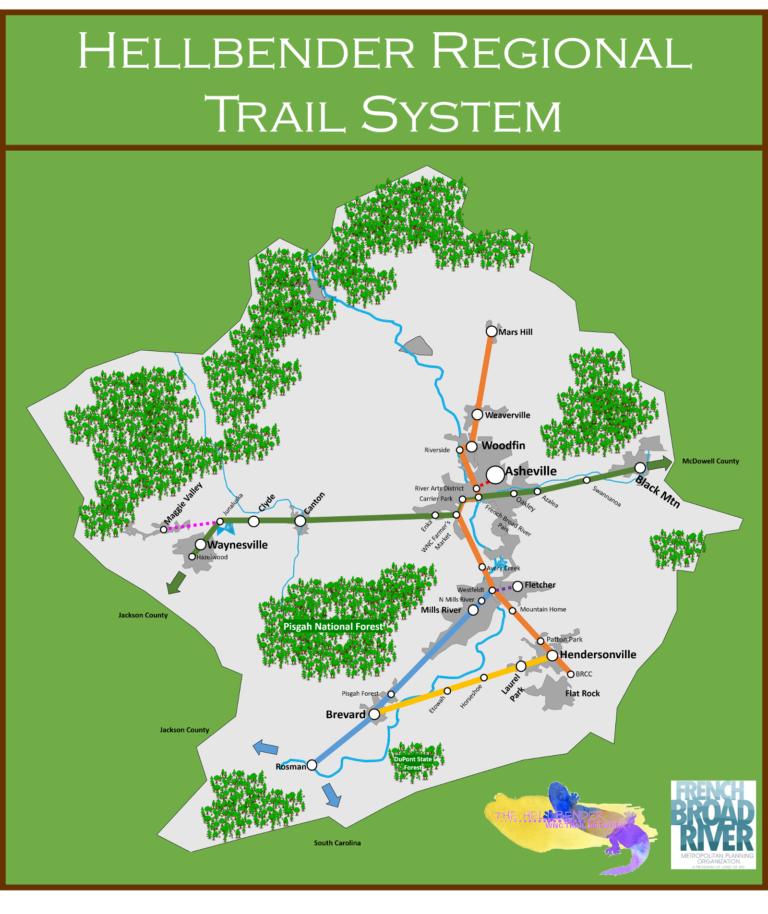
The French Broad River MPO has been working with local governments and community stakeholders in the region over the last year to develop a plan for a regional trail network, the Hellbender Regional trail. This plan connects the various bicycle, pedestrian, and greenway plans developed locally in Buncombe, Haywood, Henderson, Madison, and Transylvania counties to illustrate existing and planned trails that may someday connect to form a regional network for bicycle and pedestrian travel.
Unlike highway and roads, bicycle and pedestrian infrastructure is primarily the responsibility of the various local governments in our region so the Hellbender Regional Trail Plan does not intend to usurp local brands or mandate designs, but intends to make the various sections of planned and existing networks greater than the sum of its parts through increased coordination and partnerships. This plan focuses on regional connections, but does not deprioritize more locally-focused infrastructure. It is primarily focused on multi-use paths (paved trails, greenways, rail-to-trails, sidepaths, etc.) but may include some sections with on-street and other connections where constraints may require exceptions to a typical off-road path. This is also a long-range plan. At more than 150 miles, the full build-out of this network would reflect a nearly ten-fold increase in the miles of multi-use paths in the region- a task that will likely take a considerable amount of time at current funding levels. At this point, organizers are inviting the public to comment on the Draft Hellbender Regional Trail Plan that reflects the work of the work group and stakeholders as well as the countless hours put into developing the local plans in our region on which the Hellbender Regional Trail Plan is based.
The Draft Hellbender Regional Trail Plan is available on the MPO’s website and comments bay be sent in by Friday, August 21st via the google doc form available on the website or by emailing [email protected].
|

|
The grand finale of the 16th Annual Lake Lure Olympiad – a 3-day family sports festival showcases the beautiful scenery of Lake Lure and Chimney Rock. The Race to the Rock is a challenging 5k run or 25-mile bike race that climbs 900 feet in the last 3 miles (a 7-9% grade) to finish at the base of Chimney Rock. The rewarding 75-mile views from the finish line overlooking Lake Lure are enough to take your breath away… or what’s left of it! This is the ONLY TIME you can ever run or bike up the Park road.
Register for this event at lakelureolympiad.com. Spectators get in free if in the Park before 7:30am.

On exhibit Saturdays and Sundays from 12 – 4 p.m. (weather permitting), Rocky Cove Railroad is a G-Scale (garden scale) model train that demonstrates the coming of trains to western North Carolina at the turn of the 20th century. The exhibit is located below the Grand Garden Promenade.
Monday, August
10, 2020
It’s Time to Clean Up the French Broad River
Fairy Trail at Bullington Gardens
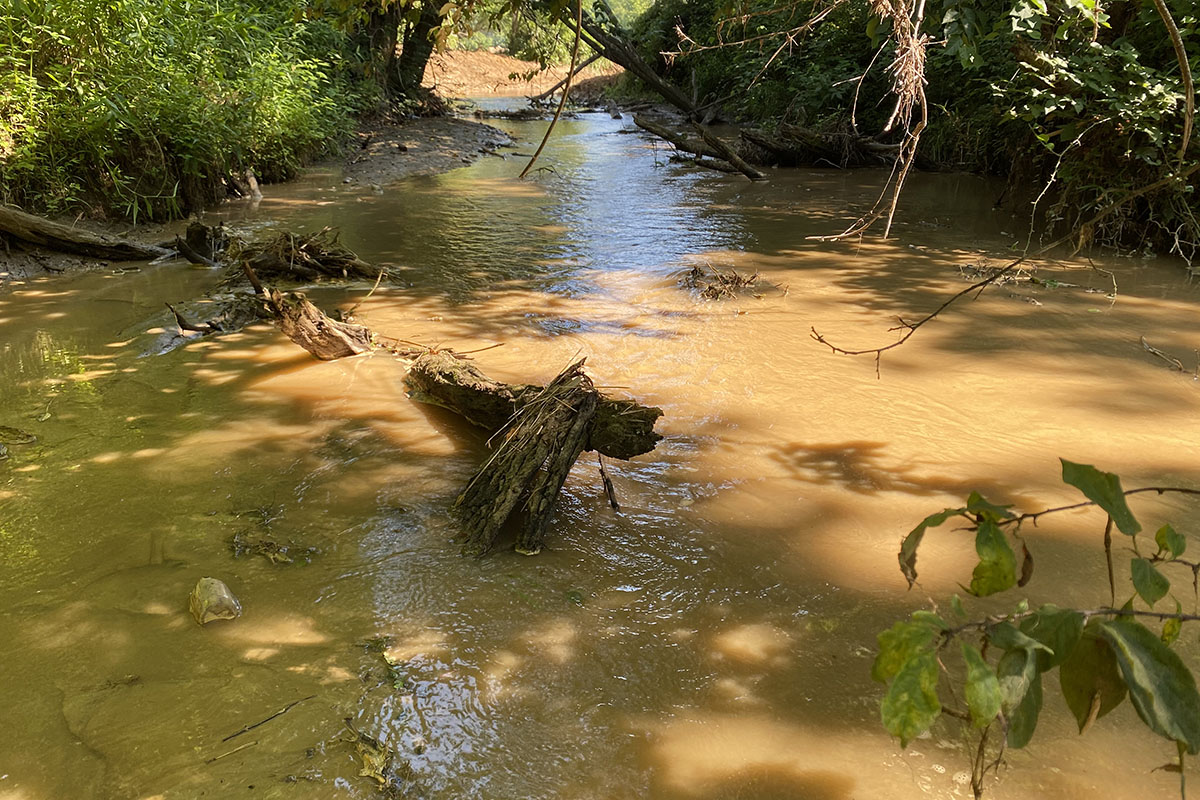
Call on Asheville City Council to do its part to clean up the French Broad River, starting with the establishment of a Stormwater Task Force to address the City’s water pollution problems. Not only does the City have a legal obligation to protect water quality, Council’s commitment to racial equity demands action to protect residents of the Southside neighborhood from the highest pollution levels in the city.
Our river is a public resource, and tens of thousands of people recreate on the French Broad every year. However, none of the testing sites within the City of Asheville pass the EPA’s safe limit on average, and the worst site that we test is Nasty Branch, which drains over half of downtown Asheville and flows through the historically African American Southside neighborhood, before discharging into the French Broad River in the River Arts District.
High levels of E. coli also indicate the presence of other, more harmful microbes, such as Cryptosporidium, Giardia, Shigella, and norovirus. Heavy rains and storms often result in spikes in E. coli contamination, increasing the risk to human health. Contact with or consumption of contaminated water can cause gastrointestinal illness and skin, ear, respiratory, eye, neurologic and wound infections. The most commonly reported symptoms are stomach cramps, diarrhea, nausea, vomiting and low-grade fever.
Asheville City Council has a moral and legal responsibility under the Clean Water Act to protect our river and water quality for all city residents. Henderson County has already established a Stormwater Task Force, Asheville should too.

The Fairy trail is open Monday thru Saturday, 9am-4pm. We encourage all visitors to be patient as there will be limits to the number of people allowed on the trail at the same time. While the trail is outdoors, there are some small spaces and we want to ensure our guests and fairies are safe. Please practice appropriate social distancing and bring a mask in case. Masks are not required, but are considerate in a close area. Our restrooms are not open to the public at this time. Please make arrangements prior to visiting.
Rules of the trail:
Do not move or rearrange fairy displays. The fairies are very fond of their own decorating.
Do not leave trash on the trail. Fairies do not like litter in their town.
Please ensure children and pets are supervised at all times. Dogs and loud noises can scare the fairies into hiding.
Do not disturb wildlife or vegetation. The fairies depend on the vegetation to build their homes.
The trail is one way only. Please stay on the trail at all times.
The Fairies can’t wait to see you all here!
P.S. the Fairies would like us to remind you that we are a non-profit and donations are greatly appreciated. Help us keep the fairies living in the style with which they’ve become accustomed.
Tuesday, August
11, 2020
It’s Time to Clean Up the French Broad River
Fairy Trail at Bullington Gardens
Beginning Gardening + Container Gardening
Deep Dining in Your Garden
Call on Asheville City Council to do its part to clean up the French Broad River, starting with the establishment of a Stormwater Task Force to address the City’s water pollution problems. Not only does the City have a legal obligation to protect water quality, Council’s commitment to racial equity demands action to protect residents of the Southside neighborhood from the highest pollution levels in the city.
Our river is a public resource, and tens of thousands of people recreate on the French Broad every year. However, none of the testing sites within the City of Asheville pass the EPA’s safe limit on average, and the worst site that we test is Nasty Branch, which drains over half of downtown Asheville and flows through the historically African American Southside neighborhood, before discharging into the French Broad River in the River Arts District.
High levels of E. coli also indicate the presence of other, more harmful microbes, such as Cryptosporidium, Giardia, Shigella, and norovirus. Heavy rains and storms often result in spikes in E. coli contamination, increasing the risk to human health. Contact with or consumption of contaminated water can cause gastrointestinal illness and skin, ear, respiratory, eye, neurologic and wound infections. The most commonly reported symptoms are stomach cramps, diarrhea, nausea, vomiting and low-grade fever.
Asheville City Council has a moral and legal responsibility under the Clean Water Act to protect our river and water quality for all city residents. Henderson County has already established a Stormwater Task Force, Asheville should too.
The Fairy trail is open Monday thru Saturday, 9am-4pm. We encourage all visitors to be patient as there will be limits to the number of people allowed on the trail at the same time. While the trail is outdoors, there are some small spaces and we want to ensure our guests and fairies are safe. Please practice appropriate social distancing and bring a mask in case. Masks are not required, but are considerate in a close area. Our restrooms are not open to the public at this time. Please make arrangements prior to visiting.
Rules of the trail:
Do not move or rearrange fairy displays. The fairies are very fond of their own decorating.
Do not leave trash on the trail. Fairies do not like litter in their town.
Please ensure children and pets are supervised at all times. Dogs and loud noises can scare the fairies into hiding.
Do not disturb wildlife or vegetation. The fairies depend on the vegetation to build their homes.
The trail is one way only. Please stay on the trail at all times.
The Fairies can’t wait to see you all here!
P.S. the Fairies would like us to remind you that we are a non-profit and donations are greatly appreciated. Help us keep the fairies living in the style with which they’ve become accustomed.
This workshop will help folks just getting started with home gardening and container gardening. The class will include tips on planning, materials, what to plant and when, pest management , and so much more! Join us for a great beginners workshop and make sure to bring all your questions! Join us on Zoom
What if you truly had to sustain yourself without a lot of purchased food? In this workshop, Patryk Battle will share tips and tricks for eating rather well year-round from food you grow yourself, weeds you might find in your yard, and foraged items from wild spaces near you. Recipes included.
Wednesday, August
12, 2020
It’s Time to Clean Up the French Broad River
Fairy Trail at Bullington Gardens
Animal Enrichment Day Grandfather Mountain

Call on Asheville City Council to do its part to clean up the French Broad River, starting with the establishment of a Stormwater Task Force to address the City’s water pollution problems. Not only does the City have a legal obligation to protect water quality, Council’s commitment to racial equity demands action to protect residents of the Southside neighborhood from the highest pollution levels in the city.
Our river is a public resource, and tens of thousands of people recreate on the French Broad every year. However, none of the testing sites within the City of Asheville pass the EPA’s safe limit on average, and the worst site that we test is Nasty Branch, which drains over half of downtown Asheville and flows through the historically African American Southside neighborhood, before discharging into the French Broad River in the River Arts District.
High levels of E. coli also indicate the presence of other, more harmful microbes, such as Cryptosporidium, Giardia, Shigella, and norovirus. Heavy rains and storms often result in spikes in E. coli contamination, increasing the risk to human health. Contact with or consumption of contaminated water can cause gastrointestinal illness and skin, ear, respiratory, eye, neurologic and wound infections. The most commonly reported symptoms are stomach cramps, diarrhea, nausea, vomiting and low-grade fever.
Asheville City Council has a moral and legal responsibility under the Clean Water Act to protect our river and water quality for all city residents. Henderson County has already established a Stormwater Task Force, Asheville should too.
The Fairy trail is open Monday thru Saturday, 9am-4pm. We encourage all visitors to be patient as there will be limits to the number of people allowed on the trail at the same time. While the trail is outdoors, there are some small spaces and we want to ensure our guests and fairies are safe. Please practice appropriate social distancing and bring a mask in case. Masks are not required, but are considerate in a close area. Our restrooms are not open to the public at this time. Please make arrangements prior to visiting.
Rules of the trail:
Do not move or rearrange fairy displays. The fairies are very fond of their own decorating.
Do not leave trash on the trail. Fairies do not like litter in their town.
Please ensure children and pets are supervised at all times. Dogs and loud noises can scare the fairies into hiding.
Do not disturb wildlife or vegetation. The fairies depend on the vegetation to build their homes.
The trail is one way only. Please stay on the trail at all times.
The Fairies can’t wait to see you all here!
P.S. the Fairies would like us to remind you that we are a non-profit and donations are greatly appreciated. Help us keep the fairies living in the style with which they’ve become accustomed.
Enrichment is an integral part of how the mountain cares for its habitat animals every day. An enrichment is a special treat, new toy or even an unfamiliar scent given to the animals to break up their routines and help keep them active and intellectually stimulated. On Animal Enrichment Day, visitors can watch enrichment demonstrations, talk directly with keepers and participate in family-oriented games and crafts.
Thursday, August
13, 2020
It’s Time to Clean Up the French Broad River
Fairy Trail at Bullington Gardens
NC Arboretum’s “Arbor Evenings”
ArborEvenings
Call on Asheville City Council to do its part to clean up the French Broad River, starting with the establishment of a Stormwater Task Force to address the City’s water pollution problems. Not only does the City have a legal obligation to protect water quality, Council’s commitment to racial equity demands action to protect residents of the Southside neighborhood from the highest pollution levels in the city.
Our river is a public resource, and tens of thousands of people recreate on the French Broad every year. However, none of the testing sites within the City of Asheville pass the EPA’s safe limit on average, and the worst site that we test is Nasty Branch, which drains over half of downtown Asheville and flows through the historically African American Southside neighborhood, before discharging into the French Broad River in the River Arts District.
High levels of E. coli also indicate the presence of other, more harmful microbes, such as Cryptosporidium, Giardia, Shigella, and norovirus. Heavy rains and storms often result in spikes in E. coli contamination, increasing the risk to human health. Contact with or consumption of contaminated water can cause gastrointestinal illness and skin, ear, respiratory, eye, neurologic and wound infections. The most commonly reported symptoms are stomach cramps, diarrhea, nausea, vomiting and low-grade fever.
Asheville City Council has a moral and legal responsibility under the Clean Water Act to protect our river and water quality for all city residents. Henderson County has already established a Stormwater Task Force, Asheville should too.
The Fairy trail is open Monday thru Saturday, 9am-4pm. We encourage all visitors to be patient as there will be limits to the number of people allowed on the trail at the same time. While the trail is outdoors, there are some small spaces and we want to ensure our guests and fairies are safe. Please practice appropriate social distancing and bring a mask in case. Masks are not required, but are considerate in a close area. Our restrooms are not open to the public at this time. Please make arrangements prior to visiting.
Rules of the trail:
Do not move or rearrange fairy displays. The fairies are very fond of their own decorating.
Do not leave trash on the trail. Fairies do not like litter in their town.
Please ensure children and pets are supervised at all times. Dogs and loud noises can scare the fairies into hiding.
Do not disturb wildlife or vegetation. The fairies depend on the vegetation to build their homes.
The trail is one way only. Please stay on the trail at all times.
The Fairies can’t wait to see you all here!
P.S. the Fairies would like us to remind you that we are a non-profit and donations are greatly appreciated. Help us keep the fairies living in the style with which they’ve become accustomed.

Relax and unwind at the Arboretum’s “ArborEvenings” after hours series. Held every Thursday, June – October, from 6 to 9 p.m., visitors will sip and stroll through the Arboretum’s beautiful gardens while enjoying live music amongst flowers and friends. Local beverages, including beer and wine, are available for purchase along with light food options.
Admission to ArborEvenings is free; however, standard parking fees apply to non-members.
The Arboretum’s popular ArborEvenings summer after hours series will return this season with a special LEGO twist. Held every Thursday, Friday and Saturday, July through September, from 8 to 11 …
Friday, August
14, 2020
Farm Beginnings® Farmer-Led Training Program Virtual for 2020-2021
Gardening Video: Sun to Shade—Changing Light Patterns in Your Garden
It’s Time to Clean Up the French Broad River
Notice of Public Comment Period: Hellbender Regional Trail Plan
On line Gardening Resources Buncombe County Extension
Speaking of Gardening Symposium CANCELLED
Many skills are required to start and expand a successful farm business: passion, clear goals, production experience, financial and marketing know-how, and more. Farm Beginnings® will help you build these skills through one year of farmer-led training, mentoring, and networking. Using a holistic management frame, farmer-led classroom sessions, on-farm tours, and an extensive farmer network, Farm Beginnings® will help you clarify your goals and strengths, establish a strong enterprise plan, and start building a profitable and sustainable operation. Although students do not need to own land, some farming or production experience is required to get the most out of the program. As we know, farming is more critical than ever. Apply to this program and be prepared when crisis hits!
Program Details: December 2020 – September 2021
2020-2021 Farm Beginnings® Farmer Training is 200+ Hours including:
— Winter Whole-Farm Business Planning Courses – 60 hours (October – March)**
— ASAP’s Business of Farming Conference (February) – 8 hours
— OGS Conferences – 40+ hours
— Mentorship with an experienced Farmer Mentor (March – September) – 15 hours
— Production Training – 45 hours (April – October): WNC CRAFT tours on sustainable farms around WNC & Field Days with regional partners Living Web Farms and the Southern Appalachian Highlands Conservancy Incubator Farm
— One year WNC CRAFT Farmer Network membership – Membership and mentoring in a regional farmer network
Presenter: Kay Green, Extension Master GardenerSM Volunteer
The amount of sun or shade in your garden will change as the sun moves across the sky during the day and with the seasons. By knowing how much sun the garden gets, you can better plan where your plants will thrive. In this video, Kay shows you how to create a “Sun Map” and a “Sun Chart” to record the sun and shade patterns in your garden. Using these simple tools will help you make better plant selections and reward you with better results.
Video access:
To access these videos on the Buncombe County Master Gardener website, click on the link below:
Sun to Shade—Changing Light Patterns in Your Garden
Or go to www.buncombemastergardener.org, click on the ‘Resources’ tab at the top of the page, and select ‘Gardening Videos’ from the drop down menu.
Call on Asheville City Council to do its part to clean up the French Broad River, starting with the establishment of a Stormwater Task Force to address the City’s water pollution problems. Not only does the City have a legal obligation to protect water quality, Council’s commitment to racial equity demands action to protect residents of the Southside neighborhood from the highest pollution levels in the city.
Our river is a public resource, and tens of thousands of people recreate on the French Broad every year. However, none of the testing sites within the City of Asheville pass the EPA’s safe limit on average, and the worst site that we test is Nasty Branch, which drains over half of downtown Asheville and flows through the historically African American Southside neighborhood, before discharging into the French Broad River in the River Arts District.
High levels of E. coli also indicate the presence of other, more harmful microbes, such as Cryptosporidium, Giardia, Shigella, and norovirus. Heavy rains and storms often result in spikes in E. coli contamination, increasing the risk to human health. Contact with or consumption of contaminated water can cause gastrointestinal illness and skin, ear, respiratory, eye, neurologic and wound infections. The most commonly reported symptoms are stomach cramps, diarrhea, nausea, vomiting and low-grade fever.
Asheville City Council has a moral and legal responsibility under the Clean Water Act to protect our river and water quality for all city residents. Henderson County has already established a Stormwater Task Force, Asheville should too.
The French Broad River MPO has been working with local governments and community stakeholders in the region over the last year to develop a plan for a regional trail network, the Hellbender Regional trail. This plan connects the various bicycle, pedestrian, and greenway plans developed locally in Buncombe, Haywood, Henderson, Madison, and Transylvania counties to illustrate existing and planned trails that may someday connect to form a regional network for bicycle and pedestrian travel.
Unlike highway and roads, bicycle and pedestrian infrastructure is primarily the responsibility of the various local governments in our region so the Hellbender Regional Trail Plan does not intend to usurp local brands or mandate designs, but intends to make the various sections of planned and existing networks greater than the sum of its parts through increased coordination and partnerships. This plan focuses on regional connections, but does not deprioritize more locally-focused infrastructure. It is primarily focused on multi-use paths (paved trails, greenways, rail-to-trails, sidepaths, etc.) but may include some sections with on-street and other connections where constraints may require exceptions to a typical off-road path. This is also a long-range plan. At more than 150 miles, the full build-out of this network would reflect a nearly ten-fold increase in the miles of multi-use paths in the region- a task that will likely take a considerable amount of time at current funding levels. At this point, organizers are inviting the public to comment on the Draft Hellbender Regional Trail Plan that reflects the work of the work group and stakeholders as well as the countless hours put into developing the local plans in our region on which the Hellbender Regional Trail Plan is based.
The Draft Hellbender Regional Trail Plan is available on the MPO’s website and comments bay be sent in by Friday, August 21st via the google doc form available on the website or by emailing [email protected].
|
|
Resources
Gardening advice is easy to find on the web, but much of the information is inaccurate, inappropriate for your area, and may do more harm than good! The links on this page are excellent sources for research-based gardening information. Click here for a few tips to finding useful gardening information for Western North Carolina: Web Research Tips for WNC
The Speaking of Gardening Symposium was first held in 1998. The vision of Hunter Stubbs (1969-2017), then the Director of Horticulture at Richmond Hill Inn, the first events were held at the inn. Stubbs’ vision was simple, and remains our mission today: Provide a two-day lecture style symposium based on sound horticultural principals for industry professionals and gardening enthusiasts.