MATCHES
- A generous, anonymous gift will match all donations up to $5,000.
Ad Blocker Detected
It looks like you're using ad blocking technology. We are a local company, and our advertisers are local as well. Please consider allow listing our website in the future.
Upcoming events and things to do in Asheville, NC. Below is a list of events for festivals, concerts, art exhibitions, group meetups and more.
Interested in adding an event to our calendar? Please click the green “Post Your Event” button below.

Join us and Bingeable Trivia every Wednesday at 7pm for outdoor trivia night!!
-All trivia players must have a seat outside to play. There are a limited amount of tables outside so get here early to claim your seat
-Tables are spread out 6 feet apart for social distancing
-Players will text in their answers instead of turning in sheets
-And masks are required while ordering beers inside
We will have a theme every other week! Trivia is subject to cancellation depending on the weather.


We post each Thursday morning any ripening updates in the orchard. Remember we are an heirloom apple orchard. Our mission is to save the good stuff…including apple varieties. In addition to trees that fruit during the normal late September/October season in greater quantity, also we plant small batch numbers of heirloom apple trees. Some ripen earlier (an unexpected gift); all have their uses from apple sauce, to butters, to juice and ciders, and just fresh eating off the trees. They won’t all be available all the time. But, when they are, we’ll let you know. Please come and see for yourself.



We post each Thursday morning any ripening updates in the orchard. Remember we are an heirloom apple orchard. Our mission is to save the good stuff…including apple varieties. In addition to trees that fruit during the normal late September/October season in greater quantity, also we plant small batch numbers of heirloom apple trees. Some ripen earlier (an unexpected gift); all have their uses from apple sauce, to butters, to juice and ciders, and just fresh eating off the trees. They won’t all be available all the time. But, when they are, we’ll let you know. Please come and see for yourself.

Welcome to Prevent Child Abuse North Carolina’s first-ever 5 Factors (virtual) 5k! Because we cannot safely gather in-person this year, we are expanding our annual, one-day event to AN ENTIRE RACE WEEK (Oct. 24-31), packed with all the family-friendly activities we typically host on race day. That means you get to choose when and where you complete your 5k, AND you will have access to an entire week of fun, virtual activities designed for all ages!
When you register below, you will have access to our race week calendar of activities that will run October 24th through October 31st. We are so excited to feature mini events focused on mental and physical health, education, and family entertainment scheduled at different times throughout the week.
Your VIP Race Week includes:
VIP Race Week is jam-packed with family fun, all for the low price of $35. We may be physically distant, but we are TOGETHER in preventing child abuse and neglect.
Enter to win an ENO Leave No Trace Double Nest hammock and suspension system today! ENO and Explore Brevard are excited to partner in the effort to promote our new Leave It Better campaign. Entering is easy. Simply follow these steps and you’ll be automatically entered into the sweepstakes:
Each month will have multiple winners so stay tuned.
See below for official contest rules and alternate form of entry.


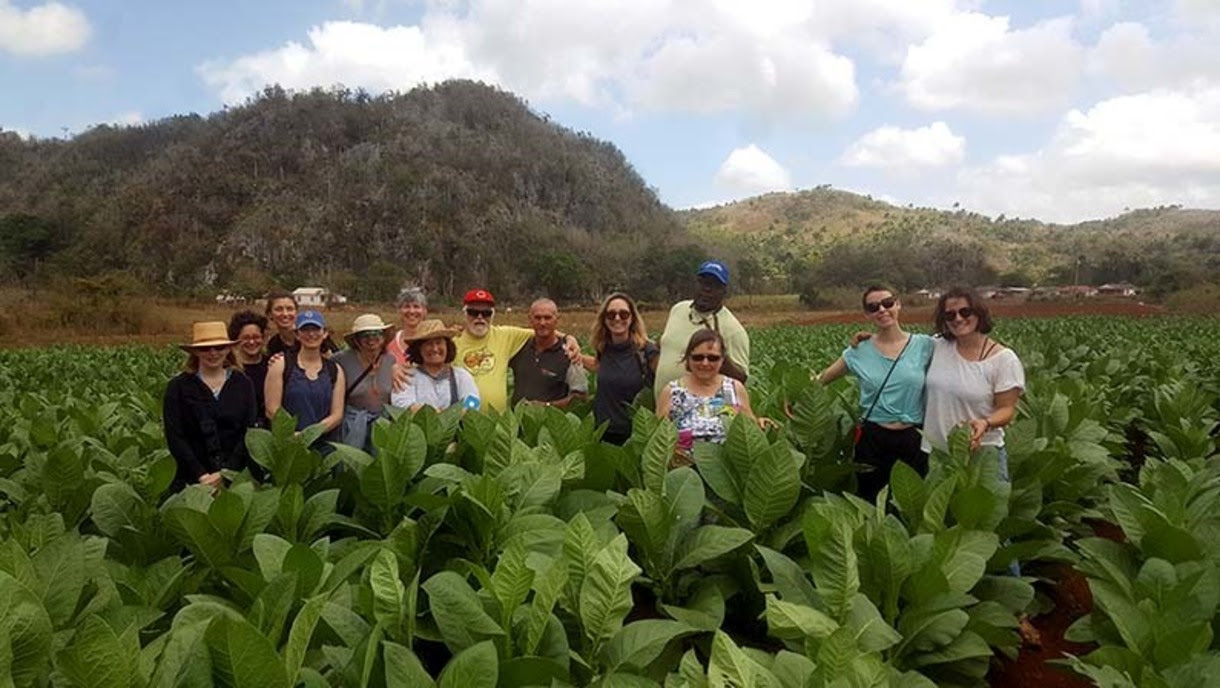
Another Cuba Trip!
We’re excited to announce we have scheduled a second trip to Cuba for June 22nd – July 1, 2021In the case of trip cancellation, a full refund or roll over of funds paid to future trips will be offered to all registered participants. Flexible payment plans are available.


We post each Thursday morning any ripening updates in the orchard. Remember we are an heirloom apple orchard. Our mission is to save the good stuff…including apple varieties. In addition to trees that fruit during the normal late September/October season in greater quantity, also we plant small batch numbers of heirloom apple trees. Some ripen earlier (an unexpected gift); all have their uses from apple sauce, to butters, to juice and ciders, and just fresh eating off the trees. They won’t all be available all the time. But, when they are, we’ll let you know. Please come and see for yourself.


Another Cuba Trip!
We’re excited to announce we have scheduled a second trip to Cuba for June 22nd – July 1, 2021In the case of trip cancellation, a full refund or roll over of funds paid to future trips will be offered to all registered participants. Flexible payment plans are available.

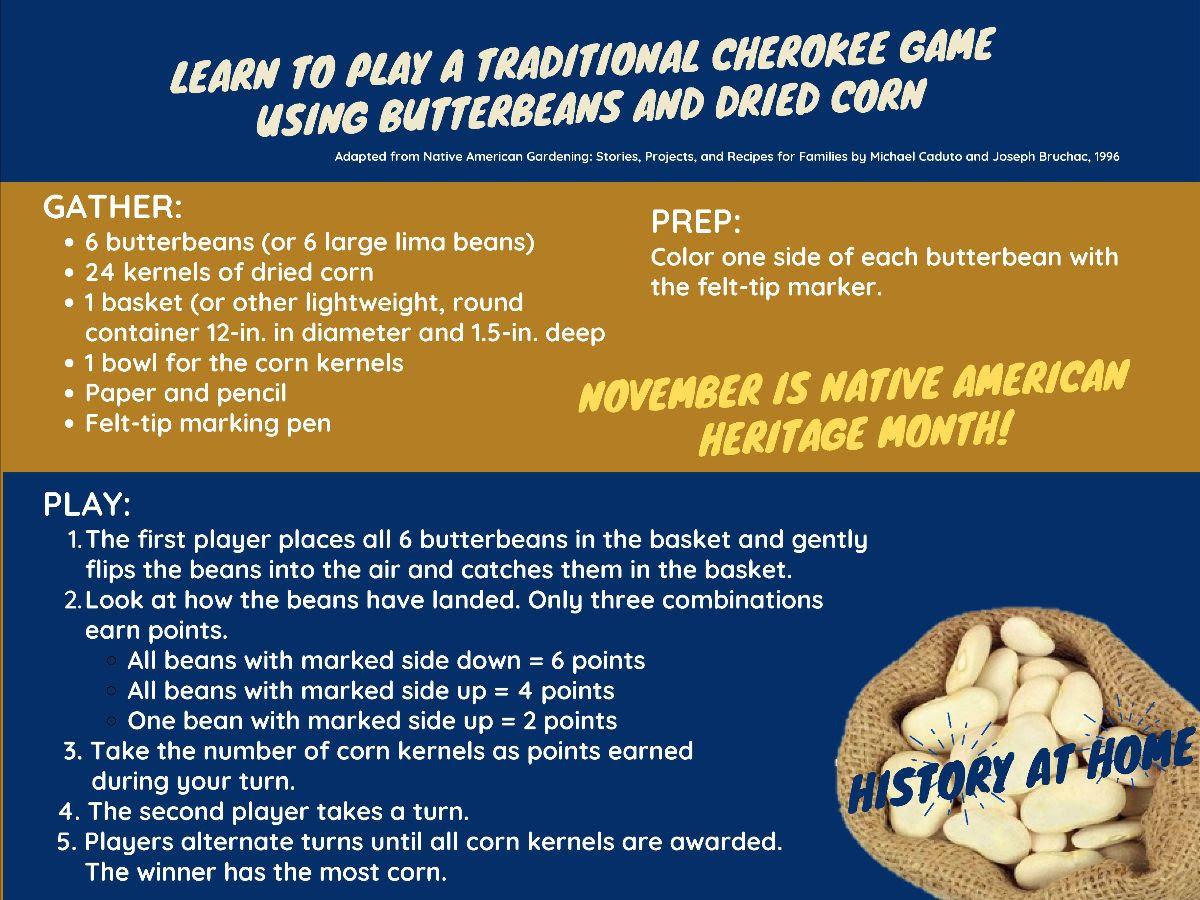
This is a variation on the tradition Cherokee Butterbean Game. It can be played by several individual players or several teams. Traditionally, this game uses three butterbeans that have been split in half. More…
From the Museum of the Cherokee Indian: Cherokee people began growing a form of corn two thousand years ago. By about a thousand years ago, or 1000 AD, they were growing corn and beans, as we know them today. Corn, beans, and squash was always grown together and was known as the “Three Sisters.” Beans restore nitrogen to the soil while corn depletes nitrogen. The vines of the beans and squash twined up the cornstalks. When corn and beans are eaten together, they provide complete proteins and amino acids for our diet.
Corn was so important to the Cherokee that they had important celebrations and ceremonies called “Green Corn Festivals.” The first of these was held in August, before the sweet corn was ready to eat. The last was held in October or November, when the
field corn was ready to be picked. At these ceremonies, people purified themselves physically and spiritually before feasting together. At this time, people got married and divorced. All old scores were settled and everyone started a new year together.

This is a variation on the tradition Cherokee Butterbean Game. It can be played by several individual players or several teams. Traditionally, this game uses three butterbeans that have been split in half. More…
From the Museum of the Cherokee Indian: Cherokee people began growing a form of corn two thousand years ago. By about a thousand years ago, or 1000 AD, they were growing corn and beans, as we know them today. Corn, beans, and squash was always grown together and was known as the “Three Sisters.” Beans restore nitrogen to the soil while corn depletes nitrogen. The vines of the beans and squash twined up the cornstalks. When corn and beans are eaten together, they provide complete proteins and amino acids for our diet.
Corn was so important to the Cherokee that they had important celebrations and ceremonies called “Green Corn Festivals.” The first of these was held in August, before the sweet corn was ready to eat. The last was held in October or November, when the
field corn was ready to be picked. At these ceremonies, people purified themselves physically and spiritually before feasting together. At this time, people got married and divorced. All old scores were settled and everyone started a new year together.

This is a variation on the tradition Cherokee Butterbean Game. It can be played by several individual players or several teams. Traditionally, this game uses three butterbeans that have been split in half. More…
From the Museum of the Cherokee Indian: Cherokee people began growing a form of corn two thousand years ago. By about a thousand years ago, or 1000 AD, they were growing corn and beans, as we know them today. Corn, beans, and squash was always grown together and was known as the “Three Sisters.” Beans restore nitrogen to the soil while corn depletes nitrogen. The vines of the beans and squash twined up the cornstalks. When corn and beans are eaten together, they provide complete proteins and amino acids for our diet.
Corn was so important to the Cherokee that they had important celebrations and ceremonies called “Green Corn Festivals.” The first of these was held in August, before the sweet corn was ready to eat. The last was held in October or November, when the
field corn was ready to be picked. At these ceremonies, people purified themselves physically and spiritually before feasting together. At this time, people got married and divorced. All old scores were settled and everyone started a new year together.

This is a variation on the tradition Cherokee Butterbean Game. It can be played by several individual players or several teams. Traditionally, this game uses three butterbeans that have been split in half. More…
From the Museum of the Cherokee Indian: Cherokee people began growing a form of corn two thousand years ago. By about a thousand years ago, or 1000 AD, they were growing corn and beans, as we know them today. Corn, beans, and squash was always grown together and was known as the “Three Sisters.” Beans restore nitrogen to the soil while corn depletes nitrogen. The vines of the beans and squash twined up the cornstalks. When corn and beans are eaten together, they provide complete proteins and amino acids for our diet.
Corn was so important to the Cherokee that they had important celebrations and ceremonies called “Green Corn Festivals.” The first of these was held in August, before the sweet corn was ready to eat. The last was held in October or November, when the
field corn was ready to be picked. At these ceremonies, people purified themselves physically and spiritually before feasting together. At this time, people got married and divorced. All old scores were settled and everyone started a new year together.

This is a variation on the tradition Cherokee Butterbean Game. It can be played by several individual players or several teams. Traditionally, this game uses three butterbeans that have been split in half. More…
From the Museum of the Cherokee Indian: Cherokee people began growing a form of corn two thousand years ago. By about a thousand years ago, or 1000 AD, they were growing corn and beans, as we know them today. Corn, beans, and squash was always grown together and was known as the “Three Sisters.” Beans restore nitrogen to the soil while corn depletes nitrogen. The vines of the beans and squash twined up the cornstalks. When corn and beans are eaten together, they provide complete proteins and amino acids for our diet.
Corn was so important to the Cherokee that they had important celebrations and ceremonies called “Green Corn Festivals.” The first of these was held in August, before the sweet corn was ready to eat. The last was held in October or November, when the
field corn was ready to be picked. At these ceremonies, people purified themselves physically and spiritually before feasting together. At this time, people got married and divorced. All old scores were settled and everyone started a new year together.


Another Cuba Trip!
We’re excited to announce we have scheduled a second trip to Cuba for June 22nd – July 1, 2021In the case of trip cancellation, a full refund or roll over of funds paid to future trips will be offered to all registered participants. Flexible payment plans are available.

This is a variation on the tradition Cherokee Butterbean Game. It can be played by several individual players or several teams. Traditionally, this game uses three butterbeans that have been split in half. More…
From the Museum of the Cherokee Indian: Cherokee people began growing a form of corn two thousand years ago. By about a thousand years ago, or 1000 AD, they were growing corn and beans, as we know them today. Corn, beans, and squash was always grown together and was known as the “Three Sisters.” Beans restore nitrogen to the soil while corn depletes nitrogen. The vines of the beans and squash twined up the cornstalks. When corn and beans are eaten together, they provide complete proteins and amino acids for our diet.
Corn was so important to the Cherokee that they had important celebrations and ceremonies called “Green Corn Festivals.” The first of these was held in August, before the sweet corn was ready to eat. The last was held in October or November, when the
field corn was ready to be picked. At these ceremonies, people purified themselves physically and spiritually before feasting together. At this time, people got married and divorced. All old scores were settled and everyone started a new year together.


Another Cuba Trip!
We’re excited to announce we have scheduled a second trip to Cuba for June 22nd – July 1, 2021In the case of trip cancellation, a full refund or roll over of funds paid to future trips will be offered to all registered participants. Flexible payment plans are available.

Is it time to give your winter wardrobe an upgrade? Do you have more winter clothing than you want or need? Are some of your winter clothes too small or too big? If you answered yes to any of these questions, consider donating your extra or unwanted winter clothing items to the Stay Warm Winter Clothing Drive hosted by Buncombe County Health and Human Services in partnership with Sunrise Community for Recovery and Wellness.
Donations will be accepted Nov. 1-30, Monday-Friday from noon-4 p.m. in our Syringe Service Program (Disease Control) located at 40 Coxe Ave. We will accept gently used donations of the following items:
For your safety and ours, we are offering no contact donation drop off. We have donation bins located at The Syringe Service Program (Disease Control). Donations will be collected daily by our Harm Reduction Coordinator, cleaned, and prepared to be distributed to clients in need of warm clothing this winter.

Is it time to give your winter wardrobe an upgrade? Do you have more winter clothing than you want or need? Are some of your winter clothes too small or too big? If you answered yes to any of these questions, consider donating your extra or unwanted winter clothing items to the Stay Warm Winter Clothing Drive hosted by Buncombe County Health and Human Services in partnership with Sunrise Community for Recovery and Wellness.
Donations will be accepted Nov. 1-30, Monday-Friday from noon-4 p.m. in our Syringe Service Program (Disease Control) located at 40 Coxe Ave. We will accept gently used donations of the following items:
For your safety and ours, we are offering no contact donation drop off. We have donation bins located at The Syringe Service Program (Disease Control). Donations will be collected daily by our Harm Reduction Coordinator, cleaned, and prepared to be distributed to clients in need of warm clothing this winter.

Is it time to give your winter wardrobe an upgrade? Do you have more winter clothing than you want or need? Are some of your winter clothes too small or too big? If you answered yes to any of these questions, consider donating your extra or unwanted winter clothing items to the Stay Warm Winter Clothing Drive hosted by Buncombe County Health and Human Services in partnership with Sunrise Community for Recovery and Wellness.
Donations will be accepted Nov. 1-30, Monday-Friday from noon-4 p.m. in our Syringe Service Program (Disease Control) located at 40 Coxe Ave. We will accept gently used donations of the following items:
For your safety and ours, we are offering no contact donation drop off. We have donation bins located at The Syringe Service Program (Disease Control). Donations will be collected daily by our Harm Reduction Coordinator, cleaned, and prepared to be distributed to clients in need of warm clothing this winter.

Is it time to give your winter wardrobe an upgrade? Do you have more winter clothing than you want or need? Are some of your winter clothes too small or too big? If you answered yes to any of these questions, consider donating your extra or unwanted winter clothing items to the Stay Warm Winter Clothing Drive hosted by Buncombe County Health and Human Services in partnership with Sunrise Community for Recovery and Wellness.
Donations will be accepted Nov. 1-30, Monday-Friday from noon-4 p.m. in our Syringe Service Program (Disease Control) located at 40 Coxe Ave. We will accept gently used donations of the following items:
For your safety and ours, we are offering no contact donation drop off. We have donation bins located at The Syringe Service Program (Disease Control). Donations will be collected daily by our Harm Reduction Coordinator, cleaned, and prepared to be distributed to clients in need of warm clothing this winter.

This is a variation on the tradition Cherokee Butterbean Game. It can be played by several individual players or several teams. Traditionally, this game uses three butterbeans that have been split in half. More…
From the Museum of the Cherokee Indian: Cherokee people began growing a form of corn two thousand years ago. By about a thousand years ago, or 1000 AD, they were growing corn and beans, as we know them today. Corn, beans, and squash was always grown together and was known as the “Three Sisters.” Beans restore nitrogen to the soil while corn depletes nitrogen. The vines of the beans and squash twined up the cornstalks. When corn and beans are eaten together, they provide complete proteins and amino acids for our diet.
Corn was so important to the Cherokee that they had important celebrations and ceremonies called “Green Corn Festivals.” The first of these was held in August, before the sweet corn was ready to eat. The last was held in October or November, when the
field corn was ready to be picked. At these ceremonies, people purified themselves physically and spiritually before feasting together. At this time, people got married and divorced. All old scores were settled and everyone started a new year together.

Is it time to give your winter wardrobe an upgrade? Do you have more winter clothing than you want or need? Are some of your winter clothes too small or too big? If you answered yes to any of these questions, consider donating your extra or unwanted winter clothing items to the Stay Warm Winter Clothing Drive hosted by Buncombe County Health and Human Services in partnership with Sunrise Community for Recovery and Wellness.
Donations will be accepted Nov. 1-30, Monday-Friday from noon-4 p.m. in our Syringe Service Program (Disease Control) located at 40 Coxe Ave. We will accept gently used donations of the following items:
For your safety and ours, we are offering no contact donation drop off. We have donation bins located at The Syringe Service Program (Disease Control). Donations will be collected daily by our Harm Reduction Coordinator, cleaned, and prepared to be distributed to clients in need of warm clothing this winter.

|

This is a variation on the tradition Cherokee Butterbean Game. It can be played by several individual players or several teams. Traditionally, this game uses three butterbeans that have been split in half. More…
From the Museum of the Cherokee Indian: Cherokee people began growing a form of corn two thousand years ago. By about a thousand years ago, or 1000 AD, they were growing corn and beans, as we know them today. Corn, beans, and squash was always grown together and was known as the “Three Sisters.” Beans restore nitrogen to the soil while corn depletes nitrogen. The vines of the beans and squash twined up the cornstalks. When corn and beans are eaten together, they provide complete proteins and amino acids for our diet.
Corn was so important to the Cherokee that they had important celebrations and ceremonies called “Green Corn Festivals.” The first of these was held in August, before the sweet corn was ready to eat. The last was held in October or November, when the
field corn was ready to be picked. At these ceremonies, people purified themselves physically and spiritually before feasting together. At this time, people got married and divorced. All old scores were settled and everyone started a new year together.


Another Cuba Trip!
We’re excited to announce we have scheduled a second trip to Cuba for June 22nd – July 1, 2021In the case of trip cancellation, a full refund or roll over of funds paid to future trips will be offered to all registered participants. Flexible payment plans are available.

|