It looks like you're using ad blocking technology. We are a local company, and our advertisers are local as well. Please consider allow listing our website in the future.
Our market is a seasonal Saturday morning community event featuring organic and sustainably grown produce, plants, cut flowers, herbs, locally raised meats, seafood, breads, pastries, cheeses, eggs and local arts and handcrafted items. A family event every Saturday from May through November.
Did you know that data shows having active male role models in the life of children can breakdown stereotypical gender biases and lead to higher gender equality and empowerment? With that in mind, Buncombe County public libraries is excited to introduce our new Saturday morning story time series, Reading MENtors. This reading initiative encourages men from our local community to celebrate that men love to read. “According to the US Bureau of Labor Statistics, less than 3% of early childhood educators, including preschool teachers and librarians, are men,” says Enka-Candler Library Branch Manager Erin Parcels. “That means that we have entire generations of children who grew up without a clear idea of what positive male educators are. To see strong literacy practices in children, adults need to model such behavior, which is why we are inviting men with different professions from the local community to share good reading habits to children.”
To help bolster the number of male reading role models, the Enka-Candler Library is inviting men with different professions from all over Buncombe County to share their joy of reading with young patrons. Data shows that having active male role models in children’s lives can break down stereotypical gender biases and lead to higher gender equality and empowerment. Additionally, teaching and modeling reading at an early age vitally important for brain development. “In the first few years of life, more than one million new neural connections are formed every second. Ninety percent of the brain develops by the age of five,” exclaims Librarian Kate Sprate, “Reading plays a pivotal role in setting children up for future social, emotional, and educational success because literacy helps build language, phonological awareness, and comprehension skills.”
This program is open to children of all ages and gender identities. We believe that positive literacy role models are for everyone! Story time will be every other Saturday beginning May 4 at 10:30 a.m., please join us for a story time followed by fun activities! See below for more MENtor story times.
Interested in being a MENtor?
If you know of someone in our community who would be a great Reading MENtor, let us know! Volunteers will read a book and be accompanied by Youth Services Librarian Kate Spratt, who will host a follow-up activity in line with the theme of the story or the person’s career. We love to collaborate, so ideas from volunteers and full participation are welcome. We are looking for volunteers who enjoy reading and sharing the love of reading, are patient, positive, and joyful. To submit a reading MENtor nomination, email [email protected].
Upcoming MENtor story time and acitivity schedule – all story times are at 10:30 a.m.
May 4: Read & Play!
Jason Hyatt, Director of Buncombe County Public Libraries
Play-Doh Club preview
Free book prize
May 18: Music & Movement
Mike Martinez, LEAF Global Arts #SparktheArtsNC Artist-in-residence, Announcer at Blue Ridge Public Radio, Artist Mentor for StoryCraft
Musical instrument petting zoo, Build your own instrument, songwriting station
June 1: GOAL!
Gregg Munn, Director and Head Coach of Mars Hill University Men’s Soccer Team & players
Soccer obstacle course/warm-up stations
June 15: TBD
June 29: TBD
July 20: Building communities
David McNair, Rector at St. James Episcopal Church
LEGO free-build and giant foam block building
Aug. 3: Fun and games
Mac Stanley and Matt Dixon, Buncombe County Parks & Recreation
ASAP’s Local Food Guide, the annual free publication for finding local food and farms, is updated for the 2024–25 season. This definitive resource lists hundreds of Appalachian GrownTM certified farms, farmers markets, restaurants, groceries, artisan producers, and more throughout Western North Carolina and surrounding counties in Virginia, Tennessee, Georgia, and South Carolina. A digital version of the print Guide may be viewed at asapconnections.org/guide.
In addition to listing content, the 2024–25 edition features stories that highlight the variety of farming across the region. Delia Jovel Dubón of Tierra Fértil Coop (pictured on the cover) talks about creating a sense of belonging for the Hispanic immigrant community in Henderson County. Lyric and Noah East of Wild East Farm in McDowell County detail the journey through their first full year of farming and how they’ve arrived at “a rough draft that’s working.” Kaci Nidiffer of The Liar’s Table in Avery County shares how scaling up and opening several retail spaces have created stronger connections with customers and community. Rounding out the issue are recipes from farmers at Two Trees Farm (Sustainabillies), Lee’s One Fortune Farm, Two Stones Farm + Mill, Carringer Farms, and Terra Lingua Growers.
“The Local Food Guide is such a beautiful way to share the stories of this place,” said Sarah Hart, ASAP’s Communications and Engagement Director. “To emphasize that sense of place, listings in this year’s Guide are organized into nine subregions with a short intro on what makes local farms in each area unique.”
Look for the Guide at farmers markets, visitors centers, libraries, groceries, restaurants, and other partner businesses throughout the region. Copies of the Guide are also available to pick up in the lobby of ASAP’s office in Asheville at 306 W. Haywood St., Tuesday to Thursday, 9 a.m. to 5 p.m. Contact ASAP if you need help locating a copy in your area or if you are interested in distributing Guides at your business.
In addition to the print Guide, ASAP maintains the online Local Food Guide at appalachiangrown.org. This database, with more than 1,400 listings, is updated throughout the year and is searchable by products, location, activities, and more.
Funding for the Local Food Guide was made possible in part by the U.S. Department of Agriculture (USDA) through the Agricultural Marketing Service, National Institute of Food and Agriculture’s Beginning Farmer Rancher Development Program, Gus Schumacher Nutrition Incentive Program, and Southern Sustainable Agriculture Research and Education program. Support was also provided by Dogwood Health Trust, the Community Foundation of Western North Carolina, and Asheville Regional Airport.
Dolly Parton’s Imagination Library Free Books for Children ages 0-5
May 19 all-day
online w/ Literacy Together
Dolly Parton’s Imagination Library impacts the pre-literacy skills and school readiness of children under the age of 5 in Buncombe County. The program mails a new, free, age-appropriate book to registered children each month until they turn five years old. Dolly Parton’s Imagination Library creates a home library of up to 60 books and instills a love of books and reading from an early age. If you have any questions about the program, please send an email to [email protected].
A national panel of educators selects the Imagination Library titles, which include: The Little Engine that Could, Last Stop on Market Street, Violet the Pilot, As an Oak Tree Grows, The Tale of Peter Rabbit, Llama Llama Red Pajama, Look Out Kindergarten, here I come, and many more (take a look at all the titles).
Literacy Together became a Dolly Parton’s Imagination Library affiliate in November 2015 with support from the BuncombePartnership for Children. Through this program, registered children in Buncombe County receive a free book in the mail each month. Their parents also have the opportunity to attend workshops to learn how to build their children’s early literacy skills. Parents in need of literacy assistance are encouraged to receive tutoring through Literacy Together’s adult programming.
The program served 200 children during the 2015/16 fiscal year. The program expanded to serve 400 children in July 2016, and 600 in August 2017. In July 2018, capacity increased to 1,900 thanks to a special allocation in the North Carolina state budget. We’re now serving 4,600 kids in Buncombe County.
Southside Community Farmers Market
May 19 @ 12:00 pm – 3:00 pm
Southside Community Farmers Market
About Southside Community Farmers Market
Buncombe County will continue to offer ASAP’s Double SNAP for Fruits and Vegetables and Farm Fresh Produce Prescription.
Southside Community Farm hosts a farmers market featuring all BIPOC (Black, Indigenous, and people of color) vendors on the first Sunday of every month, May-Oct. from 12-3 PM. The market is EBT accessible. Come enjoy delicious patties, hot sauces, veggies, fruit, flowers, medicines, crafts and more!
ASAP’s Local Food Guide, the annual free publication for finding local food and farms, is updated for the 2024–25 season. This definitive resource lists hundreds of Appalachian GrownTM certified farms, farmers markets, restaurants, groceries, artisan producers, and more throughout Western North Carolina and surrounding counties in Virginia, Tennessee, Georgia, and South Carolina. A digital version of the print Guide may be viewed at asapconnections.org/guide.
In addition to listing content, the 2024–25 edition features stories that highlight the variety of farming across the region. Delia Jovel Dubón of Tierra Fértil Coop (pictured on the cover) talks about creating a sense of belonging for the Hispanic immigrant community in Henderson County. Lyric and Noah East of Wild East Farm in McDowell County detail the journey through their first full year of farming and how they’ve arrived at “a rough draft that’s working.” Kaci Nidiffer of The Liar’s Table in Avery County shares how scaling up and opening several retail spaces have created stronger connections with customers and community. Rounding out the issue are recipes from farmers at Two Trees Farm (Sustainabillies), Lee’s One Fortune Farm, Two Stones Farm + Mill, Carringer Farms, and Terra Lingua Growers.
“The Local Food Guide is such a beautiful way to share the stories of this place,” said Sarah Hart, ASAP’s Communications and Engagement Director. “To emphasize that sense of place, listings in this year’s Guide are organized into nine subregions with a short intro on what makes local farms in each area unique.”
Look for the Guide at farmers markets, visitors centers, libraries, groceries, restaurants, and other partner businesses throughout the region. Copies of the Guide are also available to pick up in the lobby of ASAP’s office in Asheville at 306 W. Haywood St., Tuesday to Thursday, 9 a.m. to 5 p.m. Contact ASAP if you need help locating a copy in your area or if you are interested in distributing Guides at your business.
In addition to the print Guide, ASAP maintains the online Local Food Guide at appalachiangrown.org. This database, with more than 1,400 listings, is updated throughout the year and is searchable by products, location, activities, and more.
Funding for the Local Food Guide was made possible in part by the U.S. Department of Agriculture (USDA) through the Agricultural Marketing Service, National Institute of Food and Agriculture’s Beginning Farmer Rancher Development Program, Gus Schumacher Nutrition Incentive Program, and Southern Sustainable Agriculture Research and Education program. Support was also provided by Dogwood Health Trust, the Community Foundation of Western North Carolina, and Asheville Regional Airport.
ASAP’s Local Food Guide, the annual free publication for finding local food and farms, is updated for the 2024–25 season. This definitive resource lists hundreds of Appalachian GrownTM certified farms, farmers markets, restaurants, groceries, artisan producers, and more throughout Western North Carolina and surrounding counties in Virginia, Tennessee, Georgia, and South Carolina. A digital version of the print Guide may be viewed at asapconnections.org/guide.
In addition to listing content, the 2024–25 edition features stories that highlight the variety of farming across the region. Delia Jovel Dubón of Tierra Fértil Coop (pictured on the cover) talks about creating a sense of belonging for the Hispanic immigrant community in Henderson County. Lyric and Noah East of Wild East Farm in McDowell County detail the journey through their first full year of farming and how they’ve arrived at “a rough draft that’s working.” Kaci Nidiffer of The Liar’s Table in Avery County shares how scaling up and opening several retail spaces have created stronger connections with customers and community. Rounding out the issue are recipes from farmers at Two Trees Farm (Sustainabillies), Lee’s One Fortune Farm, Two Stones Farm + Mill, Carringer Farms, and Terra Lingua Growers.
“The Local Food Guide is such a beautiful way to share the stories of this place,” said Sarah Hart, ASAP’s Communications and Engagement Director. “To emphasize that sense of place, listings in this year’s Guide are organized into nine subregions with a short intro on what makes local farms in each area unique.”
Look for the Guide at farmers markets, visitors centers, libraries, groceries, restaurants, and other partner businesses throughout the region. Copies of the Guide are also available to pick up in the lobby of ASAP’s office in Asheville at 306 W. Haywood St., Tuesday to Thursday, 9 a.m. to 5 p.m. Contact ASAP if you need help locating a copy in your area or if you are interested in distributing Guides at your business.
In addition to the print Guide, ASAP maintains the online Local Food Guide at appalachiangrown.org. This database, with more than 1,400 listings, is updated throughout the year and is searchable by products, location, activities, and more.
Funding for the Local Food Guide was made possible in part by the U.S. Department of Agriculture (USDA) through the Agricultural Marketing Service, National Institute of Food and Agriculture’s Beginning Farmer Rancher Development Program, Gus Schumacher Nutrition Incentive Program, and Southern Sustainable Agriculture Research and Education program. Support was also provided by Dogwood Health Trust, the Community Foundation of Western North Carolina, and Asheville Regional Airport.
Online Book Club from the Library: Bookmarked
May 21 @ 7:00 pm
online
Buncombe County has an online book club called Bookmarked that meets on Zoom on the third Tuesday of each month, September through May, at 7 p.m.
Each month Bookmarked will read a title of popular fiction selected by the club. The online book discussion is hosted by one of our librarians. Copies of the selected books are available at the Fairview Library and you can request any of the books to be sent to your favorite library for pickup. Most selections can be downloaded as an eBook or audiobook from the North Carolina Digital Library. No need to leave your house on a cold winter day – you can share books with other interested readers in your pajamas from your own couch. Read along with us to discover new titles you may not have bookmarked on your own.
You can join Bookmarked any time by emailing prior to any meeting. This book club (and all library events) are listed on the library calendar.
Upcoming Bookmarked Selections
Jan. 16 – Ducks: Two Years in the Oil Sands by Kate Beaton
Feb. 20 – People of the Book by Geraldine Brooks
March 19 – The Song of Achilles by Madeline Miller
April 16 – The Violin Conspiracy by Brendan Slocumb
May 21 – We Measure the Earth With Our Bodies by Tsering Yangzoma Lama
Interested in other library book clubs? Join us at Pack Library on Tuesday, Jan. 30 at 6 p.m. for our annual Book Club Fair. This program will feature short presentations from representatives from a dozen local book clubs and some time to chat. Find the book club that best fits your interests and schedule.
ASAP’s Local Food Guide, the annual free publication for finding local food and farms, is updated for the 2024–25 season. This definitive resource lists hundreds of Appalachian GrownTM certified farms, farmers markets, restaurants, groceries, artisan producers, and more throughout Western North Carolina and surrounding counties in Virginia, Tennessee, Georgia, and South Carolina. A digital version of the print Guide may be viewed at asapconnections.org/guide.
In addition to listing content, the 2024–25 edition features stories that highlight the variety of farming across the region. Delia Jovel Dubón of Tierra Fértil Coop (pictured on the cover) talks about creating a sense of belonging for the Hispanic immigrant community in Henderson County. Lyric and Noah East of Wild East Farm in McDowell County detail the journey through their first full year of farming and how they’ve arrived at “a rough draft that’s working.” Kaci Nidiffer of The Liar’s Table in Avery County shares how scaling up and opening several retail spaces have created stronger connections with customers and community. Rounding out the issue are recipes from farmers at Two Trees Farm (Sustainabillies), Lee’s One Fortune Farm, Two Stones Farm + Mill, Carringer Farms, and Terra Lingua Growers.
“The Local Food Guide is such a beautiful way to share the stories of this place,” said Sarah Hart, ASAP’s Communications and Engagement Director. “To emphasize that sense of place, listings in this year’s Guide are organized into nine subregions with a short intro on what makes local farms in each area unique.”
Look for the Guide at farmers markets, visitors centers, libraries, groceries, restaurants, and other partner businesses throughout the region. Copies of the Guide are also available to pick up in the lobby of ASAP’s office in Asheville at 306 W. Haywood St., Tuesday to Thursday, 9 a.m. to 5 p.m. Contact ASAP if you need help locating a copy in your area or if you are interested in distributing Guides at your business.
In addition to the print Guide, ASAP maintains the online Local Food Guide at appalachiangrown.org. This database, with more than 1,400 listings, is updated throughout the year and is searchable by products, location, activities, and more.
Funding for the Local Food Guide was made possible in part by the U.S. Department of Agriculture (USDA) through the Agricultural Marketing Service, National Institute of Food and Agriculture’s Beginning Farmer Rancher Development Program, Gus Schumacher Nutrition Incentive Program, and Southern Sustainable Agriculture Research and Education program. Support was also provided by Dogwood Health Trust, the Community Foundation of Western North Carolina, and Asheville Regional Airport.
Etowah Lions Club Farmers Market
May 22 @ 3:00 pm – 6:00 pm
Etowah Lions Club Farmers Market
Etowah Lions Club Farmers Market, 3-6pm, On Wednesdays through October, check out the Etowah Lions Club Farmers Market,
which showcases local farmers, vendors and artisans and the delicious produce the area is known for, all items sold here are
made by or grown by the vendor
River Arts District Farmers Market
May 22 @ 3:00 pm – 6:00 pm
River Arts District Farmers Market
Located in the River Arts District, and surrounded by art galleries and breweries, come find out about Asheville’s favourite mid-week market!
Buncombe County will continue to offer ASAP’s Double SNAP for Fruits and Vegetables and Farm Fresh Produce Prescription.
ASAP’s Local Food Guide, the annual free publication for finding local food and farms, is updated for the 2024–25 season. This definitive resource lists hundreds of Appalachian GrownTM certified farms, farmers markets, restaurants, groceries, artisan producers, and more throughout Western North Carolina and surrounding counties in Virginia, Tennessee, Georgia, and South Carolina. A digital version of the print Guide may be viewed at asapconnections.org/guide.
In addition to listing content, the 2024–25 edition features stories that highlight the variety of farming across the region. Delia Jovel Dubón of Tierra Fértil Coop (pictured on the cover) talks about creating a sense of belonging for the Hispanic immigrant community in Henderson County. Lyric and Noah East of Wild East Farm in McDowell County detail the journey through their first full year of farming and how they’ve arrived at “a rough draft that’s working.” Kaci Nidiffer of The Liar’s Table in Avery County shares how scaling up and opening several retail spaces have created stronger connections with customers and community. Rounding out the issue are recipes from farmers at Two Trees Farm (Sustainabillies), Lee’s One Fortune Farm, Two Stones Farm + Mill, Carringer Farms, and Terra Lingua Growers.
“The Local Food Guide is such a beautiful way to share the stories of this place,” said Sarah Hart, ASAP’s Communications and Engagement Director. “To emphasize that sense of place, listings in this year’s Guide are organized into nine subregions with a short intro on what makes local farms in each area unique.”
Look for the Guide at farmers markets, visitors centers, libraries, groceries, restaurants, and other partner businesses throughout the region. Copies of the Guide are also available to pick up in the lobby of ASAP’s office in Asheville at 306 W. Haywood St., Tuesday to Thursday, 9 a.m. to 5 p.m. Contact ASAP if you need help locating a copy in your area or if you are interested in distributing Guides at your business.
In addition to the print Guide, ASAP maintains the online Local Food Guide at appalachiangrown.org. This database, with more than 1,400 listings, is updated throughout the year and is searchable by products, location, activities, and more.
Funding for the Local Food Guide was made possible in part by the U.S. Department of Agriculture (USDA) through the Agricultural Marketing Service, National Institute of Food and Agriculture’s Beginning Farmer Rancher Development Program, Gus Schumacher Nutrition Incentive Program, and Southern Sustainable Agriculture Research and Education program. Support was also provided by Dogwood Health Trust, the Community Foundation of Western North Carolina, and Asheville Regional Airport.
Flat Rock Farmers Market
May 23 @ 3:00 pm – 6:00 pm
Pinecrest Presbyterian Church
Bringing Local Farm Fresh Food to your Table
Opening Day- 5/4/23
Join us on Thursdays from 3-6 pm through October
Celebrating over 15 years of bringing fresh, local produce and handcrafted goods to the community of Flat Rock NC.
Join us every Thursday, May – October at our location at Pinecrest Presbyterian Church at the corner of Upward Rd and Greenville Hwy.
Enka-Candler Farmer’s Market
May 23 @ 3:30 pm – 6:30 pm
Enka-Candler Farmer’s Market
Buncombe County farmers markets are opening throughout April and May—or, for year-round markets, shifting back to regular season hours. Spring markets offer an array of produce as well as meat, cheese, eggs, bread, prepared foods, and a wide selection of plant starts.
Nine markets in Buncombe County will continue to offer ASAP’s Double SNAP for Fruits and Vegetables and Farm Fresh Produce Prescription.
ASAP’s Local Food Guide, the annual free publication for finding local food and farms, is updated for the 2024–25 season. This definitive resource lists hundreds of Appalachian GrownTM certified farms, farmers markets, restaurants, groceries, artisan producers, and more throughout Western North Carolina and surrounding counties in Virginia, Tennessee, Georgia, and South Carolina. A digital version of the print Guide may be viewed at asapconnections.org/guide.
In addition to listing content, the 2024–25 edition features stories that highlight the variety of farming across the region. Delia Jovel Dubón of Tierra Fértil Coop (pictured on the cover) talks about creating a sense of belonging for the Hispanic immigrant community in Henderson County. Lyric and Noah East of Wild East Farm in McDowell County detail the journey through their first full year of farming and how they’ve arrived at “a rough draft that’s working.” Kaci Nidiffer of The Liar’s Table in Avery County shares how scaling up and opening several retail spaces have created stronger connections with customers and community. Rounding out the issue are recipes from farmers at Two Trees Farm (Sustainabillies), Lee’s One Fortune Farm, Two Stones Farm + Mill, Carringer Farms, and Terra Lingua Growers.
“The Local Food Guide is such a beautiful way to share the stories of this place,” said Sarah Hart, ASAP’s Communications and Engagement Director. “To emphasize that sense of place, listings in this year’s Guide are organized into nine subregions with a short intro on what makes local farms in each area unique.”
Look for the Guide at farmers markets, visitors centers, libraries, groceries, restaurants, and other partner businesses throughout the region. Copies of the Guide are also available to pick up in the lobby of ASAP’s office in Asheville at 306 W. Haywood St., Tuesday to Thursday, 9 a.m. to 5 p.m. Contact ASAP if you need help locating a copy in your area or if you are interested in distributing Guides at your business.
In addition to the print Guide, ASAP maintains the online Local Food Guide at appalachiangrown.org. This database, with more than 1,400 listings, is updated throughout the year and is searchable by products, location, activities, and more.
Funding for the Local Food Guide was made possible in part by the U.S. Department of Agriculture (USDA) through the Agricultural Marketing Service, National Institute of Food and Agriculture’s Beginning Farmer Rancher Development Program, Gus Schumacher Nutrition Incentive Program, and Southern Sustainable Agriculture Research and Education program. Support was also provided by Dogwood Health Trust, the Community Foundation of Western North Carolina, and Asheville Regional Airport.
Swannanoa Valley Book Club Series
May 24 @ 10:00 am – 12:00 pm
Black Mountain Library
This series, in collaboration with the Swannanoa Valley Museum & History Center, explores novels, poetry, and historic nonfiction focused on Appalachian experiences and Swannanoa Valley history through discussions and visits from regional authors.
Schedule:
10:00-10:30 a.m. Book club discussion
Short break
11:00 a.m. – noon Author reading and Q&A
Cost: Swannanoa Valley Book Club Series events are FREE to the public.
Registration is FREE and strongly encouraged: https://book.peek.com/s/67a8f17f-ab07-4336-8fbe-2a8a817c5c55/6a6eY?gaClientId=938399776.1700153138
Accessing Books: The Black Mountain Public Library will order and hold SVM Book Club books ahead of time for checkout by book club members. Some books are available for purchase through the Swannanoa Valley Museum.
The May title is Appalachia on the Table by Heather Abrams Locklear.
East Asheville Tailgate Market
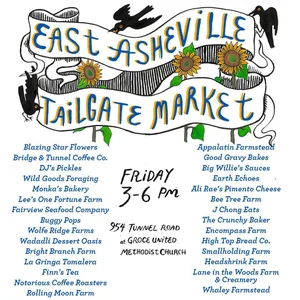
May 24 @ 3:00 pm – 6:00 pm
East Asheville Tailgate Market
Buncombe County will continue to offer ASAP’s Double SNAP for Fruits and Vegetables and Farm Fresh Produce Prescription.
ASAP’s Local Food Guide, the annual free publication for finding local food and farms, is updated for the 2024–25 season. This definitive resource lists hundreds of Appalachian GrownTM certified farms, farmers markets, restaurants, groceries, artisan producers, and more throughout Western North Carolina and surrounding counties in Virginia, Tennessee, Georgia, and South Carolina. A digital version of the print Guide may be viewed at asapconnections.org/guide.
In addition to listing content, the 2024–25 edition features stories that highlight the variety of farming across the region. Delia Jovel Dubón of Tierra Fértil Coop (pictured on the cover) talks about creating a sense of belonging for the Hispanic immigrant community in Henderson County. Lyric and Noah East of Wild East Farm in McDowell County detail the journey through their first full year of farming and how they’ve arrived at “a rough draft that’s working.” Kaci Nidiffer of The Liar’s Table in Avery County shares how scaling up and opening several retail spaces have created stronger connections with customers and community. Rounding out the issue are recipes from farmers at Two Trees Farm (Sustainabillies), Lee’s One Fortune Farm, Two Stones Farm + Mill, Carringer Farms, and Terra Lingua Growers.
“The Local Food Guide is such a beautiful way to share the stories of this place,” said Sarah Hart, ASAP’s Communications and Engagement Director. “To emphasize that sense of place, listings in this year’s Guide are organized into nine subregions with a short intro on what makes local farms in each area unique.”
Look for the Guide at farmers markets, visitors centers, libraries, groceries, restaurants, and other partner businesses throughout the region. Copies of the Guide are also available to pick up in the lobby of ASAP’s office in Asheville at 306 W. Haywood St., Tuesday to Thursday, 9 a.m. to 5 p.m. Contact ASAP if you need help locating a copy in your area or if you are interested in distributing Guides at your business.
In addition to the print Guide, ASAP maintains the online Local Food Guide at appalachiangrown.org. This database, with more than 1,400 listings, is updated throughout the year and is searchable by products, location, activities, and more.
Funding for the Local Food Guide was made possible in part by the U.S. Department of Agriculture (USDA) through the Agricultural Marketing Service, National Institute of Food and Agriculture’s Beginning Farmer Rancher Development Program, Gus Schumacher Nutrition Incentive Program, and Southern Sustainable Agriculture Research and Education program. Support was also provided by Dogwood Health Trust, the Community Foundation of Western North Carolina, and Asheville Regional Airport.
Dolly Parton’s Imagination Library Free Books for Children ages 0-5
May 25 all-day
online w/ Literacy Together
Dolly Parton’s Imagination Library impacts the pre-literacy skills and school readiness of children under the age of 5 in Buncombe County. The program mails a new, free, age-appropriate book to registered children each month until they turn five years old. Dolly Parton’s Imagination Library creates a home library of up to 60 books and instills a love of books and reading from an early age. If you have any questions about the program, please send an email to [email protected].
A national panel of educators selects the Imagination Library titles, which include: The Little Engine that Could, Last Stop on Market Street, Violet the Pilot, As an Oak Tree Grows, The Tale of Peter Rabbit, Llama Llama Red Pajama, Look Out Kindergarten, here I come, and many more (take a look at all the titles).
Literacy Together became a Dolly Parton’s Imagination Library affiliate in November 2015 with support from the BuncombePartnership for Children. Through this program, registered children in Buncombe County receive a free book in the mail each month. Their parents also have the opportunity to attend workshops to learn how to build their children’s early literacy skills. Parents in need of literacy assistance are encouraged to receive tutoring through Literacy Together’s adult programming.
The program served 200 children during the 2015/16 fiscal year. The program expanded to serve 400 children in July 2016, and 600 in August 2017. In July 2018, capacity increased to 1,900 thanks to a special allocation in the North Carolina state budget. We’re now serving 4,600 kids in Buncombe County.
Henderson County Tailgate Market
May 25 @ 8:00 am – 12:00 pm
Henderson County Tailgate Market
Every Saturday from 8am-12pm, This is the 44th year for this
weekly tailgate market, where vendors sell fresh-picked seasonal vegetables and fruit, local honey, cut flowers, plant starts and
more, The market will be open through October. L
Hendersonville Farmers Market
May 25 @ 8:00 am – 1:00 pm
Historic Train Depot
Hendersonville Farmers Market in front of the Historic Train Depot, 8am-1pm, Hendersonville Farmers Market aims to be a world-class market that contributes to the success of local producers and growers, expands access to farm fresh foods, and creates a
vibrant community gathering space. With fresh produce, meats, baked goods, crafts, live entertainment, food trucks, and more,
it’s a weekly outing with something for everybody! Visitors can expect a lively atmosphere celebrating food, farm and family with
live music every Saturday! At least 30 vendors from within a 60-mile radius participate in each market, offering produce, meat,
eggs, dairy, honey, baked goods, crafts, beverages, and more. Special events such as Tomato Day, Wellness Day and
Juneteenth Celebration will occur at the market regularly throughout the season. Food trucks will also be a staple, allowing
visitors to enjoy breakfast or lunch on their farmers market adventure
North Asheville Tailgate Market
May 25 @ 8:00 am – 12:00 pm
North Asheville Tailgate Market
Welcome to Western NC’s most premier farmers market!
Since 1980, we have been providing Asheville and the surrounding area with a full range of local, sustainably produced produce, meats, eggs, cheeses, breads, plants, prepared foods and crafts. Day vendors complement the members’ offerings with additional products and services.
The North Asheville Tailgate Market is a weekly, Saturday morning gathering of the best farmers, craftsmen, and bakers. With over 40 vendors and more than 40,000 annual customers, the market’s energetic and warm environment welcomes all.
Asheville City Market
May 25 @ 9:00 am – 12:00 pm
Asheville City Market
Buncombe County will continue to offer ASAP’s Double SNAP for Fruits and Vegetables and Farm Fresh Produce Prescription. Both programs expand access to fresh fruits and vegetables to more people in the community that might not otherwise be able to afford them. Learn more about how these programs work at asapconnections.org/farmersmarkets.
Visit the Market
WHEN:Saturday mornings, 9 a.m.–12 p.m., April–Dec. Winter market hours: 10 a.m.–1 p.m., Jan.–March. No market the last two weeks of the year.
WHERE: North Market Street between Woodfin and Walnut streets in downtown Asheville. The street is closed to traffic during market times.
GETTING HERE: Free parking for customers is available at the HomeTrust Bank lot and at the Family Justice Center lot across from the YMCA at 35 Woodfin Street. Handicapped parking is available. There is a bus stop on the N1 and N2 routes one block away, on Broadway. Buses stop at both Woodfin and Walnut streets.
Asheville City Market is a producer-only market, which means that all farm vendors grow or raise the products they are selling themselves. For non-farm vendors (such as prepared food, seafood, coffee), preference is given to products and foods prepared or processed locally or made with locally sourced ingredients.
The list below reflects vendors for the entire season, but not all will attend market each week. Sign up for the Asheville City Market e-newsletter to see the weekly vendor schedule.
Black Mountain Tailgate Market
May 25 @ 9:00 am – 12:00 pm
Black Mountain Tailgate Market
COME CELEBRATE!
OPEN FROM MAY – NOVEMBER :: 9AM – NOON
Our market is a seasonal Saturday morning community event featuring organic and sustainably grown produce, plants, cut flowers, herbs, locally raised meats, seafood, breads, pastries, cheeses, eggs and local arts and handcrafted items. A family event every Saturday from May through November.
ASAP’s Local Food Guide, the annual free publication for finding local food and farms, is updated for the 2024–25 season. This definitive resource lists hundreds of Appalachian GrownTM certified farms, farmers markets, restaurants, groceries, artisan producers, and more throughout Western North Carolina and surrounding counties in Virginia, Tennessee, Georgia, and South Carolina. A digital version of the print Guide may be viewed at asapconnections.org/guide.
In addition to listing content, the 2024–25 edition features stories that highlight the variety of farming across the region. Delia Jovel Dubón of Tierra Fértil Coop (pictured on the cover) talks about creating a sense of belonging for the Hispanic immigrant community in Henderson County. Lyric and Noah East of Wild East Farm in McDowell County detail the journey through their first full year of farming and how they’ve arrived at “a rough draft that’s working.” Kaci Nidiffer of The Liar’s Table in Avery County shares how scaling up and opening several retail spaces have created stronger connections with customers and community. Rounding out the issue are recipes from farmers at Two Trees Farm (Sustainabillies), Lee’s One Fortune Farm, Two Stones Farm + Mill, Carringer Farms, and Terra Lingua Growers.
“The Local Food Guide is such a beautiful way to share the stories of this place,” said Sarah Hart, ASAP’s Communications and Engagement Director. “To emphasize that sense of place, listings in this year’s Guide are organized into nine subregions with a short intro on what makes local farms in each area unique.”
Look for the Guide at farmers markets, visitors centers, libraries, groceries, restaurants, and other partner businesses throughout the region. Copies of the Guide are also available to pick up in the lobby of ASAP’s office in Asheville at 306 W. Haywood St., Tuesday to Thursday, 9 a.m. to 5 p.m. Contact ASAP if you need help locating a copy in your area or if you are interested in distributing Guides at your business.
In addition to the print Guide, ASAP maintains the online Local Food Guide at appalachiangrown.org. This database, with more than 1,400 listings, is updated throughout the year and is searchable by products, location, activities, and more.
Funding for the Local Food Guide was made possible in part by the U.S. Department of Agriculture (USDA) through the Agricultural Marketing Service, National Institute of Food and Agriculture’s Beginning Farmer Rancher Development Program, Gus Schumacher Nutrition Incentive Program, and Southern Sustainable Agriculture Research and Education program. Support was also provided by Dogwood Health Trust, the Community Foundation of Western North Carolina, and Asheville Regional Airport.
Dolly Parton’s Imagination Library Free Books for Children ages 0-5
May 26 all-day
online w/ Literacy Together
Dolly Parton’s Imagination Library impacts the pre-literacy skills and school readiness of children under the age of 5 in Buncombe County. The program mails a new, free, age-appropriate book to registered children each month until they turn five years old. Dolly Parton’s Imagination Library creates a home library of up to 60 books and instills a love of books and reading from an early age. If you have any questions about the program, please send an email to [email protected].
A national panel of educators selects the Imagination Library titles, which include: The Little Engine that Could, Last Stop on Market Street, Violet the Pilot, As an Oak Tree Grows, The Tale of Peter Rabbit, Llama Llama Red Pajama, Look Out Kindergarten, here I come, and many more (take a look at all the titles).
Literacy Together became a Dolly Parton’s Imagination Library affiliate in November 2015 with support from the BuncombePartnership for Children. Through this program, registered children in Buncombe County receive a free book in the mail each month. Their parents also have the opportunity to attend workshops to learn how to build their children’s early literacy skills. Parents in need of literacy assistance are encouraged to receive tutoring through Literacy Together’s adult programming.
The program served 200 children during the 2015/16 fiscal year. The program expanded to serve 400 children in July 2016, and 600 in August 2017. In July 2018, capacity increased to 1,900 thanks to a special allocation in the North Carolina state budget. We’re now serving 4,600 kids in Buncombe County.
Southside Community Farmers Market
May 26 @ 12:00 pm – 3:00 pm
Southside Community Farmers Market
About Southside Community Farmers Market
Buncombe County will continue to offer ASAP’s Double SNAP for Fruits and Vegetables and Farm Fresh Produce Prescription.
Southside Community Farm hosts a farmers market featuring all BIPOC (Black, Indigenous, and people of color) vendors on the first Sunday of every month, May-Oct. from 12-3 PM. The market is EBT accessible. Come enjoy delicious patties, hot sauces, veggies, fruit, flowers, medicines, crafts and more!
ASAP’s Local Food Guide, the annual free publication for finding local food and farms, is updated for the 2024–25 season. This definitive resource lists hundreds of Appalachian GrownTM certified farms, farmers markets, restaurants, groceries, artisan producers, and more throughout Western North Carolina and surrounding counties in Virginia, Tennessee, Georgia, and South Carolina. A digital version of the print Guide may be viewed at asapconnections.org/guide.
In addition to listing content, the 2024–25 edition features stories that highlight the variety of farming across the region. Delia Jovel Dubón of Tierra Fértil Coop (pictured on the cover) talks about creating a sense of belonging for the Hispanic immigrant community in Henderson County. Lyric and Noah East of Wild East Farm in McDowell County detail the journey through their first full year of farming and how they’ve arrived at “a rough draft that’s working.” Kaci Nidiffer of The Liar’s Table in Avery County shares how scaling up and opening several retail spaces have created stronger connections with customers and community. Rounding out the issue are recipes from farmers at Two Trees Farm (Sustainabillies), Lee’s One Fortune Farm, Two Stones Farm + Mill, Carringer Farms, and Terra Lingua Growers.
“The Local Food Guide is such a beautiful way to share the stories of this place,” said Sarah Hart, ASAP’s Communications and Engagement Director. “To emphasize that sense of place, listings in this year’s Guide are organized into nine subregions with a short intro on what makes local farms in each area unique.”
Look for the Guide at farmers markets, visitors centers, libraries, groceries, restaurants, and other partner businesses throughout the region. Copies of the Guide are also available to pick up in the lobby of ASAP’s office in Asheville at 306 W. Haywood St., Tuesday to Thursday, 9 a.m. to 5 p.m. Contact ASAP if you need help locating a copy in your area or if you are interested in distributing Guides at your business.
In addition to the print Guide, ASAP maintains the online Local Food Guide at appalachiangrown.org. This database, with more than 1,400 listings, is updated throughout the year and is searchable by products, location, activities, and more.
Funding for the Local Food Guide was made possible in part by the U.S. Department of Agriculture (USDA) through the Agricultural Marketing Service, National Institute of Food and Agriculture’s Beginning Farmer Rancher Development Program, Gus Schumacher Nutrition Incentive Program, and Southern Sustainable Agriculture Research and Education program. Support was also provided by Dogwood Health Trust, the Community Foundation of Western North Carolina, and Asheville Regional Airport.