It looks like you're using ad blocking technology. We are a local company, and our advertisers are local as well. Please consider allow listing our website in the future.
Vera B. Williams / STORIES Eight Decades of Politics and Picture Making
May 4 @ 11:00 am – 5:00 pm
Black Mountain College Museum + Arts Center
Exhibition and Public Programming
Vera B. Williams, an award-winning author and illustrator of children’s books, started making pictures almost as soon as she could walk. She studied at Black Mountain College in a time where summer institutes were held with classes taught by John Cage and Merce Cunningham. Williams studied under the Bauhaus luminary Josef Albers and went on to make art for the rest of her life. At the time of her death, The New York Times wrote: “Her illustrations, known for bold colors and a style reminiscent of folk art, were praised by reviewers for their great tenderness and crackling vitality.” Despite numerous awards and recognition for her children’s books, much of her wider life and work remains unexplored. This retrospective will showcase the complete range of Williams’ life and work. It will highlight her time at Black Mountain College, her political activism, and her establishment, with Paul Williams, of an influential yet little-known artist community, in addition to her work as an author and illustrator.
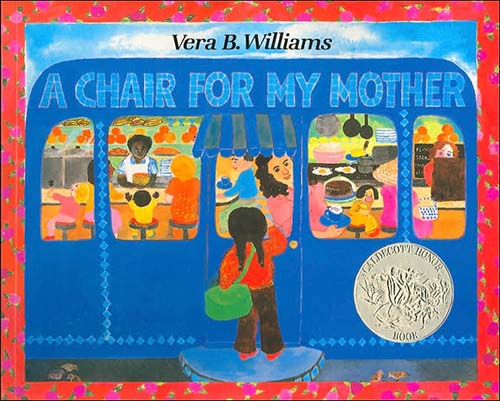
Author and illustrator of 17 children’s books, including Caldecott medal winner, A Chair for My Mother, Vera B. Williams always had a passion for the arts. Williams grew up in the Bronx, NY, and in 1936, when she was nine years old, one of her paintings, called Yentas, opens a new window, was included in an exhibition at the Museum of Modern Art. While Williams is widely known for her children’s books today, this exhibition’s expansive scope highlights unexplored aspects of her artistic practice and eight decades of life. From groundbreaking, powerful covers for Liberation Magazine, to Peace calendar collaborations with writer activist Grace Paley, to scenic sketches for Julian Beck and Judith Malina’s Living Theater, to hundreds of late life “Aging and Illness” cartoons sketches and doodles, Vera never sat still.
Williams arrived at Black Mountain College in 1945. While there, she embraced all aspects of living, working, and learning in the intensely creative college community. She was at BMC during a particularly fertile period, which allowed her to study with faculty members Buckminster Fuller and Josef Albers, and to participate in the famed summer sessions with John Cage, Merce Cunningham, M.C. Richards, and Robert Rauschenberg. In 1948, she graduated with Josef Albers as her advisor and sculptor Richard Lippold as her outside examiner. Forever one of the College’s shining stars, Vera graduated from BMC with just six semesters of coursework, at only twenty-one years old. She continued to visit BMC for years afterward, staying deeply involved with the artistic community that BMC incubated.
Anticipating the eventual closure of BMC, Williams, alongside her husband Paul Williams and a group of influential former BMC figures, founded The Gate Hill Cooperative Artists community located 30 miles north of NYC on the outskirts of Stony Point, NY. The Gate Hill Cooperative, also known as The Land, became an outcropping of Black Mountain College’s experimental ethos. Students and faculty including John Cage, M.C. Richards, David Tudor, Karen Karnes, David Weinrib, Stan VanDerBeek, and Patsy Lynch Wood shaped Gate Hill as founding members of the community. Vera B. Williams raised her three children at Gate Hill while continuing to make work.
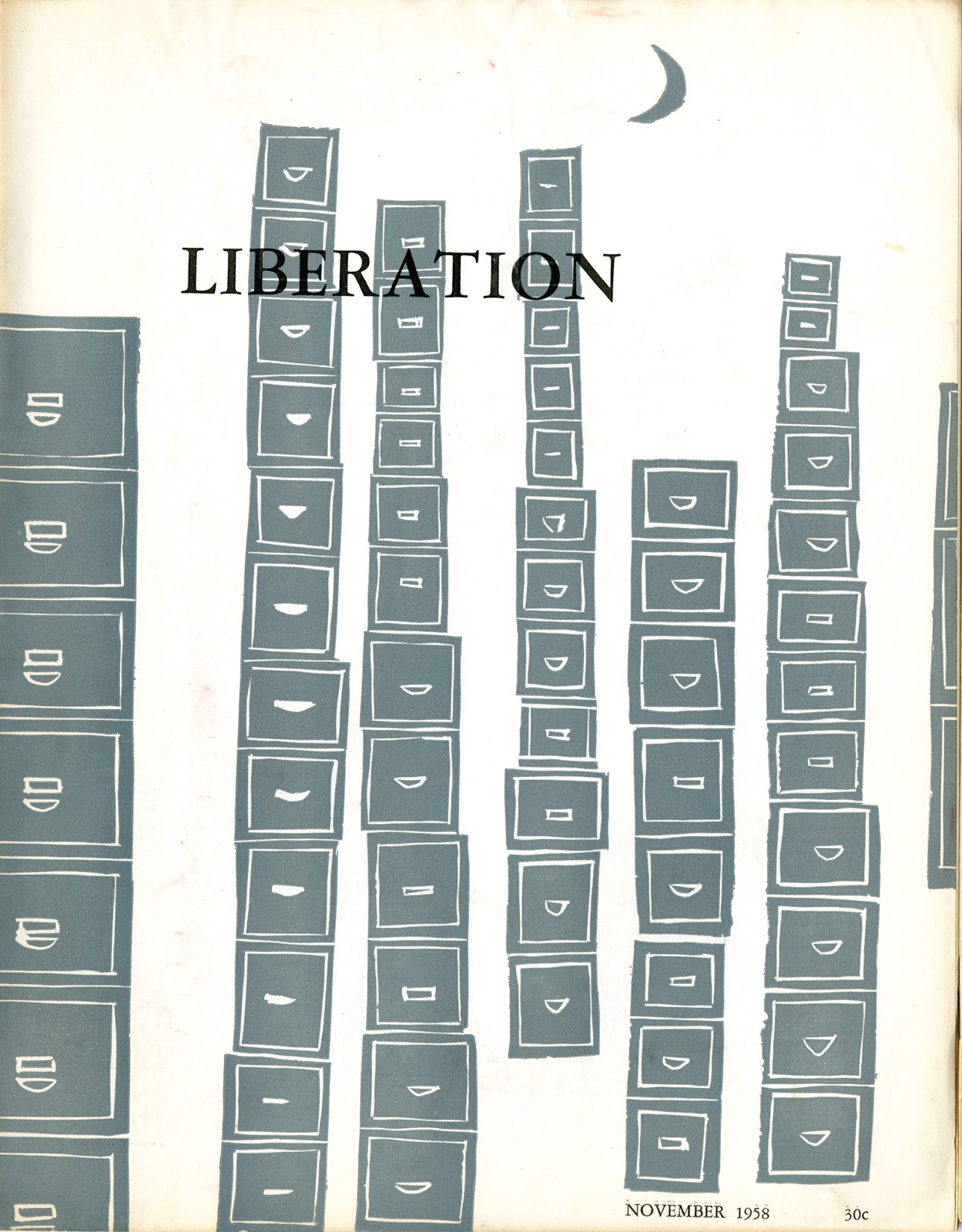
The early Gate Hill era represented an especially creative phase for the BMC group. For Williams, this period saw the creation of 76 covers for Liberation Magazine, a radical, groundbreaking publication. This exhibition will feature some of Williams’ most powerful Liberation covers including a design for the June 1963 edition, which contained the first full publication of MLK’s “Letter from Birmingham Jail.” Williams’ activism work continued throughout her life. As president of PEN’s Children Committee and member of The War Resisters league, she created a wide range of political and educational posters and journal covers. Williams protested the war in Vietnam and nuclear proliferation while supporting women’s causes and racial equality. In 1981, Williams was arrested and spent a month in a federal prison on charges stemming from her political activism.
In her late 40’s, Williams embarked in earnest on her career as a children’s book author and illustrator, a career which garnered the NY Public Library’s recognition of A Chair for My Mother as one of the greatest 100 children’s books of all time. Infinitely curious and always a wanderer at heart, Williams’ personal life was as expansive as her art. In addition to her prolific picture making, Williams started and helped run a Summerhill-based alternative school, canoed the Yukon, and lived alone on a houseboat in Vancouver Harbor. She helped to organize and attended dozens of political demonstrations throughout her adult life.
Her books won many awards including the Caldecott Medal Honor Book for A Chair for My Mother in 1983, the Boston Globe–Horn Book Award– Fiction category– for Scooter in 1994, the Jane Addams Honor for Amber Was Brave, Essie Was Smart in 2002, and the NSK Neustadt Prize for Children’s Literature in 2009. Her books reflected her values, emphasizing love, compassion, kindness, joy, strength, individuality, and courage.
Images:
Cover of Vera B. Williams’ A Chair for My Mother, published in 1982.
Vera B. Williams, Cover for Liberation Magazine, November 1958.
Southside Community Farmers Market
May 4 @ 12:00 pm – 3:00 pm
Southside Community Farmers Market
About Southside Community Farmers Market
Buncombe County will continue to offer ASAP’s Double SNAP for Fruits and Vegetables and Farm Fresh Produce Prescription.
Southside Community Farm hosts a farmers market featuring all BIPOC (Black, Indigenous, and people of color) vendors on the first Sunday of every month, May-Oct. from 12-3 PM. The market is EBT accessible. Come enjoy delicious patties, hot sauces, veggies, fruit, flowers, medicines, crafts and more!
Dolly Parton’s Imagination Library Free Books for Children ages 0-5
May 5 all-day
online w/ Literacy Together
Dolly Parton’s Imagination Library impacts the pre-literacy skills and school readiness of children under the age of 5 in Buncombe County. The program mails a new, free, age-appropriate book to registered children each month until they turn five years old. Dolly Parton’s Imagination Library creates a home library of up to 60 books and instills a love of books and reading from an early age. If you have any questions about the program, please send an email to [email protected].
A national panel of educators selects the Imagination Library titles, which include: The Little Engine that Could, Last Stop on Market Street, Violet the Pilot, As an Oak Tree Grows, The Tale of Peter Rabbit, Llama Llama Red Pajama, Look Out Kindergarten, here I come, and many more (take a look at all the titles).
Literacy Together became a Dolly Parton’s Imagination Library affiliate in November 2015 with support from the BuncombePartnership for Children. Through this program, registered children in Buncombe County receive a free book in the mail each month. Their parents also have the opportunity to attend workshops to learn how to build their children’s early literacy skills. Parents in need of literacy assistance are encouraged to receive tutoring through Literacy Together’s adult programming.
The program served 200 children during the 2015/16 fiscal year. The program expanded to serve 400 children in July 2016, and 600 in August 2017. In July 2018, capacity increased to 1,900 thanks to a special allocation in the North Carolina state budget. We’re now serving 4,600 kids in Buncombe County.
Southside Community Farmers Market
May 5 @ 12:00 pm – 3:00 pm
Southside Community Farmers Market
About Southside Community Farmers Market
Buncombe County will continue to offer ASAP’s Double SNAP for Fruits and Vegetables and Farm Fresh Produce Prescription.
Southside Community Farm hosts a farmers market featuring all BIPOC (Black, Indigenous, and people of color) vendors on the first Sunday of every month, May-Oct. from 12-3 PM. The market is EBT accessible. Come enjoy delicious patties, hot sauces, veggies, fruit, flowers, medicines, crafts and more!
Vera B. Williams / STORIES Eight Decades of Politics and Picture Making
May 6 @ 11:00 am – 5:00 pm
Black Mountain College Museum + Arts Center
Exhibition and Public Programming
Vera B. Williams, an award-winning author and illustrator of children’s books, started making pictures almost as soon as she could walk. She studied at Black Mountain College in a time where summer institutes were held with classes taught by John Cage and Merce Cunningham. Williams studied under the Bauhaus luminary Josef Albers and went on to make art for the rest of her life. At the time of her death, The New York Times wrote: “Her illustrations, known for bold colors and a style reminiscent of folk art, were praised by reviewers for their great tenderness and crackling vitality.” Despite numerous awards and recognition for her children’s books, much of her wider life and work remains unexplored. This retrospective will showcase the complete range of Williams’ life and work. It will highlight her time at Black Mountain College, her political activism, and her establishment, with Paul Williams, of an influential yet little-known artist community, in addition to her work as an author and illustrator.
Author and illustrator of 17 children’s books, including Caldecott medal winner, A Chair for My Mother, Vera B. Williams always had a passion for the arts. Williams grew up in the Bronx, NY, and in 1936, when she was nine years old, one of her paintings, called Yentas, opens a new window, was included in an exhibition at the Museum of Modern Art. While Williams is widely known for her children’s books today, this exhibition’s expansive scope highlights unexplored aspects of her artistic practice and eight decades of life. From groundbreaking, powerful covers for Liberation Magazine, to Peace calendar collaborations with writer activist Grace Paley, to scenic sketches for Julian Beck and Judith Malina’s Living Theater, to hundreds of late life “Aging and Illness” cartoons sketches and doodles, Vera never sat still.
Williams arrived at Black Mountain College in 1945. While there, she embraced all aspects of living, working, and learning in the intensely creative college community. She was at BMC during a particularly fertile period, which allowed her to study with faculty members Buckminster Fuller and Josef Albers, and to participate in the famed summer sessions with John Cage, Merce Cunningham, M.C. Richards, and Robert Rauschenberg. In 1948, she graduated with Josef Albers as her advisor and sculptor Richard Lippold as her outside examiner. Forever one of the College’s shining stars, Vera graduated from BMC with just six semesters of coursework, at only twenty-one years old. She continued to visit BMC for years afterward, staying deeply involved with the artistic community that BMC incubated.
Anticipating the eventual closure of BMC, Williams, alongside her husband Paul Williams and a group of influential former BMC figures, founded The Gate Hill Cooperative Artists community located 30 miles north of NYC on the outskirts of Stony Point, NY. The Gate Hill Cooperative, also known as The Land, became an outcropping of Black Mountain College’s experimental ethos. Students and faculty including John Cage, M.C. Richards, David Tudor, Karen Karnes, David Weinrib, Stan VanDerBeek, and Patsy Lynch Wood shaped Gate Hill as founding members of the community. Vera B. Williams raised her three children at Gate Hill while continuing to make work.
The early Gate Hill era represented an especially creative phase for the BMC group. For Williams, this period saw the creation of 76 covers for Liberation Magazine, a radical, groundbreaking publication. This exhibition will feature some of Williams’ most powerful Liberation covers including a design for the June 1963 edition, which contained the first full publication of MLK’s “Letter from Birmingham Jail.” Williams’ activism work continued throughout her life. As president of PEN’s Children Committee and member of The War Resisters league, she created a wide range of political and educational posters and journal covers. Williams protested the war in Vietnam and nuclear proliferation while supporting women’s causes and racial equality. In 1981, Williams was arrested and spent a month in a federal prison on charges stemming from her political activism.
In her late 40’s, Williams embarked in earnest on her career as a children’s book author and illustrator, a career which garnered the NY Public Library’s recognition of A Chair for My Mother as one of the greatest 100 children’s books of all time. Infinitely curious and always a wanderer at heart, Williams’ personal life was as expansive as her art. In addition to her prolific picture making, Williams started and helped run a Summerhill-based alternative school, canoed the Yukon, and lived alone on a houseboat in Vancouver Harbor. She helped to organize and attended dozens of political demonstrations throughout her adult life.
Her books won many awards including the Caldecott Medal Honor Book for A Chair for My Mother in 1983, the Boston Globe–Horn Book Award– Fiction category– for Scooter in 1994, the Jane Addams Honor for Amber Was Brave, Essie Was Smart in 2002, and the NSK Neustadt Prize for Children’s Literature in 2009. Her books reflected her values, emphasizing love, compassion, kindness, joy, strength, individuality, and courage.
Images:
Cover of Vera B. Williams’ A Chair for My Mother, published in 1982.
Vera B. Williams, Cover for Liberation Magazine, November 1958.
Vera B. Williams / STORIES Eight Decades of Politics and Picture Making
May 7 @ 11:00 am – 5:00 pm
Black Mountain College Museum + Arts Center
Exhibition and Public Programming
Vera B. Williams, an award-winning author and illustrator of children’s books, started making pictures almost as soon as she could walk. She studied at Black Mountain College in a time where summer institutes were held with classes taught by John Cage and Merce Cunningham. Williams studied under the Bauhaus luminary Josef Albers and went on to make art for the rest of her life. At the time of her death, The New York Times wrote: “Her illustrations, known for bold colors and a style reminiscent of folk art, were praised by reviewers for their great tenderness and crackling vitality.” Despite numerous awards and recognition for her children’s books, much of her wider life and work remains unexplored. This retrospective will showcase the complete range of Williams’ life and work. It will highlight her time at Black Mountain College, her political activism, and her establishment, with Paul Williams, of an influential yet little-known artist community, in addition to her work as an author and illustrator.
Author and illustrator of 17 children’s books, including Caldecott medal winner, A Chair for My Mother, Vera B. Williams always had a passion for the arts. Williams grew up in the Bronx, NY, and in 1936, when she was nine years old, one of her paintings, called Yentas, opens a new window, was included in an exhibition at the Museum of Modern Art. While Williams is widely known for her children’s books today, this exhibition’s expansive scope highlights unexplored aspects of her artistic practice and eight decades of life. From groundbreaking, powerful covers for Liberation Magazine, to Peace calendar collaborations with writer activist Grace Paley, to scenic sketches for Julian Beck and Judith Malina’s Living Theater, to hundreds of late life “Aging and Illness” cartoons sketches and doodles, Vera never sat still.
Williams arrived at Black Mountain College in 1945. While there, she embraced all aspects of living, working, and learning in the intensely creative college community. She was at BMC during a particularly fertile period, which allowed her to study with faculty members Buckminster Fuller and Josef Albers, and to participate in the famed summer sessions with John Cage, Merce Cunningham, M.C. Richards, and Robert Rauschenberg. In 1948, she graduated with Josef Albers as her advisor and sculptor Richard Lippold as her outside examiner. Forever one of the College’s shining stars, Vera graduated from BMC with just six semesters of coursework, at only twenty-one years old. She continued to visit BMC for years afterward, staying deeply involved with the artistic community that BMC incubated.
Anticipating the eventual closure of BMC, Williams, alongside her husband Paul Williams and a group of influential former BMC figures, founded The Gate Hill Cooperative Artists community located 30 miles north of NYC on the outskirts of Stony Point, NY. The Gate Hill Cooperative, also known as The Land, became an outcropping of Black Mountain College’s experimental ethos. Students and faculty including John Cage, M.C. Richards, David Tudor, Karen Karnes, David Weinrib, Stan VanDerBeek, and Patsy Lynch Wood shaped Gate Hill as founding members of the community. Vera B. Williams raised her three children at Gate Hill while continuing to make work.
The early Gate Hill era represented an especially creative phase for the BMC group. For Williams, this period saw the creation of 76 covers for Liberation Magazine, a radical, groundbreaking publication. This exhibition will feature some of Williams’ most powerful Liberation covers including a design for the June 1963 edition, which contained the first full publication of MLK’s “Letter from Birmingham Jail.” Williams’ activism work continued throughout her life. As president of PEN’s Children Committee and member of The War Resisters league, she created a wide range of political and educational posters and journal covers. Williams protested the war in Vietnam and nuclear proliferation while supporting women’s causes and racial equality. In 1981, Williams was arrested and spent a month in a federal prison on charges stemming from her political activism.
In her late 40’s, Williams embarked in earnest on her career as a children’s book author and illustrator, a career which garnered the NY Public Library’s recognition of A Chair for My Mother as one of the greatest 100 children’s books of all time. Infinitely curious and always a wanderer at heart, Williams’ personal life was as expansive as her art. In addition to her prolific picture making, Williams started and helped run a Summerhill-based alternative school, canoed the Yukon, and lived alone on a houseboat in Vancouver Harbor. She helped to organize and attended dozens of political demonstrations throughout her adult life.
Her books won many awards including the Caldecott Medal Honor Book for A Chair for My Mother in 1983, the Boston Globe–Horn Book Award– Fiction category– for Scooter in 1994, the Jane Addams Honor for Amber Was Brave, Essie Was Smart in 2002, and the NSK Neustadt Prize for Children’s Literature in 2009. Her books reflected her values, emphasizing love, compassion, kindness, joy, strength, individuality, and courage.
Images:
Cover of Vera B. Williams’ A Chair for My Mother, published in 1982.
Vera B. Williams, Cover for Liberation Magazine, November 1958.
The Pack Library Book Club is a book discussion group that meets the second Wednesday of each month at 10:30AM at the library. We read and discuss a variety of book genres. The book for January 2024 is “Solito” by Javier Zamora.
Newcomers are always welcome! If you have any questions about book club, you can email [email protected] .
Vera B. Williams / STORIES Eight Decades of Politics and Picture Making
May 8 @ 11:00 am – 5:00 pm
Black Mountain College Museum + Arts Center
Exhibition and Public Programming
Vera B. Williams, an award-winning author and illustrator of children’s books, started making pictures almost as soon as she could walk. She studied at Black Mountain College in a time where summer institutes were held with classes taught by John Cage and Merce Cunningham. Williams studied under the Bauhaus luminary Josef Albers and went on to make art for the rest of her life. At the time of her death, The New York Times wrote: “Her illustrations, known for bold colors and a style reminiscent of folk art, were praised by reviewers for their great tenderness and crackling vitality.” Despite numerous awards and recognition for her children’s books, much of her wider life and work remains unexplored. This retrospective will showcase the complete range of Williams’ life and work. It will highlight her time at Black Mountain College, her political activism, and her establishment, with Paul Williams, of an influential yet little-known artist community, in addition to her work as an author and illustrator.
Author and illustrator of 17 children’s books, including Caldecott medal winner, A Chair for My Mother, Vera B. Williams always had a passion for the arts. Williams grew up in the Bronx, NY, and in 1936, when she was nine years old, one of her paintings, called Yentas, opens a new window, was included in an exhibition at the Museum of Modern Art. While Williams is widely known for her children’s books today, this exhibition’s expansive scope highlights unexplored aspects of her artistic practice and eight decades of life. From groundbreaking, powerful covers for Liberation Magazine, to Peace calendar collaborations with writer activist Grace Paley, to scenic sketches for Julian Beck and Judith Malina’s Living Theater, to hundreds of late life “Aging and Illness” cartoons sketches and doodles, Vera never sat still.
Williams arrived at Black Mountain College in 1945. While there, she embraced all aspects of living, working, and learning in the intensely creative college community. She was at BMC during a particularly fertile period, which allowed her to study with faculty members Buckminster Fuller and Josef Albers, and to participate in the famed summer sessions with John Cage, Merce Cunningham, M.C. Richards, and Robert Rauschenberg. In 1948, she graduated with Josef Albers as her advisor and sculptor Richard Lippold as her outside examiner. Forever one of the College’s shining stars, Vera graduated from BMC with just six semesters of coursework, at only twenty-one years old. She continued to visit BMC for years afterward, staying deeply involved with the artistic community that BMC incubated.
Anticipating the eventual closure of BMC, Williams, alongside her husband Paul Williams and a group of influential former BMC figures, founded The Gate Hill Cooperative Artists community located 30 miles north of NYC on the outskirts of Stony Point, NY. The Gate Hill Cooperative, also known as The Land, became an outcropping of Black Mountain College’s experimental ethos. Students and faculty including John Cage, M.C. Richards, David Tudor, Karen Karnes, David Weinrib, Stan VanDerBeek, and Patsy Lynch Wood shaped Gate Hill as founding members of the community. Vera B. Williams raised her three children at Gate Hill while continuing to make work.
The early Gate Hill era represented an especially creative phase for the BMC group. For Williams, this period saw the creation of 76 covers for Liberation Magazine, a radical, groundbreaking publication. This exhibition will feature some of Williams’ most powerful Liberation covers including a design for the June 1963 edition, which contained the first full publication of MLK’s “Letter from Birmingham Jail.” Williams’ activism work continued throughout her life. As president of PEN’s Children Committee and member of The War Resisters league, she created a wide range of political and educational posters and journal covers. Williams protested the war in Vietnam and nuclear proliferation while supporting women’s causes and racial equality. In 1981, Williams was arrested and spent a month in a federal prison on charges stemming from her political activism.
In her late 40’s, Williams embarked in earnest on her career as a children’s book author and illustrator, a career which garnered the NY Public Library’s recognition of A Chair for My Mother as one of the greatest 100 children’s books of all time. Infinitely curious and always a wanderer at heart, Williams’ personal life was as expansive as her art. In addition to her prolific picture making, Williams started and helped run a Summerhill-based alternative school, canoed the Yukon, and lived alone on a houseboat in Vancouver Harbor. She helped to organize and attended dozens of political demonstrations throughout her adult life.
Her books won many awards including the Caldecott Medal Honor Book for A Chair for My Mother in 1983, the Boston Globe–Horn Book Award– Fiction category– for Scooter in 1994, the Jane Addams Honor for Amber Was Brave, Essie Was Smart in 2002, and the NSK Neustadt Prize for Children’s Literature in 2009. Her books reflected her values, emphasizing love, compassion, kindness, joy, strength, individuality, and courage.
Images:
Cover of Vera B. Williams’ A Chair for My Mother, published in 1982.
Vera B. Williams, Cover for Liberation Magazine, November 1958.
River Arts District Farmers Market
May 8 @ 3:00 pm – 6:00 pm
River Arts District Farmers Market
Located in the River Arts District, and surrounded by art galleries and breweries, come find out about Asheville’s favourite mid-week market!
Buncombe County will continue to offer ASAP’s Double SNAP for Fruits and Vegetables and Farm Fresh Produce Prescription.
Vera B. Williams / STORIES Eight Decades of Politics and Picture Making
May 9 @ 11:00 am – 5:00 pm
Black Mountain College Museum + Arts Center
Exhibition and Public Programming
Vera B. Williams, an award-winning author and illustrator of children’s books, started making pictures almost as soon as she could walk. She studied at Black Mountain College in a time where summer institutes were held with classes taught by John Cage and Merce Cunningham. Williams studied under the Bauhaus luminary Josef Albers and went on to make art for the rest of her life. At the time of her death, The New York Times wrote: “Her illustrations, known for bold colors and a style reminiscent of folk art, were praised by reviewers for their great tenderness and crackling vitality.” Despite numerous awards and recognition for her children’s books, much of her wider life and work remains unexplored. This retrospective will showcase the complete range of Williams’ life and work. It will highlight her time at Black Mountain College, her political activism, and her establishment, with Paul Williams, of an influential yet little-known artist community, in addition to her work as an author and illustrator.
Author and illustrator of 17 children’s books, including Caldecott medal winner, A Chair for My Mother, Vera B. Williams always had a passion for the arts. Williams grew up in the Bronx, NY, and in 1936, when she was nine years old, one of her paintings, called Yentas, opens a new window, was included in an exhibition at the Museum of Modern Art. While Williams is widely known for her children’s books today, this exhibition’s expansive scope highlights unexplored aspects of her artistic practice and eight decades of life. From groundbreaking, powerful covers for Liberation Magazine, to Peace calendar collaborations with writer activist Grace Paley, to scenic sketches for Julian Beck and Judith Malina’s Living Theater, to hundreds of late life “Aging and Illness” cartoons sketches and doodles, Vera never sat still.
Williams arrived at Black Mountain College in 1945. While there, she embraced all aspects of living, working, and learning in the intensely creative college community. She was at BMC during a particularly fertile period, which allowed her to study with faculty members Buckminster Fuller and Josef Albers, and to participate in the famed summer sessions with John Cage, Merce Cunningham, M.C. Richards, and Robert Rauschenberg. In 1948, she graduated with Josef Albers as her advisor and sculptor Richard Lippold as her outside examiner. Forever one of the College’s shining stars, Vera graduated from BMC with just six semesters of coursework, at only twenty-one years old. She continued to visit BMC for years afterward, staying deeply involved with the artistic community that BMC incubated.
Anticipating the eventual closure of BMC, Williams, alongside her husband Paul Williams and a group of influential former BMC figures, founded The Gate Hill Cooperative Artists community located 30 miles north of NYC on the outskirts of Stony Point, NY. The Gate Hill Cooperative, also known as The Land, became an outcropping of Black Mountain College’s experimental ethos. Students and faculty including John Cage, M.C. Richards, David Tudor, Karen Karnes, David Weinrib, Stan VanDerBeek, and Patsy Lynch Wood shaped Gate Hill as founding members of the community. Vera B. Williams raised her three children at Gate Hill while continuing to make work.
The early Gate Hill era represented an especially creative phase for the BMC group. For Williams, this period saw the creation of 76 covers for Liberation Magazine, a radical, groundbreaking publication. This exhibition will feature some of Williams’ most powerful Liberation covers including a design for the June 1963 edition, which contained the first full publication of MLK’s “Letter from Birmingham Jail.” Williams’ activism work continued throughout her life. As president of PEN’s Children Committee and member of The War Resisters league, she created a wide range of political and educational posters and journal covers. Williams protested the war in Vietnam and nuclear proliferation while supporting women’s causes and racial equality. In 1981, Williams was arrested and spent a month in a federal prison on charges stemming from her political activism.
In her late 40’s, Williams embarked in earnest on her career as a children’s book author and illustrator, a career which garnered the NY Public Library’s recognition of A Chair for My Mother as one of the greatest 100 children’s books of all time. Infinitely curious and always a wanderer at heart, Williams’ personal life was as expansive as her art. In addition to her prolific picture making, Williams started and helped run a Summerhill-based alternative school, canoed the Yukon, and lived alone on a houseboat in Vancouver Harbor. She helped to organize and attended dozens of political demonstrations throughout her adult life.
Her books won many awards including the Caldecott Medal Honor Book for A Chair for My Mother in 1983, the Boston Globe–Horn Book Award– Fiction category– for Scooter in 1994, the Jane Addams Honor for Amber Was Brave, Essie Was Smart in 2002, and the NSK Neustadt Prize for Children’s Literature in 2009. Her books reflected her values, emphasizing love, compassion, kindness, joy, strength, individuality, and courage.
Images:
Cover of Vera B. Williams’ A Chair for My Mother, published in 1982.
Vera B. Williams, Cover for Liberation Magazine, November 1958.
Enka-Candler Farmer’s Market
May 9 @ 3:30 pm – 6:30 pm
Enka-Candler Farmer’s Market
Buncombe County farmers markets are opening throughout April and May—or, for year-round markets, shifting back to regular season hours. Spring markets offer an array of produce as well as meat, cheese, eggs, bread, prepared foods, and a wide selection of plant starts.
Nine markets in Buncombe County will continue to offer ASAP’s Double SNAP for Fruits and Vegetables and Farm Fresh Produce Prescription.
Vera B. Williams / STORIES Eight Decades of Politics and Picture Making
May 10 @ 11:00 am – 5:00 pm
Black Mountain College Museum + Arts Center
Exhibition and Public Programming
Vera B. Williams, an award-winning author and illustrator of children’s books, started making pictures almost as soon as she could walk. She studied at Black Mountain College in a time where summer institutes were held with classes taught by John Cage and Merce Cunningham. Williams studied under the Bauhaus luminary Josef Albers and went on to make art for the rest of her life. At the time of her death, The New York Times wrote: “Her illustrations, known for bold colors and a style reminiscent of folk art, were praised by reviewers for their great tenderness and crackling vitality.” Despite numerous awards and recognition for her children’s books, much of her wider life and work remains unexplored. This retrospective will showcase the complete range of Williams’ life and work. It will highlight her time at Black Mountain College, her political activism, and her establishment, with Paul Williams, of an influential yet little-known artist community, in addition to her work as an author and illustrator.
Author and illustrator of 17 children’s books, including Caldecott medal winner, A Chair for My Mother, Vera B. Williams always had a passion for the arts. Williams grew up in the Bronx, NY, and in 1936, when she was nine years old, one of her paintings, called Yentas, opens a new window, was included in an exhibition at the Museum of Modern Art. While Williams is widely known for her children’s books today, this exhibition’s expansive scope highlights unexplored aspects of her artistic practice and eight decades of life. From groundbreaking, powerful covers for Liberation Magazine, to Peace calendar collaborations with writer activist Grace Paley, to scenic sketches for Julian Beck and Judith Malina’s Living Theater, to hundreds of late life “Aging and Illness” cartoons sketches and doodles, Vera never sat still.
Williams arrived at Black Mountain College in 1945. While there, she embraced all aspects of living, working, and learning in the intensely creative college community. She was at BMC during a particularly fertile period, which allowed her to study with faculty members Buckminster Fuller and Josef Albers, and to participate in the famed summer sessions with John Cage, Merce Cunningham, M.C. Richards, and Robert Rauschenberg. In 1948, she graduated with Josef Albers as her advisor and sculptor Richard Lippold as her outside examiner. Forever one of the College’s shining stars, Vera graduated from BMC with just six semesters of coursework, at only twenty-one years old. She continued to visit BMC for years afterward, staying deeply involved with the artistic community that BMC incubated.
Anticipating the eventual closure of BMC, Williams, alongside her husband Paul Williams and a group of influential former BMC figures, founded The Gate Hill Cooperative Artists community located 30 miles north of NYC on the outskirts of Stony Point, NY. The Gate Hill Cooperative, also known as The Land, became an outcropping of Black Mountain College’s experimental ethos. Students and faculty including John Cage, M.C. Richards, David Tudor, Karen Karnes, David Weinrib, Stan VanDerBeek, and Patsy Lynch Wood shaped Gate Hill as founding members of the community. Vera B. Williams raised her three children at Gate Hill while continuing to make work.
The early Gate Hill era represented an especially creative phase for the BMC group. For Williams, this period saw the creation of 76 covers for Liberation Magazine, a radical, groundbreaking publication. This exhibition will feature some of Williams’ most powerful Liberation covers including a design for the June 1963 edition, which contained the first full publication of MLK’s “Letter from Birmingham Jail.” Williams’ activism work continued throughout her life. As president of PEN’s Children Committee and member of The War Resisters league, she created a wide range of political and educational posters and journal covers. Williams protested the war in Vietnam and nuclear proliferation while supporting women’s causes and racial equality. In 1981, Williams was arrested and spent a month in a federal prison on charges stemming from her political activism.
In her late 40’s, Williams embarked in earnest on her career as a children’s book author and illustrator, a career which garnered the NY Public Library’s recognition of A Chair for My Mother as one of the greatest 100 children’s books of all time. Infinitely curious and always a wanderer at heart, Williams’ personal life was as expansive as her art. In addition to her prolific picture making, Williams started and helped run a Summerhill-based alternative school, canoed the Yukon, and lived alone on a houseboat in Vancouver Harbor. She helped to organize and attended dozens of political demonstrations throughout her adult life.
Her books won many awards including the Caldecott Medal Honor Book for A Chair for My Mother in 1983, the Boston Globe–Horn Book Award– Fiction category– for Scooter in 1994, the Jane Addams Honor for Amber Was Brave, Essie Was Smart in 2002, and the NSK Neustadt Prize for Children’s Literature in 2009. Her books reflected her values, emphasizing love, compassion, kindness, joy, strength, individuality, and courage.
Images:
Cover of Vera B. Williams’ A Chair for My Mother, published in 1982.
Vera B. Williams, Cover for Liberation Magazine, November 1958.
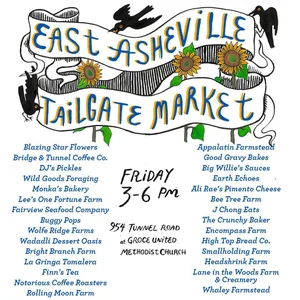
East Asheville Tailgate Market
May 10 @ 3:00 pm – 6:00 pm
East Asheville Tailgate Market
Buncombe County will continue to offer ASAP’s Double SNAP for Fruits and Vegetables and Farm Fresh Produce Prescription.
Dolly Parton’s Imagination Library Free Books for Children ages 0-5
May 11 all-day
online w/ Literacy Together
Dolly Parton’s Imagination Library impacts the pre-literacy skills and school readiness of children under the age of 5 in Buncombe County. The program mails a new, free, age-appropriate book to registered children each month until they turn five years old. Dolly Parton’s Imagination Library creates a home library of up to 60 books and instills a love of books and reading from an early age. If you have any questions about the program, please send an email to [email protected].
A national panel of educators selects the Imagination Library titles, which include: The Little Engine that Could, Last Stop on Market Street, Violet the Pilot, As an Oak Tree Grows, The Tale of Peter Rabbit, Llama Llama Red Pajama, Look Out Kindergarten, here I come, and many more (take a look at all the titles).
Literacy Together became a Dolly Parton’s Imagination Library affiliate in November 2015 with support from the BuncombePartnership for Children. Through this program, registered children in Buncombe County receive a free book in the mail each month. Their parents also have the opportunity to attend workshops to learn how to build their children’s early literacy skills. Parents in need of literacy assistance are encouraged to receive tutoring through Literacy Together’s adult programming.
The program served 200 children during the 2015/16 fiscal year. The program expanded to serve 400 children in July 2016, and 600 in August 2017. In July 2018, capacity increased to 1,900 thanks to a special allocation in the North Carolina state budget. We’re now serving 4,600 kids in Buncombe County.
North Asheville Tailgate Market
May 11 @ 8:00 am – 12:00 pm
North Asheville Tailgate Market
Welcome to Western NC’s most premier farmers market!
Since 1980, we have been providing Asheville and the surrounding area with a full range of local, sustainably produced produce, meats, eggs, cheeses, breads, plants, prepared foods and crafts. Day vendors complement the members’ offerings with additional products and services.
The North Asheville Tailgate Market is a weekly, Saturday morning gathering of the best farmers, craftsmen, and bakers. With over 40 vendors and more than 40,000 annual customers, the market’s energetic and warm environment welcomes all.
Asheville City Market
May 11 @ 9:00 am – 12:00 pm
Asheville City Market
Buncombe County will continue to offer ASAP’s Double SNAP for Fruits and Vegetables and Farm Fresh Produce Prescription. Both programs expand access to fresh fruits and vegetables to more people in the community that might not otherwise be able to afford them. Learn more about how these programs work at asapconnections.org/farmersmarkets.
Visit the Market
WHEN:Saturday mornings, 9 a.m.–12 p.m., April–Dec. Winter market hours: 10 a.m.–1 p.m., Jan.–March. No market the last two weeks of the year.
WHERE: North Market Street between Woodfin and Walnut streets in downtown Asheville. The street is closed to traffic during market times.
GETTING HERE: Free parking for customers is available at the HomeTrust Bank lot and at the Family Justice Center lot across from the YMCA at 35 Woodfin Street. Handicapped parking is available. There is a bus stop on the N1 and N2 routes one block away, on Broadway. Buses stop at both Woodfin and Walnut streets.
Asheville City Market is a producer-only market, which means that all farm vendors grow or raise the products they are selling themselves. For non-farm vendors (such as prepared food, seafood, coffee), preference is given to products and foods prepared or processed locally or made with locally sourced ingredients.
The list below reflects vendors for the entire season, but not all will attend market each week. Sign up for the Asheville City Market e-newsletter to see the weekly vendor schedule.
Black Mountain Tailgate Market
May 11 @ 9:00 am – 12:00 pm
Black Mountain Tailgate Market
COME CELEBRATE!
OPEN FROM MAY – NOVEMBER :: 9AM – NOON
Our market is a seasonal Saturday morning community event featuring organic and sustainably grown produce, plants, cut flowers, herbs, locally raised meats, seafood, breads, pastries, cheeses, eggs and local arts and handcrafted items. A family event every Saturday from May through November.
Vera B. Williams / STORIES Eight Decades of Politics and Picture Making
May 11 @ 11:00 am – 5:00 pm
Black Mountain College Museum + Arts Center
Exhibition and Public Programming
Vera B. Williams, an award-winning author and illustrator of children’s books, started making pictures almost as soon as she could walk. She studied at Black Mountain College in a time where summer institutes were held with classes taught by John Cage and Merce Cunningham. Williams studied under the Bauhaus luminary Josef Albers and went on to make art for the rest of her life. At the time of her death, The New York Times wrote: “Her illustrations, known for bold colors and a style reminiscent of folk art, were praised by reviewers for their great tenderness and crackling vitality.” Despite numerous awards and recognition for her children’s books, much of her wider life and work remains unexplored. This retrospective will showcase the complete range of Williams’ life and work. It will highlight her time at Black Mountain College, her political activism, and her establishment, with Paul Williams, of an influential yet little-known artist community, in addition to her work as an author and illustrator.
Author and illustrator of 17 children’s books, including Caldecott medal winner, A Chair for My Mother, Vera B. Williams always had a passion for the arts. Williams grew up in the Bronx, NY, and in 1936, when she was nine years old, one of her paintings, called Yentas, opens a new window, was included in an exhibition at the Museum of Modern Art. While Williams is widely known for her children’s books today, this exhibition’s expansive scope highlights unexplored aspects of her artistic practice and eight decades of life. From groundbreaking, powerful covers for Liberation Magazine, to Peace calendar collaborations with writer activist Grace Paley, to scenic sketches for Julian Beck and Judith Malina’s Living Theater, to hundreds of late life “Aging and Illness” cartoons sketches and doodles, Vera never sat still.
Williams arrived at Black Mountain College in 1945. While there, she embraced all aspects of living, working, and learning in the intensely creative college community. She was at BMC during a particularly fertile period, which allowed her to study with faculty members Buckminster Fuller and Josef Albers, and to participate in the famed summer sessions with John Cage, Merce Cunningham, M.C. Richards, and Robert Rauschenberg. In 1948, she graduated with Josef Albers as her advisor and sculptor Richard Lippold as her outside examiner. Forever one of the College’s shining stars, Vera graduated from BMC with just six semesters of coursework, at only twenty-one years old. She continued to visit BMC for years afterward, staying deeply involved with the artistic community that BMC incubated.
Anticipating the eventual closure of BMC, Williams, alongside her husband Paul Williams and a group of influential former BMC figures, founded The Gate Hill Cooperative Artists community located 30 miles north of NYC on the outskirts of Stony Point, NY. The Gate Hill Cooperative, also known as The Land, became an outcropping of Black Mountain College’s experimental ethos. Students and faculty including John Cage, M.C. Richards, David Tudor, Karen Karnes, David Weinrib, Stan VanDerBeek, and Patsy Lynch Wood shaped Gate Hill as founding members of the community. Vera B. Williams raised her three children at Gate Hill while continuing to make work.
The early Gate Hill era represented an especially creative phase for the BMC group. For Williams, this period saw the creation of 76 covers for Liberation Magazine, a radical, groundbreaking publication. This exhibition will feature some of Williams’ most powerful Liberation covers including a design for the June 1963 edition, which contained the first full publication of MLK’s “Letter from Birmingham Jail.” Williams’ activism work continued throughout her life. As president of PEN’s Children Committee and member of The War Resisters league, she created a wide range of political and educational posters and journal covers. Williams protested the war in Vietnam and nuclear proliferation while supporting women’s causes and racial equality. In 1981, Williams was arrested and spent a month in a federal prison on charges stemming from her political activism.
In her late 40’s, Williams embarked in earnest on her career as a children’s book author and illustrator, a career which garnered the NY Public Library’s recognition of A Chair for My Mother as one of the greatest 100 children’s books of all time. Infinitely curious and always a wanderer at heart, Williams’ personal life was as expansive as her art. In addition to her prolific picture making, Williams started and helped run a Summerhill-based alternative school, canoed the Yukon, and lived alone on a houseboat in Vancouver Harbor. She helped to organize and attended dozens of political demonstrations throughout her adult life.
Her books won many awards including the Caldecott Medal Honor Book for A Chair for My Mother in 1983, the Boston Globe–Horn Book Award– Fiction category– for Scooter in 1994, the Jane Addams Honor for Amber Was Brave, Essie Was Smart in 2002, and the NSK Neustadt Prize for Children’s Literature in 2009. Her books reflected her values, emphasizing love, compassion, kindness, joy, strength, individuality, and courage.
Images:
Cover of Vera B. Williams’ A Chair for My Mother, published in 1982.
Vera B. Williams, Cover for Liberation Magazine, November 1958.
Dolly Parton’s Imagination Library Free Books for Children ages 0-5
May 12 all-day
online w/ Literacy Together
Dolly Parton’s Imagination Library impacts the pre-literacy skills and school readiness of children under the age of 5 in Buncombe County. The program mails a new, free, age-appropriate book to registered children each month until they turn five years old. Dolly Parton’s Imagination Library creates a home library of up to 60 books and instills a love of books and reading from an early age. If you have any questions about the program, please send an email to [email protected].
A national panel of educators selects the Imagination Library titles, which include: The Little Engine that Could, Last Stop on Market Street, Violet the Pilot, As an Oak Tree Grows, The Tale of Peter Rabbit, Llama Llama Red Pajama, Look Out Kindergarten, here I come, and many more (take a look at all the titles).
Literacy Together became a Dolly Parton’s Imagination Library affiliate in November 2015 with support from the BuncombePartnership for Children. Through this program, registered children in Buncombe County receive a free book in the mail each month. Their parents also have the opportunity to attend workshops to learn how to build their children’s early literacy skills. Parents in need of literacy assistance are encouraged to receive tutoring through Literacy Together’s adult programming.
The program served 200 children during the 2015/16 fiscal year. The program expanded to serve 400 children in July 2016, and 600 in August 2017. In July 2018, capacity increased to 1,900 thanks to a special allocation in the North Carolina state budget. We’re now serving 4,600 kids in Buncombe County.
Southside Community Farmers Market
May 12 @ 12:00 pm – 3:00 pm
Southside Community Farmers Market
About Southside Community Farmers Market
Buncombe County will continue to offer ASAP’s Double SNAP for Fruits and Vegetables and Farm Fresh Produce Prescription.
Southside Community Farm hosts a farmers market featuring all BIPOC (Black, Indigenous, and people of color) vendors on the first Sunday of every month, May-Oct. from 12-3 PM. The market is EBT accessible. Come enjoy delicious patties, hot sauces, veggies, fruit, flowers, medicines, crafts and more!
This group meets monthly to discuss books on a specific topic and make & take a related craft. The theme this month is PLANTS. Teens who wish to participate should read anything even remotely related to plants of any kind..fiction, non-fiction..graphic novel…magazine…memoir…you name it
TBR Tuesdays Book Club at Black Mountain Public Library
May 14 @ 6:30 pm – 7:30 pm
Black Mountain Library
The book that will be discussed in May is A Gentleman in Moscow by Amor Towles.
ASAP’s Local Food Guide, the annual free publication for finding local food and farms, is updated for the 2024–25 season. This definitive resource lists hundreds of Appalachian GrownTM certified farms, farmers markets, restaurants, groceries, artisan producers, and more throughout Western North Carolina and surrounding counties in Virginia, Tennessee, Georgia, and South Carolina. A digital version of the print Guide may be viewed at asapconnections.org/guide.
In addition to listing content, the 2024–25 edition features stories that highlight the variety of farming across the region. Delia Jovel Dubón of Tierra Fértil Coop (pictured on the cover) talks about creating a sense of belonging for the Hispanic immigrant community in Henderson County. Lyric and Noah East of Wild East Farm in McDowell County detail the journey through their first full year of farming and how they’ve arrived at “a rough draft that’s working.” Kaci Nidiffer of The Liar’s Table in Avery County shares how scaling up and opening several retail spaces have created stronger connections with customers and community. Rounding out the issue are recipes from farmers at Two Trees Farm (Sustainabillies), Lee’s One Fortune Farm, Two Stones Farm + Mill, Carringer Farms, and Terra Lingua Growers.
“The Local Food Guide is such a beautiful way to share the stories of this place,” said Sarah Hart, ASAP’s Communications and Engagement Director. “To emphasize that sense of place, listings in this year’s Guide are organized into nine subregions with a short intro on what makes local farms in each area unique.”
Look for the Guide at farmers markets, visitors centers, libraries, groceries, restaurants, and other partner businesses throughout the region. Copies of the Guide are also available to pick up in the lobby of ASAP’s office in Asheville at 306 W. Haywood St., Tuesday to Thursday, 9 a.m. to 5 p.m. Contact ASAP if you need help locating a copy in your area or if you are interested in distributing Guides at your business.
In addition to the print Guide, ASAP maintains the online Local Food Guide at appalachiangrown.org. This database, with more than 1,400 listings, is updated throughout the year and is searchable by products, location, activities, and more.
Funding for the Local Food Guide was made possible in part by the U.S. Department of Agriculture (USDA) through the Agricultural Marketing Service, National Institute of Food and Agriculture’s Beginning Farmer Rancher Development Program, Gus Schumacher Nutrition Incentive Program, and Southern Sustainable Agriculture Research and Education program. Support was also provided by Dogwood Health Trust, the Community Foundation of Western North Carolina, and Asheville Regional Airport.
Etowah Lions Club Farmers Market
May 15 @ 3:00 pm – 6:00 pm
Etowah Lions Club Farmers Market
Etowah Lions Club Farmers Market, 3-6pm, On Wednesdays through October, check out the Etowah Lions Club Farmers Market,
which showcases local farmers, vendors and artisans and the delicious produce the area is known for, all items sold here are
made by or grown by the vendor
River Arts District Farmers Market
May 15 @ 3:00 pm – 6:00 pm
River Arts District Farmers Market
Located in the River Arts District, and surrounded by art galleries and breweries, come find out about Asheville’s favourite mid-week market!
Buncombe County will continue to offer ASAP’s Double SNAP for Fruits and Vegetables and Farm Fresh Produce Prescription.
ASAP’s Local Food Guide, the annual free publication for finding local food and farms, is updated for the 2024–25 season. This definitive resource lists hundreds of Appalachian GrownTM certified farms, farmers markets, restaurants, groceries, artisan producers, and more throughout Western North Carolina and surrounding counties in Virginia, Tennessee, Georgia, and South Carolina. A digital version of the print Guide may be viewed at asapconnections.org/guide.
In addition to listing content, the 2024–25 edition features stories that highlight the variety of farming across the region. Delia Jovel Dubón of Tierra Fértil Coop (pictured on the cover) talks about creating a sense of belonging for the Hispanic immigrant community in Henderson County. Lyric and Noah East of Wild East Farm in McDowell County detail the journey through their first full year of farming and how they’ve arrived at “a rough draft that’s working.” Kaci Nidiffer of The Liar’s Table in Avery County shares how scaling up and opening several retail spaces have created stronger connections with customers and community. Rounding out the issue are recipes from farmers at Two Trees Farm (Sustainabillies), Lee’s One Fortune Farm, Two Stones Farm + Mill, Carringer Farms, and Terra Lingua Growers.
“The Local Food Guide is such a beautiful way to share the stories of this place,” said Sarah Hart, ASAP’s Communications and Engagement Director. “To emphasize that sense of place, listings in this year’s Guide are organized into nine subregions with a short intro on what makes local farms in each area unique.”
Look for the Guide at farmers markets, visitors centers, libraries, groceries, restaurants, and other partner businesses throughout the region. Copies of the Guide are also available to pick up in the lobby of ASAP’s office in Asheville at 306 W. Haywood St., Tuesday to Thursday, 9 a.m. to 5 p.m. Contact ASAP if you need help locating a copy in your area or if you are interested in distributing Guides at your business.
In addition to the print Guide, ASAP maintains the online Local Food Guide at appalachiangrown.org. This database, with more than 1,400 listings, is updated throughout the year and is searchable by products, location, activities, and more.
Funding for the Local Food Guide was made possible in part by the U.S. Department of Agriculture (USDA) through the Agricultural Marketing Service, National Institute of Food and Agriculture’s Beginning Farmer Rancher Development Program, Gus Schumacher Nutrition Incentive Program, and Southern Sustainable Agriculture Research and Education program. Support was also provided by Dogwood Health Trust, the Community Foundation of Western North Carolina, and Asheville Regional Airport.
Flat Rock Farmers Market
May 16 @ 3:00 pm – 6:00 pm
Pinecrest Presbyterian Church
Bringing Local Farm Fresh Food to your Table
Opening Day- 5/4/23
Join us on Thursdays from 3-6 pm through October
Celebrating over 15 years of bringing fresh, local produce and handcrafted goods to the community of Flat Rock NC.
Join us every Thursday, May – October at our location at Pinecrest Presbyterian Church at the corner of Upward Rd and Greenville Hwy.
Enka-Candler Farmer’s Market
May 16 @ 3:30 pm – 6:30 pm
Enka-Candler Farmer’s Market
Buncombe County farmers markets are opening throughout April and May—or, for year-round markets, shifting back to regular season hours. Spring markets offer an array of produce as well as meat, cheese, eggs, bread, prepared foods, and a wide selection of plant starts.
Nine markets in Buncombe County will continue to offer ASAP’s Double SNAP for Fruits and Vegetables and Farm Fresh Produce Prescription.