

Calendar of Events
Upcoming events and things to do in Asheville, NC. Below is a list of events for festivals, concerts, art exhibitions, group meetups and more.
Interested in adding an event to our calendar? Please click the green “Post Your Event” button below.
Thursday, June
15, 2023
Inqwiry: Outdoor Wire Sculptures by Josh Coté
Juneteenth Story Walk
Tryon Fine Arts Center Summer Art Camps Registration Open
Wilderness Medicine + Survival Skills at Nantahala Outdoor Center
Biltmore Estate: Ciao! From Italy Sculptural Postcard Display
WILD Excursions: Appalachian Highland Science Learning Center: middle and high school students
Pollinator Exploration Kit (Available for Loan)
Adult Field Course: Exploring the Sky Island of the Southern Appalachians – The Spruce-Fir Forest
Eidolon art exhibition
Exhibition: NEO MINERALIA
.jpg) Exhibition: Something earned, Something left behind
Exhibition: Something earned, Something left behind
 Exhibition: Crafting Denim
 Italian Renaissance Alive
Black Mountain College and Mexico (BMC/MX): Exhibition
Pulp Potential: Works in Handmade Paper
Italian Renaissance Alive
Black Mountain College and Mexico (BMC/MX): Exhibition
Pulp Potential: Works in Handmade Paper
The Art of Food: From the Collections of Jordan D. Schnitzer and His Family Foundation
New Social Media Platforms
Summer Animal Encounters
Grovewood Gallery will present Inqwiry, an outdoor exhibition of wire animal sculptures by Bakersville, NC, artist Josh Coté. This event is open to the public and free to attend. Inqwiry will remain on view through August 13, 2023.
NC State Parks is celebrating Juneteenth. Throughout the week, explore our Juneteenth Story Walk on the Great Woodland Adventure trail to learn more about this national holiday and its history.
|
|
|
|
|
|
|
LEARN MORE THIS YEAR |
|
Brush up on your wilderness medicine or learn new survival skills! SOLO Southeast & NOC are offering over 200 courses in 2023 and classes in locations across the southeast.
Find your next course with SOLO Southeast and be prepared for the unexpected! |
Included with admission
Embark on a scenic journey across George Vanderbilt’s Italy with a large-scale outdoor display that combines brilliant botanical designs with authentic messages written by Vanderbilt himself.
Beautifully handcrafted of natural elements, each sculptural postcard depicts a location or landmark Vanderbilt visited more than a century ago. This captivating complement to Biltmore’s Italian Renaissance Alive exhibition reveals Vanderbilt’s passions for travel, culture, architecture, and art as well as his personal experience of such renowned Italian cities as Milan, Florence, Venice, Pisa, and Vatican City.
Adding to the charm and visual appeal of Ciao! From Italy—sure to be a hit among kids of all ages—is the G-scale model train that travels in and out of each postcard in this enlightening display!
Come be a community scientist for a day at Purchase Knob! National Park Service educators will take us through several ongoing research projects including a salamander survey and macroinvertebrate sampling. This outdoor education experience for middle and high school students is FREE!
Meet: Buncombe County Agricultural and Land Resources Office, 49 Mount Carmel Rd. Asheville, NC 28806
Bring: water and lunch, sunscreen/bug spray, closed-toe shoes
Cost: FREE!
Contact Rose Wall and Jen Knight for more details: [email protected]
Presented by Bee City USA- Hendersonville and Bullington Gardens
For educators: teachers, camp counselors, home-school parents, childcare professionals, summer program leaders, and more, the Pollinator Exploration Kit provides excellent tools. Bee City USA – Hendersonville is eager to help you share the wonder of pollinators with children you teach. The kit includes sets of 12 sturdy child-size insect nets, special bug capture bubbles, bug boxes with magnifying lids, and magnifying glasses. Two pop-up insect habitats and two sets of laminated fold-out field guides (NC Trees & Wildflowers, NC Butterflies & Moths, Bees & Other Pollinators) are also included. The kit can be loaned for up to a week (as available) and may be picked up and returned weekdays 9am-4pm.
Pick-up location:
Bullington Gardens, 95 Upper Red Oak Trail, Hendersonville.
Cost: no charge
Reservation needed: contact [email protected] to check availability and reserve the dates to borrow the Pollinator Exploration Kit.
Join John Caveny, Grandfather Mountain Stewardship Foundation’s own Director of Conservation and Education, as we explore, examine and discuss one of the most endangered forest types in the United States, the Spruce-Fir Forest. During this field course, participants will explore off the beaten path to find some of the largest Red Spruce trees on the park property. Participants will learn about the forest ecology and wildlife and assist John in gathering scientific data to benefit Grandfather Mountain Stewardship Foundation’s Natural Resource Management Program. Participants need to be prepared to hike through the woods where there is no trail.
John Caveny has worked with the Grandfather Mountain Stewardship Foundation for 10 years and has served in several capacities in the park. In his current role, he oversees the Department of Conservation and Education and has been very active in developing, implementing, and expanding the natural resource management projects that occur on the property.
Program Itinerary
10:00 a.m.: Meet at the Wilson Center for Nature Discovery and Introductions
10:30 a.m. – 12:00 p.m.: Field time
12:00-12:30 p.m.: Lunch at Wilson Center
12:30 – 1:30 p.m.: Spruce-fir lecture
1:30 – 3:30 p.m.: Field time
3:30 – 4:00 p.m.: Wrap up/Q&A/Evaluations
Registration
This Adult Field Course costs $60 for general admission and $51 for members of Grandfather Mountain’s Bridge Club, plus tax. Attendance is limited to 20 participants. Registration opens below on April 20 at 9 a.m.
Your program cost includes admission into the park, field instruction, and transportation during your program (you may drive your own vehicle to visit sites on the mountain if you would prefer). It does not include meals or lodging. Bringing a bagged lunch is recommended for most field courses, although Mildred’s Grill will be open to attendees. Tips are not accepted for field courses. However, donations to the Grandfather Mountain Stewardship Foundation are accepted if you would like to recognize a program.
General Clothing List
Much of your time will be spent outdoors and all programs are held rain, snow or shine. You should be prepared for a variety of mountain weather conditions and temperatures. Appropriate clothing, equipment, and footwear are very important.
Equipment
- Daypack with enough room to carry extra clothing, water, lunch, camera, etc.
- Water Bottle
- Sunglasses
- Sunscreen
- Hiking boots
- Binoculars
Equipment Specific to this Course
- Note pad and writing utensil
- Long pants and preferably long sleeved shirts are strongly encouraged as we will be walking through the woods.
- Sturdy hiking boots or closed-toed shoes are required
- Data gathering instruments will be provided
Exhibition dates: June 9 – July 23
Hours: Tuesday-Saturdays from 10-5 pm, Sundays 11-4 pm
Eidolon is an ancient term from Greek -oeidēs “form”. Early meanings included “mental image”, “appearance”, and “reflection” (as in a mirror or pool), and later, “apparition” or “imaginary entity”, among other things. Expanding beyond the definition pointing to a phantasm or specter, eidolon also sounds like some kind of astral or idyllic place in a novel or poem about an imaginary world. Eidolon features the work of Jacqueline Shatz and Margaret Thompson.
Jacqueline Shatz’s small sculptures of ambiguous and hybridized figures float, entwine, swim, commune with animals and collapse into abstract arabesques and gestures, hinting at mythology, in-between states, and the permeable nature of existence. Margaret Thompson’s paintings are inspired by elements of the symbolist movement and magical realism; she channels dreams and the associative powers of the imagination into her practice, painting subjects that live between our physical realm and spaces beyond the categories of known experience: they are unrestrained, undefined, and free.
Photo credit:
Sae Honda. Courtesy of the Artist.
NEO MINERALIA suggests that recent rock formations no longer fit within the traditional groups: Igneous, Metamorphic, and Sedimentary. Instead, the Anthropocene, the era of human influence on the climate and environment, has introduced two post-natural rocks: Synthetic and Digital.
NEO MINERALIA presents a selection of new geological specimens crafted by ten international artists exploring rocks as reflections of our effects on human and nonhuman ecologies. By embedding synthetic materials (plastics, e-waste) and layers of data points (critical, financial, social) into the craftsmanship of these artifacts, the artists transgress the definition of rocks, turning them from passive aggregates of minerals into metaphorical aggregates of data. Within their apparent “rockness” we can decode hopes, warnings, and speculative future scenarios.
The featured works stemming from places as varied as Mexico, Japan, Poland, and Australia (including a curated artists’ books library), collectively signal a new era of planetary and geological consciousness where we are asked to read, feel, and listen to rocks in new ways.
Photo credit:
J Diamond, “Pony II,” 2022. Courtesy of the Artist
Something earned, Something left behind is an exhibition of objecthood; a critical analysis of the transactional and political languages of everyday and culturally significant objects. This exhibition challenges a history of exclusion and inclusion of People of Color (POC) and their narratives from the canon of craft based on subject matter. It dissects this history’s origins and precedent as an economic transaction to gain access to white spaces.
Racial and ethnic identity influences the way individuals perceive themselves, the way others perceive them, and the way they choose to behave. For this reason, People of Color are expected to perform certain roles in order to fit into hegemonic institutions. These roles can be an active shrinking of themselves and the racialized part of them, or a personal exploitation of their racialized selves. This exhibition addresses and redresses the ways narrowed populations have been included, and the ways in which they have been asked to participate.
Together, this work creates space for and legitimizes POC narratives with depth and care. The exhibiting artists’ practices work against institutionalized expectations of POC work, expanding discourse and inserting new subjectivity into the canon of craft art. It engages with a community hungry for the revitalization and resuscitation of non-Western voices within art spaces. This exhibition challenges the expectations of art from artists of marginalized backgrounds and embraces a new subjectivity of interrogating one’s inherited experiences.
Photo credit:
Photograph by Bowery Blue Makers
Jeans – with their standardized pockets, rivets, and denim – are so much a part of everyday wardrobes that they are easy to overlook. Yet, in workshops across the nation, independent makers are reevaluating the garment and creating jeans by hand, using antiquated equipment and denim woven on midcentury looms. Crafting Denim explores how and why jeans have come to exist at the intersections of industry and craft, modernity, and tradition.
A product of industrial factory production for over a century, jeans are being recast by a new cohort of small-scale makers including craftspeople like Ryan Martin of W.H. Ranch Dungarees, Takayuki Echigoya of Bowery Blue Makers, and Sarah Yarborough and Victor Lytvinenko of Raleigh Denim, who favor choice materials and small-batch fabrication. The jeans they make merge craft traditions with industry and extend the conversation between hand and machine.
Each maker creates a distinctive product but shares a deep appreciation for materials, tools, history, and denim. These jeans are in dialogue with the past and in line with contemporary interests in sustainability. The small workshops featured here are sites of innovation and preservation, and visitors are invited to take a close look at an everyday item and imagine alternative contexts for making and living in our own clothes.
Explore Biltmore House with an Audio Guide that introduces you to the Vanderbilt family and their magnificent home’s history, architecture, and collections of fine art and furnishings.
PLUS: Immersive, multi-sensory Italian Renaissance Alive exhibition created by Grande Experiences
PLUS: FREE next-day access to Biltmore’s Gardens and Grounds
This visit includes access to:
- Italian Renaissance Alive at Amherst at Deerpark®
- 8,000 Acres of Gardens and Grounds for two consecutive days
- Antler Hill Village & Winery
- Complimentary Wine Tastings at the Winery
- Tastings require a Day-of-Visit Reservation, which can be made by:
- Scanning the QR Code found in your Estate Guide
- Visiting any Guest Services location
- Complimentary parking
Art Exhibition: Italian Renaissance Alive
This fascinating experience takes you on a spellbinding tour of Italy, fully immersing you in the beauty and brilliance of iconic masterworks from the greatest artistic period in history
Black Mountain College and Mexico (BMC/MX): Exhibition, Publication, and Public Programming
Black Mountain College (1933–1957), a small but remarkably influential liberal arts school in rural North Carolina, had important links to Mexico that until now have been little investigated. A crucible of twentieth-century creativity, BMC galvanized and inspired artists and intellectuals from around the world, while Mexico’s innovations and age-old traditions—in fine and applied arts, architecture, poetry, music, performance, and more—dovetailed with, and indeed drove, global impulses toward modernism and beyond. Among the many key BMC figures whose lives were importantly touched by experiences in Mexico were Anni and Josef Albers, Ruth Asawa, John Cage, Jean Charlot, Elaine de Kooning, Buckminster Fuller, Carlos Mérida, Robert Motherwell, Charles Olson, Clara Porset, M.C. Richards, and Aaron Siskind. In turn, engagements with BMC and its legacy have played a significant role in shaping contemporary approaches to art in Mexico, evident in the works of Jorge Méndez Blake, Iñaki Bonillas, Abraham Cruzvillegas, Jose Dávila, Gerda Gruber, Lake Verea, Gabriel Orozco, and Damián Ortega, among others.
The exhibition BMC/MX features works by these and other prominent contemporary Mexican artists alongside a selection of historic works by BMC artists, highlighting the ways in which ideas and modalities are translated across materials, space, and time.
Related programming, planned in collaboration with Mexican artists, features a series of public events, including a performance by artist (and BMC/MX co-curator) David Miranda to take place at Different Wrld; an exhibition visit (in Spanish and English) with BMC/MX Project Director Eric Baden; and a series of experiential art events in the BMCM+AC library.
The exhibition is accompanied by the book Black Mountain College and Mexico (forthcoming late summer 2023), which investigates the people, ideas, and practices linking BMC and Mexico during the life of the school, as well as resonances between BMC and the work of contemporary Mexican artists. With contributions by BMC/MX’s curators, as well as by artist Abraham Cruzvillegas, design scholar Ana Elena Mallet, and author and activist Margaret Randall, this fully illustrated volume brings new light to this complex and underexplored subject.
BMC/MX is an investigation into modes of communication—the arenas in which new ideas and alliances may come to be—between Black Mountain College and Mexico, between past and present, between form and idea.
About the Curators
BMC/MX’s Project Director Eric Baden is a photographer and from 1994 to 2022 was professor of photography at Warren Wilson College in Swannanoa, North Carolina. He is the founding director of photo+, a multidisciplinary arts event held in Asheville, North Carolina.
Artist and educator David Miranda is curator at the Museo Experimental El Eco (Universidad Nacional Autónoma de México, UNAM), and teaches at the Escuela Nacional de Pintura, Escultura y Grabado “La Esmeralda” in Mexico City.
Diana Stoll is an editor, writer and curator who works with institutions such as The Museum of Modern Art and the J. Paul Getty Museum. She has served as an editor at Aperture and Artforum magazines, and contributes writings to prominent arts publications.
 |
|
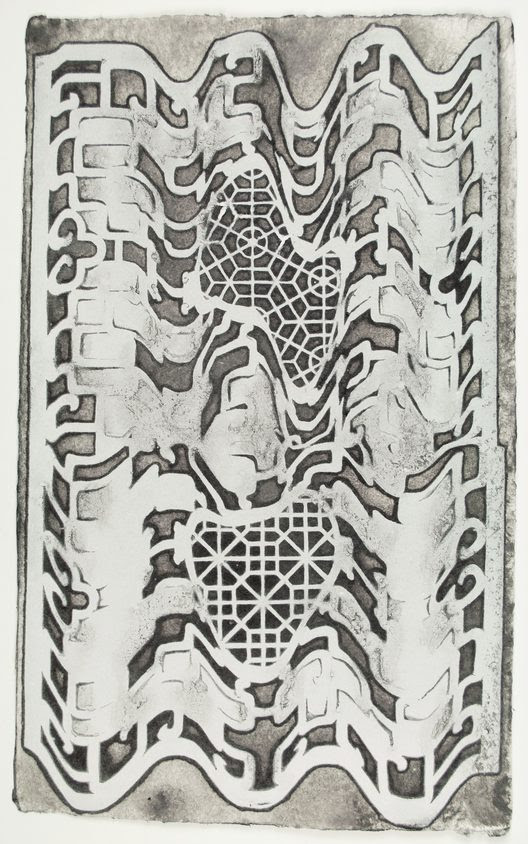
Paul Wong, Carbon, silver and gold, 2016, pigmented linen and cotton pulp, publisher: Dieu Donné, New York, edition 3/25, 18 × 11 inches. Gift of Dieu Donné, New York, 2022.27.06. © Paul Wong. |
On View March 8 through July 24, 2023
The Van Winkle Law Firm Gallery • Level 1
Paper is an essential part of the art-making process for many artists, serving as the base for drawing, painting, printmaking, and other forms of art. As a substrate, paper can vary in weight, absorbency, color, size, and other aspects. Since industrialization, paper has primarily been produced through mechanical means that allow for consistency and affordability.
What happens, then, when an artist chooses to return to the foundations of paper, wherein it is made by hand using pulps, fibers, and dyes that reflect the human element through variations, inconsistencies, flaws, and surprises? Certain artists have sought out these qualities and embraced them, making paper not just a support on which to work, but fully a medium in and of itself.
Pulp Potential: Works in Handmade Paper is organized by the Asheville Art Museum and curated by Hilary Schroeder, former assistant curator, with assistance from Alexis Meldrum, curatorial assistant. Special thanks to Dieu Donné, New York, NY.
The Art of Food features works from important postwar artists, like Robert Rauschenberg, Roy Lichtenstein, John Baldessari, Wayne Thiebaud, Ed Ruscha, Andy Warhol, David Hockney, and Jasper Johns, alongside the work of contemporary artists, like Alison Saar, Lorna Simpson, Enrique Chagoya, Rachel Whiteread, and Jenny Holzer, among others.
The Art of Food features more than 100 works in mediums that include drawings, paintings, photographs, prints, sculptures, and ceramics by 37 artists.
Each artist has a unique means of depicting food in their work that, when seen alongside others, creates a nuanced representation of the complex place food holds in everyday life. Cross-historical resonances between artists in the exhibition spark novel meditations on food and its discontents, while speaking to a broad range of audiences.
Online: Zoom Webinar
No cost due to sponsor support
It seems like everyday we see a new social media platform popping up. Come to this seminar to learn the differences between them and how you can leverage these sites to build and grow your business. We will discuss Snapchat, Tik Tok, Clubhouse, and several others. Learn why, how, and what you need to know in order to make an impact for your business.
Speaker(s): Matt Rudisill, owner and lead trainer of The Leadership Academy, assists small business owners and aspiring entrepreneurs by teaching them how to be the best in their field. Over the past 25 years, Matt has worked with thousands of businesses and has helped launch over 100 companies, while also consulting with several Fortune 500 and 100 companies. He conducts training sessions on social media marketing, customer service, strategic leadership, business planning, and other related business topics.
Co-Sponsor(s): Henderson County Chamber of Commerce and Brevard/Transylvania Chamber of Commerce
Webinar info will be emailed after registration.
Weekdays only at 2pm
Do you know our staff has a wild side? Join a Park naturalist to meet some of our live Animal Ambassadors and learn about the types of wildlife in the area and their jobs. Some of our best educators have feathers, fur, shells or scales!
Friday, June
16, 2023
Biltmore Estate: Ciao! From Italy Sculptural Postcard Display
IN PERSON WORKSHOP: “Creative Animal Sculpture” with Tina Curry
Pollinator Exploration Kit (Available for Loan)
Eidolon art exhibition
Exhibition: NEO MINERALIA
Exhibition: Something earned, Something left behind
Exhibition: Crafting Denim
Italian Renaissance Alive
Black Mountain College and Mexico (BMC/MX): Exhibition
Pulp Potential: Works in Handmade Paper
The Art of Food: From the Collections of Jordan D. Schnitzer and His Family Foundation
Summer Animal Encounters
Included with admission
Embark on a scenic journey across George Vanderbilt’s Italy with a large-scale outdoor display that combines brilliant botanical designs with authentic messages written by Vanderbilt himself.
Beautifully handcrafted of natural elements, each sculptural postcard depicts a location or landmark Vanderbilt visited more than a century ago. This captivating complement to Biltmore’s Italian Renaissance Alive exhibition reveals Vanderbilt’s passions for travel, culture, architecture, and art as well as his personal experience of such renowned Italian cities as Milan, Florence, Venice, Pisa, and Vatican City.
Adding to the charm and visual appeal of Ciao! From Italy—sure to be a hit among kids of all ages—is the G-scale model train that travels in and out of each postcard in this enlightening display!
“Creative Animal Sculpture” with Tina Curry
Week-Long Workshop
Day/Time: Monday-Friday, 9am-3pm
This workshop has the potential to launch you into a new creative realm by implementing sculpting techniques with clay to create creatures and forms of all kinds. Join us as we host, artist-sculptor, Tina Curry, as she walks you through the process of creating animal sculptures utilizing basic anatomy and proportions. Wood base and dowel supports will be used with newspaper in the basic construction. Photographs will be provided as reference for creating the sculptures. Each step of the sculpting process will include inspiring demonstrations by Tina, along with and individual instruction. This clay building technique will work for a variety of animal forms. The greenware sculptures can be transported home to be fired in your own studio or at The Village Potters Clay Center for an additional firing fee, plus shipping if needed. Tina will provide drying and firing instructions, along with other various finishing techniques.
Basic handbuilding knowledge is required.
Students will purchase clay directly from the Village Potters Clay Center the week of the workshop.
Open studio hours will be from 3-6pm each day.
Several weeks before the workshop you will receive the details of what to expect, what to bring, materials list, and directions to the studio.
Please contact The Village Potters Clay Center if you have any questions about this workshop.
Click HERE for suggested accommodations located near The Village Potters Clay Center.
Cancellation Policy:
-
- Cancellation up to 45 days prior to the start of class/workshop, students receive a full refund (minus a $75 administrative fee).
- Cancellation within less than 45 days of the start of class/workshop, students receive no refund.
About Tina Curry:
Tina began working with clay over 27 years ago. She holds a BA from the University of Florida and worked for 35 years in Graphic Design. Now retired, she is a full-time ceramic and bronze sculptor living in Knoxville, Tennessee. All of her sculptures are hand-built, so each has its own distinctive personality and characteristics. The specialty pieces are one of a kind and born of pure imagination. Alternative firing techniques using natural elements of horse hair, sawdust, banana peels, coffee, manure, and salt create an organic fusion. The fire, smoke, and fumes dance to create more natural surface effects and colorations. Bronze sculpture was added to her body of work in 2019 – another artistic medium that she has always wanted to pursue.
She was the featured artist for the Southern Highlands Craft Guild marketing campaign in 2016 and was honored with a solo exhibition for the Tennessee Arts Commission in Nashville, Tennessee in 2018. Her animal sculptures have been commissioned by the Knoxville Zoo, Tennessee and the Calgary Zoo in Alberta, Canada. Tina was also recently featured in the 2022 September Issue of Ceramics Monthly Magazine. Her clay work is in collections of both national and international art enthusiasts.
Presented by Bee City USA- Hendersonville and Bullington Gardens
For educators: teachers, camp counselors, home-school parents, childcare professionals, summer program leaders, and more, the Pollinator Exploration Kit provides excellent tools. Bee City USA – Hendersonville is eager to help you share the wonder of pollinators with children you teach. The kit includes sets of 12 sturdy child-size insect nets, special bug capture bubbles, bug boxes with magnifying lids, and magnifying glasses. Two pop-up insect habitats and two sets of laminated fold-out field guides (NC Trees & Wildflowers, NC Butterflies & Moths, Bees & Other Pollinators) are also included. The kit can be loaned for up to a week (as available) and may be picked up and returned weekdays 9am-4pm.
Pick-up location:
Bullington Gardens, 95 Upper Red Oak Trail, Hendersonville.
Cost: no charge
Reservation needed: contact [email protected] to check availability and reserve the dates to borrow the Pollinator Exploration Kit.
Exhibition dates: June 9 – July 23
Hours: Tuesday-Saturdays from 10-5 pm, Sundays 11-4 pm
Eidolon is an ancient term from Greek -oeidēs “form”. Early meanings included “mental image”, “appearance”, and “reflection” (as in a mirror or pool), and later, “apparition” or “imaginary entity”, among other things. Expanding beyond the definition pointing to a phantasm or specter, eidolon also sounds like some kind of astral or idyllic place in a novel or poem about an imaginary world. Eidolon features the work of Jacqueline Shatz and Margaret Thompson.
Jacqueline Shatz’s small sculptures of ambiguous and hybridized figures float, entwine, swim, commune with animals and collapse into abstract arabesques and gestures, hinting at mythology, in-between states, and the permeable nature of existence. Margaret Thompson’s paintings are inspired by elements of the symbolist movement and magical realism; she channels dreams and the associative powers of the imagination into her practice, painting subjects that live between our physical realm and spaces beyond the categories of known experience: they are unrestrained, undefined, and free.
Photo credit:
Sae Honda. Courtesy of the Artist.
NEO MINERALIA suggests that recent rock formations no longer fit within the traditional groups: Igneous, Metamorphic, and Sedimentary. Instead, the Anthropocene, the era of human influence on the climate and environment, has introduced two post-natural rocks: Synthetic and Digital.
NEO MINERALIA presents a selection of new geological specimens crafted by ten international artists exploring rocks as reflections of our effects on human and nonhuman ecologies. By embedding synthetic materials (plastics, e-waste) and layers of data points (critical, financial, social) into the craftsmanship of these artifacts, the artists transgress the definition of rocks, turning them from passive aggregates of minerals into metaphorical aggregates of data. Within their apparent “rockness” we can decode hopes, warnings, and speculative future scenarios.
The featured works stemming from places as varied as Mexico, Japan, Poland, and Australia (including a curated artists’ books library), collectively signal a new era of planetary and geological consciousness where we are asked to read, feel, and listen to rocks in new ways.
Photo credit:
J Diamond, “Pony II,” 2022. Courtesy of the Artist
Something earned, Something left behind is an exhibition of objecthood; a critical analysis of the transactional and political languages of everyday and culturally significant objects. This exhibition challenges a history of exclusion and inclusion of People of Color (POC) and their narratives from the canon of craft based on subject matter. It dissects this history’s origins and precedent as an economic transaction to gain access to white spaces.
Racial and ethnic identity influences the way individuals perceive themselves, the way others perceive them, and the way they choose to behave. For this reason, People of Color are expected to perform certain roles in order to fit into hegemonic institutions. These roles can be an active shrinking of themselves and the racialized part of them, or a personal exploitation of their racialized selves. This exhibition addresses and redresses the ways narrowed populations have been included, and the ways in which they have been asked to participate.
Together, this work creates space for and legitimizes POC narratives with depth and care. The exhibiting artists’ practices work against institutionalized expectations of POC work, expanding discourse and inserting new subjectivity into the canon of craft art. It engages with a community hungry for the revitalization and resuscitation of non-Western voices within art spaces. This exhibition challenges the expectations of art from artists of marginalized backgrounds and embraces a new subjectivity of interrogating one’s inherited experiences.
Photo credit:
Photograph by Bowery Blue Makers
Jeans – with their standardized pockets, rivets, and denim – are so much a part of everyday wardrobes that they are easy to overlook. Yet, in workshops across the nation, independent makers are reevaluating the garment and creating jeans by hand, using antiquated equipment and denim woven on midcentury looms. Crafting Denim explores how and why jeans have come to exist at the intersections of industry and craft, modernity, and tradition.
A product of industrial factory production for over a century, jeans are being recast by a new cohort of small-scale makers including craftspeople like Ryan Martin of W.H. Ranch Dungarees, Takayuki Echigoya of Bowery Blue Makers, and Sarah Yarborough and Victor Lytvinenko of Raleigh Denim, who favor choice materials and small-batch fabrication. The jeans they make merge craft traditions with industry and extend the conversation between hand and machine.
Each maker creates a distinctive product but shares a deep appreciation for materials, tools, history, and denim. These jeans are in dialogue with the past and in line with contemporary interests in sustainability. The small workshops featured here are sites of innovation and preservation, and visitors are invited to take a close look at an everyday item and imagine alternative contexts for making and living in our own clothes.
Explore Biltmore House with an Audio Guide that introduces you to the Vanderbilt family and their magnificent home’s history, architecture, and collections of fine art and furnishings.
PLUS: Immersive, multi-sensory Italian Renaissance Alive exhibition created by Grande Experiences
PLUS: FREE next-day access to Biltmore’s Gardens and Grounds
This visit includes access to:
- Italian Renaissance Alive at Amherst at Deerpark®
- 8,000 Acres of Gardens and Grounds for two consecutive days
- Antler Hill Village & Winery
- Complimentary Wine Tastings at the Winery
- Tastings require a Day-of-Visit Reservation, which can be made by:
- Scanning the QR Code found in your Estate Guide
- Visiting any Guest Services location
- Complimentary parking
Art Exhibition: Italian Renaissance Alive
This fascinating experience takes you on a spellbinding tour of Italy, fully immersing you in the beauty and brilliance of iconic masterworks from the greatest artistic period in history
Black Mountain College and Mexico (BMC/MX): Exhibition, Publication, and Public Programming
Black Mountain College (1933–1957), a small but remarkably influential liberal arts school in rural North Carolina, had important links to Mexico that until now have been little investigated. A crucible of twentieth-century creativity, BMC galvanized and inspired artists and intellectuals from around the world, while Mexico’s innovations and age-old traditions—in fine and applied arts, architecture, poetry, music, performance, and more—dovetailed with, and indeed drove, global impulses toward modernism and beyond. Among the many key BMC figures whose lives were importantly touched by experiences in Mexico were Anni and Josef Albers, Ruth Asawa, John Cage, Jean Charlot, Elaine de Kooning, Buckminster Fuller, Carlos Mérida, Robert Motherwell, Charles Olson, Clara Porset, M.C. Richards, and Aaron Siskind. In turn, engagements with BMC and its legacy have played a significant role in shaping contemporary approaches to art in Mexico, evident in the works of Jorge Méndez Blake, Iñaki Bonillas, Abraham Cruzvillegas, Jose Dávila, Gerda Gruber, Lake Verea, Gabriel Orozco, and Damián Ortega, among others.
The exhibition BMC/MX features works by these and other prominent contemporary Mexican artists alongside a selection of historic works by BMC artists, highlighting the ways in which ideas and modalities are translated across materials, space, and time.
Related programming, planned in collaboration with Mexican artists, features a series of public events, including a performance by artist (and BMC/MX co-curator) David Miranda to take place at Different Wrld; an exhibition visit (in Spanish and English) with BMC/MX Project Director Eric Baden; and a series of experiential art events in the BMCM+AC library.
The exhibition is accompanied by the book Black Mountain College and Mexico (forthcoming late summer 2023), which investigates the people, ideas, and practices linking BMC and Mexico during the life of the school, as well as resonances between BMC and the work of contemporary Mexican artists. With contributions by BMC/MX’s curators, as well as by artist Abraham Cruzvillegas, design scholar Ana Elena Mallet, and author and activist Margaret Randall, this fully illustrated volume brings new light to this complex and underexplored subject.
BMC/MX is an investigation into modes of communication—the arenas in which new ideas and alliances may come to be—between Black Mountain College and Mexico, between past and present, between form and idea.
About the Curators
BMC/MX’s Project Director Eric Baden is a photographer and from 1994 to 2022 was professor of photography at Warren Wilson College in Swannanoa, North Carolina. He is the founding director of photo+, a multidisciplinary arts event held in Asheville, North Carolina.
Artist and educator David Miranda is curator at the Museo Experimental El Eco (Universidad Nacional Autónoma de México, UNAM), and teaches at the Escuela Nacional de Pintura, Escultura y Grabado “La Esmeralda” in Mexico City.
Diana Stoll is an editor, writer and curator who works with institutions such as The Museum of Modern Art and the J. Paul Getty Museum. She has served as an editor at Aperture and Artforum magazines, and contributes writings to prominent arts publications.
|
|
Paul Wong, Carbon, silver and gold, 2016, pigmented linen and cotton pulp, publisher: Dieu Donné, New York, edition 3/25, 18 × 11 inches. Gift of Dieu Donné, New York, 2022.27.06. © Paul Wong. |
On View March 8 through July 24, 2023
The Van Winkle Law Firm Gallery • Level 1
Paper is an essential part of the art-making process for many artists, serving as the base for drawing, painting, printmaking, and other forms of art. As a substrate, paper can vary in weight, absorbency, color, size, and other aspects. Since industrialization, paper has primarily been produced through mechanical means that allow for consistency and affordability.
What happens, then, when an artist chooses to return to the foundations of paper, wherein it is made by hand using pulps, fibers, and dyes that reflect the human element through variations, inconsistencies, flaws, and surprises? Certain artists have sought out these qualities and embraced them, making paper not just a support on which to work, but fully a medium in and of itself.
Pulp Potential: Works in Handmade Paper is organized by the Asheville Art Museum and curated by Hilary Schroeder, former assistant curator, with assistance from Alexis Meldrum, curatorial assistant. Special thanks to Dieu Donné, New York, NY.
The Art of Food features works from important postwar artists, like Robert Rauschenberg, Roy Lichtenstein, John Baldessari, Wayne Thiebaud, Ed Ruscha, Andy Warhol, David Hockney, and Jasper Johns, alongside the work of contemporary artists, like Alison Saar, Lorna Simpson, Enrique Chagoya, Rachel Whiteread, and Jenny Holzer, among others.
The Art of Food features more than 100 works in mediums that include drawings, paintings, photographs, prints, sculptures, and ceramics by 37 artists.
Each artist has a unique means of depicting food in their work that, when seen alongside others, creates a nuanced representation of the complex place food holds in everyday life. Cross-historical resonances between artists in the exhibition spark novel meditations on food and its discontents, while speaking to a broad range of audiences.
Weekdays only at 2pm
Do you know our staff has a wild side? Join a Park naturalist to meet some of our live Animal Ambassadors and learn about the types of wildlife in the area and their jobs. Some of our best educators have feathers, fur, shells or scales!