It looks like you're using ad blocking technology. We are a local company, and our advertisers are local as well. Please consider allow listing our website in the future.
The Art of Food: From the Collections of Jordan D. Schnitzer and His Family Foundation
Sep 16 @ 11:00 am – 6:00 pm
Asheville Art Museum
The Art of Food features works from important postwar artists, like Robert Rauschenberg, Roy Lichtenstein, John Baldessari, Wayne Thiebaud, Ed Ruscha, Andy Warhol, David Hockney, and Jasper Johns, alongside the work of contemporary artists, like Alison Saar, Lorna Simpson, Enrique Chagoya, Rachel Whiteread, and Jenny Holzer, among others.
The Art of Food features more than 100 works in mediums that include drawings, paintings, photographs, prints, sculptures, and ceramics by 37 artists.
Each artist has a unique means of depicting food in their work that, when seen alongside others, creates a nuanced representation of the complex place food holds in everyday life. Cross-historical resonances between artists in the exhibition spark novel meditations on food and its discontents, while speaking to a broad range of audiences.
Western North Carolina Glass: Selections from the Collection
Sep 16 @ 11:00 am – 6:00 pm
Asheville Art Museum
Western North Carolina is important in the history of American glass art. Several artists of the Studio Glass Movement came to the region, including its founder Harvey K. Littleton. Begun in 1962 in Wisconsin, it was a student of Littleton’s that first came to the area in 1965 and set up a glass studio at the Penland School of Craft in Penland, North Carolina. By 1967, Mark Peiser was the first glass artist resident at the school and taught many notable artists, like Jak Brewer in 1968 and Richard Ritter who came to study in 1971. By 1977, Littleton retired from teaching and moved to nearby Spruce Pine, North Carolina and set up a glass studio at his home.
Since that time, glass artists like Ken Carder, Rick and Valerie Beck, Shane Fero, and Yaffa Sikorsky and Jeff Todd—to name only a few—have flocked to the area to reside, collaborate, and teach, making it a significant place for experimentation and education in glass. The next generation of artists like Hayden Wilson and Alex Bernstein continue to create here. The Museum is dedicated to collecting American studio glass and within that umbrella, explores the work of Artists connected to Western North Carolina. Exhibitions, including Intersections of American Art, explore glass art in the context of American Art of the 20th and 21st centuries. A variety of techniques and a willingness to push boundaries of the medium can be seen in this selection of works from the Museum’s Collection.
Makers Market at Atelier Maison + Co.
Sep 16 @ 12:00 pm – 5:00 pm
Atelier Maison
Atelier Maison & Co. and Show & Tell are teaming up to showcase the best in art & design to the Asheville Design District. Join us at the Atelier Maison Co. showroom off of Sweeten Creek Rd for a monthly Makers Market every third Saturday. Each month will feature vendors and artisans selling housewares, vintage clothing, original art, handmade crafts, fair trade imports, and more.
LAZOOM Tours: GHOST COMEDY BUS TOUR
Sep 16 @ 7:00 pm
LaZoom Room
GHOST COMEDY BUS TOUR
Grab a local beer, crucifix and a rubber chicken* —You might survive this hour long hilarious haunted ghost tour of Asheville.
Guided comedy bus tour of Haunted Asheville
60 minutes; tours run nightly after dark
$33 per person (Ages 17+ only)
Departs from 76 Biltmore Avenue
*Legal Note:Crucifix not required to board the bus; we do not condone exorcisms, chickens, rubber, or any combination of the three.
Monty Python’s Spamalot
Sep 16 @ 7:30 pm
HART Theatre
Find your grail.
Lovingly ripped off from the classic film comedy Monty Python and the Holy Grail, Monty Python’s Spamalot retells the legend of King Arthur and his Knights of the Round Table, and features a bevy of beautiful show girls, not to mention cows, killer rabbits, and French people. The 2005 Broadway production received 14 Tony nominations and won three Tony Awards, including Best Musical, and was followed by two successful West End runs. The outrageous, uproarious, and gloriously entertaining story of King Arthur and the Lady of the Lake will delight audiences as they search for the Holy Grail and “always look on the bright side of life.”
Rated PG-13 for mild language and suggestive content.
Modelface Comedy Presents: Brendan Gay at Ginger’s Revenge
Sep 16 @ 8:00 pm
Ginger's Revenge
Modelface Comedy brings you the best comedians from all over the country!
Born and raised in the Midwest, Brendan is a national touring comedian who smiles confidently when nervous. Whether it’s his keen perspective on minority culture or growing up as a millennial, he’ll make you laugh. Brendan was a finalist on TruTV’s Comedy Breakout initiative at The New York Television Festival, Finalist in the Make Me Laugh USA Competition, and Semi finalist in NBC’s Stand Up Diversity Showcase and part of the San Francisco International Comedy Competition. In 2017, Brendan went on a “52 x 52” comedy tour where he traveled to 52 cities in 52 weeks doing stand up comedy at the most respected clubs and venues across the country. He’s also the creator and producer of Send It Show Podcast. His Comedy Special The Riot is out now on Youtube
Applications open: 2024 Asheville Fringe Arts Festival
Sep 17 all-day
online w/ Asheville Fringe Arts
APPLICATIONS OPEN NOW!
Do you have a boundary-pushing, innovative performance piece, short film or installation that you’re ready to share?
We will open applications for the film portion of the festival in fall 2023. Films must be submitted via FilmFreeway. Our application fee for films is $5.
NOW CONSIDERING WORKS OF ALL KINDS
We accept live performances from 5 to 60 minutes in length, plus installations and films. We’re open to other types of performance as well – let’s talk! Depending on its length, your piece may be grouped with another show, or scheduled as a Random Act of Fringe. RAFs are free and open to the public, and artists receive a stipend for their performance, rather than relying on door sales.
Typically each artist with a ticketed show gets 2 performances. But in 2024, we’re exploring the option of giving a few shows 3 performances, at select venues only. Our venues range from 20-80 person capacity.
1. FRINGE SHOT
A piece that is
5-15 minutes long
May be paired with another performance, or be selected as a free Random Act of Fringe.
2. SHORT FORM
A piece that is 20-40 minutes long
May be paired with another show.
3. FULL-LENGTH
A piece that is 45-60 minutes long
Ticketed theater-style show.
4. INSTALLATION
A piece that is Site-specific (any length)
May be in an unusual location, or repeated many times. May be seen by as few as one person at a time.
5. FILM
A piece that is Designed specifically for film.
May be of any genre & length. Could be combined with other films for a showcase or film night.
Submit on Film Freeway Fall 2023
3. THE ASHEVILLE FRINGE ARTS FESTIVAL IS A JURIED FESTIVAL.
We carefully review each and every submission. You’ll know by late October if your piece is selected. Should your piece get selected, there is a $35 participation fee.
ReStore ReUse Contest
Sep 17 all-day
online
The local ReStore ReUse Contest is officially open for
submissions. Now through September 30, residents can show off their creativity and talent for
a chance to win in the 12 th annual contest. Fabulous furniture make-overs, remarkable
renovations, or unique yard art…if you recently took on a DIY project using predominantly
reused building materials, the Asheville Habitat ReStore wants to know. There are five
categories this year plus Best in Show, and all entries must be submitted electronically. For
guidelines and entry form, visit ashevillehabitat.org/restore .
The creativity of this community never ceases to amaze. Past projects have included a fence
fashioned from doors, a potting bench built from pallets, a wine bar made from a vintage
console radio, a chair constructed from an oil drum, and so much more. To see photos from
2022, click here.
A panel of five judges will select winners in the following categories: Furniture, Homesteading,
Live/Work Space, Home Décor, Art + Best in Show. Winners will be announced in mid-
October.
Biltmore Estate: Ciao! From Italy Sculptural Postcard Display
Sep 17 @ 8:30 am
Biltmore Estate
Included with admission
Embark on a scenic journey across George Vanderbilt’s Italy with a large-scale outdoor display that combines brilliant botanical designs with authentic messages written by Vanderbilt himself.
Beautifully handcrafted of natural elements, each sculptural postcard depicts a location or landmark Vanderbilt visited more than a century ago. This captivating complement to Biltmore’s Italian Renaissance Alive exhibition reveals Vanderbilt’s passions for travel, culture, architecture, and art as well as his personal experience of such renowned Italian cities as Milan, Florence, Venice, Pisa, and Vatican City.
Adding to the charm and visual appeal of Ciao! From Italy—sure to be a hit among kids of all ages—is the G-scale model train that travels in and out of each postcard in this enlightening display!
LAZOOM: CITY COMEDY TOUR
Sep 17 @ 10:00 am
LaZoom Room
Learn Asheville’s history, discover hidden gems, and laugh at LaZoom’s quirky sense of adventure.
Beyond the Lens: Photorealist Perspectives on Looking, Seeing, and Painting
Sep 17 @ 11:00 am – 6:00 pm
Asheville Art Museum
Throughout the history of painting from the mid-19th century forward, artists have used an
endless variety of approaches to record their world. Beyond the Lens: Photorealist Perspectives on Looking, Seeing, and Painting continues this thread, offering an opportunity to explore a singular and still forceful aspect of American art. Photorealism shares many of the approaches of historical and modernist realism, with a twist. The use of the camera as a basic tool for organizing visual information in advance of painterly expression is now quite common, but Photorealists embraced the camera as the focal point in their creative process.
Beyond the Lens presents key works from the collection of Louis K. and Susan Pear Meisel,
bringing together paintings and works on paper dating from the 1970s to the present to focus on this profoundly influential art movement. The exhibition includes work by highly acclaimed formative artists of the movement such as Charles Bell, Robert Bechtle, Tom Blackwell, Richard Estes, Audrey Flack, and Ralph Goings as well as paintings by the successive generations of Photorealist artists Anthony Brunelli, Davis Cone, Bertrand Meniel, Rod Penner, and Raphaella Spence. Featured artworks in the exhibition include diverse subject matters, but the primary focus is on the common and every day: urban scenes, “portraits” of cars, trucks, and motorcycles, still life compositions using toys, food, candy wrappers, and salt and pepper shakers. All provide opportunities for virtuoso studies in how light, reflection, and the camera as intermediary shapes our perception of the material world.
This multigenerational survey demonstrates how the 35-mm camera, and later technological
advances in digital image-making, informed and impacted the painterly gesture. Taken together, the paintings and works on paper in Beyond the Lens show how simply spellbinding these virtuosic works of art can be.
“Beyond the Lens offers a fascinating look into the Photorealism movement and delves into the profound connection between the artists’ observation and creative process,” says Pamela L. Myers, Executive Director of Asheville Art Museum. “We are delighted to present this curated collection of artworks encapsulating the creative vision and technical precision that defines this artistic genre.”
Photorealism found its roots in the late 1960s in California and New York, coexisting with an explosion of new ideas in art-making that included Conceptual, Pop, Minimalism, Land and Performance Art. At first, representational realism coexisted with the thematic and conceptual explosion but was eventually relegated to the margins regarding critical and curatorial attention. Often misunderstood and sometimes negatively criticized or lampooned as a betrayal of modernism’s commitment to abstraction, the artists involved in Photorealism remained committed explorers of the trail they had blazed. In the decades of the late twentieth century and early twenty-first century, realistic and symbolic painting experienced a renaissance, as contemporary artists are increasingly drawn to narrative and storytelling. Concurrently, using a camera as a preparatory tool equally legitimate and valuable as pencils and pens has made the rubric of Photorealism increasingly relevant.
This exhibition is organized by the Asheville Art Museum and guest curated by Terrie Sultan.
This exhibition is sponsored in part by Jim and Julia Calkins Peterson.
Romare Bearden: Ways of Working Exhibition
Sep 17 @ 11:00 am – 6:00 pm
Asheville Art Museum
Romare Bearden (Charlotte, NC 1911–1988 New York, NY), African American writer and artist, is renowned for his collages. He constantly experimented with various techniques to achieve his artistic goals throughout his career. This exhibition highlights works on paper and explores his most frequently used mediums, including screen-printing, lithography, hand-colored etching, collagraph, monotype, relief print, photomontage, and collage.
Bearden’s work reflects his improvisational approach to his practice. He considered his process akin to that of jazz and blues composers. Starting with an open mind, he would let an idea evolve spontaneously.
“Romare Bearden: Ways of Working highlights Bearden’s unique artistic practice and masterful storytelling through art,” says Pamela L. Myers, Executive Director of the Asheville Art Museum. “We are thrilled to collaborate with Jerald Melberg Gallery to present these extraordinary works on paper in conversation with Bearden’s collage Sunset Express, 1984 in the Museum Collection (on view in the Museum’s SECU Collection Hall). This exhibition will also provide a glimpse into the cultural histories and personal interests that influenced his art-making practice, and we hope it encourages introspection and dialogue with our visitors.”
Jerald Melberg states, “Romare Bearden’s groundbreaking artistic practice continues to captivate audiences worldwide. With an unparalleled legacy of creativity and innovation, Bearden’s contributions to art remain deeply influential years beyond his life.” We have enjoyed organizing this exhibition with the Asheville Art Museum to showcase his artistic genius and inspire visitors from the Western North Carolina region and beyond.”
This exhibition is made possible in part by the Judy Appleton Fund. Many thanks to the Jerald Melberg Gallery for the loan of these important artworks and to Mary and Jerald Melberg for their long-standing support of the arts, artists, and the Asheville Art Museum.
The Art of Food: From the Collections of Jordan D. Schnitzer and His Family Foundation
Sep 17 @ 11:00 am – 6:00 pm
Asheville Art Museum
The Art of Food features works from important postwar artists, like Robert Rauschenberg, Roy Lichtenstein, John Baldessari, Wayne Thiebaud, Ed Ruscha, Andy Warhol, David Hockney, and Jasper Johns, alongside the work of contemporary artists, like Alison Saar, Lorna Simpson, Enrique Chagoya, Rachel Whiteread, and Jenny Holzer, among others.
The Art of Food features more than 100 works in mediums that include drawings, paintings, photographs, prints, sculptures, and ceramics by 37 artists.
Each artist has a unique means of depicting food in their work that, when seen alongside others, creates a nuanced representation of the complex place food holds in everyday life. Cross-historical resonances between artists in the exhibition spark novel meditations on food and its discontents, while speaking to a broad range of audiences.
Western North Carolina Glass: Selections from the Collection
Sep 17 @ 11:00 am – 6:00 pm
Asheville Art Museum
Western North Carolina is important in the history of American glass art. Several artists of the Studio Glass Movement came to the region, including its founder Harvey K. Littleton. Begun in 1962 in Wisconsin, it was a student of Littleton’s that first came to the area in 1965 and set up a glass studio at the Penland School of Craft in Penland, North Carolina. By 1967, Mark Peiser was the first glass artist resident at the school and taught many notable artists, like Jak Brewer in 1968 and Richard Ritter who came to study in 1971. By 1977, Littleton retired from teaching and moved to nearby Spruce Pine, North Carolina and set up a glass studio at his home.
Since that time, glass artists like Ken Carder, Rick and Valerie Beck, Shane Fero, and Yaffa Sikorsky and Jeff Todd—to name only a few—have flocked to the area to reside, collaborate, and teach, making it a significant place for experimentation and education in glass. The next generation of artists like Hayden Wilson and Alex Bernstein continue to create here. The Museum is dedicated to collecting American studio glass and within that umbrella, explores the work of Artists connected to Western North Carolina. Exhibitions, including Intersections of American Art, explore glass art in the context of American Art of the 20th and 21st centuries. A variety of techniques and a willingness to push boundaries of the medium can be seen in this selection of works from the Museum’s Collection.
Art Exhibition: Eden Revisited
Sep 17 @ 12:00 pm – 5:00 pm
Bender Gallery
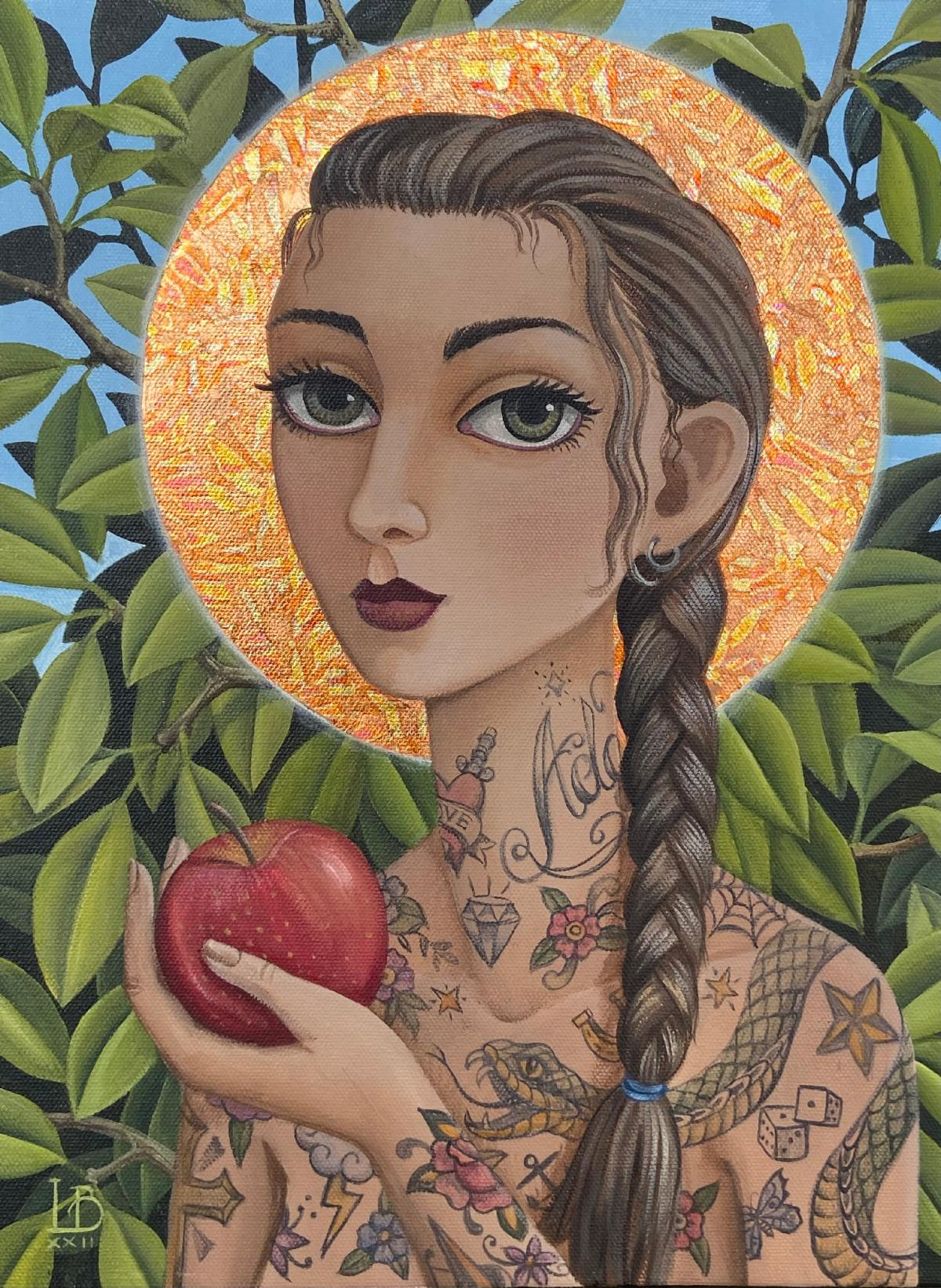
Eve
acrylic on canvas
16 x 12 inches
LAINE BACHMAN
Eden Revisited
September 30 – October 30
Bender Gallery is excited to present Eden Revisited, a solo exhibition of thirty-plus lush, botanical paintings by popular artist Laine Bachman featuring real and imaginary creatures and goddess-like women with a deep connection to the natural world. Often inspired by myths, folklore, and nature, Bachman infuses the colorful worlds she creates with verdant foliage, archetypal imagery, underlying themes, exotic fauna, and meticulous detail.
Monty Python’s Spamalot
Sep 17 @ 2:00 pm
HART Theatre
Find your grail.
Lovingly ripped off from the classic film comedy Monty Python and the Holy Grail, Monty Python’s Spamalot retells the legend of King Arthur and his Knights of the Round Table, and features a bevy of beautiful show girls, not to mention cows, killer rabbits, and French people. The 2005 Broadway production received 14 Tony nominations and won three Tony Awards, including Best Musical, and was followed by two successful West End runs. The outrageous, uproarious, and gloriously entertaining story of King Arthur and the Lady of the Lake will delight audiences as they search for the Holy Grail and “always look on the bright side of life.”
Rated PG-13 for mild language and suggestive content.
Slice of Life Comedy Open Mic + Feature Comedy at Asheville Pizza
Sep 17 @ 6:30 pm
Asheville Pizza & Brewing Co
Another Great Comedy Show at Asheville Pizza & Brewing Co, Theater 2! 6:30p, 18+, Get Dinner, Drinks & Laughs with the areas best standup comics. Featured and Open Mic Comedy. Performing comics get FREE entry and pizza. Get Your Tickets Now!! Hosted Morgan Marie. Featuring James Burkes, Jack Pearson & more great comics!
Bert Kreischer: Tops Off World Tour
Sep 17 @ 7:00 pm
Bon Secours Wellness Arena
Renowned comedian, actor, host, and author Bert Kreischer announced he’ll be extending his Tops Off World Tourwith 31 new dates this fall.For more information and tickets, visitbertbertbert.com or follow @bertkreischer on social media.
As one of the best storytellers of his generation, Kreischer seamlessly and sincerely shares anecdotes about his family and fatherhood while proving “that there’s a way to take his [party-boy] antics into middle-age,” (Forbes).
On March 14th, Kreischer released his highly anticipated 5th stand-up special, Razzle Dazzle on Netflix. Shameless — and shirtless — as ever, Bert spills on bodily emissions, being bullied by his kids, and the explosive end to his family’s escape room outing. His stand-up specials, Secret Time, The Machine, and Hey Big Boy are currently streaming on Netflix.
As if that wasn’t enough, Kreischer tops off this summer as the star and producer in the Legendary/ Sony picture film, The Machine, exclusively in theatres across the country on May 26th. Kreischer rose to fame as a stand-up comedian known as The Machine, and in his signature set, he recounts his true experience with Russian mobsters while on a booze-soaked college trip. Now, 23 years later, that trip has come back to haunt him as he and his estranged father (Mark Hamill) are kidnapped back to Russia by the mob to atone for something they say he did. Together, Bert and his father must retrace the steps of his younger self (Jimmy Tatro) in the midst of a war within a sociopathic crime family, all while attempting to find common ground in their often-fraught relationship.
On June 14th, Bert will kick-off the second annual Fully Loaded Comedy Festival at sixteen of the most iconic ballparks and arenas across the country. The biggest comedy event of the year with a “Fully Loaded” line-up that includes Bert Kreischer, Mark Normand, Shane Gillis, Tiffany Haddish, Stavros Halkias, Fortune Feimster, Dave Attell, Lewis Black, Jim Norton, Andrew Santino, Big Jay Oakerson, Jay Pharoah, Dan Soder, Chad Daniels, Ralph Barbosa, Rosebud Baker and Tammy Pescatelli.
In addition to a successful stand-up career, Kreischer has made himself a world-renowned top podcaster with his popular comedy podcasts. Bert hosts Bertcast where he shares his wisdom and life with fans and has recorded over 500 episodes. He also co-hosts the podcast, Two Bears One Cave with Tom Segura, which is consistently charting in the top 10 comedy podcasts in the world. In addition to the podcast, Bert is the host of the YouTube cooking show, Something’s Burning that has gathered close to 10 million views.
LAZOOM Tours: GHOST COMEDY BUS TOUR
Sep 17 @ 7:00 pm
LaZoom Room
GHOST COMEDY BUS TOUR
Grab a local beer, crucifix and a rubber chicken* —You might survive this hour long hilarious haunted ghost tour of Asheville.
Guided comedy bus tour of Haunted Asheville
60 minutes; tours run nightly after dark
$33 per person (Ages 17+ only)
Departs from 76 Biltmore Avenue
*Legal Note:Crucifix not required to board the bus; we do not condone exorcisms, chickens, rubber, or any combination of the three.
Monty Python’s Spamalot
Sep 17 @ 7:30 pm
HART Theatre
Find your grail.
Lovingly ripped off from the classic film comedy Monty Python and the Holy Grail, Monty Python’s Spamalot retells the legend of King Arthur and his Knights of the Round Table, and features a bevy of beautiful show girls, not to mention cows, killer rabbits, and French people. The 2005 Broadway production received 14 Tony nominations and won three Tony Awards, including Best Musical, and was followed by two successful West End runs. The outrageous, uproarious, and gloriously entertaining story of King Arthur and the Lady of the Lake will delight audiences as they search for the Holy Grail and “always look on the bright side of life.”
Rated PG-13 for mild language and suggestive content.
Biltmore Estate: Ciao! From Italy Sculptural Postcard Display
Sep 18 @ 8:30 am
Biltmore Estate
Included with admission
Embark on a scenic journey across George Vanderbilt’s Italy with a large-scale outdoor display that combines brilliant botanical designs with authentic messages written by Vanderbilt himself.
Beautifully handcrafted of natural elements, each sculptural postcard depicts a location or landmark Vanderbilt visited more than a century ago. This captivating complement to Biltmore’s Italian Renaissance Alive exhibition reveals Vanderbilt’s passions for travel, culture, architecture, and art as well as his personal experience of such renowned Italian cities as Milan, Florence, Venice, Pisa, and Vatican City.
Adding to the charm and visual appeal of Ciao! From Italy—sure to be a hit among kids of all ages—is the G-scale model train that travels in and out of each postcard in this enlightening display!
Exhibition: NEO MINERALIA
Sep 18 @ 10:00 am – 6:00 pm
Center for Craft
Photo credit:
Sae Honda. Courtesy of the Artist.
NEO MINERALIA suggests that recent rock formations no longer fit within the traditional groups: Igneous, Metamorphic, and Sedimentary. Instead, the Anthropocene, the era of human influence on the climate and environment, has introduced two post-natural rocks: Synthetic and Digital.
NEO MINERALIA presents a selection of new geological specimens crafted by ten international artists exploring rocks as reflections of our effects on human and nonhuman ecologies. By embedding synthetic materials (plastics, e-waste) and layers of data points (critical, financial, social) into the craftsmanship of these artifacts, the artists transgress the definition of rocks, turning them from passive aggregates of minerals into metaphorical aggregates of data. Within their apparent “rockness” we can decode hopes, warnings, and speculative future scenarios.
The featured works stemming from places as varied as Mexico, Japan, Poland, and Australia (including a curated artists’ books library), collectively signal a new era of planetary and geological consciousness where we are asked to read, feel, and listen to rocks in new ways.
Exhibition: Something earned, Something left behind
Sep 18 @ 10:00 am – 6:00 pm
Center for Craft
Photo credit:
J Diamond, “Pony II,” 2022. Courtesy of the Artist
Something earned, Something left behind is an exhibition of objecthood; a critical analysis of the transactional and political languages of everyday and culturally significant objects. This exhibition challenges a history of exclusion and inclusion of People of Color (POC) and their narratives from the canon of craft based on subject matter. It dissects this history’s origins and precedent as an economic transaction to gain access to white spaces.
Racial and ethnic identity influences the way individuals perceive themselves, the way others perceive them, and the way they choose to behave. For this reason, People of Color are expected to perform certain roles in order to fit into hegemonic institutions. These roles can be an active shrinking of themselves and the racialized part of them, or a personal exploitation of their racialized selves. This exhibition addresses and redresses the ways narrowed populations have been included, and the ways in which they have been asked to participate.
Together, this work creates space for and legitimizes POC narratives with depth and care. The exhibiting artists’ practices work against institutionalized expectations of POC work, expanding discourse and inserting new subjectivity into the canon of craft art. It engages with a community hungry for the revitalization and resuscitation of non-Western voices within art spaces. This exhibition challenges the expectations of art from artists of marginalized backgrounds and embraces a new subjectivity of interrogating one’s inherited experiences.
Exhibition: Crafting Denim
Sep 18 @ 10:00 am – 6:00 pm
Center for Craft
Photo credit:
Photograph by Bowery Blue Makers
Jeans – with their standardized pockets, rivets, and denim – are so much a part of everyday wardrobes that they are easy to overlook. Yet, in workshops across the nation, independent makers are reevaluating the garment and creating jeans by hand, using antiquated equipment and denim woven on midcentury looms. Crafting Denim explores how and why jeans have come to exist at the intersections of industry and craft, modernity, and tradition.
A product of industrial factory production for over a century, jeans are being recast by a new cohort of small-scale makers including craftspeople like Ryan Martin of W.H. Ranch Dungarees, Takayuki Echigoya of Bowery Blue Makers, and Sarah Yarborough and Victor Lytvinenko of Raleigh Denim, who favor choice materials and small-batch fabrication. The jeans they make merge craft traditions with industry and extend the conversation between hand and machine.
Each maker creates a distinctive product but shares a deep appreciation for materials, tools, history, and denim. These jeans are in dialogue with the past and in line with contemporary interests in sustainability. The small workshops featured here are sites of innovation and preservation, and visitors are invited to take a close look at an everyday item and imagine alternative contexts for making and living in our own clothes.
LAZOOM: CITY COMEDY TOUR
Sep 18 @ 10:00 am
LaZoom Room
Learn Asheville’s history, discover hidden gems, and laugh at LaZoom’s quirky sense of adventure.
Beyond the Lens: Photorealist Perspectives on Looking, Seeing, and Painting
Sep 18 @ 11:00 am – 6:00 pm
Asheville Art Museum
Throughout the history of painting from the mid-19th century forward, artists have used an
endless variety of approaches to record their world. Beyond the Lens: Photorealist Perspectives on Looking, Seeing, and Painting continues this thread, offering an opportunity to explore a singular and still forceful aspect of American art. Photorealism shares many of the approaches of historical and modernist realism, with a twist. The use of the camera as a basic tool for organizing visual information in advance of painterly expression is now quite common, but Photorealists embraced the camera as the focal point in their creative process.
Beyond the Lens presents key works from the collection of Louis K. and Susan Pear Meisel,
bringing together paintings and works on paper dating from the 1970s to the present to focus on this profoundly influential art movement. The exhibition includes work by highly acclaimed formative artists of the movement such as Charles Bell, Robert Bechtle, Tom Blackwell, Richard Estes, Audrey Flack, and Ralph Goings as well as paintings by the successive generations of Photorealist artists Anthony Brunelli, Davis Cone, Bertrand Meniel, Rod Penner, and Raphaella Spence. Featured artworks in the exhibition include diverse subject matters, but the primary focus is on the common and every day: urban scenes, “portraits” of cars, trucks, and motorcycles, still life compositions using toys, food, candy wrappers, and salt and pepper shakers. All provide opportunities for virtuoso studies in how light, reflection, and the camera as intermediary shapes our perception of the material world.
This multigenerational survey demonstrates how the 35-mm camera, and later technological
advances in digital image-making, informed and impacted the painterly gesture. Taken together, the paintings and works on paper in Beyond the Lens show how simply spellbinding these virtuosic works of art can be.
“Beyond the Lens offers a fascinating look into the Photorealism movement and delves into the profound connection between the artists’ observation and creative process,” says Pamela L. Myers, Executive Director of Asheville Art Museum. “We are delighted to present this curated collection of artworks encapsulating the creative vision and technical precision that defines this artistic genre.”
Photorealism found its roots in the late 1960s in California and New York, coexisting with an explosion of new ideas in art-making that included Conceptual, Pop, Minimalism, Land and Performance Art. At first, representational realism coexisted with the thematic and conceptual explosion but was eventually relegated to the margins regarding critical and curatorial attention. Often misunderstood and sometimes negatively criticized or lampooned as a betrayal of modernism’s commitment to abstraction, the artists involved in Photorealism remained committed explorers of the trail they had blazed. In the decades of the late twentieth century and early twenty-first century, realistic and symbolic painting experienced a renaissance, as contemporary artists are increasingly drawn to narrative and storytelling. Concurrently, using a camera as a preparatory tool equally legitimate and valuable as pencils and pens has made the rubric of Photorealism increasingly relevant.
This exhibition is organized by the Asheville Art Museum and guest curated by Terrie Sultan.
This exhibition is sponsored in part by Jim and Julia Calkins Peterson.
Romare Bearden: Ways of Working Exhibition
Sep 18 @ 11:00 am – 6:00 pm
Asheville Art Museum
Romare Bearden (Charlotte, NC 1911–1988 New York, NY), African American writer and artist, is renowned for his collages. He constantly experimented with various techniques to achieve his artistic goals throughout his career. This exhibition highlights works on paper and explores his most frequently used mediums, including screen-printing, lithography, hand-colored etching, collagraph, monotype, relief print, photomontage, and collage.
Bearden’s work reflects his improvisational approach to his practice. He considered his process akin to that of jazz and blues composers. Starting with an open mind, he would let an idea evolve spontaneously.
“Romare Bearden: Ways of Working highlights Bearden’s unique artistic practice and masterful storytelling through art,” says Pamela L. Myers, Executive Director of the Asheville Art Museum. “We are thrilled to collaborate with Jerald Melberg Gallery to present these extraordinary works on paper in conversation with Bearden’s collage Sunset Express, 1984 in the Museum Collection (on view in the Museum’s SECU Collection Hall). This exhibition will also provide a glimpse into the cultural histories and personal interests that influenced his art-making practice, and we hope it encourages introspection and dialogue with our visitors.”
Jerald Melberg states, “Romare Bearden’s groundbreaking artistic practice continues to captivate audiences worldwide. With an unparalleled legacy of creativity and innovation, Bearden’s contributions to art remain deeply influential years beyond his life.” We have enjoyed organizing this exhibition with the Asheville Art Museum to showcase his artistic genius and inspire visitors from the Western North Carolina region and beyond.”
This exhibition is made possible in part by the Judy Appleton Fund. Many thanks to the Jerald Melberg Gallery for the loan of these important artworks and to Mary and Jerald Melberg for their long-standing support of the arts, artists, and the Asheville Art Museum.
The Art of Food: From the Collections of Jordan D. Schnitzer and His Family Foundation
Sep 18 @ 11:00 am – 6:00 pm
Asheville Art Museum
The Art of Food features works from important postwar artists, like Robert Rauschenberg, Roy Lichtenstein, John Baldessari, Wayne Thiebaud, Ed Ruscha, Andy Warhol, David Hockney, and Jasper Johns, alongside the work of contemporary artists, like Alison Saar, Lorna Simpson, Enrique Chagoya, Rachel Whiteread, and Jenny Holzer, among others.
The Art of Food features more than 100 works in mediums that include drawings, paintings, photographs, prints, sculptures, and ceramics by 37 artists.
Each artist has a unique means of depicting food in their work that, when seen alongside others, creates a nuanced representation of the complex place food holds in everyday life. Cross-historical resonances between artists in the exhibition spark novel meditations on food and its discontents, while speaking to a broad range of audiences.
Western North Carolina Glass: Selections from the Collection
Sep 18 @ 11:00 am – 6:00 pm
Asheville Art Museum
Western North Carolina is important in the history of American glass art. Several artists of the Studio Glass Movement came to the region, including its founder Harvey K. Littleton. Begun in 1962 in Wisconsin, it was a student of Littleton’s that first came to the area in 1965 and set up a glass studio at the Penland School of Craft in Penland, North Carolina. By 1967, Mark Peiser was the first glass artist resident at the school and taught many notable artists, like Jak Brewer in 1968 and Richard Ritter who came to study in 1971. By 1977, Littleton retired from teaching and moved to nearby Spruce Pine, North Carolina and set up a glass studio at his home.
Since that time, glass artists like Ken Carder, Rick and Valerie Beck, Shane Fero, and Yaffa Sikorsky and Jeff Todd—to name only a few—have flocked to the area to reside, collaborate, and teach, making it a significant place for experimentation and education in glass. The next generation of artists like Hayden Wilson and Alex Bernstein continue to create here. The Museum is dedicated to collecting American studio glass and within that umbrella, explores the work of Artists connected to Western North Carolina. Exhibitions, including Intersections of American Art, explore glass art in the context of American Art of the 20th and 21st centuries. A variety of techniques and a willingness to push boundaries of the medium can be seen in this selection of works from the Museum’s Collection.
LAZOOM Tours: GHOST COMEDY BUS TOUR
Sep 18 @ 7:00 pm
LaZoom Room
GHOST COMEDY BUS TOUR
Grab a local beer, crucifix and a rubber chicken* —You might survive this hour long hilarious haunted ghost tour of Asheville.
Guided comedy bus tour of Haunted Asheville
60 minutes; tours run nightly after dark
$33 per person (Ages 17+ only)
Departs from 76 Biltmore Avenue
*Legal Note:Crucifix not required to board the bus; we do not condone exorcisms, chickens, rubber, or any combination of the three.



.jpg) Exhibition: Something earned, Something left behind
Exhibition: Something earned, Something left behind
 Exhibition: Crafting Denim
 LAZOOM: CITY COMEDY TOUR
Beyond the Lens: Photorealist Perspectives on Looking, Seeing, and Painting
Romare Bearden: Ways of Working Exhibition
The Art of Food: From the Collections of Jordan D. Schnitzer and His Family Foundation
Western North Carolina Glass: Selections from the Collection
LAZOOM: CITY COMEDY TOUR
Beyond the Lens: Photorealist Perspectives on Looking, Seeing, and Painting
Romare Bearden: Ways of Working Exhibition
The Art of Food: From the Collections of Jordan D. Schnitzer and His Family Foundation
Western North Carolina Glass: Selections from the Collection