

Calendar of Events
Upcoming events and things to do in Asheville, NC. Below is a list of events for festivals, concerts, art exhibitions, group meetups and more.
Interested in adding an event to our calendar? Please click the green “Post Your Event” button below.
 |
|
We’re flipping the script on trick or treating this year! Guess Who: A Costume Quest is an outdoor walking tour and interactive game that features costumed actors from past ACT plays and musicals. Guess who’s who, and after you do, there’s a take-home bag of candy and treats for you! This family-friendly night of fun will be held in the parking lots and surrounding grounds of Asheville Community Theatre and the Thomas Wolfe House. Tours will begin at 6:00 pm and start times will be staggered to maintain social distancing. How will this work? Chanda Calentine explains: “You’ll walk on a path around our building and will encounter 12 different characters along the way. They’ll each share a clue or two about themselves, and you’ll try to guess who they are and which show they’re from. These are recognizable characters from our family friendly shows, and even if you haven’t seen these shows at ACT, we think you’ll still be able to make a good guess! And, at the end of the tour, we’ll have treats for you to take home. |
LEAVE IT BETTER SWEEPSTAKES
Enter to win an ENO Leave No Trace Double Nest hammock and suspension system today! ENO and Explore Brevard are excited to partner in the effort to promote our new Leave It Better campaign. Entering is easy. Simply follow these steps and you’ll be automatically entered into the sweepstakes:
STEP 1
Follow ENO Hammocks and Explore Brevard on Instagram or Facebook.
Step 2
Post an example of how you Leave No Trace and go the extra step to Leave It Better on your own social media account with the hashtag #ILeaveItBetter
Step 3
Watch our social media accounts for winner announcements at the end of August, September and October!
Each month will have multiple winners so stay tuned.
See below for official contest rules and alternate form of entry.
|
|
We’re flipping the script on trick or treating this year! Guess Who: A Costume Quest is an outdoor walking tour and interactive game that features costumed actors from past ACT plays and musicals. Guess who’s who, and after you do, there’s a take-home bag of candy and treats for you! This family-friendly night of fun will be held in the parking lots and surrounding grounds of Asheville Community Theatre and the Thomas Wolfe House. Tours will begin at 6:00 pm and start times will be staggered to maintain social distancing. How will this work? Chanda Calentine explains: “You’ll walk on a path around our building and will encounter 12 different characters along the way. They’ll each share a clue or two about themselves, and you’ll try to guess who they are and which show they’re from. These are recognizable characters from our family friendly shows, and even if you haven’t seen these shows at ACT, we think you’ll still be able to make a good guess! And, at the end of the tour, we’ll have treats for you to take home. |
LEAVE IT BETTER SWEEPSTAKES
Enter to win an ENO Leave No Trace Double Nest hammock and suspension system today! ENO and Explore Brevard are excited to partner in the effort to promote our new Leave It Better campaign. Entering is easy. Simply follow these steps and you’ll be automatically entered into the sweepstakes:
STEP 1
Follow ENO Hammocks and Explore Brevard on Instagram or Facebook.
Step 2
Post an example of how you Leave No Trace and go the extra step to Leave It Better on your own social media account with the hashtag #ILeaveItBetter
Step 3
Watch our social media accounts for winner announcements at the end of August, September and October!
Each month will have multiple winners so stay tuned.
See below for official contest rules and alternate form of entry.
|
|
We’re flipping the script on trick or treating this year! Guess Who: A Costume Quest is an outdoor walking tour and interactive game that features costumed actors from past ACT plays and musicals. Guess who’s who, and after you do, there’s a take-home bag of candy and treats for you! This family-friendly night of fun will be held in the parking lots and surrounding grounds of Asheville Community Theatre and the Thomas Wolfe House. Tours will begin at 6:00 pm and start times will be staggered to maintain social distancing. How will this work? Chanda Calentine explains: “You’ll walk on a path around our building and will encounter 12 different characters along the way. They’ll each share a clue or two about themselves, and you’ll try to guess who they are and which show they’re from. These are recognizable characters from our family friendly shows, and even if you haven’t seen these shows at ACT, we think you’ll still be able to make a good guess! And, at the end of the tour, we’ll have treats for you to take home. |
LEAVE IT BETTER SWEEPSTAKES
Enter to win an ENO Leave No Trace Double Nest hammock and suspension system today! ENO and Explore Brevard are excited to partner in the effort to promote our new Leave It Better campaign. Entering is easy. Simply follow these steps and you’ll be automatically entered into the sweepstakes:
STEP 1
Follow ENO Hammocks and Explore Brevard on Instagram or Facebook.
Step 2
Post an example of how you Leave No Trace and go the extra step to Leave It Better on your own social media account with the hashtag #ILeaveItBetter
Step 3
Watch our social media accounts for winner announcements at the end of August, September and October!
Each month will have multiple winners so stay tuned.
See below for official contest rules and alternate form of entry.

Yet another reason to love fall in WNC! The front window display of Woolworth Walk will come alive with wildlife as imagined by 17 local artists. Mark your calendars and visit Woolworth Walk in October to purchase your favorite, these works are sure to sell out fast! Not only will you go home with a beautiful piece of art, but you will be supporting the wild ones and the mission of Appalachian Wildlife Refuge!
Teen – (grades 6-12)

Join us and Bingeable Trivia every Wednesday at 7pm for outdoor trivia night!!
-All trivia players must have a seat outside to play. There are a limited amount of tables outside so get here early to claim your seat
-Tables are spread out 6 feet apart for social distancing
-Players will text in their answers instead of turning in sheets
-And masks are required while ordering beers inside
We will have a theme every other week! Trivia is subject to cancellation depending on the weather.
Yet another reason to love fall in WNC! The front window display of Woolworth Walk will come alive with wildlife as imagined by 17 local artists. Mark your calendars and visit Woolworth Walk in October to purchase your favorite, these works are sure to sell out fast! Not only will you go home with a beautiful piece of art, but you will be supporting the wild ones and the mission of Appalachian Wildlife Refuge!

|
|
We’re flipping the script on trick or treating this year! Guess Who: A Costume Quest is an outdoor walking tour and interactive game that features costumed actors from past ACT plays and musicals. Guess who’s who, and after you do, there’s a take-home bag of candy and treats for you! This family-friendly night of fun will be held in the parking lots and surrounding grounds of Asheville Community Theatre and the Thomas Wolfe House. Tours will begin at 6:00 pm and start times will be staggered to maintain social distancing. How will this work? Chanda Calentine explains: “You’ll walk on a path around our building and will encounter 12 different characters along the way. They’ll each share a clue or two about themselves, and you’ll try to guess who they are and which show they’re from. These are recognizable characters from our family friendly shows, and even if you haven’t seen these shows at ACT, we think you’ll still be able to make a good guess! And, at the end of the tour, we’ll have treats for you to take home. |
Yet another reason to love fall in WNC! The front window display of Woolworth Walk will come alive with wildlife as imagined by 17 local artists. Mark your calendars and visit Woolworth Walk in October to purchase your favorite, these works are sure to sell out fast! Not only will you go home with a beautiful piece of art, but you will be supporting the wild ones and the mission of Appalachian Wildlife Refuge!

We are teaming up with Children First/Communities In Schools of Buncombe County to host a safe and socially-distanced trick-or-treating event for friends and families alike!
We are creating a maze of tables (minimally 6ft apart) for trick-or-treaters to follow stopping at each table to collect a special Halloween treat from volunteers at the Children First/Communities In Schools of Buncombe County.
Check-out the details below:
– Fun Halloween music and decorations throughout the building
– Admission is $10
– Admission gets you (1) Beer Token and up to 6 entries in your group (i.e. 1 Adult & 5 Kids, etc.)
– A special treat for each person in your group at each station
– Only 15 groups allowed per 30-minute session to allow proper social distancing
***All ticket proceeds go directly to the Children First/Communities In Schools of Buncombe County***
|
|
We’re flipping the script on trick or treating this year! Guess Who: A Costume Quest is an outdoor walking tour and interactive game that features costumed actors from past ACT plays and musicals. Guess who’s who, and after you do, there’s a take-home bag of candy and treats for you! This family-friendly night of fun will be held in the parking lots and surrounding grounds of Asheville Community Theatre and the Thomas Wolfe House. Tours will begin at 6:00 pm and start times will be staggered to maintain social distancing. How will this work? Chanda Calentine explains: “You’ll walk on a path around our building and will encounter 12 different characters along the way. They’ll each share a clue or two about themselves, and you’ll try to guess who they are and which show they’re from. These are recognizable characters from our family friendly shows, and even if you haven’t seen these shows at ACT, we think you’ll still be able to make a good guess! And, at the end of the tour, we’ll have treats for you to take home. |

Welcome to Prevent Child Abuse North Carolina’s first-ever 5 Factors (virtual) 5k! Because we cannot safely gather in-person this year, we are expanding our annual, one-day event to AN ENTIRE RACE WEEK (Oct. 24-31), packed with all the family-friendly activities we typically host on race day. That means you get to choose when and where you complete your 5k, AND you will have access to an entire week of fun, virtual activities designed for all ages!
When you register below, you will have access to our race week calendar of activities that will run October 24th through October 31st. We are so excited to feature mini events focused on mental and physical health, education, and family entertainment scheduled at different times throughout the week.
Your VIP Race Week includes:
- Access to more than 20 family-friendly virtual activities (live and pre-recorded) focused on exercise, entertainment, and education
- Pop-up drawings for free swag
- Discounts on featured merchandise
- Printable customized bib
- Printable customized certificate of completion – there is an option for you to submit your time!
VIP Race Week is jam-packed with family fun, all for the low price of $35. We may be physically distant, but we are TOGETHER in preventing child abuse and neglect.
LEAVE IT BETTER SWEEPSTAKES
Enter to win an ENO Leave No Trace Double Nest hammock and suspension system today! ENO and Explore Brevard are excited to partner in the effort to promote our new Leave It Better campaign. Entering is easy. Simply follow these steps and you’ll be automatically entered into the sweepstakes:
STEP 1
Follow ENO Hammocks and Explore Brevard on Instagram or Facebook.
Step 2
Post an example of how you Leave No Trace and go the extra step to Leave It Better on your own social media account with the hashtag #ILeaveItBetter
Step 3
Watch our social media accounts for winner announcements at the end of August, September and October!
Each month will have multiple winners so stay tuned.
See below for official contest rules and alternate form of entry.
Yet another reason to love fall in WNC! The front window display of Woolworth Walk will come alive with wildlife as imagined by 17 local artists. Mark your calendars and visit Woolworth Walk in October to purchase your favorite, these works are sure to sell out fast! Not only will you go home with a beautiful piece of art, but you will be supporting the wild ones and the mission of Appalachian Wildlife Refuge!

https://www.facebook.com/events/358787162213411/
|
|
We’re flipping the script on trick or treating this year! Guess Who: A Costume Quest is an outdoor walking tour and interactive game that features costumed actors from past ACT plays and musicals. Guess who’s who, and after you do, there’s a take-home bag of candy and treats for you! This family-friendly night of fun will be held in the parking lots and surrounding grounds of Asheville Community Theatre and the Thomas Wolfe House. Tours will begin at 6:00 pm and start times will be staggered to maintain social distancing. How will this work? Chanda Calentine explains: “You’ll walk on a path around our building and will encounter 12 different characters along the way. They’ll each share a clue or two about themselves, and you’ll try to guess who they are and which show they’re from. These are recognizable characters from our family friendly shows, and even if you haven’t seen these shows at ACT, we think you’ll still be able to make a good guess! And, at the end of the tour, we’ll have treats for you to take home. |
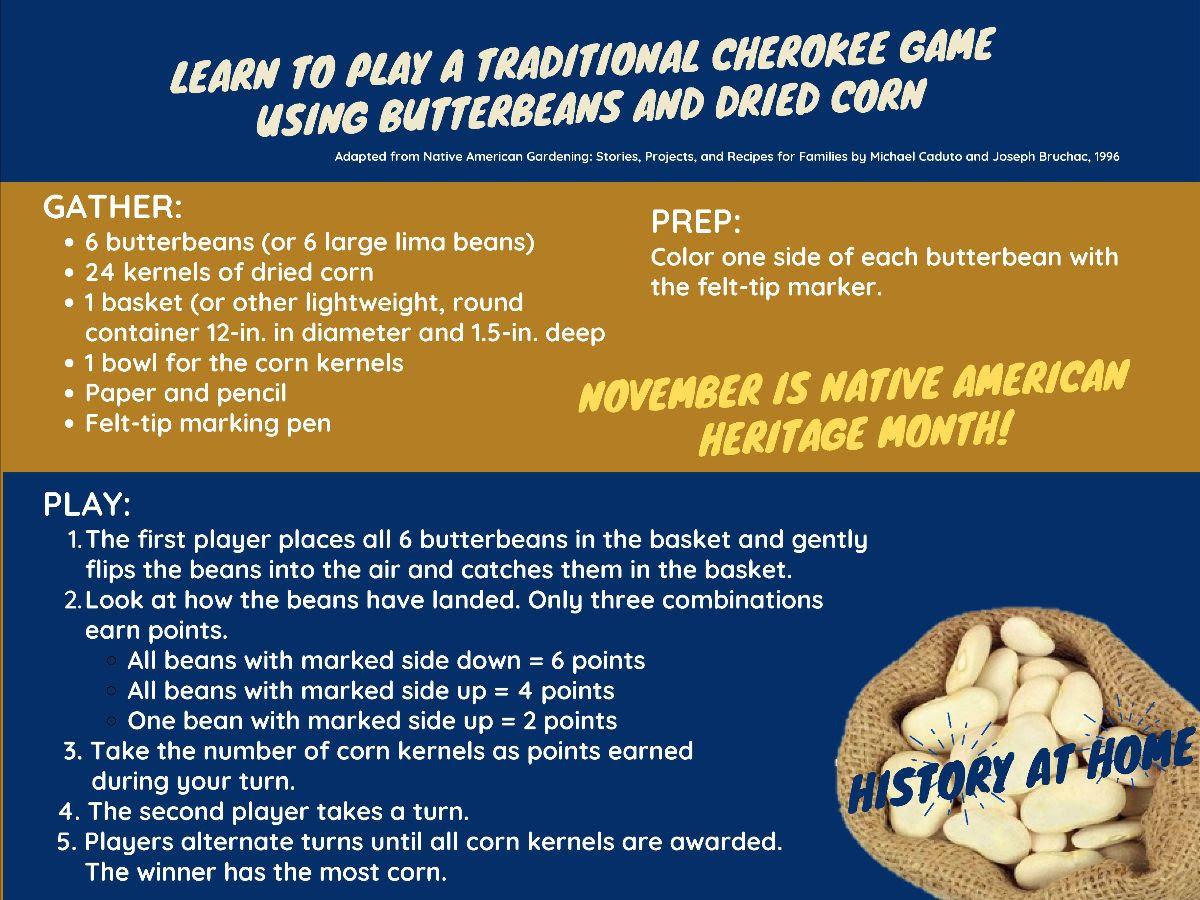
This is a variation on the tradition Cherokee Butterbean Game. It can be played by several individual players or several teams. Traditionally, this game uses three butterbeans that have been split in half. More…
From the Museum of the Cherokee Indian: Cherokee people began growing a form of corn two thousand years ago. By about a thousand years ago, or 1000 AD, they were growing corn and beans, as we know them today. Corn, beans, and squash was always grown together and was known as the “Three Sisters.” Beans restore nitrogen to the soil while corn depletes nitrogen. The vines of the beans and squash twined up the cornstalks. When corn and beans are eaten together, they provide complete proteins and amino acids for our diet.
Corn was so important to the Cherokee that they had important celebrations and ceremonies called “Green Corn Festivals.” The first of these was held in August, before the sweet corn was ready to eat. The last was held in October or November, when the
field corn was ready to be picked. At these ceremonies, people purified themselves physically and spiritually before feasting together. At this time, people got married and divorced. All old scores were settled and everyone started a new year together.
This is a variation on the tradition Cherokee Butterbean Game. It can be played by several individual players or several teams. Traditionally, this game uses three butterbeans that have been split in half. More…
From the Museum of the Cherokee Indian: Cherokee people began growing a form of corn two thousand years ago. By about a thousand years ago, or 1000 AD, they were growing corn and beans, as we know them today. Corn, beans, and squash was always grown together and was known as the “Three Sisters.” Beans restore nitrogen to the soil while corn depletes nitrogen. The vines of the beans and squash twined up the cornstalks. When corn and beans are eaten together, they provide complete proteins and amino acids for our diet.
Corn was so important to the Cherokee that they had important celebrations and ceremonies called “Green Corn Festivals.” The first of these was held in August, before the sweet corn was ready to eat. The last was held in October or November, when the
field corn was ready to be picked. At these ceremonies, people purified themselves physically and spiritually before feasting together. At this time, people got married and divorced. All old scores were settled and everyone started a new year together.
This is a variation on the tradition Cherokee Butterbean Game. It can be played by several individual players or several teams. Traditionally, this game uses three butterbeans that have been split in half. More…
From the Museum of the Cherokee Indian: Cherokee people began growing a form of corn two thousand years ago. By about a thousand years ago, or 1000 AD, they were growing corn and beans, as we know them today. Corn, beans, and squash was always grown together and was known as the “Three Sisters.” Beans restore nitrogen to the soil while corn depletes nitrogen. The vines of the beans and squash twined up the cornstalks. When corn and beans are eaten together, they provide complete proteins and amino acids for our diet.
Corn was so important to the Cherokee that they had important celebrations and ceremonies called “Green Corn Festivals.” The first of these was held in August, before the sweet corn was ready to eat. The last was held in October or November, when the
field corn was ready to be picked. At these ceremonies, people purified themselves physically and spiritually before feasting together. At this time, people got married and divorced. All old scores were settled and everyone started a new year together.
This is a variation on the tradition Cherokee Butterbean Game. It can be played by several individual players or several teams. Traditionally, this game uses three butterbeans that have been split in half. More…
From the Museum of the Cherokee Indian: Cherokee people began growing a form of corn two thousand years ago. By about a thousand years ago, or 1000 AD, they were growing corn and beans, as we know them today. Corn, beans, and squash was always grown together and was known as the “Three Sisters.” Beans restore nitrogen to the soil while corn depletes nitrogen. The vines of the beans and squash twined up the cornstalks. When corn and beans are eaten together, they provide complete proteins and amino acids for our diet.
Corn was so important to the Cherokee that they had important celebrations and ceremonies called “Green Corn Festivals.” The first of these was held in August, before the sweet corn was ready to eat. The last was held in October or November, when the
field corn was ready to be picked. At these ceremonies, people purified themselves physically and spiritually before feasting together. At this time, people got married and divorced. All old scores were settled and everyone started a new year together.
This is a variation on the tradition Cherokee Butterbean Game. It can be played by several individual players or several teams. Traditionally, this game uses three butterbeans that have been split in half. More…
From the Museum of the Cherokee Indian: Cherokee people began growing a form of corn two thousand years ago. By about a thousand years ago, or 1000 AD, they were growing corn and beans, as we know them today. Corn, beans, and squash was always grown together and was known as the “Three Sisters.” Beans restore nitrogen to the soil while corn depletes nitrogen. The vines of the beans and squash twined up the cornstalks. When corn and beans are eaten together, they provide complete proteins and amino acids for our diet.
Corn was so important to the Cherokee that they had important celebrations and ceremonies called “Green Corn Festivals.” The first of these was held in August, before the sweet corn was ready to eat. The last was held in October or November, when the
field corn was ready to be picked. At these ceremonies, people purified themselves physically and spiritually before feasting together. At this time, people got married and divorced. All old scores were settled and everyone started a new year together.

This is a variation on the tradition Cherokee Butterbean Game. It can be played by several individual players or several teams. Traditionally, this game uses three butterbeans that have been split in half. More…
From the Museum of the Cherokee Indian: Cherokee people began growing a form of corn two thousand years ago. By about a thousand years ago, or 1000 AD, they were growing corn and beans, as we know them today. Corn, beans, and squash was always grown together and was known as the “Three Sisters.” Beans restore nitrogen to the soil while corn depletes nitrogen. The vines of the beans and squash twined up the cornstalks. When corn and beans are eaten together, they provide complete proteins and amino acids for our diet.
Corn was so important to the Cherokee that they had important celebrations and ceremonies called “Green Corn Festivals.” The first of these was held in August, before the sweet corn was ready to eat. The last was held in October or November, when the
field corn was ready to be picked. At these ceremonies, people purified themselves physically and spiritually before feasting together. At this time, people got married and divorced. All old scores were settled and everyone started a new year together.
This is a variation on the tradition Cherokee Butterbean Game. It can be played by several individual players or several teams. Traditionally, this game uses three butterbeans that have been split in half. More…
From the Museum of the Cherokee Indian: Cherokee people began growing a form of corn two thousand years ago. By about a thousand years ago, or 1000 AD, they were growing corn and beans, as we know them today. Corn, beans, and squash was always grown together and was known as the “Three Sisters.” Beans restore nitrogen to the soil while corn depletes nitrogen. The vines of the beans and squash twined up the cornstalks. When corn and beans are eaten together, they provide complete proteins and amino acids for our diet.
Corn was so important to the Cherokee that they had important celebrations and ceremonies called “Green Corn Festivals.” The first of these was held in August, before the sweet corn was ready to eat. The last was held in October or November, when the
field corn was ready to be picked. At these ceremonies, people purified themselves physically and spiritually before feasting together. At this time, people got married and divorced. All old scores were settled and everyone started a new year together.
This is a variation on the tradition Cherokee Butterbean Game. It can be played by several individual players or several teams. Traditionally, this game uses three butterbeans that have been split in half. More…
From the Museum of the Cherokee Indian: Cherokee people began growing a form of corn two thousand years ago. By about a thousand years ago, or 1000 AD, they were growing corn and beans, as we know them today. Corn, beans, and squash was always grown together and was known as the “Three Sisters.” Beans restore nitrogen to the soil while corn depletes nitrogen. The vines of the beans and squash twined up the cornstalks. When corn and beans are eaten together, they provide complete proteins and amino acids for our diet.
Corn was so important to the Cherokee that they had important celebrations and ceremonies called “Green Corn Festivals.” The first of these was held in August, before the sweet corn was ready to eat. The last was held in October or November, when the
field corn was ready to be picked. At these ceremonies, people purified themselves physically and spiritually before feasting together. At this time, people got married and divorced. All old scores were settled and everyone started a new year together.
This is a variation on the tradition Cherokee Butterbean Game. It can be played by several individual players or several teams. Traditionally, this game uses three butterbeans that have been split in half. More…
From the Museum of the Cherokee Indian: Cherokee people began growing a form of corn two thousand years ago. By about a thousand years ago, or 1000 AD, they were growing corn and beans, as we know them today. Corn, beans, and squash was always grown together and was known as the “Three Sisters.” Beans restore nitrogen to the soil while corn depletes nitrogen. The vines of the beans and squash twined up the cornstalks. When corn and beans are eaten together, they provide complete proteins and amino acids for our diet.
Corn was so important to the Cherokee that they had important celebrations and ceremonies called “Green Corn Festivals.” The first of these was held in August, before the sweet corn was ready to eat. The last was held in October or November, when the
field corn was ready to be picked. At these ceremonies, people purified themselves physically and spiritually before feasting together. At this time, people got married and divorced. All old scores were settled and everyone started a new year together.