

Calendar of Events
Upcoming events and things to do in Asheville, NC. Below is a list of events for festivals, concerts, art exhibitions, group meetups and more.
Interested in adding an event to our calendar? Please click the green “Post Your Event” button below.

Get ready to go wild at the library for our annual Summer Learning Program. Join us for Tails & Tales – an exploration of wildlife and fantastical folktales. We’ll have an activity sheet with lots of fun adventures for all ages. You can pick up a sheet at any library starting June 1, or download it HERE. Check our calendar to find our most up to date list of programs all summer long.
The 2021 Summer Learning Program is open to young people, preschool through teen, with books and activities for every age. All library programs are free and open to children of all abilities. Come in and see what the library has for you!
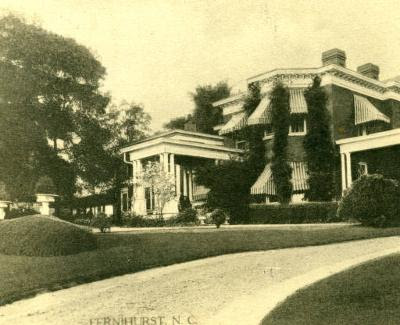 |
| Contained by its larger growing neighbor (Asheville), the French Broad and Swannanoa rivers, and the Southern Railway line, the Town of Victoria existed from 1887 until 1905, when it was absorbed into Asheville. The community—which included the Smith-McDowell House and Fernihurst mansion—originally incorporated into a town to prevent unwanted development (particularly from the Vanderbilts). |

The Farm Beginnings® class is a 12-month training session that uses holistic management to help beginning farmers clarify their goals and strengths, establish a strong enterprise plan and start building their operation.
Farm Beginnings will help you build these skills through one year of farmer-led training, mentoring, and networking.
Farm Beginnings is designed for new and prospective farmers who want to plan a profitable farm business. Classes will be hybrid this year, starting in October 24th 2021.
Farm Beginnings will be hybrid for 2021/2022.
———-
Applications open now, due by September 18th
Farm Beginnings® Farmer Training is approved by the US Department of Agriculture’s Farm Service Agency (FSA) as an Education Vendor. As a Farm Beginnings® Graduate, your training counts as a year of farm management experience when you apply for a farmland loan through the Farm Service Agency.
———-

4 Week Session with 1 Weekend of digital performance
Rehearse – Monday through Friday 12-2(3)pm (June 15th through July 10th)
Shows pre-recorded and streamed – Friday, Saturday, Sunday at 5:30pm (July 10, 11, 12)
w/live Q & A after
Limit 20 Participants

Hit the trails and learn more about the Arboretum’s botanically diverse forest with the return of guided trail walks in 2021! In response to COVID-19, new safety measures have been put in place to protect our guests, members, volunteers and staff: Walks will be limited to 10 people, including the guide, and all participants will be required to wear face coverings for the duration of the walk.
This free hiking program is led by trained volunteer guides who take small groups of participants along woodland trails and through a variety of forest types. Depending on the season, topics of discussion may include wildflowers, plant and tree identification, natural history and more.
Guided trail walks depart from the Baker Exhibit Center Lobby every Tuesday and Saturday at 1 p.m. through the month of October. Walks last 1.5- 2.5 hours and are approximately one to two miles in length, and as such are recommended for guests 14 years or older. Walks are held rain or shine, so all participants should dress appropriately for the weather.
Register In Advance
Space is limited and advance registration is encouraged. Pre-registered participants must check in at the Baker Information Desk no later than 10 minutes before the scheduled program to keep their spot. Unclaimed spots will be offered to other guests.
Guests may sign up for trail walks in the following ways:
- Pre-register online
- Sign up in-person at the Baker Information Desk.
Dolly Parton’s Imagination Library

A FREE book mailed to your child, every month!
Dolly Parton’s Imagination Library mails an age-appropriate book monthly to enrolled children ages 0-5. Do you live in Henderson County and have a child younger than 5? Register today and your child can receive a free book in the mail each month until his/her fifth birthday!
How Do I Enroll My Child?
Enrolling your child is easy! You can register your child electronically (click for online registration) or call us at 828-693-1580 and we will mail you a hard copy of the registration form to complete and return to us.
When does the first book arrive?
If you enroll your child in person, we will give your child his/her first book. If not, your child will begin receiving books through the U.S. Postal Services six-eight weeks after the registration form has been received. If you move, please contact Smart Start at 828-693-1580 to notify us of your change in address so your child can continue receiving books.
Is there ever a cost to me?
NO! Through the generous support of the NC General Assembly and donations and grants from individuals and businesses in our community, this is a FREE program.
Annual Survey
Annually, some parents will be asked to complete a short survey. The survey will only take a few minutes to complete. Results will be used to make sure the program is getting results for families. If asked, please consider completing the short questionnaire. Thank you!
Do you have questions about Dolly Parton’s Imagination Library in Henderson County? Check out the Frequently Asked Questions here. If you still have questions, feel free to contact Smart Start Partnership for Children using the contact information below.
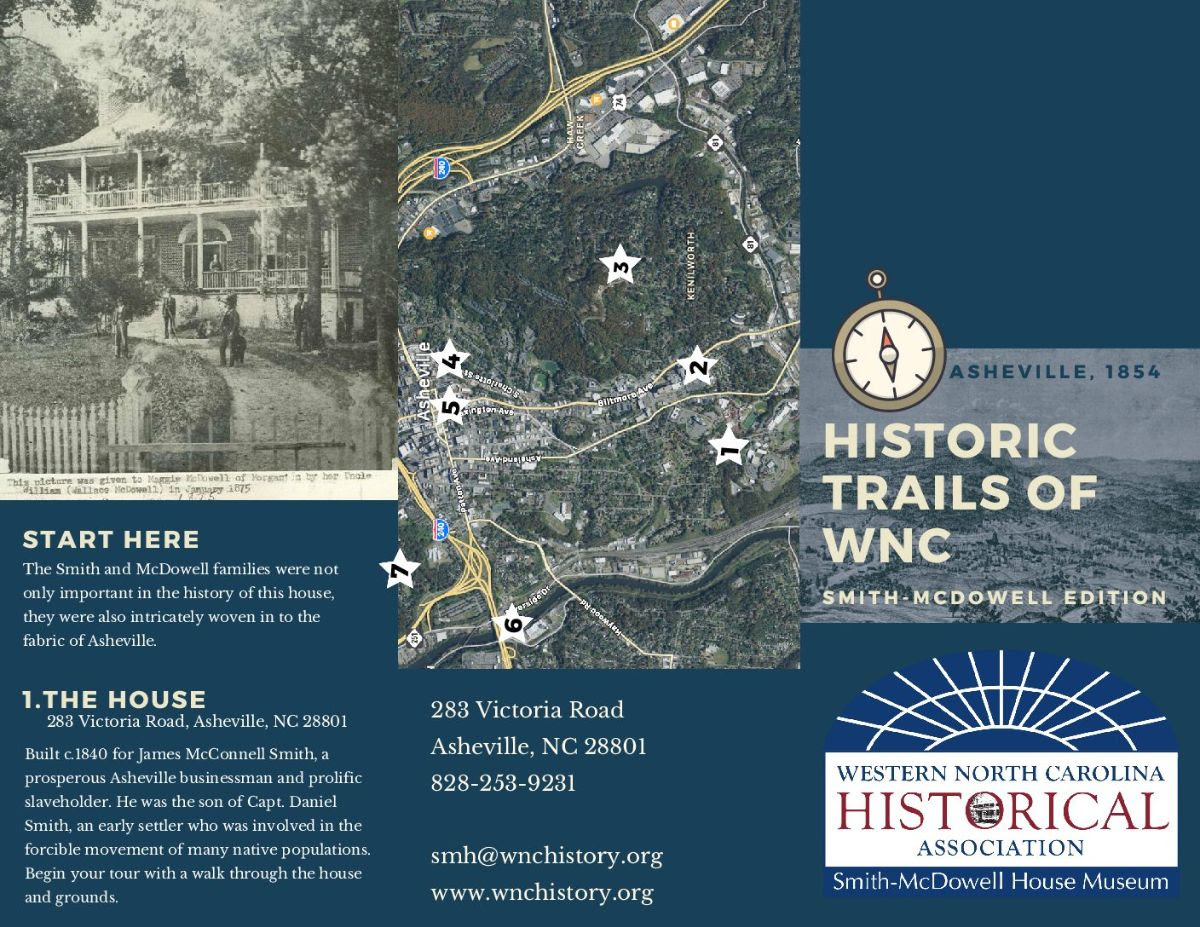 |
| The residents of the Smith-McDowell House and grounds were woven in to the fabric of Asheville.
This driving tour begins at the Smith-McDowell House Museum on the campus of A-B Tech and continues through historic sites related to early occupants of the house. |
NOMINATIONS BEING ACCEPTED FOR THE
2021 THOMAS WOLFE MEMORIAL LITERARY AWARD
The Western North Carolina Historical Association is now accepting nominations for the Thomas Wolfe Memorial Literary Award. Originated by the Louis Lipinsky family and now supported by Michael Sartisky, PhD, the Award is a partnership between WNCHA and the Thomas Wolfe Memorial Advisory Committee. It has been presented by WNCHA since 1955. The award comes with a $2,500 cash prize.
The deadline for submission of nominated works is July 31, 2021. Anyone with knowledge of an author who meets the qualification criteria may nominate the author for the award. To be considered, an entry must be a published work of fiction, nonfiction, drama or poetry and meet the following criteria:
- It must be a first edition work; revised editions of published works will not be considered for the Award.
- The publication date must be between July 1, 2020 and July 1, 2021.
- The author must be a native of western North Carolina or a resident of western North Carolina for at least twelve months prior to the closing date for the Award.
- An author may also qualify if the work submitted has a focus on or setting in western North Carolina.
Western North Carolina includes the Qualla Boundary and the following 25 counties: Alleghany, Ashe, Avery, Buncombe, Burke, Caldwell, Cherokee, Clay, Graham, Haywood, Henderson, Jackson, Macon, Madison, McDowell, Mitchell, Polk, Rutherford, Surry, Swain, Transylvania, Watauga, Wilkes, Yadkin, and Yancey.
The Award Panel this year consists of: Catherine Frank, Chair, Director, Osher Lifelong Learning Institute at UNC Asheville; Dee James, retired Director of the First-Year Writing Program at UNC Asheville; Tom Muir, Historic Site Manager, Thomas Wolfe Memorial; Gordon McKinney, PhD, former president, Appalachian Studies Association; Terry Roberts, PhD, Director, National Paideia Center; Jim Stokely, President, Wilma Dykeman Legacy.
Nomination letters must specify the following eligibility criteria:
- date of publication
- birthplace or residence of author
- setting of work
Nominators should submit a cover letter along with three copies of the work postmarked no later than July 31, 2021 to:
Wolfe Award Committee
℅ Anne Chesky Smith
WNC Historical Association
283 Victoria Road
Asheville, NC 28801
An awards ceremony and reception, in honor of the finalists and 2021 Award recipient, will be held in early December 2021.
The Association presented the first Thomas Wolfe Memorial Literary Award to Wilma Dykeman in 1955 for The French Broad. The Award has continued to be funded, in part, by Mrs. E. Frank Edwin, a member of the Lipinsky family and for the last three years by WNCHA, and the Thomas Wolfe Memorial Advisory Board, both with support from Michael Sartisky, PhD. Other recipients of this prestigious Award include Robert Morgan, Gail Godwin, John Ehle, Robert Brunk, Michael McFee, Lee Smith, Ron Rash, Wayne Caldwell, and Terry Roberts. Sandra Muse Isaacs was the recipient of the 2020 Thomas Wolfe Memorial Literary Award for her book: Eastern Cherokee Stories: A Living Oral Tradition and Its Cultural Continuance.


A year-long program
Individualized to meet you where you are
in your farm business journey
Starting a farm is a formidable challenge, but keeping a farm business going, growing and thriving is even harder! The Journeyperson Program is designed for farmers who have been independently farming for 3 or more years, and are serious about operating farm businesses in the Southern Appalachian region. This program will give you the space and time to work on your business while making connections that deepen your peer-to-peer support.
This 12-month program starts in November 2021 and ends in October 2022.
What is unique about this program?
Participants can use this program as a tangible step toward achieving their farm goals, and make significant contributions to the agricultural community and economy. This program is designed to give tailored guidance and support for your farm business to answer questions of: scale, market access, land access, risk management, understanding cash flow, and enterprise innovation. You will leave this program with a responsive, adaptable business plan to help your farm achieve long-term farm viability and resilience.
|
|
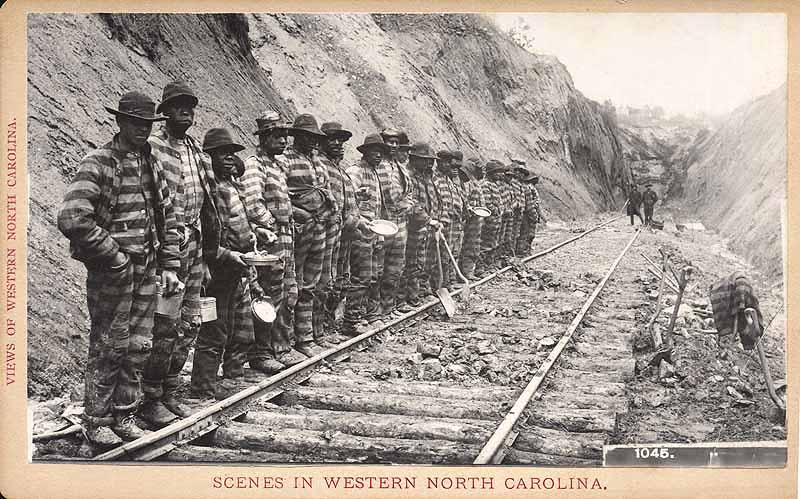
The construction of the Mountain Division of the Western North Carolina Railroad is widely considered one of the greatest human accomplishments in regards to both engineering and construction ever undertaken at the time it occurred. The project took place over a period of several years in the late 1800s. Many people are aware that the railroad provided the first dependable access to and from much of Western North Carolina for the rest of the state as well as much of the nation. Many also know the names of some of those who were instrumental in seeing through the completion of this ambitious project. Names such as Colonel Alexander Boyd Andrews, of Andrews’ Geyser fame. However, what most people are unaware of is that at least 95% of the labor which built the railroad across the Blue Ridge Escarpment was completed by inmates from the North Carolina State Penitentiary… and approximately 98% of those inmates were African American men… the majority of whom were unjustly imprisoned…
This project was created to share the true story behind this human endeavor and to honor the memory of those who labored and those who died here.
Western North Carolina has a rich assortment of county historical societies, archives, and museums. The Western North Carolina Historical Association seeks to help researchers, historians, genealogists, and the general public take full advantage of these resources.

Get ready to go wild at the library for our annual Summer Learning Program. Join us for Tails & Tales – an exploration of wildlife and fantastical folktales. We’ll have an activity sheet with lots of fun adventures for all ages. You can pick up a sheet at any library starting June 1, or download it HERE. Check our calendar to find our most up to date list of programs all summer long.
The 2021 Summer Learning Program is open to young people, preschool through teen, with books and activities for every age. All library programs are free and open to children of all abilities. Come in and see what the library has for you!
|
| Contained by its larger growing neighbor (Asheville), the French Broad and Swannanoa rivers, and the Southern Railway line, the Town of Victoria existed from 1887 until 1905, when it was absorbed into Asheville. The community—which included the Smith-McDowell House and Fernihurst mansion—originally incorporated into a town to prevent unwanted development (particularly from the Vanderbilts). |
The Farm Beginnings® class is a 12-month training session that uses holistic management to help beginning farmers clarify their goals and strengths, establish a strong enterprise plan and start building their operation.
Farm Beginnings will help you build these skills through one year of farmer-led training, mentoring, and networking.
Farm Beginnings is designed for new and prospective farmers who want to plan a profitable farm business. Classes will be hybrid this year, starting in October 24th 2021.
Farm Beginnings will be hybrid for 2021/2022.
———-
Applications open now, due by September 18th
Farm Beginnings® Farmer Training is approved by the US Department of Agriculture’s Farm Service Agency (FSA) as an Education Vendor. As a Farm Beginnings® Graduate, your training counts as a year of farm management experience when you apply for a farmland loan through the Farm Service Agency.
———-
NOMINATIONS BEING ACCEPTED FOR THE
2021 THOMAS WOLFE MEMORIAL LITERARY AWARD
The Western North Carolina Historical Association is now accepting nominations for the Thomas Wolfe Memorial Literary Award. Originated by the Louis Lipinsky family and now supported by Michael Sartisky, PhD, the Award is a partnership between WNCHA and the Thomas Wolfe Memorial Advisory Committee. It has been presented by WNCHA since 1955. The award comes with a $2,500 cash prize.
The deadline for submission of nominated works is July 31, 2021. Anyone with knowledge of an author who meets the qualification criteria may nominate the author for the award. To be considered, an entry must be a published work of fiction, nonfiction, drama or poetry and meet the following criteria:
- It must be a first edition work; revised editions of published works will not be considered for the Award.
- The publication date must be between July 1, 2020 and July 1, 2021.
- The author must be a native of western North Carolina or a resident of western North Carolina for at least twelve months prior to the closing date for the Award.
- An author may also qualify if the work submitted has a focus on or setting in western North Carolina.
Western North Carolina includes the Qualla Boundary and the following 25 counties: Alleghany, Ashe, Avery, Buncombe, Burke, Caldwell, Cherokee, Clay, Graham, Haywood, Henderson, Jackson, Macon, Madison, McDowell, Mitchell, Polk, Rutherford, Surry, Swain, Transylvania, Watauga, Wilkes, Yadkin, and Yancey.
The Award Panel this year consists of: Catherine Frank, Chair, Director, Osher Lifelong Learning Institute at UNC Asheville; Dee James, retired Director of the First-Year Writing Program at UNC Asheville; Tom Muir, Historic Site Manager, Thomas Wolfe Memorial; Gordon McKinney, PhD, former president, Appalachian Studies Association; Terry Roberts, PhD, Director, National Paideia Center; Jim Stokely, President, Wilma Dykeman Legacy.
Nomination letters must specify the following eligibility criteria:
- date of publication
- birthplace or residence of author
- setting of work
Nominators should submit a cover letter along with three copies of the work postmarked no later than July 31, 2021 to:
Wolfe Award Committee
℅ Anne Chesky Smith
WNC Historical Association
283 Victoria Road
Asheville, NC 28801
An awards ceremony and reception, in honor of the finalists and 2021 Award recipient, will be held in early December 2021.
The Association presented the first Thomas Wolfe Memorial Literary Award to Wilma Dykeman in 1955 for The French Broad. The Award has continued to be funded, in part, by Mrs. E. Frank Edwin, a member of the Lipinsky family and for the last three years by WNCHA, and the Thomas Wolfe Memorial Advisory Board, both with support from Michael Sartisky, PhD. Other recipients of this prestigious Award include Robert Morgan, Gail Godwin, John Ehle, Robert Brunk, Michael McFee, Lee Smith, Ron Rash, Wayne Caldwell, and Terry Roberts. Sandra Muse Isaacs was the recipient of the 2020 Thomas Wolfe Memorial Literary Award for her book: Eastern Cherokee Stories: A Living Oral Tradition and Its Cultural Continuance.
|
|
Get ready to go wild at the library for our annual Summer Learning Program. Join us for Tails & Tales – an exploration of wildlife and fantastical folktales. We’ll have an activity sheet with lots of fun adventures for all ages. You can pick up a sheet at any library starting June 1, or download it HERE. Check our calendar to find our most up to date list of programs all summer long.
The 2021 Summer Learning Program is open to young people, preschool through teen, with books and activities for every age. All library programs are free and open to children of all abilities. Come in and see what the library has for you!

Your vegetable garden is likely approaching peak production time—but when and how to harvest? Even if you are a pro, here’s how to make sure those caring for your precious crops while you’re away know when to pick!
What matters about harvest time?
- Harvest stage affects flavor and yields:
- Picking too soon not only reduces the amount of food your garden produces but also may mean missing that perfectly ripened taste—although not all vegetables lose flavor after picking.
- Waiting too long definitely means missing the best flavor—think sweet corn turned starchy—and your produce actually spoils. Crops literally go to seed have accomplished their goal and will stop producing!
- Factors that affect harvest and storage.
- Warmer temperatures after picking can affect flavor—crops like peas and sweet corn that turn starchy, for example, need immediate cooling. Joseph Masabni of Texas A&M Extension, advises “harvest these vegetables early in the morning or right before you intend to use them.”
- Not all crops benefit from refrigeration, however! And humidity levels and air circulation are important, too! If you’re not going to use your bounty immediately, some crops, such as garlic, dry onions, potatoes, and tomatoes are best stored only at room temperature, according to UC-Davis Post Harvest Technology specialists (see below). They also recommend that cucumbers, eggplants, and peppers be refrigerated only for 1 to 3 days and then used as soon as you remove them from the cold.
- Advise those harvesting in your absence how often you check your crops, and which are most time-sensitive!
Things to look for when you harvest
Harvesting takes more time than you’d expect—look carefully for items to pick amongst all those leaves and vines. This makes harvesting a great time to give your garden plants a quick check-up!
- Size matters!
- Jokes abound about baseball-bat-size zucchini, but squash aren’t the only crops that can grow out of useful size.
- If you intend to eat fresh beans rather than saving them to use dry, the beans need to just start to fill out their pods.
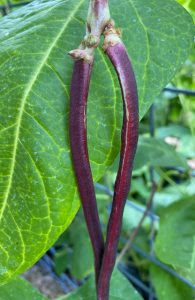
These red noodle beans need picking!
- Color changes are usually important, too.
- Tomatoes turning red are an obvious example, but how red is the best time for picking? Maybe earlier than you think! Picking at the “breaker” stage rather than fully red means your tomatoes will continue to ripen indoors, taste vine-ripened, but won’t suffer sunscald, or damage from insects or birds.
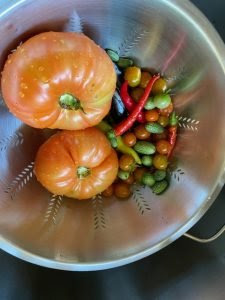
Tomatoes will develop full flavor ripened indoors if picked once they begin to show some color. - Cucumbers should still be uniformly green, not starting to yellow.

Cucumbers are best picked green rather than starting to yellow. - Eggplants should be purple (light or dark depending on the variety), but still glossy, not dull
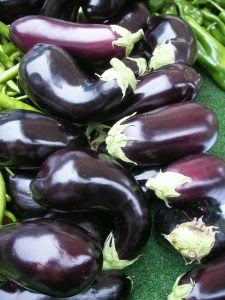
Pick eggplants while the skin is still glossy. - Watermelons, on the other hand, should develop a duller, rougher surface and the spot touching the ground should be yellowing, not white

Ripe watermelon skin should be starting to dull and roughen and the ground spot turning yellow. - .Detecting defects may mean removing fruits before they take any more resources from the plant—think blossom-end rot on tomatoes or peppers—or harvesting while part of the crop is still salvageable—such as a nip out of an otherwise healthy tomato.
- Damage may alert you to insect infestations—minimize or eliminate, by hand-picking the culprits—such as snails or slugs—or treating to prevent further damage—wash away aphids on greens or treating pickleworm infestations of cucumbers and squash with pesticides, for example. Learn which “bugs” you see are pests and which are helpful predators!
- Harvest “helpers” will be more eager to volunteer if they pick at the right time—and you won’t find all your tomatoes gone despite their size or plants loaded with overripe items bringing production to a halt. Alerting you to any emerging problems is another bonus.
- Tomatoes turning red are an obvious example, but how red is the best time for picking? Maybe earlier than you think! Picking at the “breaker” stage rather than fully red means your tomatoes will continue to ripen indoors, taste vine-ripened, but won’t suffer sunscald, or damage from insects or birds.


“Harvesting” spent plants?
While picking your crops pick off dead leaves, spent blossoms, and trim errant runners to keep plants looking good and productive. Knowledgeable helpers can perform these tasks.
In WNC, most vegetable garden plants are annuals, or treated as such, so when you harvest, evaluate when it’s time to pull the whole plant—it may be too risky to ask short-term caregivers to make this decision!
- Is the plant diseased? If there are signs of disease, either do what you can to remove diseased portions, treat the problem, or remove the entire plant.
- Is production slowing?
- Review fertilizing or watering practices to improve yields. Most crops need an inch of rain a week to prosper—water established plants deeply once a week if rains are insufficient. Check your crops’ needs for fertilizer and the application rates recommended for the fertilizers you are using.
- Extreme temperatures may interfere with fruit set or how your crops ripen. Be patient if better weather will solve the problem! Note, though, that spring crops that fade with high temperatures are long gone; so too, frosts will damage tender crops, so harvest these before freezing temperatures.
- Once you’ve decided your plants have passed peak production, pull the plants and consider planting a fall crop. See the calendar below for all the crops you can plant in August for a bountiful autumn harvest!
Article by Buncombe County Extension Master GardenerSM Volunteers
For more information:
When to harvest specific crops: https://content.ces.ncsu.edu/extension-gardener-handbook/16-vegetable-gardening#vegetableharvestingguidelines
https://agrilifeextension.tamu.edu/library/gardening/harvesting-handling-vegetables-garden/
Ripening after harvest:
https://gardenprofessors.com/ripening/
https://www.johnson.k-state.edu/lawn-garden/agent-articles/vegetables/harvest-ripen-tomatoes.html
Storing produce:
http://postharvest.ucdavis.edu/files/230110.pdf
Planting times for WNC:

Asheville’s economic and building boom of the 1920s created a rarified atmosphere unique within Western North Carolina. Douglas Ellington is known as the architect who changed Asheville into an Art Deco showplace. With his ability to combine architectural styles he produced a series of one of a kind buildings—buildings which changed the face of Asheville—the City Building, Asheville High School, First Baptist Church and S&W Cafeteria. Douglas Ellington: Asheville’s Boomtown Architect presents a look at his iconic Asheville creations along with other buildings he completed throughout his career in other cities.

WINNER of a 2014 Griffin Award for Excellence in Education from the Preservation Society of Asheville and Buncombe County

Take your business to the next level.
A comprehensive business innovation program designed to assist for profit, not-for-profit and family owned businesses to take them to the next level of success and sustainability.
August 25 – December 15, 2021
Registration for the 2021 Program now open.
Registration accepted through August 23, 2021.
Blue Ridge Community College and the Henderson County Chamber of Commerce have partnered once again to offer the Mission Acceleration Business Accelerator, a five-month, ten-course program.
August 25, 2021
Business Best Practices and KPI (Key Performance Indicators) Checklist by Department Identifying Opportunities for Acceleration
September 8, 2021
Management and Leadership
September 15, 2021
Human Resources, Legal and Insurance
September 29, 2021
Capital and Purchasing
October 13, 2021
Competition and Competitive Advantage
October 27, 2021
Branding, Marketing and Sales
November 10, 2021
Customer Service and Information Technology
November 17, 2021
Business Logistics: Best ways to meet customer needs
December 1, 2021
Accounting and Finance
December 15, 2021
Business Acceleration Plan Presentation and Graduation
Sessions run Wednesdays, from 8:30 a.m. to 12:30 p.m. except 8:30 a.m. to 4:30 p.m. on August 25 and December 15, 2021.

Mon-Fri from 2-5pm. You have access to high speed internet, work space and HALF-OFF pastries when you present your college ID.

Peer Support
Group meetings: Monday, Wednesday, Friday 2:00 – 3:00 PM
Please contact us for individual services at 828.388.7979, Option #2
Through the “lived-experience” of our peer support specialists, we will assist, encourage, empower and advocate with others on their journey to finding their own path to recovery. Recovery is possible but is not meant to do alone. We do recover together.
About Hope Coalition
Hope Coalition is a grassroots effort initiated by the Henderson County Partnership for Health in 2013 as a community collaborative to educate, evaluate, and implement evidence-based models on substance misuse and underage drinking in Henderson County by building capacity and creating long-term and sustainable plans that are action-oriented and focus on community level change.
NOMINATIONS BEING ACCEPTED FOR THE
2021 THOMAS WOLFE MEMORIAL LITERARY AWARD
The Western North Carolina Historical Association is now accepting nominations for the Thomas Wolfe Memorial Literary Award. Originated by the Louis Lipinsky family and now supported by Michael Sartisky, PhD, the Award is a partnership between WNCHA and the Thomas Wolfe Memorial Advisory Committee. It has been presented by WNCHA since 1955. The award comes with a $2,500 cash prize.
The deadline for submission of nominated works is July 31, 2021. Anyone with knowledge of an author who meets the qualification criteria may nominate the author for the award. To be considered, an entry must be a published work of fiction, nonfiction, drama or poetry and meet the following criteria:
- It must be a first edition work; revised editions of published works will not be considered for the Award.
- The publication date must be between July 1, 2020 and July 1, 2021.
- The author must be a native of western North Carolina or a resident of western North Carolina for at least twelve months prior to the closing date for the Award.
- An author may also qualify if the work submitted has a focus on or setting in western North Carolina.
Western North Carolina includes the Qualla Boundary and the following 25 counties: Alleghany, Ashe, Avery, Buncombe, Burke, Caldwell, Cherokee, Clay, Graham, Haywood, Henderson, Jackson, Macon, Madison, McDowell, Mitchell, Polk, Rutherford, Surry, Swain, Transylvania, Watauga, Wilkes, Yadkin, and Yancey.
The Award Panel this year consists of: Catherine Frank, Chair, Director, Osher Lifelong Learning Institute at UNC Asheville; Dee James, retired Director of the First-Year Writing Program at UNC Asheville; Tom Muir, Historic Site Manager, Thomas Wolfe Memorial; Gordon McKinney, PhD, former president, Appalachian Studies Association; Terry Roberts, PhD, Director, National Paideia Center; Jim Stokely, President, Wilma Dykeman Legacy.
Nomination letters must specify the following eligibility criteria:
- date of publication
- birthplace or residence of author
- setting of work
Nominators should submit a cover letter along with three copies of the work postmarked no later than July 31, 2021 to:
Wolfe Award Committee
℅ Anne Chesky Smith
WNC Historical Association
283 Victoria Road
Asheville, NC 28801
An awards ceremony and reception, in honor of the finalists and 2021 Award recipient, will be held in early December 2021.
The Association presented the first Thomas Wolfe Memorial Literary Award to Wilma Dykeman in 1955 for The French Broad. The Award has continued to be funded, in part, by Mrs. E. Frank Edwin, a member of the Lipinsky family and for the last three years by WNCHA, and the Thomas Wolfe Memorial Advisory Board, both with support from Michael Sartisky, PhD. Other recipients of this prestigious Award include Robert Morgan, Gail Godwin, John Ehle, Robert Brunk, Michael McFee, Lee Smith, Ron Rash, Wayne Caldwell, and Terry Roberts. Sandra Muse Isaacs was the recipient of the 2020 Thomas Wolfe Memorial Literary Award for her book: Eastern Cherokee Stories: A Living Oral Tradition and Its Cultural Continuance.
|
|