

Calendar of Events
Upcoming events and things to do in Asheville, NC. Below is a list of events for festivals, concerts, art exhibitions, group meetups and more.
Interested in adding an event to our calendar? Please click the green “Post Your Event” button below.

Join us for the virtual event of the year:
United Way’s Carpool Karaoke Challenge
The Fall Community Engagement Event is the one night a year when the community comes together in a fun, friendly competition to help raise awareness of our collective work to reduce the root causes and consequences of poverty. The event also serves as a call-to-action for both businesses and individuals to pledge their time and financial resources in support of the LIVE UNITED Fund.
Because of health concerns, this year’s event (The Carpool Karaoke Challenge) is being held virtually. Ten teams have pre-submitted their Carpool Karaoke videos, and each submission will be shown during the event. The kicker? This year you, the audience, will vote to decide 1st, 2nd, and 3rd place winners.
YOU’RE INVITED
WHO: You, your friends, family, and neighbors
WHAT: United Way’s Carpool Karaoke Challenge Event
WHERE: Virtual
WHEN: Friday, November 20, 4:30 pm-5:45 pm
COST: FREE. You’ll also be eligible to win cash door-prizes just for attending
*Seating for this event is limited, so don’t wait, register below — you must register to attend the event. A link will be shared with registered attendees the day before the event and will allow you access.
This is the one virtual event you’ll actually want to attend this year! Ten teams, 10 Carpool Karaoke submissions, 1 champion: YOU DECIDE!
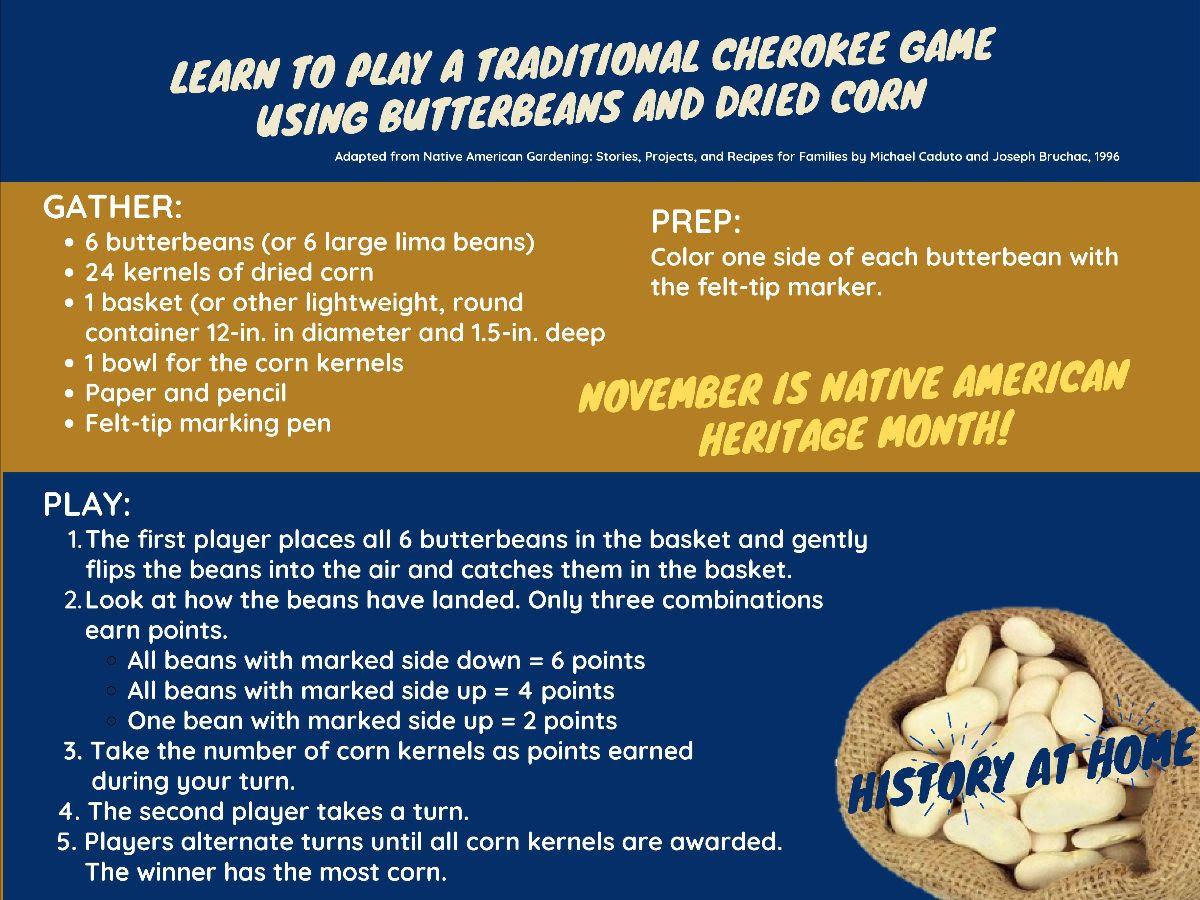
This is a variation on the tradition Cherokee Butterbean Game. It can be played by several individual players or several teams. Traditionally, this game uses three butterbeans that have been split in half. More…
From the Museum of the Cherokee Indian: Cherokee people began growing a form of corn two thousand years ago. By about a thousand years ago, or 1000 AD, they were growing corn and beans, as we know them today. Corn, beans, and squash was always grown together and was known as the “Three Sisters.” Beans restore nitrogen to the soil while corn depletes nitrogen. The vines of the beans and squash twined up the cornstalks. When corn and beans are eaten together, they provide complete proteins and amino acids for our diet.
Corn was so important to the Cherokee that they had important celebrations and ceremonies called “Green Corn Festivals.” The first of these was held in August, before the sweet corn was ready to eat. The last was held in October or November, when the
field corn was ready to be picked. At these ceremonies, people purified themselves physically and spiritually before feasting together. At this time, people got married and divorced. All old scores were settled and everyone started a new year together.
purchases. (You can join the Friends at the bookstore). Anyone can donate books, CDs,
and DVDs at the store, but only during the hours it is open.
As with the book sales, everything at the bookstore is in excellent condition. Books are
shelved by author or subject so they are easy to find, and books are restocked
throughout the week. The store also sells CDs and DVDs.
The bookstore follows health guidelines. Anyone entering must wear a mask and
practice social distancing. Hand sanitizers are available. When the store is busy,
shopping is limited to 30 minutes.
a need for more volunteers to help at the bookstore. It is a great way to meet people
who love reading while also helping to support our library system.
This is a variation on the tradition Cherokee Butterbean Game. It can be played by several individual players or several teams. Traditionally, this game uses three butterbeans that have been split in half. More…
From the Museum of the Cherokee Indian: Cherokee people began growing a form of corn two thousand years ago. By about a thousand years ago, or 1000 AD, they were growing corn and beans, as we know them today. Corn, beans, and squash was always grown together and was known as the “Three Sisters.” Beans restore nitrogen to the soil while corn depletes nitrogen. The vines of the beans and squash twined up the cornstalks. When corn and beans are eaten together, they provide complete proteins and amino acids for our diet.
Corn was so important to the Cherokee that they had important celebrations and ceremonies called “Green Corn Festivals.” The first of these was held in August, before the sweet corn was ready to eat. The last was held in October or November, when the
field corn was ready to be picked. At these ceremonies, people purified themselves physically and spiritually before feasting together. At this time, people got married and divorced. All old scores were settled and everyone started a new year together.

Volunteers are needed in advance of the event on Sunday Nov. 22 1:30-4:30pm to pass out flyers in the neighborhood alerting community members and sharing details. We will need 6-8 volunteers to attend a training with some historical information about the neighborhood and best practices. The training will be at the Edington Center on Nov. 22nd beginning at 1:30. The flyering will begin immediately after the training with volunteers going to different segments of the Southside community.
https://www.paypal.com/donate?hosted_button_id=8UM7X4DPJAQQL
purchases. (You can join the Friends at the bookstore). Anyone can donate books, CDs,
and DVDs at the store, but only during the hours it is open.
As with the book sales, everything at the bookstore is in excellent condition. Books are
shelved by author or subject so they are easy to find, and books are restocked
throughout the week. The store also sells CDs and DVDs.
The bookstore follows health guidelines. Anyone entering must wear a mask and
practice social distancing. Hand sanitizers are available. When the store is busy,
shopping is limited to 30 minutes.
a need for more volunteers to help at the bookstore. It is a great way to meet people
who love reading while also helping to support our library system.
This is a variation on the tradition Cherokee Butterbean Game. It can be played by several individual players or several teams. Traditionally, this game uses three butterbeans that have been split in half. More…
From the Museum of the Cherokee Indian: Cherokee people began growing a form of corn two thousand years ago. By about a thousand years ago, or 1000 AD, they were growing corn and beans, as we know them today. Corn, beans, and squash was always grown together and was known as the “Three Sisters.” Beans restore nitrogen to the soil while corn depletes nitrogen. The vines of the beans and squash twined up the cornstalks. When corn and beans are eaten together, they provide complete proteins and amino acids for our diet.
Corn was so important to the Cherokee that they had important celebrations and ceremonies called “Green Corn Festivals.” The first of these was held in August, before the sweet corn was ready to eat. The last was held in October or November, when the
field corn was ready to be picked. At these ceremonies, people purified themselves physically and spiritually before feasting together. At this time, people got married and divorced. All old scores were settled and everyone started a new year together.

 We’re kicking off Black Friday with out Black Watch Double Chocolate Milk Stout release. This popular limited-release brew is basically a brownie in a glass, overflowing with smooth and rich chocolatey flavors.
purchases. (You can join the Friends at the bookstore). Anyone can donate books, CDs,
and DVDs at the store, but only during the hours it is open.
As with the book sales, everything at the bookstore is in excellent condition. Books are
shelved by author or subject so they are easy to find, and books are restocked
throughout the week. The store also sells CDs and DVDs.
The bookstore follows health guidelines. Anyone entering must wear a mask and
practice social distancing. Hand sanitizers are available. When the store is busy,
shopping is limited to 30 minutes.
a need for more volunteers to help at the bookstore. It is a great way to meet people
who love reading while also helping to support our library system.
This is a variation on the tradition Cherokee Butterbean Game. It can be played by several individual players or several teams. Traditionally, this game uses three butterbeans that have been split in half. More…
From the Museum of the Cherokee Indian: Cherokee people began growing a form of corn two thousand years ago. By about a thousand years ago, or 1000 AD, they were growing corn and beans, as we know them today. Corn, beans, and squash was always grown together and was known as the “Three Sisters.” Beans restore nitrogen to the soil while corn depletes nitrogen. The vines of the beans and squash twined up the cornstalks. When corn and beans are eaten together, they provide complete proteins and amino acids for our diet.
Corn was so important to the Cherokee that they had important celebrations and ceremonies called “Green Corn Festivals.” The first of these was held in August, before the sweet corn was ready to eat. The last was held in October or November, when the
field corn was ready to be picked. At these ceremonies, people purified themselves physically and spiritually before feasting together. At this time, people got married and divorced. All old scores were settled and everyone started a new year together.
purchases. (You can join the Friends at the bookstore). Anyone can donate books, CDs,
and DVDs at the store, but only during the hours it is open.
As with the book sales, everything at the bookstore is in excellent condition. Books are
shelved by author or subject so they are easy to find, and books are restocked
throughout the week. The store also sells CDs and DVDs.
The bookstore follows health guidelines. Anyone entering must wear a mask and
practice social distancing. Hand sanitizers are available. When the store is busy,
shopping is limited to 30 minutes.
a need for more volunteers to help at the bookstore. It is a great way to meet people
who love reading while also helping to support our library system.
This is a variation on the tradition Cherokee Butterbean Game. It can be played by several individual players or several teams. Traditionally, this game uses three butterbeans that have been split in half. More…
From the Museum of the Cherokee Indian: Cherokee people began growing a form of corn two thousand years ago. By about a thousand years ago, or 1000 AD, they were growing corn and beans, as we know them today. Corn, beans, and squash was always grown together and was known as the “Three Sisters.” Beans restore nitrogen to the soil while corn depletes nitrogen. The vines of the beans and squash twined up the cornstalks. When corn and beans are eaten together, they provide complete proteins and amino acids for our diet.
Corn was so important to the Cherokee that they had important celebrations and ceremonies called “Green Corn Festivals.” The first of these was held in August, before the sweet corn was ready to eat. The last was held in October or November, when the
field corn was ready to be picked. At these ceremonies, people purified themselves physically and spiritually before feasting together. At this time, people got married and divorced. All old scores were settled and everyone started a new year together.
Become A Volunteer
The ideal volunteer tutor is someone seeking to make a one-year commitment of two hours per week to help someone else make the change of a lifetime. For our volunteer tutors, an education background is helpful, but not necessary. The most important qualities are patience, an open mind, and resourcefulness. Tutors also need to be non-judgmental and sensitive to cultural differences. A GED or high school diploma is required. Ideal tutors enjoy seeing concrete outcomes from their efforts and sharing in the life-changing successes of others. See our full tutor position description here.
Become A Volunteer
The ideal volunteer tutor is someone seeking to make a one-year commitment of two hours per week to help someone else make the change of a lifetime. For our volunteer tutors, an education background is helpful, but not necessary. The most important qualities are patience, an open mind, and resourcefulness. Tutors also need to be non-judgmental and sensitive to cultural differences. A GED or high school diploma is required. Ideal tutors enjoy seeing concrete outcomes from their efforts and sharing in the life-changing successes of others. See our full tutor position description here.
purchases. (You can join the Friends at the bookstore). Anyone can donate books, CDs,
and DVDs at the store, but only during the hours it is open.
As with the book sales, everything at the bookstore is in excellent condition. Books are
shelved by author or subject so they are easy to find, and books are restocked
throughout the week. The store also sells CDs and DVDs.
The bookstore follows health guidelines. Anyone entering must wear a mask and
practice social distancing. Hand sanitizers are available. When the store is busy,
shopping is limited to 30 minutes.
a need for more volunteers to help at the bookstore. It is a great way to meet people
who love reading while also helping to support our library system.
Our Ideal Volunteer Tutor
The ideal volunteer tutor is someone seeking to make a one-year commitment of two hours per week to help someone else make the change of a lifetime. For our volunteer tutors, an education background is helpful, but not necessary. The most important qualities are patience, an open mind, and resourcefulness. Tutors also need to be non-judgmental and sensitive to cultural differences. A GED or high school diploma is required. Ideal tutors enjoy seeing concrete outcomes from their efforts and sharing in the life-changing successes of others. See our full tutor position description here.
purchases. (You can join the Friends at the bookstore). Anyone can donate books, CDs,
and DVDs at the store, but only during the hours it is open.
As with the book sales, everything at the bookstore is in excellent condition. Books are
shelved by author or subject so they are easy to find, and books are restocked
throughout the week. The store also sells CDs and DVDs.
The bookstore follows health guidelines. Anyone entering must wear a mask and
practice social distancing. Hand sanitizers are available. When the store is busy,
shopping is limited to 30 minutes.
a need for more volunteers to help at the bookstore. It is a great way to meet people
who love reading while also helping to support our library system.
purchases. (You can join the Friends at the bookstore). Anyone can donate books, CDs,
and DVDs at the store, but only during the hours it is open.
As with the book sales, everything at the bookstore is in excellent condition. Books are
shelved by author or subject so they are easy to find, and books are restocked
throughout the week. The store also sells CDs and DVDs.
The bookstore follows health guidelines. Anyone entering must wear a mask and
practice social distancing. Hand sanitizers are available. When the store is busy,
shopping is limited to 30 minutes.
a need for more volunteers to help at the bookstore. It is a great way to meet people
who love reading while also helping to support our library system.
purchases. (You can join the Friends at the bookstore). Anyone can donate books, CDs,
and DVDs at the store, but only during the hours it is open.
As with the book sales, everything at the bookstore is in excellent condition. Books are
shelved by author or subject so they are easy to find, and books are restocked
throughout the week. The store also sells CDs and DVDs.
The bookstore follows health guidelines. Anyone entering must wear a mask and
practice social distancing. Hand sanitizers are available. When the store is busy,
shopping is limited to 30 minutes.
a need for more volunteers to help at the bookstore. It is a great way to meet people
who love reading while also helping to support our library system.
Our Ideal Volunteer Tutor
The ideal volunteer tutor is someone seeking to make a one-year commitment of two hours per week to help someone else make the change of a lifetime. For our volunteer tutors, an education background is helpful, but not necessary. The most important qualities are patience, an open mind, and resourcefulness. Tutors also need to be non-judgmental and sensitive to cultural differences. A GED or high school diploma is required. Ideal tutors enjoy seeing concrete outcomes from their efforts and sharing in the life-changing successes of others. See our full tutor position description here.
Join us virtually on Discord. This week we will meet online in the meetup group’s Discord Server.
This group is for anyone interested in game development, 2D/3D graphics, animation, virtual reality, etc with the Unity game engine. All skills levels are welcome!

purchases. (You can join the Friends at the bookstore). Anyone can donate books, CDs,
and DVDs at the store, but only during the hours it is open.
As with the book sales, everything at the bookstore is in excellent condition. Books are
shelved by author or subject so they are easy to find, and books are restocked
throughout the week. The store also sells CDs and DVDs.
The bookstore follows health guidelines. Anyone entering must wear a mask and
practice social distancing. Hand sanitizers are available. When the store is busy,
shopping is limited to 30 minutes.
a need for more volunteers to help at the bookstore. It is a great way to meet people
who love reading while also helping to support our library system.
purchases. (You can join the Friends at the bookstore). Anyone can donate books, CDs,
and DVDs at the store, but only during the hours it is open.
As with the book sales, everything at the bookstore is in excellent condition. Books are
shelved by author or subject so they are easy to find, and books are restocked
throughout the week. The store also sells CDs and DVDs.
The bookstore follows health guidelines. Anyone entering must wear a mask and
practice social distancing. Hand sanitizers are available. When the store is busy,
shopping is limited to 30 minutes.
a need for more volunteers to help at the bookstore. It is a great way to meet people
who love reading while also helping to support our library system.
Will be serving food at WNC Ministry
Let’s Help Feed Those in Need
To put action steps to the desire to help others. Anyone who is interested in helping those who are food insecure. We will organize a way to offer a meal once weekly to those in need.
Since 2015, GreenWorks has been working to perfect the 24/7 litter capturing device.
Enter… the Trash Trout Jr!
The litter traps on our Trash Trout Jrs work all day, every day to prevent trash from reaching our rivers. The majority of litter is single-use plastic, and most of it is not recyclable. These devices are less expensive to build and easier to maintain that our larger Trash Trouts, and they are perfect for small streams and tributaries — meaning we’re able to capture and remove litter earlier in its “life in the water.” This all means less photodegradation, less exposure to aquatic life, and less negative impact on water quality.
In 2020, we added 3 new Trash Trout Jr locations: Smith Mill Creek, Haw Creek, and Hayes Run Creek (Madison County). We also built 2 others, to be installed in 2021. These devices are checked regularly, especially after large rain events, and are cleaned out by staff, interns, and volunteers.
Wanna be a hero? We’re kicking off our Adopt a Trash Trout program! If you’d like to get more involved in protecting our waterways, and if you love the Trash Trouts (because who doesn’t?!) – find more information and sign up at https://bit.ly/2W2y0iR

Grants from The Community Foundation of Western North Carolina have helped fund our Trash Trout program since 2017, and local sponsors provide support for annual maintenance and cleanouts. Let’s give them all a HUGE thank you:
Smith Mill Creek: Sponsored by New Belgium Brewing and Southern Appalachian Anglers
Town Branch Creek: Sponsored by Sitework Studios and Wedge Brewery
Hayes Run Creek: Sponsored by Ivy River Partners and Sustainable Madison
Hominy Creek: Sponsored by Zen Tubing and Pisgah Plants
Mud Creek: Sponsored by Hendersonville, NC City Government and Pisgah Plants
Since 2015, GreenWorks has been working to perfect the 24/7 litter capturing device.
Enter… the Trash Trout Jr!
The litter traps on our Trash Trout Jrs work all day, every day to prevent trash from reaching our rivers. The majority of litter is single-use plastic, and most of it is not recyclable. These devices are less expensive to build and easier to maintain that our larger Trash Trouts, and they are perfect for small streams and tributaries — meaning we’re able to capture and remove litter earlier in its “life in the water.” This all means less photodegradation, less exposure to aquatic life, and less negative impact on water quality.
In 2020, we added 3 new Trash Trout Jr locations: Smith Mill Creek, Haw Creek, and Hayes Run Creek (Madison County). We also built 2 others, to be installed in 2021. These devices are checked regularly, especially after large rain events, and are cleaned out by staff, interns, and volunteers.
Wanna be a hero? We’re kicking off our Adopt a Trash Trout program! If you’d like to get more involved in protecting our waterways, and if you love the Trash Trouts (because who doesn’t?!) – find more information and sign up at https://bit.ly/2W2y0iR
Grants from The Community Foundation of Western North Carolina have helped fund our Trash Trout program since 2017, and local sponsors provide support for annual maintenance and cleanouts. Let’s give them all a HUGE thank you:
Smith Mill Creek: Sponsored by New Belgium Brewing and Southern Appalachian Anglers
Town Branch Creek: Sponsored by Sitework Studios and Wedge Brewery
Hayes Run Creek: Sponsored by Ivy River Partners and Sustainable Madison
Hominy Creek: Sponsored by Zen Tubing and Pisgah Plants
Mud Creek: Sponsored by Hendersonville, NC City Government and Pisgah Plants
Since 2015, GreenWorks has been working to perfect the 24/7 litter capturing device.
Enter… the Trash Trout Jr!
The litter traps on our Trash Trout Jrs work all day, every day to prevent trash from reaching our rivers. The majority of litter is single-use plastic, and most of it is not recyclable. These devices are less expensive to build and easier to maintain that our larger Trash Trouts, and they are perfect for small streams and tributaries — meaning we’re able to capture and remove litter earlier in its “life in the water.” This all means less photodegradation, less exposure to aquatic life, and less negative impact on water quality.
In 2020, we added 3 new Trash Trout Jr locations: Smith Mill Creek, Haw Creek, and Hayes Run Creek (Madison County). We also built 2 others, to be installed in 2021. These devices are checked regularly, especially after large rain events, and are cleaned out by staff, interns, and volunteers.
Wanna be a hero? We’re kicking off our Adopt a Trash Trout program! If you’d like to get more involved in protecting our waterways, and if you love the Trash Trouts (because who doesn’t?!) – find more information and sign up at https://bit.ly/2W2y0iR
Grants from The Community Foundation of Western North Carolina have helped fund our Trash Trout program since 2017, and local sponsors provide support for annual maintenance and cleanouts. Let’s give them all a HUGE thank you:
Smith Mill Creek: Sponsored by New Belgium Brewing and Southern Appalachian Anglers
Town Branch Creek: Sponsored by Sitework Studios and Wedge Brewery
Hayes Run Creek: Sponsored by Ivy River Partners and Sustainable Madison
Hominy Creek: Sponsored by Zen Tubing and Pisgah Plants
Mud Creek: Sponsored by Hendersonville, NC City Government and Pisgah Plants
Since 2015, GreenWorks has been working to perfect the 24/7 litter capturing device.
Enter… the Trash Trout Jr!
The litter traps on our Trash Trout Jrs work all day, every day to prevent trash from reaching our rivers. The majority of litter is single-use plastic, and most of it is not recyclable. These devices are less expensive to build and easier to maintain that our larger Trash Trouts, and they are perfect for small streams and tributaries — meaning we’re able to capture and remove litter earlier in its “life in the water.” This all means less photodegradation, less exposure to aquatic life, and less negative impact on water quality.
In 2020, we added 3 new Trash Trout Jr locations: Smith Mill Creek, Haw Creek, and Hayes Run Creek (Madison County). We also built 2 others, to be installed in 2021. These devices are checked regularly, especially after large rain events, and are cleaned out by staff, interns, and volunteers.
Wanna be a hero? We’re kicking off our Adopt a Trash Trout program! If you’d like to get more involved in protecting our waterways, and if you love the Trash Trouts (because who doesn’t?!) – find more information and sign up at https://bit.ly/2W2y0iR
Grants from The Community Foundation of Western North Carolina have helped fund our Trash Trout program since 2017, and local sponsors provide support for annual maintenance and cleanouts. Let’s give them all a HUGE thank you:
Smith Mill Creek: Sponsored by New Belgium Brewing and Southern Appalachian Anglers
Town Branch Creek: Sponsored by Sitework Studios and Wedge Brewery
Hayes Run Creek: Sponsored by Ivy River Partners and Sustainable Madison
Hominy Creek: Sponsored by Zen Tubing and Pisgah Plants
Mud Creek: Sponsored by Hendersonville, NC City Government and Pisgah Plants
January is National Mentoring Month, and this year, Big Brothers Big Sisters of Western North Carolina is celebrating it by recruiting more adult and high school volunteers, as well as children and youth who need an extra someone on their side.
“One truth I know,” said Lelia Duncan, Executive Director of Big Brothers Big Sisters of Western North
Carolina, “is that we are all called to take care of one another, to encourage, to uplift, to hold a space for
others to be listened to and valued. There is nothing more important, nothing closer to the divine, than
to be present and to take a moment to nurture those around us, especially children and youth.”
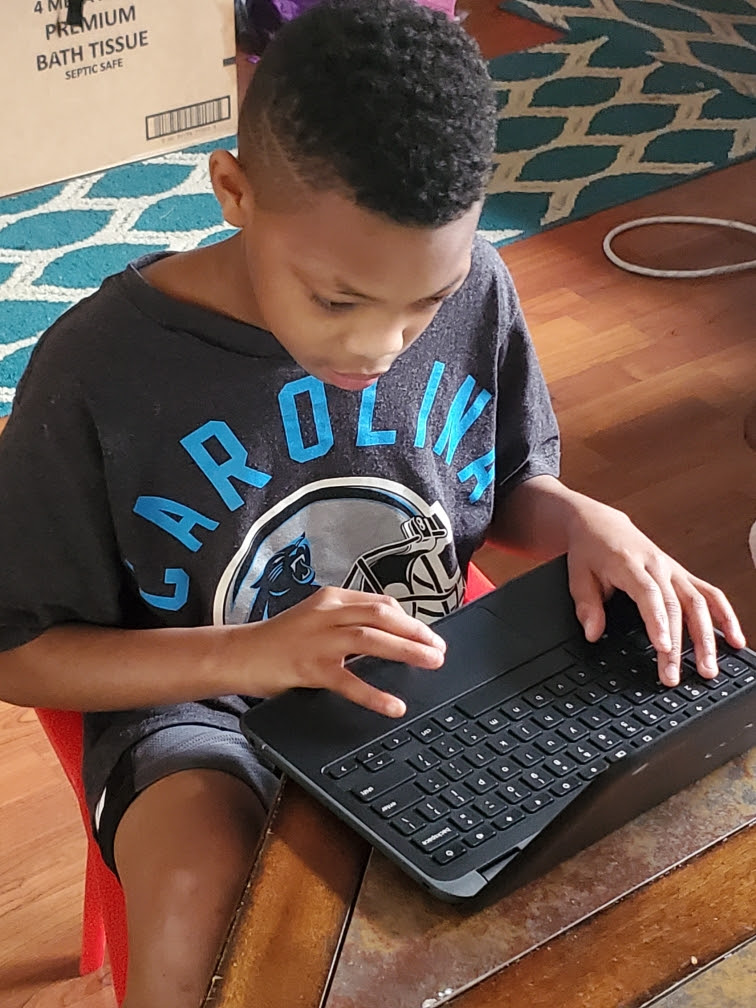
Big Brothers Big Sisters of WNC is especially effective in helping young people feel valued and heard.
Surveys of school personnel in the 2018-2019 school year show that, among BBBSWNC Littles in
community- and school/site-based programs
National Mentoring Month is the time of year where engagement from community members interested
in becoming a mentor is highest. This year, Big Brothers Big Sisters of Western North Carolina is
encouraging the public to go beyond just digital engagement – and become involved in real life.
Mentoring relationships are at their best when connections are made between a caring adult and a
young person who knows that someone is there to help guide them through real-life decisions.
To learn more about becoming a Big Brother or a Big Sister in Henderson County, contact Program
Coordinator Morgan Harris at (828) 507-6644 or email [email protected]. You can learn more
about serving across the 18 county region by visiting www.bbbswnc.org.