MATCHES
- A generous, anonymous gift will match all donations up to $5,000.
Ad Blocker Detected
It looks like you're using ad blocking technology. We are a local company, and our advertisers are local as well. Please consider allow listing our website in the future.
Upcoming events and things to do in Asheville, NC. Below is a list of events for festivals, concerts, art exhibitions, group meetups and more.
Interested in adding an event to our calendar? Please click the green “Post Your Event” button below.


Many skills are required to start and expand a successful farm business: passion, clear goals, production experience, financial and marketing know-how, and more. Farm Beginnings® will help you build these skills through one year of farmer-led training, mentoring, and networking. Using a holistic management frame, farmer-led classroom sessions, on-farm tours, and an extensive farmer network, Farm Beginnings® will help you clarify your goals and strengths, establish a strong enterprise plan, and start building a profitable and sustainable operation. Although students do not need to own land, some farming or production experience is required to get the most out of the program. As we know, farming is more critical than ever. Apply to this program and be prepared when crisis hits!
2020-2021 Farm Beginnings® Farmer Training is 200+ Hours including:
— Winter Whole-Farm Business Planning Courses – 60 hours (October – March)**
— ASAP’s Business of Farming Conference (February) – 8 hours
— OGS Conferences – 40+ hours
— Mentorship with an experienced Farmer Mentor (March – September) – 15 hours
— Production Training – 45 hours (April – October): WNC CRAFT tours on sustainable farms around WNC & Field Days with regional partners Living Web Farms and the Southern Appalachian Highlands Conservancy Incubator Farm
— One year WNC CRAFT Farmer Network membership – Membership and mentoring in a regional farmer network
The North Carolina Forest Service is accepting tree seedling orders as part of its annual sale.
Each year, the NCFS Nursery Program produces millions of quality seedlings for nearly 50 species of conifers, hardwoods and native understory plants, including eastern and Carolina hemlock seedlings, as well as an expanded selection of genetically improved third cycle loblolly pine seedlings.
How can you order tree seedlings from the NCFS Nursery Program?
Distribution of tree seedlings will occur December through mid-April, depending on weather conditions. Seedling orders can be shipped to one of 12 distribution centers statewide for a small fee or via UPS for a charge. Seedling orders are also available for pickup from the NCFS Claridge Nursery in Goldsboro or the Linville River Nursery, near Crossnore. For information on planting trees, people are encouraged to contact an NCFS county ranger. Contact information for your local NCFS county office and nursery locations is available at www.ncforestservice.gov/contacts.

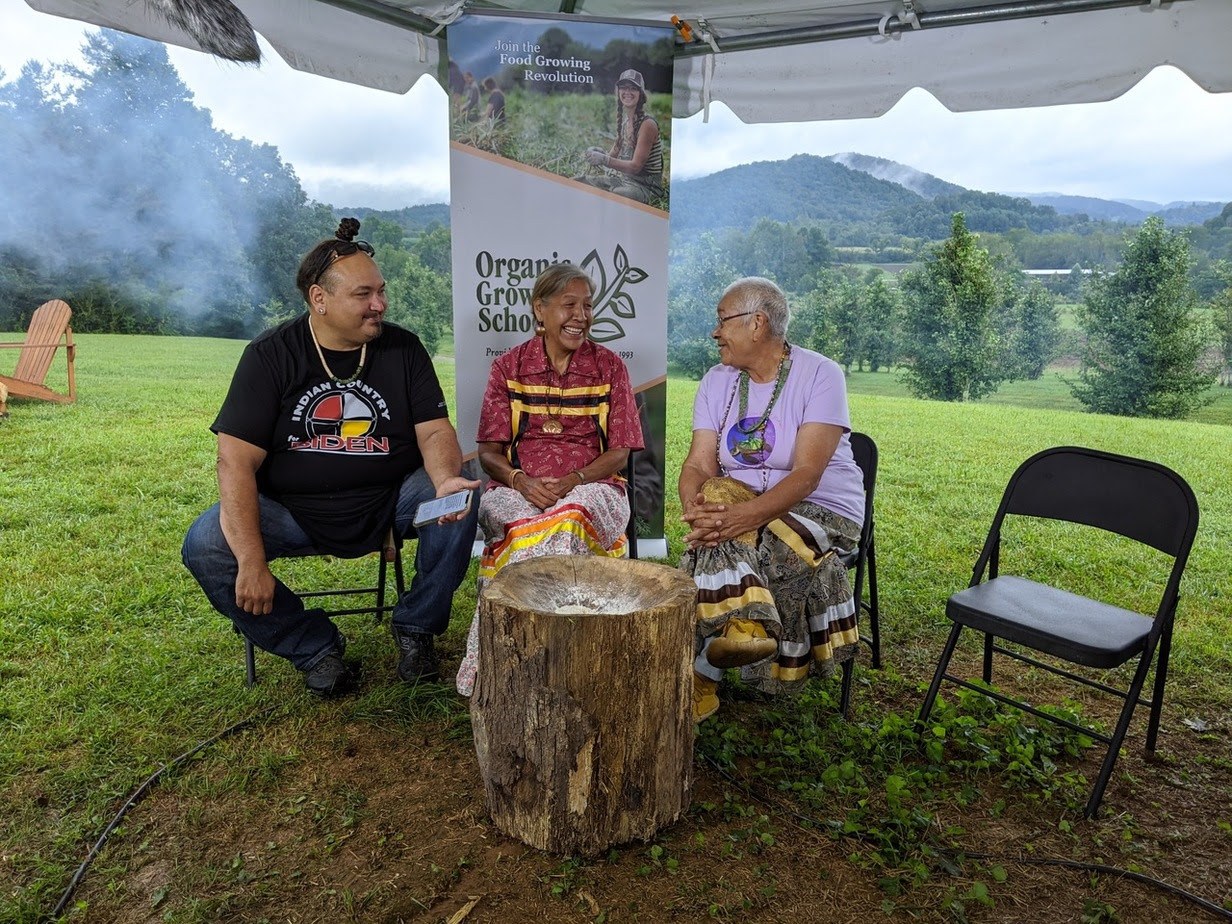
As part of the EmPOWERing Mountain Food Systems Project in the seven western counties of North Carolina, including the Qualla Boundary of the Eastern Band of Cherokee Indians, the Mountain Food & Farm Apprenticeship Program brings education and workforce development opportunities to the region in partnership with Western Carolina University, Haywood Community College, Southwestern Community College, and Tri-County Community College.


Immerse yourself in a kaleidoscope of color as George Vanderbilt’s magnificent estate and the surrounding Blue Ridge Mountains are beautifully transformed by autumn’s touch. The arrival of cool weather, an abundance of outdoor activities, plus special harvest-themed dining and Winery offerings make for a truly unique and exceptional fall getaway.

From Asheville GreenWorks:
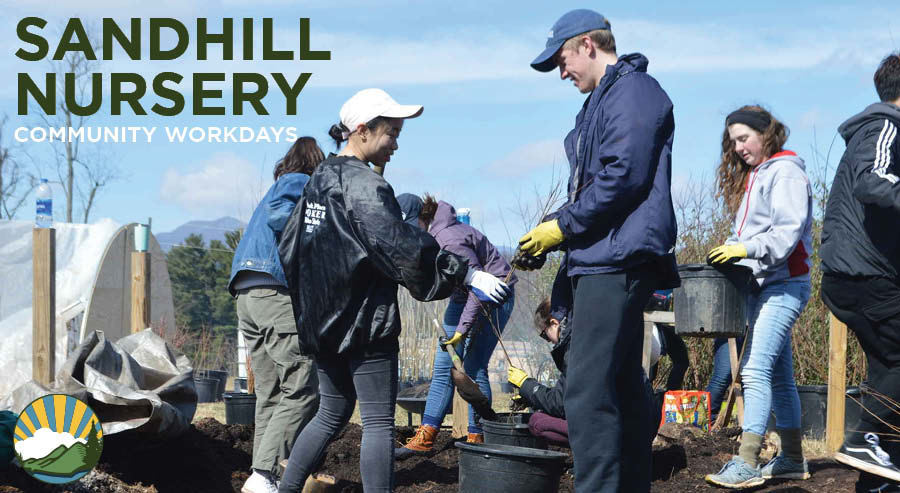
Looking to get involved, stay active, and meet some new friends? Public workdays at Sandhill Native Tree Nursery and Edible Orchard take place on the first Saturday of each month from 10 a.m. until noon at Buncombe County Sports Park (58 Apac Circle in West Asheville/Candler). 2020 dates include:
Join other volunteers in mulching, pruning, and weeding along with special projects. Please wear work clothes to get dirty and close-toed shoes. Sunscreen, water, and hat are also handy items to have on hand. All other tools and gear will be provided. Contact Gabby Fitts with any questions at (828) 232-7144 or [email protected].
The Sandhill tree nursey is supported with a Buncombe County Community Recreation Grant. Specific native trees are grown at the site and planted in public places throughout the county as a larger plan to plant no less than 500 trees annually. The project allows for a greater variety of fruit and shade trees to support a more diverse ecology.
Follow Buncombe County Recreation on Facebook and Instagram.


Join us for Second Sundays on zoom! We will be hosting Dr. Langdon Martin of Warren Wilson College. Log onto zoom, using the link in the sidebar, at 6pm EST on November 8th, 2020.
Hops are a key contributor to the flavors and aromas in beer. Some of the same molecules that contribute to the bitter taste in beer, the hop acids, are biologically active with interesting antimicrobial properties. Many of these molecules wind up in the spent yeast byproduct that forms during the beer-making process.
Spent craft yeast, which is protein-rich, has potential to be repurposed as a feed supplement for ruminants such as cattle. I will present results from initial in vitro studies that investigate this possibility. When bovine rumen fluid is incubated with spent craft yeast, methane production is inhibited, and the inhibition is comparable to that achieved with the commercial antimicrobial Monensin. Ongoing investigations involve how the methane-production process is affected by different concentrations of hop acids. This effect has the potential to improve agricultural feed efficiency and to reduce anthropogenic methane.
Langdon J. Martin, Ph.D. is a Professor of Chemistry at Warren Wilson College, where he teaches General and Organic Chemistry. His research interests include looking for environmentally beneficial uses for waste products.

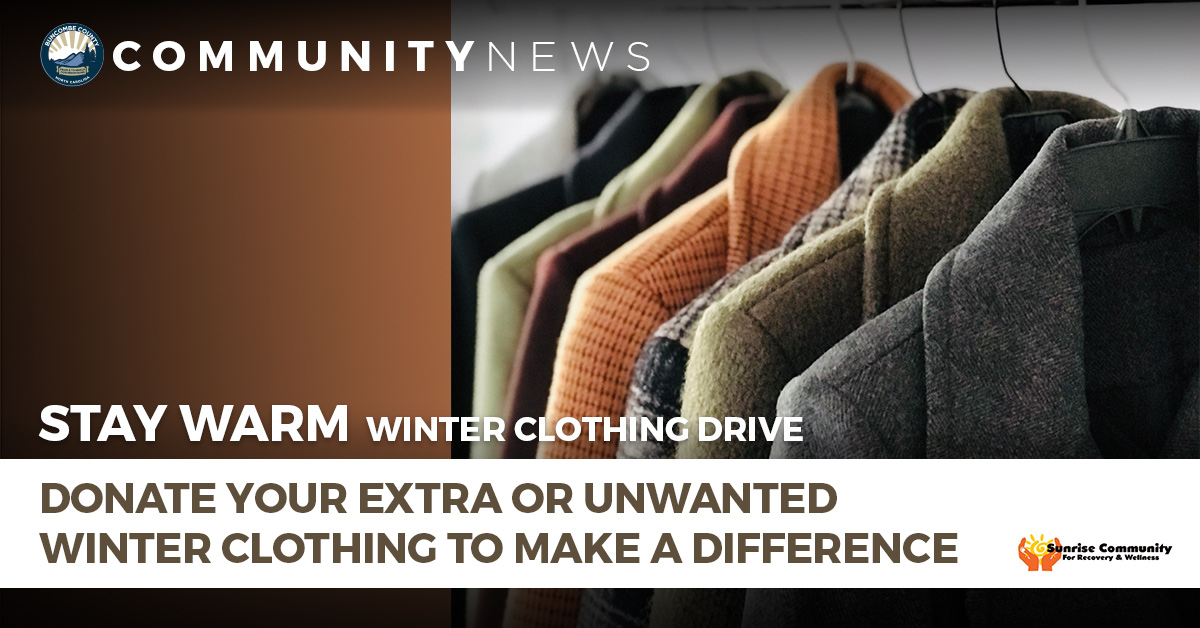
Is it time to give your winter wardrobe an upgrade? Do you have more winter clothing than you want or need? Are some of your winter clothes too small or too big? If you answered yes to any of these questions, consider donating your extra or unwanted winter clothing items to the Stay Warm Winter Clothing Drive hosted by Buncombe County Health and Human Services in partnership with Sunrise Community for Recovery and Wellness.
Donations will be accepted Nov. 1-30, Monday-Friday from noon-4 p.m. in our Syringe Service Program (Disease Control) located at 40 Coxe Ave. We will accept gently used donations of the following items:
For your safety and ours, we are offering no contact donation drop off. We have donation bins located at The Syringe Service Program (Disease Control). Donations will be collected daily by our Harm Reduction Coordinator, cleaned, and prepared to be distributed to clients in need of warm clothing this winter.

Is it time to give your winter wardrobe an upgrade? Do you have more winter clothing than you want or need? Are some of your winter clothes too small or too big? If you answered yes to any of these questions, consider donating your extra or unwanted winter clothing items to the Stay Warm Winter Clothing Drive hosted by Buncombe County Health and Human Services in partnership with Sunrise Community for Recovery and Wellness.
Donations will be accepted Nov. 1-30, Monday-Friday from noon-4 p.m. in our Syringe Service Program (Disease Control) located at 40 Coxe Ave. We will accept gently used donations of the following items:
For your safety and ours, we are offering no contact donation drop off. We have donation bins located at The Syringe Service Program (Disease Control). Donations will be collected daily by our Harm Reduction Coordinator, cleaned, and prepared to be distributed to clients in need of warm clothing this winter.

Is it time to give your winter wardrobe an upgrade? Do you have more winter clothing than you want or need? Are some of your winter clothes too small or too big? If you answered yes to any of these questions, consider donating your extra or unwanted winter clothing items to the Stay Warm Winter Clothing Drive hosted by Buncombe County Health and Human Services in partnership with Sunrise Community for Recovery and Wellness.
Donations will be accepted Nov. 1-30, Monday-Friday from noon-4 p.m. in our Syringe Service Program (Disease Control) located at 40 Coxe Ave. We will accept gently used donations of the following items:
For your safety and ours, we are offering no contact donation drop off. We have donation bins located at The Syringe Service Program (Disease Control). Donations will be collected daily by our Harm Reduction Coordinator, cleaned, and prepared to be distributed to clients in need of warm clothing this winter.

Is it time to give your winter wardrobe an upgrade? Do you have more winter clothing than you want or need? Are some of your winter clothes too small or too big? If you answered yes to any of these questions, consider donating your extra or unwanted winter clothing items to the Stay Warm Winter Clothing Drive hosted by Buncombe County Health and Human Services in partnership with Sunrise Community for Recovery and Wellness.
Donations will be accepted Nov. 1-30, Monday-Friday from noon-4 p.m. in our Syringe Service Program (Disease Control) located at 40 Coxe Ave. We will accept gently used donations of the following items:
For your safety and ours, we are offering no contact donation drop off. We have donation bins located at The Syringe Service Program (Disease Control). Donations will be collected daily by our Harm Reduction Coordinator, cleaned, and prepared to be distributed to clients in need of warm clothing this winter.
|

Is it time to give your winter wardrobe an upgrade? Do you have more winter clothing than you want or need? Are some of your winter clothes too small or too big? If you answered yes to any of these questions, consider donating your extra or unwanted winter clothing items to the Stay Warm Winter Clothing Drive hosted by Buncombe County Health and Human Services in partnership with Sunrise Community for Recovery and Wellness.
Donations will be accepted Nov. 1-30, Monday-Friday from noon-4 p.m. in our Syringe Service Program (Disease Control) located at 40 Coxe Ave. We will accept gently used donations of the following items:
For your safety and ours, we are offering no contact donation drop off. We have donation bins located at The Syringe Service Program (Disease Control). Donations will be collected daily by our Harm Reduction Coordinator, cleaned, and prepared to be distributed to clients in need of warm clothing this winter.
|


|


|

|

Is it time to give your winter wardrobe an upgrade? Do you have more winter clothing than you want or need? Are some of your winter clothes too small or too big? If you answered yes to any of these questions, consider donating your extra or unwanted winter clothing items to the Stay Warm Winter Clothing Drive hosted by Buncombe County Health and Human Services in partnership with Sunrise Community for Recovery and Wellness.
Donations will be accepted Nov. 1-30, Monday-Friday from noon-4 p.m. in our Syringe Service Program (Disease Control) located at 40 Coxe Ave. We will accept gently used donations of the following items:
For your safety and ours, we are offering no contact donation drop off. We have donation bins located at The Syringe Service Program (Disease Control). Donations will be collected daily by our Harm Reduction Coordinator, cleaned, and prepared to be distributed to clients in need of warm clothing this winter.

|

Is it time to give your winter wardrobe an upgrade? Do you have more winter clothing than you want or need? Are some of your winter clothes too small or too big? If you answered yes to any of these questions, consider donating your extra or unwanted winter clothing items to the Stay Warm Winter Clothing Drive hosted by Buncombe County Health and Human Services in partnership with Sunrise Community for Recovery and Wellness.
Donations will be accepted Nov. 1-30, Monday-Friday from noon-4 p.m. in our Syringe Service Program (Disease Control) located at 40 Coxe Ave. We will accept gently used donations of the following items:
For your safety and ours, we are offering no contact donation drop off. We have donation bins located at The Syringe Service Program (Disease Control). Donations will be collected daily by our Harm Reduction Coordinator, cleaned, and prepared to be distributed to clients in need of warm clothing this winter.

This course introduces the concept of edible and native plants for landscaping. Participants will be introduced to more than 40 edible and attractive landscaping plants, many of which are native. All of these plants either feed people, feed wildlife, build soil, and/or feed other plants while remaining an attractive addition to the landscape. They will learn how to work with clients and specific sites to meet the needs of the residents and the plants.
Participants will leave the class with a better understanding of what plants are available for edible and native landscaping. They should feel confident in incorporating at least a few edible and/or native plants into a landscape on future projects and how to communicate the benefits of these plants to their clients.
This course has been approved as a two-hour elective course eligible for continuing-education credit through the North Carolina Licensing Board for General Contractors, and is eligible for Learning Units through the American Institute of Architects. It may also meet continuing-education criteria for other organizations; please email [email protected] with questions related to qualifying for continuing education.

|