

Calendar of Events
Upcoming events and things to do in Asheville, NC. Below is a list of events for festivals, concerts, art exhibitions, group meetups and more.
Interested in adding an event to our calendar? Please click the green “Post Your Event” button below.
 |
|
We’re flipping the script on trick or treating this year! Guess Who: A Costume Quest is an outdoor walking tour and interactive game that features costumed actors from past ACT plays and musicals. Guess who’s who, and after you do, there’s a take-home bag of candy and treats for you! This family-friendly night of fun will be held in the parking lots and surrounding grounds of Asheville Community Theatre and the Thomas Wolfe House. Tours will begin at 6:00 pm and start times will be staggered to maintain social distancing. How will this work? Chanda Calentine explains: “You’ll walk on a path around our building and will encounter 12 different characters along the way. They’ll each share a clue or two about themselves, and you’ll try to guess who they are and which show they’re from. These are recognizable characters from our family friendly shows, and even if you haven’t seen these shows at ACT, we think you’ll still be able to make a good guess! And, at the end of the tour, we’ll have treats for you to take home. |
LEAVE IT BETTER SWEEPSTAKES
Enter to win an ENO Leave No Trace Double Nest hammock and suspension system today! ENO and Explore Brevard are excited to partner in the effort to promote our new Leave It Better campaign. Entering is easy. Simply follow these steps and you’ll be automatically entered into the sweepstakes:
STEP 1
Follow ENO Hammocks and Explore Brevard on Instagram or Facebook.
Step 2
Post an example of how you Leave No Trace and go the extra step to Leave It Better on your own social media account with the hashtag #ILeaveItBetter
Step 3
Watch our social media accounts for winner announcements at the end of August, September and October!
Each month will have multiple winners so stay tuned.
See below for official contest rules and alternate form of entry.
|
|
We’re flipping the script on trick or treating this year! Guess Who: A Costume Quest is an outdoor walking tour and interactive game that features costumed actors from past ACT plays and musicals. Guess who’s who, and after you do, there’s a take-home bag of candy and treats for you! This family-friendly night of fun will be held in the parking lots and surrounding grounds of Asheville Community Theatre and the Thomas Wolfe House. Tours will begin at 6:00 pm and start times will be staggered to maintain social distancing. How will this work? Chanda Calentine explains: “You’ll walk on a path around our building and will encounter 12 different characters along the way. They’ll each share a clue or two about themselves, and you’ll try to guess who they are and which show they’re from. These are recognizable characters from our family friendly shows, and even if you haven’t seen these shows at ACT, we think you’ll still be able to make a good guess! And, at the end of the tour, we’ll have treats for you to take home. |
LEAVE IT BETTER SWEEPSTAKES
Enter to win an ENO Leave No Trace Double Nest hammock and suspension system today! ENO and Explore Brevard are excited to partner in the effort to promote our new Leave It Better campaign. Entering is easy. Simply follow these steps and you’ll be automatically entered into the sweepstakes:
STEP 1
Follow ENO Hammocks and Explore Brevard on Instagram or Facebook.
Step 2
Post an example of how you Leave No Trace and go the extra step to Leave It Better on your own social media account with the hashtag #ILeaveItBetter
Step 3
Watch our social media accounts for winner announcements at the end of August, September and October!
Each month will have multiple winners so stay tuned.
See below for official contest rules and alternate form of entry.
|
|
We’re flipping the script on trick or treating this year! Guess Who: A Costume Quest is an outdoor walking tour and interactive game that features costumed actors from past ACT plays and musicals. Guess who’s who, and after you do, there’s a take-home bag of candy and treats for you! This family-friendly night of fun will be held in the parking lots and surrounding grounds of Asheville Community Theatre and the Thomas Wolfe House. Tours will begin at 6:00 pm and start times will be staggered to maintain social distancing. How will this work? Chanda Calentine explains: “You’ll walk on a path around our building and will encounter 12 different characters along the way. They’ll each share a clue or two about themselves, and you’ll try to guess who they are and which show they’re from. These are recognizable characters from our family friendly shows, and even if you haven’t seen these shows at ACT, we think you’ll still be able to make a good guess! And, at the end of the tour, we’ll have treats for you to take home. |
LEAVE IT BETTER SWEEPSTAKES
Enter to win an ENO Leave No Trace Double Nest hammock and suspension system today! ENO and Explore Brevard are excited to partner in the effort to promote our new Leave It Better campaign. Entering is easy. Simply follow these steps and you’ll be automatically entered into the sweepstakes:
STEP 1
Follow ENO Hammocks and Explore Brevard on Instagram or Facebook.
Step 2
Post an example of how you Leave No Trace and go the extra step to Leave It Better on your own social media account with the hashtag #ILeaveItBetter
Step 3
Watch our social media accounts for winner announcements at the end of August, September and October!
Each month will have multiple winners so stay tuned.
See below for official contest rules and alternate form of entry.
Teen – (grades 6-12)

Join us and Bingeable Trivia every Wednesday at 7pm for outdoor trivia night!!
-All trivia players must have a seat outside to play. There are a limited amount of tables outside so get here early to claim your seat
-Tables are spread out 6 feet apart for social distancing
-Players will text in their answers instead of turning in sheets
-And masks are required while ordering beers inside
We will have a theme every other week! Trivia is subject to cancellation depending on the weather.

|
|
We’re flipping the script on trick or treating this year! Guess Who: A Costume Quest is an outdoor walking tour and interactive game that features costumed actors from past ACT plays and musicals. Guess who’s who, and after you do, there’s a take-home bag of candy and treats for you! This family-friendly night of fun will be held in the parking lots and surrounding grounds of Asheville Community Theatre and the Thomas Wolfe House. Tours will begin at 6:00 pm and start times will be staggered to maintain social distancing. How will this work? Chanda Calentine explains: “You’ll walk on a path around our building and will encounter 12 different characters along the way. They’ll each share a clue or two about themselves, and you’ll try to guess who they are and which show they’re from. These are recognizable characters from our family friendly shows, and even if you haven’t seen these shows at ACT, we think you’ll still be able to make a good guess! And, at the end of the tour, we’ll have treats for you to take home. |
|
|
We’re flipping the script on trick or treating this year! Guess Who: A Costume Quest is an outdoor walking tour and interactive game that features costumed actors from past ACT plays and musicals. Guess who’s who, and after you do, there’s a take-home bag of candy and treats for you! This family-friendly night of fun will be held in the parking lots and surrounding grounds of Asheville Community Theatre and the Thomas Wolfe House. Tours will begin at 6:00 pm and start times will be staggered to maintain social distancing. How will this work? Chanda Calentine explains: “You’ll walk on a path around our building and will encounter 12 different characters along the way. They’ll each share a clue or two about themselves, and you’ll try to guess who they are and which show they’re from. These are recognizable characters from our family friendly shows, and even if you haven’t seen these shows at ACT, we think you’ll still be able to make a good guess! And, at the end of the tour, we’ll have treats for you to take home. |

Welcome to Prevent Child Abuse North Carolina’s first-ever 5 Factors (virtual) 5k! Because we cannot safely gather in-person this year, we are expanding our annual, one-day event to AN ENTIRE RACE WEEK (Oct. 24-31), packed with all the family-friendly activities we typically host on race day. That means you get to choose when and where you complete your 5k, AND you will have access to an entire week of fun, virtual activities designed for all ages!
When you register below, you will have access to our race week calendar of activities that will run October 24th through October 31st. We are so excited to feature mini events focused on mental and physical health, education, and family entertainment scheduled at different times throughout the week.
Your VIP Race Week includes:
- Access to more than 20 family-friendly virtual activities (live and pre-recorded) focused on exercise, entertainment, and education
- Pop-up drawings for free swag
- Discounts on featured merchandise
- Printable customized bib
- Printable customized certificate of completion – there is an option for you to submit your time!
VIP Race Week is jam-packed with family fun, all for the low price of $35. We may be physically distant, but we are TOGETHER in preventing child abuse and neglect.
LEAVE IT BETTER SWEEPSTAKES
Enter to win an ENO Leave No Trace Double Nest hammock and suspension system today! ENO and Explore Brevard are excited to partner in the effort to promote our new Leave It Better campaign. Entering is easy. Simply follow these steps and you’ll be automatically entered into the sweepstakes:
STEP 1
Follow ENO Hammocks and Explore Brevard on Instagram or Facebook.
Step 2
Post an example of how you Leave No Trace and go the extra step to Leave It Better on your own social media account with the hashtag #ILeaveItBetter
Step 3
Watch our social media accounts for winner announcements at the end of August, September and October!
Each month will have multiple winners so stay tuned.
See below for official contest rules and alternate form of entry.
|
|
We’re flipping the script on trick or treating this year! Guess Who: A Costume Quest is an outdoor walking tour and interactive game that features costumed actors from past ACT plays and musicals. Guess who’s who, and after you do, there’s a take-home bag of candy and treats for you! This family-friendly night of fun will be held in the parking lots and surrounding grounds of Asheville Community Theatre and the Thomas Wolfe House. Tours will begin at 6:00 pm and start times will be staggered to maintain social distancing. How will this work? Chanda Calentine explains: “You’ll walk on a path around our building and will encounter 12 different characters along the way. They’ll each share a clue or two about themselves, and you’ll try to guess who they are and which show they’re from. These are recognizable characters from our family friendly shows, and even if you haven’t seen these shows at ACT, we think you’ll still be able to make a good guess! And, at the end of the tour, we’ll have treats for you to take home. |
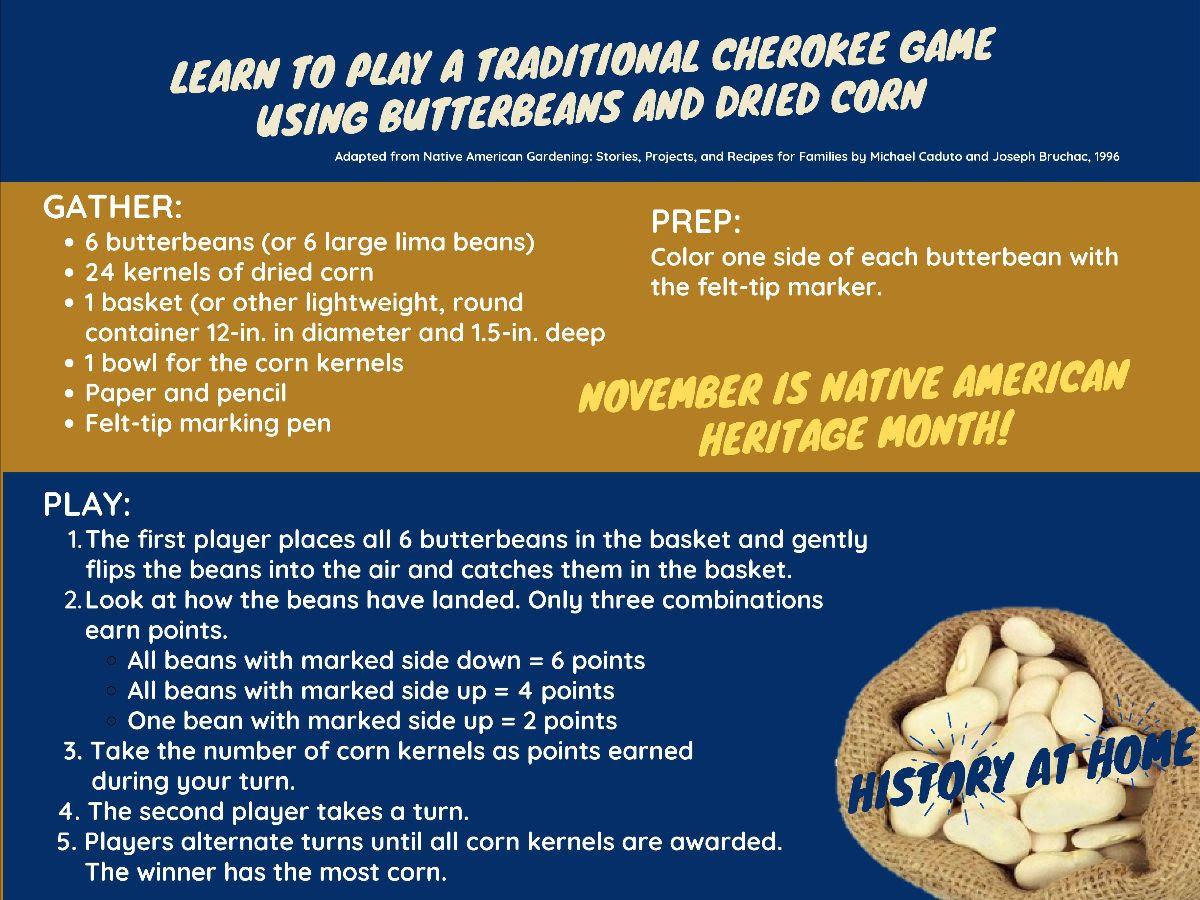
This is a variation on the tradition Cherokee Butterbean Game. It can be played by several individual players or several teams. Traditionally, this game uses three butterbeans that have been split in half. More…
From the Museum of the Cherokee Indian: Cherokee people began growing a form of corn two thousand years ago. By about a thousand years ago, or 1000 AD, they were growing corn and beans, as we know them today. Corn, beans, and squash was always grown together and was known as the “Three Sisters.” Beans restore nitrogen to the soil while corn depletes nitrogen. The vines of the beans and squash twined up the cornstalks. When corn and beans are eaten together, they provide complete proteins and amino acids for our diet.
Corn was so important to the Cherokee that they had important celebrations and ceremonies called “Green Corn Festivals.” The first of these was held in August, before the sweet corn was ready to eat. The last was held in October or November, when the
field corn was ready to be picked. At these ceremonies, people purified themselves physically and spiritually before feasting together. At this time, people got married and divorced. All old scores were settled and everyone started a new year together.
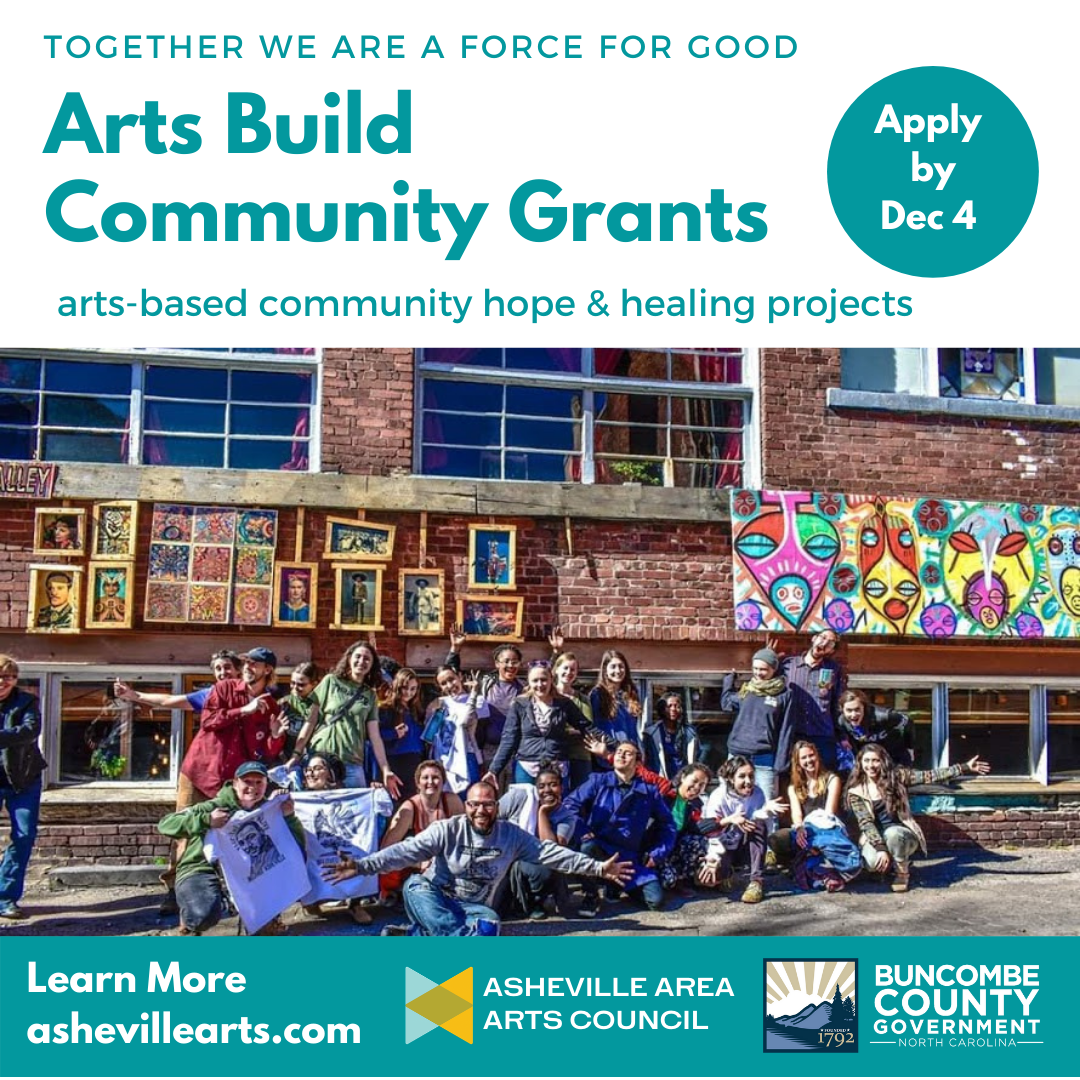
This year the Asheville Area Arts Council is offering $500 micro-grants for arts-based projects specifically focused on community hope and healing. These can be projects that bring joy to our local community, and/or projects that actively engage community members in safe activities following state and local health restrictions.
Arts and culture are a fundamental part of our community. They help us connect with one another and better understand history, people, and new ideas. When people become involved in the design, creation, and upkeep of places, they develop a vested interest in using and maintaining these spaces. When neighbors have a true sense of “ownership” or connection to the places they frequent, the community becomes a better place to live, work, and visit. According to Americans for the Arts (AFTA), “86% of participants who took part in community-based art want to be involved in future projects, and people living where these art projects occurred were more than twice as likely to be civically engaged as those whose neighborhoods did not have projects.”
This is a variation on the tradition Cherokee Butterbean Game. It can be played by several individual players or several teams. Traditionally, this game uses three butterbeans that have been split in half. More…
From the Museum of the Cherokee Indian: Cherokee people began growing a form of corn two thousand years ago. By about a thousand years ago, or 1000 AD, they were growing corn and beans, as we know them today. Corn, beans, and squash was always grown together and was known as the “Three Sisters.” Beans restore nitrogen to the soil while corn depletes nitrogen. The vines of the beans and squash twined up the cornstalks. When corn and beans are eaten together, they provide complete proteins and amino acids for our diet.
Corn was so important to the Cherokee that they had important celebrations and ceremonies called “Green Corn Festivals.” The first of these was held in August, before the sweet corn was ready to eat. The last was held in October or November, when the
field corn was ready to be picked. At these ceremonies, people purified themselves physically and spiritually before feasting together. At this time, people got married and divorced. All old scores were settled and everyone started a new year together.

As part of the state’s spending plan for federal CARES Act funding, $9.4 million was designated to provide direct aid to arts councils and arts organizations in an effort to mitigate business disruptions caused by COVID-19. These funds will be distributed on a per-capita basis to all North Carolina counties with a population less than 1 million people. Buncombe County received an allocation of $299,212.42, which will be distributed by the Asheville Area Arts Council.

The Southern Equality Studios special grant round is dedicated to resourcing and celebrating LGBTQ artists and creatives across the LGBTQ South who are BIPOC (Black, Indigenous, or people of color). Grants of up to $500 will support BIPOC LGBTQ Southern artists working on a wide range of creative projects.
These new grant rounds are part of CSE’s Southern Equality Fund, which has been making grassroots grants across the LGBTQ South since 2015. Since its inception, the Southern Equality Fund has prioritized supporting work led by BIPOC, transgender, and rural organizers.
Have you seen an inspiring BIPOC LGBTQ artists in your community, or are you a creative who could use grant support? If so, we want to hear from you!
We are specifically seeking nominations for artists or creatives efforts who are:
- Based in the South.
- Black, Indigenous, or people of color (BIPOC).
- LGBTQ people.
- Funds can be used to support a wide range of artistic endeavors.
- Nominees are eligible to receive this grant even if they have received a previous Southern Equality Fund grant; however, priority will be given to nominees who have not yet received a grant.
- Anyone is welcome and encouraged to nominate an artist for a grant and artists may also nominate themselves.
- There are no grant reports, budgets or supplemental materials required in this process. However, if selected, applicants will have to fill out and return a W9 form to receive their funding.
This year the Asheville Area Arts Council is offering $500 micro-grants for arts-based projects specifically focused on community hope and healing. These can be projects that bring joy to our local community, and/or projects that actively engage community members in safe activities following state and local health restrictions.
Arts and culture are a fundamental part of our community. They help us connect with one another and better understand history, people, and new ideas. When people become involved in the design, creation, and upkeep of places, they develop a vested interest in using and maintaining these spaces. When neighbors have a true sense of “ownership” or connection to the places they frequent, the community becomes a better place to live, work, and visit. According to Americans for the Arts (AFTA), “86% of participants who took part in community-based art want to be involved in future projects, and people living where these art projects occurred were more than twice as likely to be civically engaged as those whose neighborhoods did not have projects.”
This is a variation on the tradition Cherokee Butterbean Game. It can be played by several individual players or several teams. Traditionally, this game uses three butterbeans that have been split in half. More…
From the Museum of the Cherokee Indian: Cherokee people began growing a form of corn two thousand years ago. By about a thousand years ago, or 1000 AD, they were growing corn and beans, as we know them today. Corn, beans, and squash was always grown together and was known as the “Three Sisters.” Beans restore nitrogen to the soil while corn depletes nitrogen. The vines of the beans and squash twined up the cornstalks. When corn and beans are eaten together, they provide complete proteins and amino acids for our diet.
Corn was so important to the Cherokee that they had important celebrations and ceremonies called “Green Corn Festivals.” The first of these was held in August, before the sweet corn was ready to eat. The last was held in October or November, when the
field corn was ready to be picked. At these ceremonies, people purified themselves physically and spiritually before feasting together. At this time, people got married and divorced. All old scores were settled and everyone started a new year together.
As part of the state’s spending plan for federal CARES Act funding, $9.4 million was designated to provide direct aid to arts councils and arts organizations in an effort to mitigate business disruptions caused by COVID-19. These funds will be distributed on a per-capita basis to all North Carolina counties with a population less than 1 million people. Buncombe County received an allocation of $299,212.42, which will be distributed by the Asheville Area Arts Council.
The Southern Equality Studios special grant round is dedicated to resourcing and celebrating LGBTQ artists and creatives across the LGBTQ South who are BIPOC (Black, Indigenous, or people of color). Grants of up to $500 will support BIPOC LGBTQ Southern artists working on a wide range of creative projects.
These new grant rounds are part of CSE’s Southern Equality Fund, which has been making grassroots grants across the LGBTQ South since 2015. Since its inception, the Southern Equality Fund has prioritized supporting work led by BIPOC, transgender, and rural organizers.
Have you seen an inspiring BIPOC LGBTQ artists in your community, or are you a creative who could use grant support? If so, we want to hear from you!
We are specifically seeking nominations for artists or creatives efforts who are:
- Based in the South.
- Black, Indigenous, or people of color (BIPOC).
- LGBTQ people.
- Funds can be used to support a wide range of artistic endeavors.
- Nominees are eligible to receive this grant even if they have received a previous Southern Equality Fund grant; however, priority will be given to nominees who have not yet received a grant.
- Anyone is welcome and encouraged to nominate an artist for a grant and artists may also nominate themselves.
- There are no grant reports, budgets or supplemental materials required in this process. However, if selected, applicants will have to fill out and return a W9 form to receive their funding.
This year the Asheville Area Arts Council is offering $500 micro-grants for arts-based projects specifically focused on community hope and healing. These can be projects that bring joy to our local community, and/or projects that actively engage community members in safe activities following state and local health restrictions.
Arts and culture are a fundamental part of our community. They help us connect with one another and better understand history, people, and new ideas. When people become involved in the design, creation, and upkeep of places, they develop a vested interest in using and maintaining these spaces. When neighbors have a true sense of “ownership” or connection to the places they frequent, the community becomes a better place to live, work, and visit. According to Americans for the Arts (AFTA), “86% of participants who took part in community-based art want to be involved in future projects, and people living where these art projects occurred were more than twice as likely to be civically engaged as those whose neighborhoods did not have projects.”
This is a variation on the tradition Cherokee Butterbean Game. It can be played by several individual players or several teams. Traditionally, this game uses three butterbeans that have been split in half. More…
From the Museum of the Cherokee Indian: Cherokee people began growing a form of corn two thousand years ago. By about a thousand years ago, or 1000 AD, they were growing corn and beans, as we know them today. Corn, beans, and squash was always grown together and was known as the “Three Sisters.” Beans restore nitrogen to the soil while corn depletes nitrogen. The vines of the beans and squash twined up the cornstalks. When corn and beans are eaten together, they provide complete proteins and amino acids for our diet.
Corn was so important to the Cherokee that they had important celebrations and ceremonies called “Green Corn Festivals.” The first of these was held in August, before the sweet corn was ready to eat. The last was held in October or November, when the
field corn was ready to be picked. At these ceremonies, people purified themselves physically and spiritually before feasting together. At this time, people got married and divorced. All old scores were settled and everyone started a new year together.
As part of the state’s spending plan for federal CARES Act funding, $9.4 million was designated to provide direct aid to arts councils and arts organizations in an effort to mitigate business disruptions caused by COVID-19. These funds will be distributed on a per-capita basis to all North Carolina counties with a population less than 1 million people. Buncombe County received an allocation of $299,212.42, which will be distributed by the Asheville Area Arts Council.
The Southern Equality Studios special grant round is dedicated to resourcing and celebrating LGBTQ artists and creatives across the LGBTQ South who are BIPOC (Black, Indigenous, or people of color). Grants of up to $500 will support BIPOC LGBTQ Southern artists working on a wide range of creative projects.
These new grant rounds are part of CSE’s Southern Equality Fund, which has been making grassroots grants across the LGBTQ South since 2015. Since its inception, the Southern Equality Fund has prioritized supporting work led by BIPOC, transgender, and rural organizers.
Have you seen an inspiring BIPOC LGBTQ artists in your community, or are you a creative who could use grant support? If so, we want to hear from you!
We are specifically seeking nominations for artists or creatives efforts who are:
- Based in the South.
- Black, Indigenous, or people of color (BIPOC).
- LGBTQ people.
- Funds can be used to support a wide range of artistic endeavors.
- Nominees are eligible to receive this grant even if they have received a previous Southern Equality Fund grant; however, priority will be given to nominees who have not yet received a grant.
- Anyone is welcome and encouraged to nominate an artist for a grant and artists may also nominate themselves.
- There are no grant reports, budgets or supplemental materials required in this process. However, if selected, applicants will have to fill out and return a W9 form to receive their funding.
This year the Asheville Area Arts Council is offering $500 micro-grants for arts-based projects specifically focused on community hope and healing. These can be projects that bring joy to our local community, and/or projects that actively engage community members in safe activities following state and local health restrictions.
Arts and culture are a fundamental part of our community. They help us connect with one another and better understand history, people, and new ideas. When people become involved in the design, creation, and upkeep of places, they develop a vested interest in using and maintaining these spaces. When neighbors have a true sense of “ownership” or connection to the places they frequent, the community becomes a better place to live, work, and visit. According to Americans for the Arts (AFTA), “86% of participants who took part in community-based art want to be involved in future projects, and people living where these art projects occurred were more than twice as likely to be civically engaged as those whose neighborhoods did not have projects.”
This is a variation on the tradition Cherokee Butterbean Game. It can be played by several individual players or several teams. Traditionally, this game uses three butterbeans that have been split in half. More…
From the Museum of the Cherokee Indian: Cherokee people began growing a form of corn two thousand years ago. By about a thousand years ago, or 1000 AD, they were growing corn and beans, as we know them today. Corn, beans, and squash was always grown together and was known as the “Three Sisters.” Beans restore nitrogen to the soil while corn depletes nitrogen. The vines of the beans and squash twined up the cornstalks. When corn and beans are eaten together, they provide complete proteins and amino acids for our diet.
Corn was so important to the Cherokee that they had important celebrations and ceremonies called “Green Corn Festivals.” The first of these was held in August, before the sweet corn was ready to eat. The last was held in October or November, when the
field corn was ready to be picked. At these ceremonies, people purified themselves physically and spiritually before feasting together. At this time, people got married and divorced. All old scores were settled and everyone started a new year together.
As part of the state’s spending plan for federal CARES Act funding, $9.4 million was designated to provide direct aid to arts councils and arts organizations in an effort to mitigate business disruptions caused by COVID-19. These funds will be distributed on a per-capita basis to all North Carolina counties with a population less than 1 million people. Buncombe County received an allocation of $299,212.42, which will be distributed by the Asheville Area Arts Council.