

Calendar of Events
Upcoming events and things to do in Asheville, NC. Below is a list of events for festivals, concerts, art exhibitions, group meetups and more.
Interested in adding an event to our calendar? Please click the green “Post Your Event” button below.
Exhibition and Public Programming
Vera B. Williams, an award-winning author and illustrator of children’s books, started making pictures almost as soon as she could walk. She studied at Black Mountain College in a time where summer institutes were held with classes taught by John Cage and Merce Cunningham. Williams studied under the Bauhaus luminary Josef Albers and went on to make art for the rest of her life. At the time of her death, The New York Times wrote: “Her illustrations, known for bold colors and a style reminiscent of folk art, were praised by reviewers for their great tenderness and crackling vitality.” Despite numerous awards and recognition for her children’s books, much of her wider life and work remains unexplored. This retrospective will showcase the complete range of Williams’ life and work. It will highlight her time at Black Mountain College, her political activism, and her establishment, with Paul Williams, of an influential yet little-known artist community, in addition to her work as an author and illustrator.
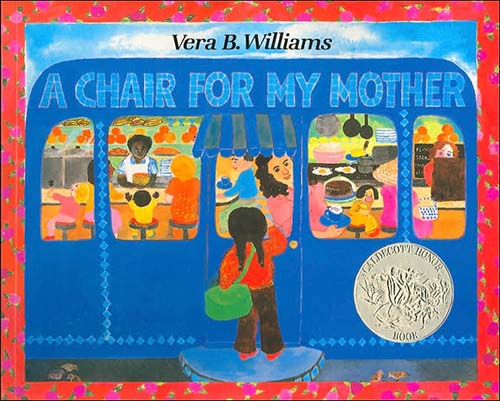
Author and illustrator of 17 children’s books, including Caldecott medal winner, A Chair for My Mother, Vera B. Williams always had a passion for the arts. Williams grew up in the Bronx, NY, and in 1936, when she was nine years old, one of her paintings, called Yentas, opens a new window, was included in an exhibition at the Museum of Modern Art. While Williams is widely known for her children’s books today, this exhibition’s expansive scope highlights unexplored aspects of her artistic practice and eight decades of life. From groundbreaking, powerful covers for Liberation Magazine, to Peace calendar collaborations with writer activist Grace Paley, to scenic sketches for Julian Beck and Judith Malina’s Living Theater, to hundreds of late life “Aging and Illness” cartoons sketches and doodles, Vera never sat still.
Williams arrived at Black Mountain College in 1945. While there, she embraced all aspects of living, working, and learning in the intensely creative college community. She was at BMC during a particularly fertile period, which allowed her to study with faculty members Buckminster Fuller and Josef Albers, and to participate in the famed summer sessions with John Cage, Merce Cunningham, M.C. Richards, and Robert Rauschenberg. In 1948, she graduated with Josef Albers as her advisor and sculptor Richard Lippold as her outside examiner. Forever one of the College’s shining stars, Vera graduated from BMC with just six semesters of coursework, at only twenty-one years old. She continued to visit BMC for years afterward, staying deeply involved with the artistic community that BMC incubated.
Anticipating the eventual closure of BMC, Williams, alongside her husband Paul Williams and a group of influential former BMC figures, founded The Gate Hill Cooperative Artists community located 30 miles north of NYC on the outskirts of Stony Point, NY. The Gate Hill Cooperative, also known as The Land, became an outcropping of Black Mountain College’s experimental ethos. Students and faculty including John Cage, M.C. Richards, David Tudor, Karen Karnes, David Weinrib, Stan VanDerBeek, and Patsy Lynch Wood shaped Gate Hill as founding members of the community. Vera B. Williams raised her three children at Gate Hill while continuing to make work.
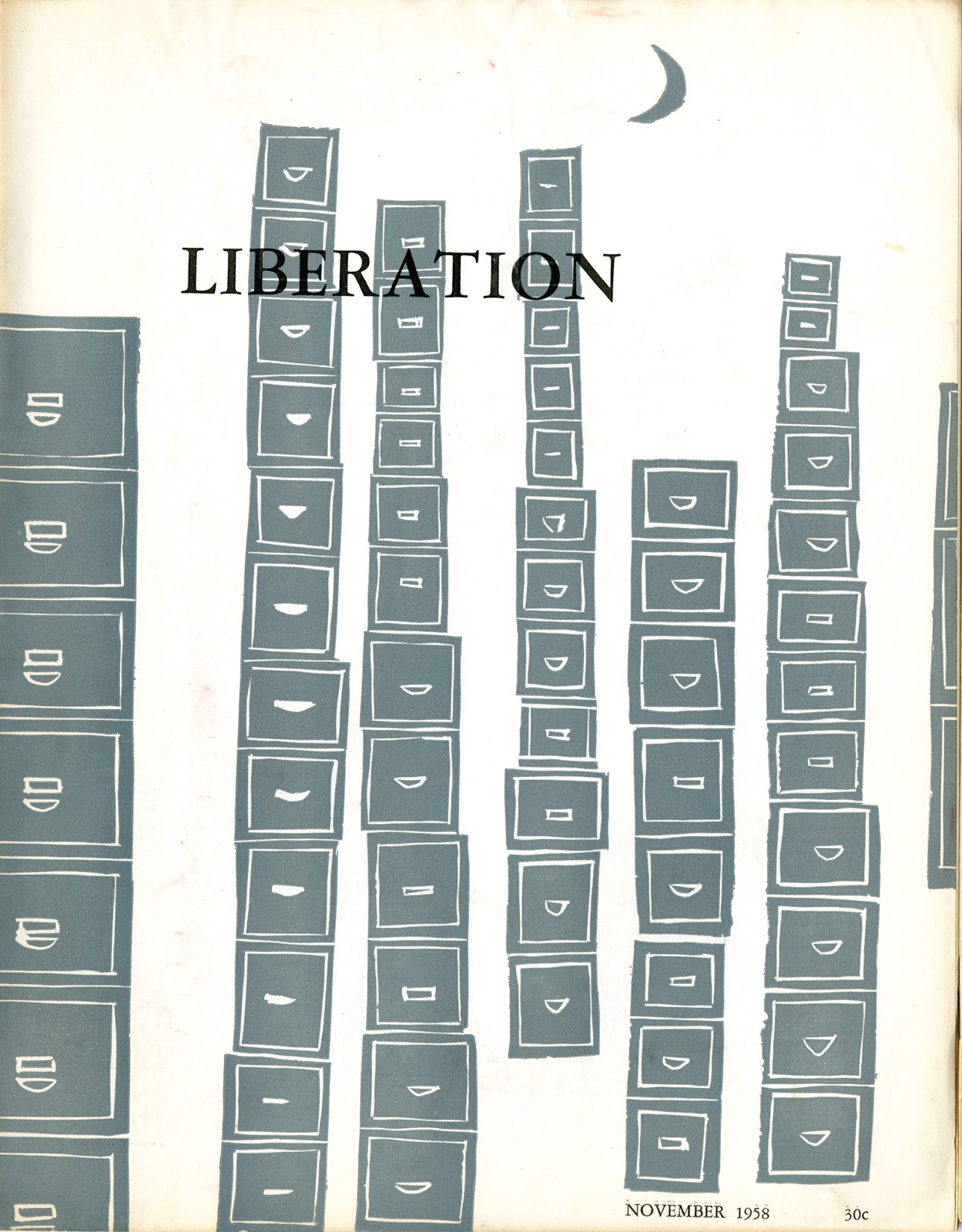
The early Gate Hill era represented an especially creative phase for the BMC group. For Williams, this period saw the creation of 76 covers for Liberation Magazine, a radical, groundbreaking publication. This exhibition will feature some of Williams’ most powerful Liberation covers including a design for the June 1963 edition, which contained the first full publication of MLK’s “Letter from Birmingham Jail.” Williams’ activism work continued throughout her life. As president of PEN’s Children Committee and member of The War Resisters league, she created a wide range of political and educational posters and journal covers. Williams protested the war in Vietnam and nuclear proliferation while supporting women’s causes and racial equality. In 1981, Williams was arrested and spent a month in a federal prison on charges stemming from her political activism.
In her late 40’s, Williams embarked in earnest on her career as a children’s book author and illustrator, a career which garnered the NY Public Library’s recognition of A Chair for My Mother as one of the greatest 100 children’s books of all time. Infinitely curious and always a wanderer at heart, Williams’ personal life was as expansive as her art. In addition to her prolific picture making, Williams started and helped run a Summerhill-based alternative school, canoed the Yukon, and lived alone on a houseboat in Vancouver Harbor. She helped to organize and attended dozens of political demonstrations throughout her adult life.
Her books won many awards including the Caldecott Medal Honor Book for A Chair for My Mother in 1983, the Boston Globe–Horn Book Award– Fiction category– for Scooter in 1994, the Jane Addams Honor for Amber Was Brave, Essie Was Smart in 2002, and the NSK Neustadt Prize for Children’s Literature in 2009. Her books reflected her values, emphasizing love, compassion, kindness, joy, strength, individuality, and courage.
Images:
Cover of Vera B. Williams’ A Chair for My Mother, published in 1982.
Vera B. Williams, Cover for Liberation Magazine, November 1958.
Liberation Tools is a cooperative subset of the 501c3 nonprofit Soul & Soil Project based in the unceded Tsalagi (Cherokee) territory of Western North Carolina.
Our mission is to build a collective that sustainably and skillfully crafts quality tools used for growing food, and freely distributes them to Black, Indigenous, and People of Color. To support these efforts, we sell these tools for twice the cost of producing one, thereby allowing people with accumulated wealth to access high quality tools by also paying for an identical tool to be sent to a BIPOC land steward.
-Bareroot Trees and Shrubs: $3-5
-Grasses: $2-5
-Berries/apples: $6-10
Exhibition and Public Programming
Vera B. Williams, an award-winning author and illustrator of children’s books, started making pictures almost as soon as she could walk. She studied at Black Mountain College in a time where summer institutes were held with classes taught by John Cage and Merce Cunningham. Williams studied under the Bauhaus luminary Josef Albers and went on to make art for the rest of her life. At the time of her death, The New York Times wrote: “Her illustrations, known for bold colors and a style reminiscent of folk art, were praised by reviewers for their great tenderness and crackling vitality.” Despite numerous awards and recognition for her children’s books, much of her wider life and work remains unexplored. This retrospective will showcase the complete range of Williams’ life and work. It will highlight her time at Black Mountain College, her political activism, and her establishment, with Paul Williams, of an influential yet little-known artist community, in addition to her work as an author and illustrator.
Author and illustrator of 17 children’s books, including Caldecott medal winner, A Chair for My Mother, Vera B. Williams always had a passion for the arts. Williams grew up in the Bronx, NY, and in 1936, when she was nine years old, one of her paintings, called Yentas, opens a new window, was included in an exhibition at the Museum of Modern Art. While Williams is widely known for her children’s books today, this exhibition’s expansive scope highlights unexplored aspects of her artistic practice and eight decades of life. From groundbreaking, powerful covers for Liberation Magazine, to Peace calendar collaborations with writer activist Grace Paley, to scenic sketches for Julian Beck and Judith Malina’s Living Theater, to hundreds of late life “Aging and Illness” cartoons sketches and doodles, Vera never sat still.
Williams arrived at Black Mountain College in 1945. While there, she embraced all aspects of living, working, and learning in the intensely creative college community. She was at BMC during a particularly fertile period, which allowed her to study with faculty members Buckminster Fuller and Josef Albers, and to participate in the famed summer sessions with John Cage, Merce Cunningham, M.C. Richards, and Robert Rauschenberg. In 1948, she graduated with Josef Albers as her advisor and sculptor Richard Lippold as her outside examiner. Forever one of the College’s shining stars, Vera graduated from BMC with just six semesters of coursework, at only twenty-one years old. She continued to visit BMC for years afterward, staying deeply involved with the artistic community that BMC incubated.
Anticipating the eventual closure of BMC, Williams, alongside her husband Paul Williams and a group of influential former BMC figures, founded The Gate Hill Cooperative Artists community located 30 miles north of NYC on the outskirts of Stony Point, NY. The Gate Hill Cooperative, also known as The Land, became an outcropping of Black Mountain College’s experimental ethos. Students and faculty including John Cage, M.C. Richards, David Tudor, Karen Karnes, David Weinrib, Stan VanDerBeek, and Patsy Lynch Wood shaped Gate Hill as founding members of the community. Vera B. Williams raised her three children at Gate Hill while continuing to make work.
The early Gate Hill era represented an especially creative phase for the BMC group. For Williams, this period saw the creation of 76 covers for Liberation Magazine, a radical, groundbreaking publication. This exhibition will feature some of Williams’ most powerful Liberation covers including a design for the June 1963 edition, which contained the first full publication of MLK’s “Letter from Birmingham Jail.” Williams’ activism work continued throughout her life. As president of PEN’s Children Committee and member of The War Resisters league, she created a wide range of political and educational posters and journal covers. Williams protested the war in Vietnam and nuclear proliferation while supporting women’s causes and racial equality. In 1981, Williams was arrested and spent a month in a federal prison on charges stemming from her political activism.
In her late 40’s, Williams embarked in earnest on her career as a children’s book author and illustrator, a career which garnered the NY Public Library’s recognition of A Chair for My Mother as one of the greatest 100 children’s books of all time. Infinitely curious and always a wanderer at heart, Williams’ personal life was as expansive as her art. In addition to her prolific picture making, Williams started and helped run a Summerhill-based alternative school, canoed the Yukon, and lived alone on a houseboat in Vancouver Harbor. She helped to organize and attended dozens of political demonstrations throughout her adult life.
Her books won many awards including the Caldecott Medal Honor Book for A Chair for My Mother in 1983, the Boston Globe–Horn Book Award– Fiction category– for Scooter in 1994, the Jane Addams Honor for Amber Was Brave, Essie Was Smart in 2002, and the NSK Neustadt Prize for Children’s Literature in 2009. Her books reflected her values, emphasizing love, compassion, kindness, joy, strength, individuality, and courage.
Images:
Cover of Vera B. Williams’ A Chair for My Mother, published in 1982.
Vera B. Williams, Cover for Liberation Magazine, November 1958.
Liberation Tools is a cooperative subset of the 501c3 nonprofit Soul & Soil Project based in the unceded Tsalagi (Cherokee) territory of Western North Carolina.
Our mission is to build a collective that sustainably and skillfully crafts quality tools used for growing food, and freely distributes them to Black, Indigenous, and People of Color. To support these efforts, we sell these tools for twice the cost of producing one, thereby allowing people with accumulated wealth to access high quality tools by also paying for an identical tool to be sent to a BIPOC land steward.
Join other literature lovers to discuss your favorite books at the library! This month’s pick is Poster Girls, by Meredith Ritchie.
Join us for our monthly poetry reading series coordinated by Mildred Barya. This month’s event features Anna Laura Reeve, Lola Haskins, Courtney LeBlanc, and Willie Edward Taylor Carver Jr.
This is a hybrid event with limited in-store seating and the option to attend online. The event is free but registration is required for both in-person and virtual attendance.
Please click here to register for the VIRTUAL event. The link required to attend will be emailed to registrants prior to the event.
Please click here to register for the IN-PERSON event. Note the important event details on the RSVP form.
All featured books will be available for purchase at the event. This event also includes a book signing.
If you would like a signed book but can’t attend in person, you may order a signed copy in advance.
If you would like to have your book personalized, please order online or call the store at least two hours before the start of the event. When ordering online, use the comments field to provide a name for personalization, e.g. “To Paul.” NOTE: We do our best to get books personalized when requested but personalization is not guaranteed.
If you decide to attend and to purchase books, we ask that you purchase from Malaprop’s. When you do this you make it possible for us to continue hosting author events and you keep more dollars in our community. You may also support our work by purchasing a gift card or making a donation of any amount below. Thank you!
Willie Edward Taylor Carver Jr. holds degrees in French and English from Morehead State University, where he focused his studies on advocacy for students, particularly first generation, Appalachian, and minoritized students. He began his work in eastern Kentucky, later studying and teaching in France. In 2022, Carver was named Kentucky Teacher of the Year and Ambassador to the Kentucky Department of Education, where he created a platform of inclusion and advocacy for LGBTQ+, BIPOC, and Appalachian students. His work has been published in Kentucky Teacher, Education Week, and elsewhere. Carver’s story has been featured on Good Morning America, NBC, PBS, NPR, and other news outlets. For more, visit https://williecarver.com
Lola Haskins’ poetry has appeared in The Atlantic, Christian Science Monitor, Georgia Review, Southern Review, and elsewhere. Homelight (Charlotte Lit Press, 2023), her 14th collection, was named the Southern Literary Review 2024 Poetry Book of the Year. Asylum (University of Pittsburgh, 2019), was featured in the NYT Magazine. Past honors include the Iowa Poetry Prize, two NEA fellowships, two Florida Book Awards, narrative poetry prizes from Southern Poetry Review and New England Poetry Review. She serves as Honorary Chancellor for the Florida State Poets Association. For more, visit https://www.lolahaskins.com
Anna Laura Reeve is the author of Reaching the Shore of the Sea of Fertility (Belle Point Press, 2023). Winner of the 2022 Adrienne Rich Award for Poetry, her work has appeared or is forthcoming in Beloit Poetry Journal, Salamander, Terrain.org, and others. She was a finalist in the 2023 Greg Grummer Poetry Contest and the 2022 Ron Rash Award. She lives and gardens near the Tennessee Overhill region, traditional land of the Eastern Cherokee. For more, visit https://www.annalaurareeve.com
Courtney LeBlanc is the author of the full-length collections Her Whole Bright Life (winner of the Jack McCarthy Book Prize); Exquisite Bloody, Beating Heart; and Beautiful & Full of Monsters. She is the Arlington County Poet Laureate and the founder and editor-in-chief of Riot in Your Throat, an independent poetry press. She loves nail polish, tattoos, and a soy latte each morning. Find her online at www.courtneyleblanc.com.
Mildred Kiconco Barya is a writer from Uganda and the author of four full-length poetry collections, most recently The Animals of My Earth School released by Terrapin Books, 2023. Her prose, hybrids, and poems have appeared in Shenandoah, Joyland, The Cincinnati Review, Tin House, Prairie Schooner, and elsewhere. She’s now working on a collection of creative nonfiction, and her essay, “Being Here in This Body”, won the 2020 Linda Flowers Literary Award and was published in the North Carolina Literary Review. Barya teaches creative writing and literature at UNC-Asheville, serves on the boards of African Writers Trust and Story Parlor, and coordinates the Poetrio Reading events at Malaprop’s Bookstore/Café. She blogs at www.mildredbarya.com.
|
|
Liberation Tools is a cooperative subset of the 501c3 nonprofit Soul & Soil Project based in the unceded Tsalagi (Cherokee) territory of Western North Carolina.
Our mission is to build a collective that sustainably and skillfully crafts quality tools used for growing food, and freely distributes them to Black, Indigenous, and People of Color. To support these efforts, we sell these tools for twice the cost of producing one, thereby allowing people with accumulated wealth to access high quality tools by also paying for an identical tool to be sent to a BIPOC land steward.
Exhibition and Public Programming
Vera B. Williams, an award-winning author and illustrator of children’s books, started making pictures almost as soon as she could walk. She studied at Black Mountain College in a time where summer institutes were held with classes taught by John Cage and Merce Cunningham. Williams studied under the Bauhaus luminary Josef Albers and went on to make art for the rest of her life. At the time of her death, The New York Times wrote: “Her illustrations, known for bold colors and a style reminiscent of folk art, were praised by reviewers for their great tenderness and crackling vitality.” Despite numerous awards and recognition for her children’s books, much of her wider life and work remains unexplored. This retrospective will showcase the complete range of Williams’ life and work. It will highlight her time at Black Mountain College, her political activism, and her establishment, with Paul Williams, of an influential yet little-known artist community, in addition to her work as an author and illustrator.
Author and illustrator of 17 children’s books, including Caldecott medal winner, A Chair for My Mother, Vera B. Williams always had a passion for the arts. Williams grew up in the Bronx, NY, and in 1936, when she was nine years old, one of her paintings, called Yentas, opens a new window, was included in an exhibition at the Museum of Modern Art. While Williams is widely known for her children’s books today, this exhibition’s expansive scope highlights unexplored aspects of her artistic practice and eight decades of life. From groundbreaking, powerful covers for Liberation Magazine, to Peace calendar collaborations with writer activist Grace Paley, to scenic sketches for Julian Beck and Judith Malina’s Living Theater, to hundreds of late life “Aging and Illness” cartoons sketches and doodles, Vera never sat still.
Williams arrived at Black Mountain College in 1945. While there, she embraced all aspects of living, working, and learning in the intensely creative college community. She was at BMC during a particularly fertile period, which allowed her to study with faculty members Buckminster Fuller and Josef Albers, and to participate in the famed summer sessions with John Cage, Merce Cunningham, M.C. Richards, and Robert Rauschenberg. In 1948, she graduated with Josef Albers as her advisor and sculptor Richard Lippold as her outside examiner. Forever one of the College’s shining stars, Vera graduated from BMC with just six semesters of coursework, at only twenty-one years old. She continued to visit BMC for years afterward, staying deeply involved with the artistic community that BMC incubated.
Anticipating the eventual closure of BMC, Williams, alongside her husband Paul Williams and a group of influential former BMC figures, founded The Gate Hill Cooperative Artists community located 30 miles north of NYC on the outskirts of Stony Point, NY. The Gate Hill Cooperative, also known as The Land, became an outcropping of Black Mountain College’s experimental ethos. Students and faculty including John Cage, M.C. Richards, David Tudor, Karen Karnes, David Weinrib, Stan VanDerBeek, and Patsy Lynch Wood shaped Gate Hill as founding members of the community. Vera B. Williams raised her three children at Gate Hill while continuing to make work.
The early Gate Hill era represented an especially creative phase for the BMC group. For Williams, this period saw the creation of 76 covers for Liberation Magazine, a radical, groundbreaking publication. This exhibition will feature some of Williams’ most powerful Liberation covers including a design for the June 1963 edition, which contained the first full publication of MLK’s “Letter from Birmingham Jail.” Williams’ activism work continued throughout her life. As president of PEN’s Children Committee and member of The War Resisters league, she created a wide range of political and educational posters and journal covers. Williams protested the war in Vietnam and nuclear proliferation while supporting women’s causes and racial equality. In 1981, Williams was arrested and spent a month in a federal prison on charges stemming from her political activism.
In her late 40’s, Williams embarked in earnest on her career as a children’s book author and illustrator, a career which garnered the NY Public Library’s recognition of A Chair for My Mother as one of the greatest 100 children’s books of all time. Infinitely curious and always a wanderer at heart, Williams’ personal life was as expansive as her art. In addition to her prolific picture making, Williams started and helped run a Summerhill-based alternative school, canoed the Yukon, and lived alone on a houseboat in Vancouver Harbor. She helped to organize and attended dozens of political demonstrations throughout her adult life.
Her books won many awards including the Caldecott Medal Honor Book for A Chair for My Mother in 1983, the Boston Globe–Horn Book Award– Fiction category– for Scooter in 1994, the Jane Addams Honor for Amber Was Brave, Essie Was Smart in 2002, and the NSK Neustadt Prize for Children’s Literature in 2009. Her books reflected her values, emphasizing love, compassion, kindness, joy, strength, individuality, and courage.
Images:
Cover of Vera B. Williams’ A Chair for My Mother, published in 1982.
Vera B. Williams, Cover for Liberation Magazine, November 1958.
Award-winning historian Grace Elizabeth Hale discusses her book In the Pines: A Lynching, A Lie, A Reckoning.
This is a hybrid event with limited in-store seating and the option to attend online. The event is free but registration is required for both in-person and virtual attendance.
Please click here to register for the VIRTUAL event. The link required to attend will be emailed to registrants prior to the event.
Please click here to register for the IN-PERSON event. Note the important event details on the RSVP form.
In this “courageous and compelling … essential and critically important” book (Bryan Stevenson), an award-winning scholar of white supremacy tackles her toughest research assignment yet: the unsolved murder of a Black man in rural Mississippi while her grandfather was the local sheriff—a cold case that sheds new light on the hidden legacy of racial terror in America.
Grace Hale was home from college when she first heard the family legend. In 1947, while her beloved grandfather had been serving as a sheriff in the Piney Woods of south-central Mississippi, he prevented a lynch mob from killing a Black man who was in his jail on suspicion of raping a white woman—only for the suspect to die the next day during an escape attempt. It was a tale straight out of To Kill a Mockingbird, with her grandfather as the tragic hero. This story, however, hid a dark truth.
Years later, as a rising scholar of white supremacy, Hale revisited the story about her grandfather and Versie Johnson, the man who died in his custody. The more she learned about what had happened that day, the less sense she could make of her family’s version of events. With the support of a Carnegie fellowship, she immersed herself in the investigation. What she discovered would upend everything she thought she knew about her family, the tragedy, and this haunted strip of the South—because Johnson’s death, she found, was actually a lynching. But guilt did not lie with a faceless mob.
A story of obsession, injustice, and the ties that bind, In the Pines casts an unsparing eye over this intimate terrain, driven by a deep desire to set straight the historical record and to understand and subvert white racism, along with its structures, costs, and consequences—and the lies that sustain it.
Grace Elizabeth Hale is the Commonwealth Professor of American Studies and History at the University of Virginia. An award-winning historian and internationally recognized expert on modern American culture and the regional culture of the U.S. South, she has written for The New York Times, The Washington Post, The American Scholar, Slate, and CNN’s website, and has appeared as an expert on southern history on CNN, C-Span, and PBS. A recent Carnegie Fellow, she has also received fellowships from the Mellon Foundation, the National Endowment for the Humanities, the Smithsonian National Museum of American History, the National Humanities Center, the Gilder Lehrman Foundation, the American Historical Association, and the American Association of University Women. The author of three previous books, including Making Whiteness: The Culture of Segregation in the South, 1890-1940. She lives in Charlottesville, VA.
This event includes a book signing. If you would like a signed book but can’t attend in person, you may order a signed copy online below. If you would like to have your book personalized, please order online or call the store at least two hours before the start of the event. When ordering online, use the comments field to provide a name for personalization, e.g. “To Paul.” NOTE: We do our best to get books personalized when requested but personalization is not guaranteed.
If you decide to attend and to purchase books, we ask that you purchase from Malaprop’s. When you do this you make it possible for us to continue hosting author events and you keep more dollars in our community. You may also support our work by purchasing a gift card or making a donation of any amount below. Thank you!
Liberation Tools is a cooperative subset of the 501c3 nonprofit Soul & Soil Project based in the unceded Tsalagi (Cherokee) territory of Western North Carolina.
Our mission is to build a collective that sustainably and skillfully crafts quality tools used for growing food, and freely distributes them to Black, Indigenous, and People of Color. To support these efforts, we sell these tools for twice the cost of producing one, thereby allowing people with accumulated wealth to access high quality tools by also paying for an identical tool to be sent to a BIPOC land steward.
Exhibition and Public Programming
Vera B. Williams, an award-winning author and illustrator of children’s books, started making pictures almost as soon as she could walk. She studied at Black Mountain College in a time where summer institutes were held with classes taught by John Cage and Merce Cunningham. Williams studied under the Bauhaus luminary Josef Albers and went on to make art for the rest of her life. At the time of her death, The New York Times wrote: “Her illustrations, known for bold colors and a style reminiscent of folk art, were praised by reviewers for their great tenderness and crackling vitality.” Despite numerous awards and recognition for her children’s books, much of her wider life and work remains unexplored. This retrospective will showcase the complete range of Williams’ life and work. It will highlight her time at Black Mountain College, her political activism, and her establishment, with Paul Williams, of an influential yet little-known artist community, in addition to her work as an author and illustrator.
Author and illustrator of 17 children’s books, including Caldecott medal winner, A Chair for My Mother, Vera B. Williams always had a passion for the arts. Williams grew up in the Bronx, NY, and in 1936, when she was nine years old, one of her paintings, called Yentas, opens a new window, was included in an exhibition at the Museum of Modern Art. While Williams is widely known for her children’s books today, this exhibition’s expansive scope highlights unexplored aspects of her artistic practice and eight decades of life. From groundbreaking, powerful covers for Liberation Magazine, to Peace calendar collaborations with writer activist Grace Paley, to scenic sketches for Julian Beck and Judith Malina’s Living Theater, to hundreds of late life “Aging and Illness” cartoons sketches and doodles, Vera never sat still.
Williams arrived at Black Mountain College in 1945. While there, she embraced all aspects of living, working, and learning in the intensely creative college community. She was at BMC during a particularly fertile period, which allowed her to study with faculty members Buckminster Fuller and Josef Albers, and to participate in the famed summer sessions with John Cage, Merce Cunningham, M.C. Richards, and Robert Rauschenberg. In 1948, she graduated with Josef Albers as her advisor and sculptor Richard Lippold as her outside examiner. Forever one of the College’s shining stars, Vera graduated from BMC with just six semesters of coursework, at only twenty-one years old. She continued to visit BMC for years afterward, staying deeply involved with the artistic community that BMC incubated.
Anticipating the eventual closure of BMC, Williams, alongside her husband Paul Williams and a group of influential former BMC figures, founded The Gate Hill Cooperative Artists community located 30 miles north of NYC on the outskirts of Stony Point, NY. The Gate Hill Cooperative, also known as The Land, became an outcropping of Black Mountain College’s experimental ethos. Students and faculty including John Cage, M.C. Richards, David Tudor, Karen Karnes, David Weinrib, Stan VanDerBeek, and Patsy Lynch Wood shaped Gate Hill as founding members of the community. Vera B. Williams raised her three children at Gate Hill while continuing to make work.
The early Gate Hill era represented an especially creative phase for the BMC group. For Williams, this period saw the creation of 76 covers for Liberation Magazine, a radical, groundbreaking publication. This exhibition will feature some of Williams’ most powerful Liberation covers including a design for the June 1963 edition, which contained the first full publication of MLK’s “Letter from Birmingham Jail.” Williams’ activism work continued throughout her life. As president of PEN’s Children Committee and member of The War Resisters league, she created a wide range of political and educational posters and journal covers. Williams protested the war in Vietnam and nuclear proliferation while supporting women’s causes and racial equality. In 1981, Williams was arrested and spent a month in a federal prison on charges stemming from her political activism.
In her late 40’s, Williams embarked in earnest on her career as a children’s book author and illustrator, a career which garnered the NY Public Library’s recognition of A Chair for My Mother as one of the greatest 100 children’s books of all time. Infinitely curious and always a wanderer at heart, Williams’ personal life was as expansive as her art. In addition to her prolific picture making, Williams started and helped run a Summerhill-based alternative school, canoed the Yukon, and lived alone on a houseboat in Vancouver Harbor. She helped to organize and attended dozens of political demonstrations throughout her adult life.
Her books won many awards including the Caldecott Medal Honor Book for A Chair for My Mother in 1983, the Boston Globe–Horn Book Award– Fiction category– for Scooter in 1994, the Jane Addams Honor for Amber Was Brave, Essie Was Smart in 2002, and the NSK Neustadt Prize for Children’s Literature in 2009. Her books reflected her values, emphasizing love, compassion, kindness, joy, strength, individuality, and courage.
Images:
Cover of Vera B. Williams’ A Chair for My Mother, published in 1982.
Vera B. Williams, Cover for Liberation Magazine, November 1958.
This presentation is designed for adults of the general public and assumes no prior knowledge of pollinators. You’ll learn about pollination and pollinators overall, as well as the most common pollinators in Western North Carolina. These topics are followed by a discussion of conservation concerns and simple steps you can take to help pollinators. The session wraps up with the fascinating concept of pollination syndromes and how you can use them to participate in pollinator conservation.
Join us as we discuss this month’s selection, On Earth We’re Briefly Gorgeous by Ocean Vuong. We’ll meet in person at the Weaverville Library. Copies of this title are available at the Weaverville Library while supplies last. Newcomers are always welcome!
|
|
Liberation Tools is a cooperative subset of the 501c3 nonprofit Soul & Soil Project based in the unceded Tsalagi (Cherokee) territory of Western North Carolina.
Our mission is to build a collective that sustainably and skillfully crafts quality tools used for growing food, and freely distributes them to Black, Indigenous, and People of Color. To support these efforts, we sell these tools for twice the cost of producing one, thereby allowing people with accumulated wealth to access high quality tools by also paying for an identical tool to be sent to a BIPOC land steward.
-
ONSITE | Three Sessions: Wednesdays, March 6, 20 & April 3, 10 a.m. – 1 p.m.
Instructor: Nina Shippen
$145 Non-member Adult**
(**Arboretum Members receive a 10% discount on all classes.)
BREG – Core
Limit: 30
Ecological gardening is a way of thinking about the designed landscape in which gardens are no longer seen as a collection of plants, but as a community of complex interdependencies among plants, soils, environment and animals. Ecology-based methods used in design, site assessment, planning, planting and management are all covered in this comprehensive overview class. Gardeners of all levels of interest and ability will find this informative and interactive class valuable for learning ecologically-sustainable practices for adapting and applying in gardening in a variety of landscapes.
The class is a core requirement for the Arboretum’s Blue Ridge Eco Gardener Certificate of Merit program. An asynchronous version of this class is open from March 6 through May 31 in 2024.
Planting in a Post-Wild World: Designing Plant Communities for Resilient Landscapes by Thomas Rainer and Claudia West and Nature’s Best Hope: A New Approach to Conservation That Starts in Your Yard by Doug Tallamy are recommended texts. Available in the Arboretum’s Connections Gallery with student member discount.
Nina Shippen practices residential landscape and garden design through her company Hidden Road Landscape Design, which focuses on coupling the principles of healing gardens with sound ecologic practices to create satisfying gardens for her clients. A graduate of the landscape design program at the Radcliffe Institute for Advanced Studies, she has lived and gardened in Transylvania County since 2005.
Exhibition and Public Programming
Vera B. Williams, an award-winning author and illustrator of children’s books, started making pictures almost as soon as she could walk. She studied at Black Mountain College in a time where summer institutes were held with classes taught by John Cage and Merce Cunningham. Williams studied under the Bauhaus luminary Josef Albers and went on to make art for the rest of her life. At the time of her death, The New York Times wrote: “Her illustrations, known for bold colors and a style reminiscent of folk art, were praised by reviewers for their great tenderness and crackling vitality.” Despite numerous awards and recognition for her children’s books, much of her wider life and work remains unexplored. This retrospective will showcase the complete range of Williams’ life and work. It will highlight her time at Black Mountain College, her political activism, and her establishment, with Paul Williams, of an influential yet little-known artist community, in addition to her work as an author and illustrator.
Author and illustrator of 17 children’s books, including Caldecott medal winner, A Chair for My Mother, Vera B. Williams always had a passion for the arts. Williams grew up in the Bronx, NY, and in 1936, when she was nine years old, one of her paintings, called Yentas, opens a new window, was included in an exhibition at the Museum of Modern Art. While Williams is widely known for her children’s books today, this exhibition’s expansive scope highlights unexplored aspects of her artistic practice and eight decades of life. From groundbreaking, powerful covers for Liberation Magazine, to Peace calendar collaborations with writer activist Grace Paley, to scenic sketches for Julian Beck and Judith Malina’s Living Theater, to hundreds of late life “Aging and Illness” cartoons sketches and doodles, Vera never sat still.
Williams arrived at Black Mountain College in 1945. While there, she embraced all aspects of living, working, and learning in the intensely creative college community. She was at BMC during a particularly fertile period, which allowed her to study with faculty members Buckminster Fuller and Josef Albers, and to participate in the famed summer sessions with John Cage, Merce Cunningham, M.C. Richards, and Robert Rauschenberg. In 1948, she graduated with Josef Albers as her advisor and sculptor Richard Lippold as her outside examiner. Forever one of the College’s shining stars, Vera graduated from BMC with just six semesters of coursework, at only twenty-one years old. She continued to visit BMC for years afterward, staying deeply involved with the artistic community that BMC incubated.
Anticipating the eventual closure of BMC, Williams, alongside her husband Paul Williams and a group of influential former BMC figures, founded The Gate Hill Cooperative Artists community located 30 miles north of NYC on the outskirts of Stony Point, NY. The Gate Hill Cooperative, also known as The Land, became an outcropping of Black Mountain College’s experimental ethos. Students and faculty including John Cage, M.C. Richards, David Tudor, Karen Karnes, David Weinrib, Stan VanDerBeek, and Patsy Lynch Wood shaped Gate Hill as founding members of the community. Vera B. Williams raised her three children at Gate Hill while continuing to make work.
The early Gate Hill era represented an especially creative phase for the BMC group. For Williams, this period saw the creation of 76 covers for Liberation Magazine, a radical, groundbreaking publication. This exhibition will feature some of Williams’ most powerful Liberation covers including a design for the June 1963 edition, which contained the first full publication of MLK’s “Letter from Birmingham Jail.” Williams’ activism work continued throughout her life. As president of PEN’s Children Committee and member of The War Resisters league, she created a wide range of political and educational posters and journal covers. Williams protested the war in Vietnam and nuclear proliferation while supporting women’s causes and racial equality. In 1981, Williams was arrested and spent a month in a federal prison on charges stemming from her political activism.
In her late 40’s, Williams embarked in earnest on her career as a children’s book author and illustrator, a career which garnered the NY Public Library’s recognition of A Chair for My Mother as one of the greatest 100 children’s books of all time. Infinitely curious and always a wanderer at heart, Williams’ personal life was as expansive as her art. In addition to her prolific picture making, Williams started and helped run a Summerhill-based alternative school, canoed the Yukon, and lived alone on a houseboat in Vancouver Harbor. She helped to organize and attended dozens of political demonstrations throughout her adult life.
Her books won many awards including the Caldecott Medal Honor Book for A Chair for My Mother in 1983, the Boston Globe–Horn Book Award– Fiction category– for Scooter in 1994, the Jane Addams Honor for Amber Was Brave, Essie Was Smart in 2002, and the NSK Neustadt Prize for Children’s Literature in 2009. Her books reflected her values, emphasizing love, compassion, kindness, joy, strength, individuality, and courage.
Images:
Cover of Vera B. Williams’ A Chair for My Mother, published in 1982.
Vera B. Williams, Cover for Liberation Magazine, November 1958.
Join us online when Joanne Leedom-Ackerman discusses her new novel, The Far Side of the Desert.
This live streamed virtual event is free but registration is required.
Sisters Samantha and Monte Waters are vacationing together in Santiago de Compostela, Spain, enjoying a festival and planning to meet with their brother, Cal—but the idyllic plans are short-lived. When terrorists’ attacks rock the city around them, Monte, a U.S. foreign service officer, and Samantha, an international television correspondent, are separated, and one of them is whisked away in the frenzy.The family mobilizes, using all their contacts to try to find their missing sister, but to no avail. She has vanished. As time presses on, the outlook darkens. Can she be found, or is she a lost cause? And, even if she returns, will the damage to her and those around her be irreparable?
Moving from Spain to Washington to Morocco to Gibraltar to the Sahara Desert, The Far Side of the Desert is a family drama and political thriller that explores links of terrorism, crime, and financial manipulation, revealing the grace that ultimately foils destruction.
JOANNE LEEDOM-ACKERMAN is a novelist, short story writer, and journalist whose works of fiction include Burning Distance, The Dark Path to the River, and No Marble Angels. Her recent nonfiction book, PEN Journeys: Memoir of Literature on the Line, drew inspiration from her job as a vice president of the worldwide writers and human rights organization, PEN International. She is also on the boards of American Writers Museum, the International Center for Journalists, Words Without Borders, and Refugees International, as well as a member of the Council on Foreign Relations and the Texas Institute of Letters. A native of Dallas, she has lived in New York City, Los Angeles, London, and Washington, DC.
The Wednesday Night Book Group, hosted by Jay Jacoby, explores a diverse selection of fiction and nonfiction books determined by member suggestion. Click here to see a full schedule of what the club is reading. Club attendees get 10% off the book at Malaprop’s!
The club meets the first Wednesday of every month at 7:00 PM and alternates between meeting via Zoom and in-person at a private Asheville location.
To join the club, please email the host at [email protected].
|
|
Liberation Tools is a cooperative subset of the 501c3 nonprofit Soul & Soil Project based in the unceded Tsalagi (Cherokee) territory of Western North Carolina.
Our mission is to build a collective that sustainably and skillfully crafts quality tools used for growing food, and freely distributes them to Black, Indigenous, and People of Color. To support these efforts, we sell these tools for twice the cost of producing one, thereby allowing people with accumulated wealth to access high quality tools by also paying for an identical tool to be sent to a BIPOC land steward.
Presenters: John Bowen, Extension Master GardenerSM Volunteer
Are you ready to open those seed packets and start growing your spring transplants?
John Bowen, Extension Master GardenerSM Volunteer and long-time gardener, will share tips and tricks for starting your seeds indoors. He will talk about containers, planting media, lights, temperature, and other parts of the process to grow those healthy, robust transplants we all need. He’ll also discuss timing and help us learn when to plant for the best outcome.
Registration: The talk is free, but seating is limited and registration is required. Please click on the link below to register. If you encounter problems registering or if you have questions, call 828-255-5522.
Exhibition and Public Programming
Vera B. Williams, an award-winning author and illustrator of children’s books, started making pictures almost as soon as she could walk. She studied at Black Mountain College in a time where summer institutes were held with classes taught by John Cage and Merce Cunningham. Williams studied under the Bauhaus luminary Josef Albers and went on to make art for the rest of her life. At the time of her death, The New York Times wrote: “Her illustrations, known for bold colors and a style reminiscent of folk art, were praised by reviewers for their great tenderness and crackling vitality.” Despite numerous awards and recognition for her children’s books, much of her wider life and work remains unexplored. This retrospective will showcase the complete range of Williams’ life and work. It will highlight her time at Black Mountain College, her political activism, and her establishment, with Paul Williams, of an influential yet little-known artist community, in addition to her work as an author and illustrator.
Author and illustrator of 17 children’s books, including Caldecott medal winner, A Chair for My Mother, Vera B. Williams always had a passion for the arts. Williams grew up in the Bronx, NY, and in 1936, when she was nine years old, one of her paintings, called Yentas, opens a new window, was included in an exhibition at the Museum of Modern Art. While Williams is widely known for her children’s books today, this exhibition’s expansive scope highlights unexplored aspects of her artistic practice and eight decades of life. From groundbreaking, powerful covers for Liberation Magazine, to Peace calendar collaborations with writer activist Grace Paley, to scenic sketches for Julian Beck and Judith Malina’s Living Theater, to hundreds of late life “Aging and Illness” cartoons sketches and doodles, Vera never sat still.
Williams arrived at Black Mountain College in 1945. While there, she embraced all aspects of living, working, and learning in the intensely creative college community. She was at BMC during a particularly fertile period, which allowed her to study with faculty members Buckminster Fuller and Josef Albers, and to participate in the famed summer sessions with John Cage, Merce Cunningham, M.C. Richards, and Robert Rauschenberg. In 1948, she graduated with Josef Albers as her advisor and sculptor Richard Lippold as her outside examiner. Forever one of the College’s shining stars, Vera graduated from BMC with just six semesters of coursework, at only twenty-one years old. She continued to visit BMC for years afterward, staying deeply involved with the artistic community that BMC incubated.
Anticipating the eventual closure of BMC, Williams, alongside her husband Paul Williams and a group of influential former BMC figures, founded The Gate Hill Cooperative Artists community located 30 miles north of NYC on the outskirts of Stony Point, NY. The Gate Hill Cooperative, also known as The Land, became an outcropping of Black Mountain College’s experimental ethos. Students and faculty including John Cage, M.C. Richards, David Tudor, Karen Karnes, David Weinrib, Stan VanDerBeek, and Patsy Lynch Wood shaped Gate Hill as founding members of the community. Vera B. Williams raised her three children at Gate Hill while continuing to make work.
The early Gate Hill era represented an especially creative phase for the BMC group. For Williams, this period saw the creation of 76 covers for Liberation Magazine, a radical, groundbreaking publication. This exhibition will feature some of Williams’ most powerful Liberation covers including a design for the June 1963 edition, which contained the first full publication of MLK’s “Letter from Birmingham Jail.” Williams’ activism work continued throughout her life. As president of PEN’s Children Committee and member of The War Resisters league, she created a wide range of political and educational posters and journal covers. Williams protested the war in Vietnam and nuclear proliferation while supporting women’s causes and racial equality. In 1981, Williams was arrested and spent a month in a federal prison on charges stemming from her political activism.
In her late 40’s, Williams embarked in earnest on her career as a children’s book author and illustrator, a career which garnered the NY Public Library’s recognition of A Chair for My Mother as one of the greatest 100 children’s books of all time. Infinitely curious and always a wanderer at heart, Williams’ personal life was as expansive as her art. In addition to her prolific picture making, Williams started and helped run a Summerhill-based alternative school, canoed the Yukon, and lived alone on a houseboat in Vancouver Harbor. She helped to organize and attended dozens of political demonstrations throughout her adult life.
Her books won many awards including the Caldecott Medal Honor Book for A Chair for My Mother in 1983, the Boston Globe–Horn Book Award– Fiction category– for Scooter in 1994, the Jane Addams Honor for Amber Was Brave, Essie Was Smart in 2002, and the NSK Neustadt Prize for Children’s Literature in 2009. Her books reflected her values, emphasizing love, compassion, kindness, joy, strength, individuality, and courage.
Images:
Cover of Vera B. Williams’ A Chair for My Mother, published in 1982.
Vera B. Williams, Cover for Liberation Magazine, November 1958.
It’s been almost 80 years since Zelda Sayre Fitzgerald passed away in Asheville in the tragic Highland Hospital fire on March 10, 1948, and people are still enraptured by her persona. Learn more about Zelda’s life and those of her contemporaries by attending the 2024 Zelda Fitzgerald Week events, happening March 7-10. This year’s events highlight the circumstances of women creatives from this period.
To learn about other Zelda Fitzgerald Week events, visit aurorastudio-gallery.com.
Asheville’s Doomed Duo: F. Scott and Zelda Fitzgerald
Thursday, March 7, 2024 from 2-3 p.m.
North Asheville Library – 1030 Merrimon Ave. – Asheville
(828) 250-4752
Join literature professor Tom Hearron at the North Asheville Library for this lecture on two of the most illustrious celebrities to call Asheville home: F. Scott and Zelda Fitzgerald.
The Fitzgeralds shared a love unique in the annals of literature. Despite the inner demons that ultimately doomed them both, they produced fiction that is as lively today as when it was written.
Tom Hearron holds a doctorate in American literature from the State University of New York at Buffalo. For over forty years he has taught writing and literature at colleges and universities in the U. S., Africa and China. He currently offers courses at OLLI/UNC Asheville.
This event is free and everyone is invited.
Becoming the Ex-Wife: The Unconventional Life & Forgotten Writings of Ursula Parrott and screening of “The Divorcee”
Saturday, March 9, 2024 from 1-4:30 p.m.
East Asheville Library – 3 Avon Rd. – Asheville
(828) 250-4738
This day-long event at the East Asheville library is free and everyone is welcome.
- 1-2:30 p.m. – Dr. Marsha Gordon, a Film Studies professor at North Carolina State University, and former co-host of movies on the radio, will discuss her new biography of writer Ursula Parrott, Becoming the Ex-Wife. Parrott’s life reflects many issues Zelda herself faced in her professional career. Gordon loves researching, writing, and speaking about American film and culture. She regularly introduces movies, moderate panels, makes radio and podcast appearances, and lectures.
- 2:30-3 p.m. – Book sales/signing/intermission (Malaprop’s Books).
- 3-4:30 p.m. – Screening of The Divorcee, which Dr. Gordon will introduce. The Divorcee is a crowd pleaser—it won Norma Shearer a Best Actress Academy Award and was based on Parrott’s 1929 best-seller, Ex-Wife. And it’s very much in the Jazz Age style with its deco design and fashion!
|
|
Liberation Tools is a cooperative subset of the 501c3 nonprofit Soul & Soil Project based in the unceded Tsalagi (Cherokee) territory of Western North Carolina.
Our mission is to build a collective that sustainably and skillfully crafts quality tools used for growing food, and freely distributes them to Black, Indigenous, and People of Color. To support these efforts, we sell these tools for twice the cost of producing one, thereby allowing people with accumulated wealth to access high quality tools by also paying for an identical tool to be sent to a BIPOC land steward.
Exhibition and Public Programming
Vera B. Williams, an award-winning author and illustrator of children’s books, started making pictures almost as soon as she could walk. She studied at Black Mountain College in a time where summer institutes were held with classes taught by John Cage and Merce Cunningham. Williams studied under the Bauhaus luminary Josef Albers and went on to make art for the rest of her life. At the time of her death, The New York Times wrote: “Her illustrations, known for bold colors and a style reminiscent of folk art, were praised by reviewers for their great tenderness and crackling vitality.” Despite numerous awards and recognition for her children’s books, much of her wider life and work remains unexplored. This retrospective will showcase the complete range of Williams’ life and work. It will highlight her time at Black Mountain College, her political activism, and her establishment, with Paul Williams, of an influential yet little-known artist community, in addition to her work as an author and illustrator.
Author and illustrator of 17 children’s books, including Caldecott medal winner, A Chair for My Mother, Vera B. Williams always had a passion for the arts. Williams grew up in the Bronx, NY, and in 1936, when she was nine years old, one of her paintings, called Yentas, opens a new window, was included in an exhibition at the Museum of Modern Art. While Williams is widely known for her children’s books today, this exhibition’s expansive scope highlights unexplored aspects of her artistic practice and eight decades of life. From groundbreaking, powerful covers for Liberation Magazine, to Peace calendar collaborations with writer activist Grace Paley, to scenic sketches for Julian Beck and Judith Malina’s Living Theater, to hundreds of late life “Aging and Illness” cartoons sketches and doodles, Vera never sat still.
Williams arrived at Black Mountain College in 1945. While there, she embraced all aspects of living, working, and learning in the intensely creative college community. She was at BMC during a particularly fertile period, which allowed her to study with faculty members Buckminster Fuller and Josef Albers, and to participate in the famed summer sessions with John Cage, Merce Cunningham, M.C. Richards, and Robert Rauschenberg. In 1948, she graduated with Josef Albers as her advisor and sculptor Richard Lippold as her outside examiner. Forever one of the College’s shining stars, Vera graduated from BMC with just six semesters of coursework, at only twenty-one years old. She continued to visit BMC for years afterward, staying deeply involved with the artistic community that BMC incubated.
Anticipating the eventual closure of BMC, Williams, alongside her husband Paul Williams and a group of influential former BMC figures, founded The Gate Hill Cooperative Artists community located 30 miles north of NYC on the outskirts of Stony Point, NY. The Gate Hill Cooperative, also known as The Land, became an outcropping of Black Mountain College’s experimental ethos. Students and faculty including John Cage, M.C. Richards, David Tudor, Karen Karnes, David Weinrib, Stan VanDerBeek, and Patsy Lynch Wood shaped Gate Hill as founding members of the community. Vera B. Williams raised her three children at Gate Hill while continuing to make work.
The early Gate Hill era represented an especially creative phase for the BMC group. For Williams, this period saw the creation of 76 covers for Liberation Magazine, a radical, groundbreaking publication. This exhibition will feature some of Williams’ most powerful Liberation covers including a design for the June 1963 edition, which contained the first full publication of MLK’s “Letter from Birmingham Jail.” Williams’ activism work continued throughout her life. As president of PEN’s Children Committee and member of The War Resisters league, she created a wide range of political and educational posters and journal covers. Williams protested the war in Vietnam and nuclear proliferation while supporting women’s causes and racial equality. In 1981, Williams was arrested and spent a month in a federal prison on charges stemming from her political activism.
In her late 40’s, Williams embarked in earnest on her career as a children’s book author and illustrator, a career which garnered the NY Public Library’s recognition of A Chair for My Mother as one of the greatest 100 children’s books of all time. Infinitely curious and always a wanderer at heart, Williams’ personal life was as expansive as her art. In addition to her prolific picture making, Williams started and helped run a Summerhill-based alternative school, canoed the Yukon, and lived alone on a houseboat in Vancouver Harbor. She helped to organize and attended dozens of political demonstrations throughout her adult life.
Her books won many awards including the Caldecott Medal Honor Book for A Chair for My Mother in 1983, the Boston Globe–Horn Book Award– Fiction category– for Scooter in 1994, the Jane Addams Honor for Amber Was Brave, Essie Was Smart in 2002, and the NSK Neustadt Prize for Children’s Literature in 2009. Her books reflected her values, emphasizing love, compassion, kindness, joy, strength, individuality, and courage.
Images:
Cover of Vera B. Williams’ A Chair for My Mother, published in 1982.
Vera B. Williams, Cover for Liberation Magazine, November 1958.
Learn about the basics of perennial and dahlia culture. What is a perennial and what makes them special in the garden? How can you get free plants from your current perennials? These questions and so much more will be covered. We will also have a demo on how to divide perennials. Presented by Isaac Wyatt, Agricultural Program Assistant with Henderson County Extension, will teach the basics of perennial and dahlia culture.