

Calendar of Events
Upcoming events and things to do in Asheville, NC. Below is a list of events for festivals, concerts, art exhibitions, group meetups and more.
Interested in adding an event to our calendar? Please click the green “Post Your Event” button below.

IMPORTANT: COVID-19 Rules and Safety Procedures
\
Our Goals:
- Safe customers
- Safe vendors
- Provide essential products to our community
- Safer customer and vendor experiences than alternatives such as grocery stores
- A demonstration that we are a responsible Asheville business by modeling virus-safe behavior
- As a market, we are determined to treat this public health crisis seriously. Persons failing to follow any of the rules below must leave the market immediately.
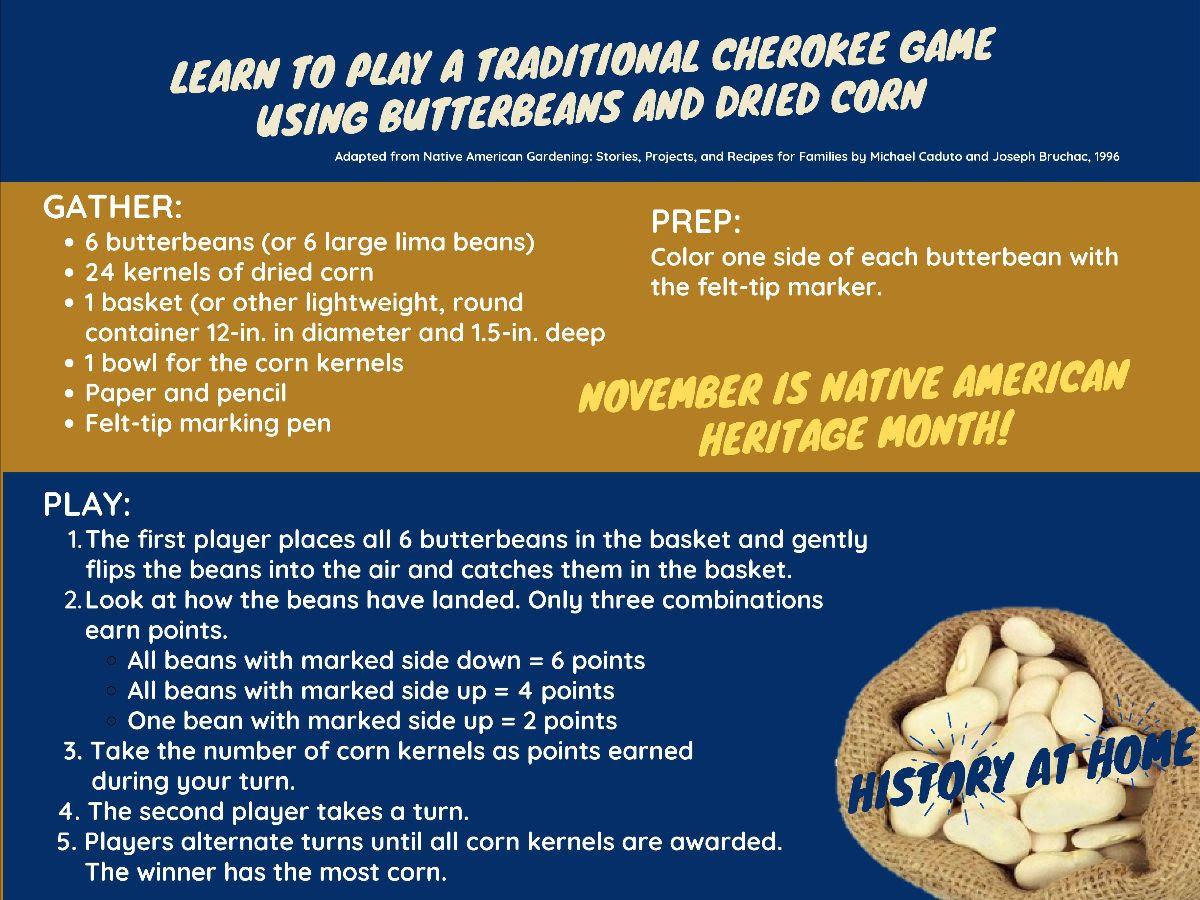
This is a variation on the tradition Cherokee Butterbean Game. It can be played by several individual players or several teams. Traditionally, this game uses three butterbeans that have been split in half. More…
From the Museum of the Cherokee Indian: Cherokee people began growing a form of corn two thousand years ago. By about a thousand years ago, or 1000 AD, they were growing corn and beans, as we know them today. Corn, beans, and squash was always grown together and was known as the “Three Sisters.” Beans restore nitrogen to the soil while corn depletes nitrogen. The vines of the beans and squash twined up the cornstalks. When corn and beans are eaten together, they provide complete proteins and amino acids for our diet.
Corn was so important to the Cherokee that they had important celebrations and ceremonies called “Green Corn Festivals.” The first of these was held in August, before the sweet corn was ready to eat. The last was held in October or November, when the
field corn was ready to be picked. At these ceremonies, people purified themselves physically and spiritually before feasting together. At this time, people got married and divorced. All old scores were settled and everyone started a new year together.
Even though it’s getting colder, you can still find fresh, local food at area farmers tailgate markets. Several markets in Buncombe County will offer holiday markets or extended seasons in November and December. In addition to seasonal produce, meats, cheeses, and bread, these markets feature local artists and handmade goods, such as wreaths, pottery, jewelry, and more.

Even though it’s getting colder, you can still find fresh, local food at area farmers tailgate markets. Several markets in Buncombe County will offer holiday markets or extended seasons in November and December. In addition to seasonal produce, meats, cheeses, and bread, these markets feature local artists and handmade goods, such as wreaths, pottery, jewelry, and more.
This is a variation on the tradition Cherokee Butterbean Game. It can be played by several individual players or several teams. Traditionally, this game uses three butterbeans that have been split in half. More…
From the Museum of the Cherokee Indian: Cherokee people began growing a form of corn two thousand years ago. By about a thousand years ago, or 1000 AD, they were growing corn and beans, as we know them today. Corn, beans, and squash was always grown together and was known as the “Three Sisters.” Beans restore nitrogen to the soil while corn depletes nitrogen. The vines of the beans and squash twined up the cornstalks. When corn and beans are eaten together, they provide complete proteins and amino acids for our diet.
Corn was so important to the Cherokee that they had important celebrations and ceremonies called “Green Corn Festivals.” The first of these was held in August, before the sweet corn was ready to eat. The last was held in October or November, when the
field corn was ready to be picked. At these ceremonies, people purified themselves physically and spiritually before feasting together. At this time, people got married and divorced. All old scores were settled and everyone started a new year together.
This is a variation on the tradition Cherokee Butterbean Game. It can be played by several individual players or several teams. Traditionally, this game uses three butterbeans that have been split in half. More…
From the Museum of the Cherokee Indian: Cherokee people began growing a form of corn two thousand years ago. By about a thousand years ago, or 1000 AD, they were growing corn and beans, as we know them today. Corn, beans, and squash was always grown together and was known as the “Three Sisters.” Beans restore nitrogen to the soil while corn depletes nitrogen. The vines of the beans and squash twined up the cornstalks. When corn and beans are eaten together, they provide complete proteins and amino acids for our diet.
Corn was so important to the Cherokee that they had important celebrations and ceremonies called “Green Corn Festivals.” The first of these was held in August, before the sweet corn was ready to eat. The last was held in October or November, when the
field corn was ready to be picked. At these ceremonies, people purified themselves physically and spiritually before feasting together. At this time, people got married and divorced. All old scores were settled and everyone started a new year together.
Even though it’s getting colder, you can still find fresh, local food at area farmers tailgate markets. Several markets in Buncombe County will offer holiday markets or extended seasons in November and December. In addition to seasonal produce, meats, cheeses, and bread, these markets feature local artists and handmade goods, such as wreaths, pottery, jewelry, and more.
IMPORTANT: COVID-19 Rules and Safety Procedures
\
Our Goals:
- Safe customers
- Safe vendors
- Provide essential products to our community
- Safer customer and vendor experiences than alternatives such as grocery stores
- A demonstration that we are a responsible Asheville business by modeling virus-safe behavior
- As a market, we are determined to treat this public health crisis seriously. Persons failing to follow any of the rules below must leave the market immediately.

The market is located in A-B Tech parking lot A-13, adjacent to the A-B Tech/Mission Health Conference Center (16 Fernihurst Dr.). Enter the market via Fernihurst Dr. off Victoria Rd., following campus signs to the conference center.
Market staff will control the number of shoppers in the market area at one time by limiting the number of cars in the parking lot. When you arrive at the market, please follow signs and staff directions to queue inside your vehicle until instructed to park your car in the parking lot. There may be a 15 – 30 minute wait to park during peak shopping times.
Dates and Hours
Saturdays, 9 a.m. to noon until December 19th…
The ASAP Winter Market will run Saturdays, 10am – 1pm, January 9th until March 27th in the same location.
Market Rules
- No customers or vendors exhibiting symptoms may enter the market.
- Maintain 6 feet of social distance at all times.
- One customer at a time for each vendor table.
- Only handle product you are purchasing. Vendors will pre-package or bunch products.
- All vendors and shoppers are required to wear masks. Customers who are not able to wear a mask may arrange to pre-order from vendors. Market staff will direct you to a separate parking area and deliver prepaid items to the car.
- Children, if they must attend with adult shoppers, must be closely supervised.
- Please leave your pets at home.
Staff will direct anyone failing to comply with these conditions to leave the market.
Paying for Purchases
Vendors accept touch-free credit or debit payments as well as SNAP. Some take exact cash (no change given) or check. Thanks to generous support from the community, we are offering Double SNAP.
This is a variation on the tradition Cherokee Butterbean Game. It can be played by several individual players or several teams. Traditionally, this game uses three butterbeans that have been split in half. More…
From the Museum of the Cherokee Indian: Cherokee people began growing a form of corn two thousand years ago. By about a thousand years ago, or 1000 AD, they were growing corn and beans, as we know them today. Corn, beans, and squash was always grown together and was known as the “Three Sisters.” Beans restore nitrogen to the soil while corn depletes nitrogen. The vines of the beans and squash twined up the cornstalks. When corn and beans are eaten together, they provide complete proteins and amino acids for our diet.
Corn was so important to the Cherokee that they had important celebrations and ceremonies called “Green Corn Festivals.” The first of these was held in August, before the sweet corn was ready to eat. The last was held in October or November, when the
field corn was ready to be picked. At these ceremonies, people purified themselves physically and spiritually before feasting together. At this time, people got married and divorced. All old scores were settled and everyone started a new year together.
Even though it’s getting colder, you can still find fresh, local food at area farmers tailgate markets. Several markets in Buncombe County will offer holiday markets or extended seasons in November and December. In addition to seasonal produce, meats, cheeses, and bread, these markets feature local artists and handmade goods, such as wreaths, pottery, jewelry, and more.
Even though it’s getting colder, you can still find fresh, local food at area farmers tailgate markets. Several markets in Buncombe County will offer holiday markets or extended seasons in November and December. In addition to seasonal produce, meats, cheeses, and bread, these markets feature local artists and handmade goods, such as wreaths, pottery, jewelry, and more.

Come play with us at the Museum’s next game night! Stop by the welcome desk or café counter to pick up some socially distanced fun activities for individuals, pairs, or small groups. No reservations needed.
THIRD THURSDAYS
Each third Thursday, the Museum and community partners offer fun events for adults to socialize through interactive art-related activities, delicious drinks, and tasty treats.
Generous support for this program is provided by Art Bridges.
Cornwagon Thunder, SkateNGames from the Wonder Series, 2017, archival print on Epson Ultra Premium Presentation Matte paper, 10 × 15 inches. Museum purchase with funds provided by the 2019 Collectors’ Circle, 2020.02.01. © Cornwagon Thunder.
This is a variation on the tradition Cherokee Butterbean Game. It can be played by several individual players or several teams. Traditionally, this game uses three butterbeans that have been split in half. More…
From the Museum of the Cherokee Indian: Cherokee people began growing a form of corn two thousand years ago. By about a thousand years ago, or 1000 AD, they were growing corn and beans, as we know them today. Corn, beans, and squash was always grown together and was known as the “Three Sisters.” Beans restore nitrogen to the soil while corn depletes nitrogen. The vines of the beans and squash twined up the cornstalks. When corn and beans are eaten together, they provide complete proteins and amino acids for our diet.
Corn was so important to the Cherokee that they had important celebrations and ceremonies called “Green Corn Festivals.” The first of these was held in August, before the sweet corn was ready to eat. The last was held in October or November, when the
field corn was ready to be picked. At these ceremonies, people purified themselves physically and spiritually before feasting together. At this time, people got married and divorced. All old scores were settled and everyone started a new year together.

Join us for the virtual event of the year:
United Way’s Carpool Karaoke Challenge
The Fall Community Engagement Event is the one night a year when the community comes together in a fun, friendly competition to help raise awareness of our collective work to reduce the root causes and consequences of poverty. The event also serves as a call-to-action for both businesses and individuals to pledge their time and financial resources in support of the LIVE UNITED Fund.
Because of health concerns, this year’s event (The Carpool Karaoke Challenge) is being held virtually. Ten teams have pre-submitted their Carpool Karaoke videos, and each submission will be shown during the event. The kicker? This year you, the audience, will vote to decide 1st, 2nd, and 3rd place winners.
YOU’RE INVITED
WHO: You, your friends, family, and neighbors
WHAT: United Way’s Carpool Karaoke Challenge Event
WHERE: Virtual
WHEN: Friday, November 20, 4:30 pm-5:45 pm
COST: FREE. You’ll also be eligible to win cash door-prizes just for attending
*Seating for this event is limited, so don’t wait, register below — you must register to attend the event. A link will be shared with registered attendees the day before the event and will allow you access.
This is the one virtual event you’ll actually want to attend this year! Ten teams, 10 Carpool Karaoke submissions, 1 champion: YOU DECIDE!
This is a variation on the tradition Cherokee Butterbean Game. It can be played by several individual players or several teams. Traditionally, this game uses three butterbeans that have been split in half. More…
From the Museum of the Cherokee Indian: Cherokee people began growing a form of corn two thousand years ago. By about a thousand years ago, or 1000 AD, they were growing corn and beans, as we know them today. Corn, beans, and squash was always grown together and was known as the “Three Sisters.” Beans restore nitrogen to the soil while corn depletes nitrogen. The vines of the beans and squash twined up the cornstalks. When corn and beans are eaten together, they provide complete proteins and amino acids for our diet.
Corn was so important to the Cherokee that they had important celebrations and ceremonies called “Green Corn Festivals.” The first of these was held in August, before the sweet corn was ready to eat. The last was held in October or November, when the
field corn was ready to be picked. At these ceremonies, people purified themselves physically and spiritually before feasting together. At this time, people got married and divorced. All old scores were settled and everyone started a new year together.
Even though it’s getting colder, you can still find fresh, local food at area farmers tailgate markets. Several markets in Buncombe County will offer holiday markets or extended seasons in November and December. In addition to seasonal produce, meats, cheeses, and bread, these markets feature local artists and handmade goods, such as wreaths, pottery, jewelry, and more.
IMPORTANT: COVID-19 Rules and Safety Procedures
\
Our Goals:
- Safe customers
- Safe vendors
- Provide essential products to our community
- Safer customer and vendor experiences than alternatives such as grocery stores
- A demonstration that we are a responsible Asheville business by modeling virus-safe behavior
- As a market, we are determined to treat this public health crisis seriously. Persons failing to follow any of the rules below must leave the market immediately.
The market is located in A-B Tech parking lot A-13, adjacent to the A-B Tech/Mission Health Conference Center (16 Fernihurst Dr.). Enter the market via Fernihurst Dr. off Victoria Rd., following campus signs to the conference center.
Market staff will control the number of shoppers in the market area at one time by limiting the number of cars in the parking lot. When you arrive at the market, please follow signs and staff directions to queue inside your vehicle until instructed to park your car in the parking lot. There may be a 15 – 30 minute wait to park during peak shopping times.
Dates and Hours
Saturdays, 9 a.m. to noon until December 19th…
The ASAP Winter Market will run Saturdays, 10am – 1pm, January 9th until March 27th in the same location.
Market Rules
- No customers or vendors exhibiting symptoms may enter the market.
- Maintain 6 feet of social distance at all times.
- One customer at a time for each vendor table.
- Only handle product you are purchasing. Vendors will pre-package or bunch products.
- All vendors and shoppers are required to wear masks. Customers who are not able to wear a mask may arrange to pre-order from vendors. Market staff will direct you to a separate parking area and deliver prepaid items to the car.
- Children, if they must attend with adult shoppers, must be closely supervised.
- Please leave your pets at home.
Staff will direct anyone failing to comply with these conditions to leave the market.
Paying for Purchases
Vendors accept touch-free credit or debit payments as well as SNAP. Some take exact cash (no change given) or check. Thanks to generous support from the community, we are offering Double SNAP.
This is a variation on the tradition Cherokee Butterbean Game. It can be played by several individual players or several teams. Traditionally, this game uses three butterbeans that have been split in half. More…
From the Museum of the Cherokee Indian: Cherokee people began growing a form of corn two thousand years ago. By about a thousand years ago, or 1000 AD, they were growing corn and beans, as we know them today. Corn, beans, and squash was always grown together and was known as the “Three Sisters.” Beans restore nitrogen to the soil while corn depletes nitrogen. The vines of the beans and squash twined up the cornstalks. When corn and beans are eaten together, they provide complete proteins and amino acids for our diet.
Corn was so important to the Cherokee that they had important celebrations and ceremonies called “Green Corn Festivals.” The first of these was held in August, before the sweet corn was ready to eat. The last was held in October or November, when the
field corn was ready to be picked. At these ceremonies, people purified themselves physically and spiritually before feasting together. At this time, people got married and divorced. All old scores were settled and everyone started a new year together.
Even though it’s getting colder, you can still find fresh, local food at area farmers tailgate markets. Several markets in Buncombe County will offer holiday markets or extended seasons in November and December. In addition to seasonal produce, meats, cheeses, and bread, these markets feature local artists and handmade goods, such as wreaths, pottery, jewelry, and more.
Even though it’s getting colder, you can still find fresh, local food at area farmers tailgate markets. Several markets in Buncombe County will offer holiday markets or extended seasons in November and December. In addition to seasonal produce, meats, cheeses, and bread, these markets feature local artists and handmade goods, such as wreaths, pottery, jewelry, and more.
This is a variation on the tradition Cherokee Butterbean Game. It can be played by several individual players or several teams. Traditionally, this game uses three butterbeans that have been split in half. More…
From the Museum of the Cherokee Indian: Cherokee people began growing a form of corn two thousand years ago. By about a thousand years ago, or 1000 AD, they were growing corn and beans, as we know them today. Corn, beans, and squash was always grown together and was known as the “Three Sisters.” Beans restore nitrogen to the soil while corn depletes nitrogen. The vines of the beans and squash twined up the cornstalks. When corn and beans are eaten together, they provide complete proteins and amino acids for our diet.
Corn was so important to the Cherokee that they had important celebrations and ceremonies called “Green Corn Festivals.” The first of these was held in August, before the sweet corn was ready to eat. The last was held in October or November, when the
field corn was ready to be picked. At these ceremonies, people purified themselves physically and spiritually before feasting together. At this time, people got married and divorced. All old scores were settled and everyone started a new year together.

 We’re kicking off Black Friday with out Black Watch Double Chocolate Milk Stout release. This popular limited-release brew is basically a brownie in a glass, overflowing with smooth and rich chocolatey flavors.
This is a variation on the tradition Cherokee Butterbean Game. It can be played by several individual players or several teams. Traditionally, this game uses three butterbeans that have been split in half. More…
From the Museum of the Cherokee Indian: Cherokee people began growing a form of corn two thousand years ago. By about a thousand years ago, or 1000 AD, they were growing corn and beans, as we know them today. Corn, beans, and squash was always grown together and was known as the “Three Sisters.” Beans restore nitrogen to the soil while corn depletes nitrogen. The vines of the beans and squash twined up the cornstalks. When corn and beans are eaten together, they provide complete proteins and amino acids for our diet.
Corn was so important to the Cherokee that they had important celebrations and ceremonies called “Green Corn Festivals.” The first of these was held in August, before the sweet corn was ready to eat. The last was held in October or November, when the
field corn was ready to be picked. At these ceremonies, people purified themselves physically and spiritually before feasting together. At this time, people got married and divorced. All old scores were settled and everyone started a new year together.
Holiday Markets
November 28 and December 5, 8:00 a.m. until 1:00 p.m.
Hendersonville Farmers Market is located at the Historic Train Depot (650 Maple Street) in downtown Hendersonville’s Seventh Avenue District.
Limited free parking spaces are available at the market on Maple Street off of Fifth Avenue in addition to parking on surrounding streets. Lot and metered parking are available 0.3 miles away at the City Hall lot (145 Fifth Avenue) or 0.4 miles away at the Maple lot (124 Fifth Avenue).
The market is located in A-B Tech parking lot A-13, adjacent to the A-B Tech/Mission Health Conference Center (16 Fernihurst Dr.). Enter the market via Fernihurst Dr. off Victoria Rd., following campus signs to the conference center.
Market staff will control the number of shoppers in the market area at one time by limiting the number of cars in the parking lot. When you arrive at the market, please follow signs and staff directions to queue inside your vehicle until instructed to park your car in the parking lot. There may be a 15 – 30 minute wait to park during peak shopping times.
Dates and Hours
Saturdays, 9 a.m. to noon until December 19th…
The ASAP Winter Market will run Saturdays, 10am – 1pm, January 9th until March 27th in the same location.
Market Rules
- No customers or vendors exhibiting symptoms may enter the market.
- Maintain 6 feet of social distance at all times.
- One customer at a time for each vendor table.
- Only handle product you are purchasing. Vendors will pre-package or bunch products.
- All vendors and shoppers are required to wear masks. Customers who are not able to wear a mask may arrange to pre-order from vendors. Market staff will direct you to a separate parking area and deliver prepaid items to the car.
- Children, if they must attend with adult shoppers, must be closely supervised.
- Please leave your pets at home.
Staff will direct anyone failing to comply with these conditions to leave the market.
Paying for Purchases
Vendors accept touch-free credit or debit payments as well as SNAP. Some take exact cash (no change given) or check. Thanks to generous support from the community, we are offering Double SNAP.

Even though it’s getting colder, you can still find fresh, local food at area farmers tailgate markets. Several markets in Buncombe County will offer holiday markets or extended seasons in November and December. In addition to seasonal produce, meats, cheeses, and bread, these markets feature local artists and handmade goods, such as wreaths, pottery, jewelry, and more.
This is a variation on the tradition Cherokee Butterbean Game. It can be played by several individual players or several teams. Traditionally, this game uses three butterbeans that have been split in half. More…
From the Museum of the Cherokee Indian: Cherokee people began growing a form of corn two thousand years ago. By about a thousand years ago, or 1000 AD, they were growing corn and beans, as we know them today. Corn, beans, and squash was always grown together and was known as the “Three Sisters.” Beans restore nitrogen to the soil while corn depletes nitrogen. The vines of the beans and squash twined up the cornstalks. When corn and beans are eaten together, they provide complete proteins and amino acids for our diet.
Corn was so important to the Cherokee that they had important celebrations and ceremonies called “Green Corn Festivals.” The first of these was held in August, before the sweet corn was ready to eat. The last was held in October or November, when the
field corn was ready to be picked. At these ceremonies, people purified themselves physically and spiritually before feasting together. At this time, people got married and divorced. All old scores were settled and everyone started a new year together.