

Calendar of Events
Upcoming events and things to do in Asheville, NC. Below is a list of events for festivals, concerts, art exhibitions, group meetups and more.
Interested in adding an event to our calendar? Please click the green “Post Your Event” button below.
Extension Master GardenerSM Volunteers of Buncombe County are happy to announce for the sixteenth year we are offering School Garden Grants to Asheville City and Buncombe County public schools, including state charter schools.

We provide a notice of the application period along with instructions to all school principals, elementary through senior high. Additional information is available on our website, buncombemastergardener.org, where you can learn more about the guidelines for receiving a grant and get online access to the 2023 School Garden Grants Application.
All applications must be completed online. Completed applications will be accepted beginning January 9, 2023, and must be submitted no later than 9 p.m. on February 3, 2023. If you have any questions, please call the Extension Office at 828-255-5522.
We are proud of our partnership with Asheville City and Buncombe County Schools. Since 2007, we have awarded 52 School Garden Grants totaling over $45,000. These grants have involved more than 16,500 students and hundreds of teachers, parents, and community volunteers.
School gardens grow more than plants. They grow imagination and creativity. They make math and science come alive, and they build community. We hope your school will join us in 2023.
Click on the link below to review the guidelines for school garden grants:
Guidelines for 2023 School Garden Grants

For the past 30 years, the Organic Growers School Spring Conference has served as a gathering place for growers in Appalachia to connect, learn from one another, and deepen connections to land and community. The Spring Conference began as an entirely volunteer-run and free event and has expanded to support an organization of ten staff with year-round programming. As we have grown, we have experimented with different approaches to keeping the event affordable and accessible while also working on compensation for our speakers and supporting our growing staff. We encourage you to check out our recent blog post exploring this in more depth. This year, we are excited to be experimenting with sliding scale ticket pricing for the first time, and we wanted to take some time to explain how this works and why we decided to implement it this year.
Looking beyond scholarships
Over the past several years, we have started implementing different scholarship options. We have set aside around $3000 in our internal budget for scholarships, and we have increased our outreach to other groups in the area who have funding to support individuals to attend conferences. We also offer work-trade opportunities for people who are interested in helping out with our event in exchange for attendance. We have around 100 work-traders access the conference each year through these opportunities, but we have never used up our entire scholarship fund for the event. We know that there are many individuals in our community that we are not reaching through our scholarship opportunities. We began to wonder if scholarship applications were creating a barrier to participation and started researching other options, landing eventually on sliding scale as our preferred model.
How alternative pricing models address accessibility
The sliding scale model, which offers the opportunity for participants to select a price to pay for their ticket, meets several of the parameters we were looking for in an accessible pricing model. Most importantly, it is a seamless way for attendees to access the price that meets their needs. So many things are means-tested in our society, and it can be exhausting to justify why one needs a more affordable price point. While many of our community members need financial support, there are also members of this community who have more than enough to share and are excited about supporting their fellow co-learners. These attendees can select the higher end of the sliding scale, which will be set at a price to offset the lower price paid by other attendees. We trust our attendees to select the option that best works for them while also considering how their selection would affect the ability of other participants to access a lower price point.
Accessibility is a priority for OGS, and implementing it is a risk for us as a small non-profit, given that we rely on our large events like the Spring Conference to support our year-round programming and staff salaries. This will certainly be an experimental year, and if we are not able to secure enough income through sliding-scale registrations, we will have to rethink our approach to pricing. We trust that our community will be thoughtful in thinking about the value that this conference has to them and about what they are able to pay for at this time. Thank you for being on this journey of discovery with us!
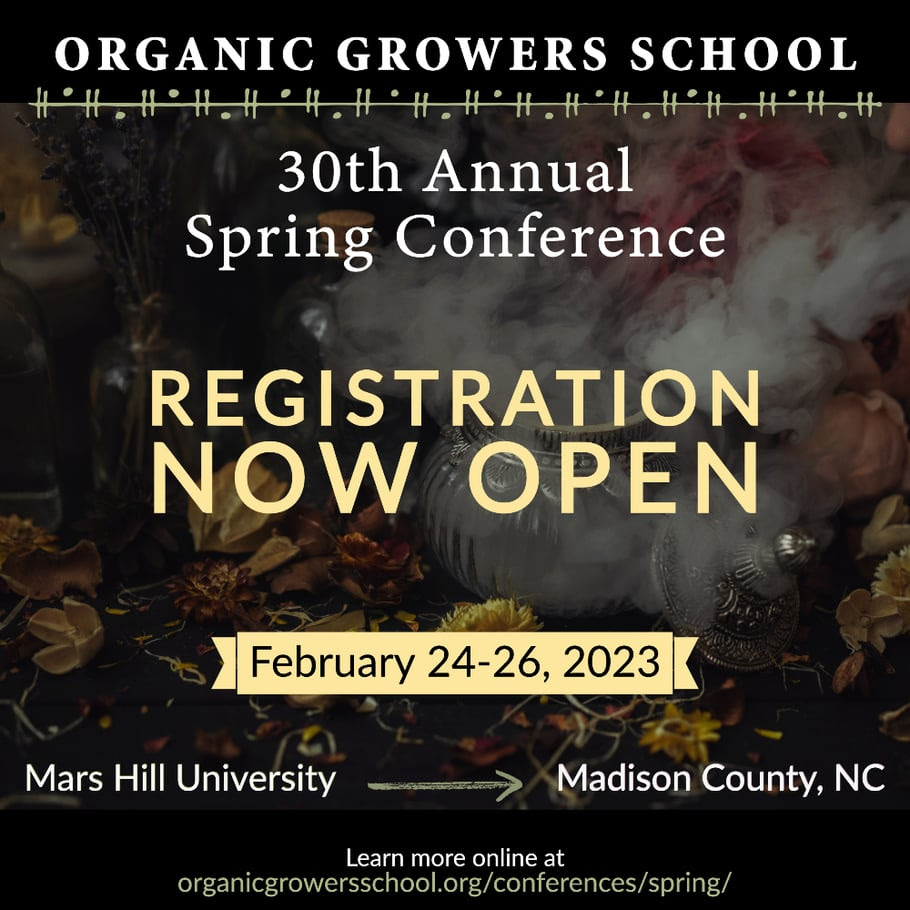
Registration is OPEN!
30th Annual Spring Conference at Mars Hill University
You’re in for a fun-filled weekend of learning and community building. This year our Tracks include Cooking, Food Justice, Farming Business + Production, Herbs, Mushrooms, Forest Farming, Gardening, Holistic Forestry, Livestock & Poultry, Living on the Land, Permaculture, Pests & Pollinators, Soils, & Sustainable Living!For each Track subject, there are 4 different classes to choose from taught by expert educators. There will also be 8 half-day workshops to choose from if you want to dive deep into subjects like Fermentation, Spirulina Cultivation, Invasive Vine Basketry, and more!
View the full Spring Conference schedule here.
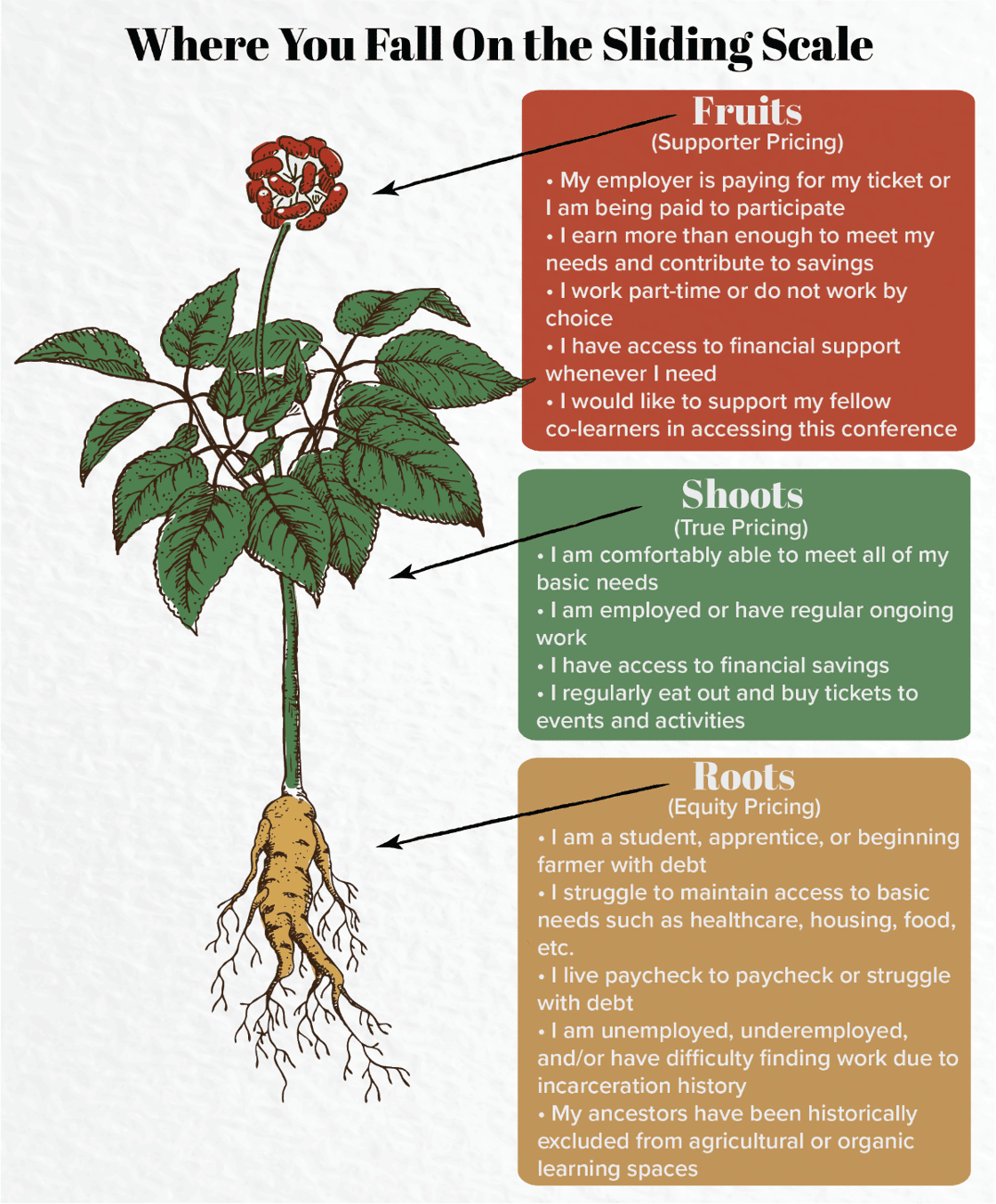
Sliding Scale Pricing for Spring Conference
OGS is implementing a Sliding Scale Price model for 2023
So many things are means-tested in our society, and it can be exhausting to justify why one needs a more affordable price point. The sliding scale model, which allows participants to select a price to pay for their ticket, meets several of the parameters we were looking for in an accessible pricing model.
While many of our community members need financial support, some of these community members have more than enough to share and are excited about supporting their fellow co-learners. These attendees can select the higher end of the sliding scale, which will be set at a price to offset the lower price paid by other attendees. We trust our attendees to select the option that best works for them while also considering how their selection would affect the ability of other participants to access a lower price point.
Accessibility is a priority for OGS, and implementing it is a risk for us as a small non-profit, given that we rely on our large events like the Spring Conference to support our year-round programming and staff salaries. This will certainly be an experimental year, and if we cannot secure enough income through sliding-scale registrations, we will have to rethink our approach to pricing. We trust that our community will be thoughtful in thinking about the value this conference has for them and what they can pay for at this time.
-1.png?width=910&upscale=true&name=registration%20open%20SC-1%20(1)-1.png)
Extension Master GardenerSM Volunteers of Buncombe County are happy to announce for the sixteenth year we are offering School Garden Grants to Asheville City and Buncombe County public schools, including state charter schools.
We provide a notice of the application period along with instructions to all school principals, elementary through senior high. Additional information is available on our website, buncombemastergardener.org, where you can learn more about the guidelines for receiving a grant and get online access to the 2023 School Garden Grants Application.
All applications must be completed online. Completed applications will be accepted beginning January 9, 2023, and must be submitted no later than 9 p.m. on February 3, 2023. If you have any questions, please call the Extension Office at 828-255-5522.
We are proud of our partnership with Asheville City and Buncombe County Schools. Since 2007, we have awarded 52 School Garden Grants totaling over $45,000. These grants have involved more than 16,500 students and hundreds of teachers, parents, and community volunteers.
School gardens grow more than plants. They grow imagination and creativity. They make math and science come alive, and they build community. We hope your school will join us in 2023.
Click on the link below to review the guidelines for school garden grants:
Guidelines for 2023 School Garden Grants
The upcoming Journeyperson course is now available AT NO COST! Due to some timely grant funding, we can offer this in-depth farmer training for farmers in years 3-7 with no associated tuition fee! The course consists of monthly cohort meet-ups and 2-3 in-depth workshops, plus mentorship!
In addition, a select number of participants will also receive matched FUNDS for your farm savings account (Savings Incentive Program) and money to spend on a professional development opportunity of your choosing! Want to attend a workshop on livestock management? OGS will contribute towards that fee! Are you saving money for a farm asset? OGS will contribute up to a certain amount to that investment.
The Journeyperson Program is for farmers who have been independently farming for three or more years and are serious about operating farm businesses in the Southern Appalachian region.
|
|
For the past 30 years, the Organic Growers School Spring Conference has served as a gathering place for growers in Appalachia to connect, learn from one another, and deepen connections to land and community. The Spring Conference began as an entirely volunteer-run and free event and has expanded to support an organization of ten staff with year-round programming. As we have grown, we have experimented with different approaches to keeping the event affordable and accessible while also working on compensation for our speakers and supporting our growing staff. We encourage you to check out our recent blog post exploring this in more depth. This year, we are excited to be experimenting with sliding scale ticket pricing for the first time, and we wanted to take some time to explain how this works and why we decided to implement it this year.
Looking beyond scholarships
Over the past several years, we have started implementing different scholarship options. We have set aside around $3000 in our internal budget for scholarships, and we have increased our outreach to other groups in the area who have funding to support individuals to attend conferences. We also offer work-trade opportunities for people who are interested in helping out with our event in exchange for attendance. We have around 100 work-traders access the conference each year through these opportunities, but we have never used up our entire scholarship fund for the event. We know that there are many individuals in our community that we are not reaching through our scholarship opportunities. We began to wonder if scholarship applications were creating a barrier to participation and started researching other options, landing eventually on sliding scale as our preferred model.
How alternative pricing models address accessibility
The sliding scale model, which offers the opportunity for participants to select a price to pay for their ticket, meets several of the parameters we were looking for in an accessible pricing model. Most importantly, it is a seamless way for attendees to access the price that meets their needs. So many things are means-tested in our society, and it can be exhausting to justify why one needs a more affordable price point. While many of our community members need financial support, there are also members of this community who have more than enough to share and are excited about supporting their fellow co-learners. These attendees can select the higher end of the sliding scale, which will be set at a price to offset the lower price paid by other attendees. We trust our attendees to select the option that best works for them while also considering how their selection would affect the ability of other participants to access a lower price point.
Accessibility is a priority for OGS, and implementing it is a risk for us as a small non-profit, given that we rely on our large events like the Spring Conference to support our year-round programming and staff salaries. This will certainly be an experimental year, and if we are not able to secure enough income through sliding-scale registrations, we will have to rethink our approach to pricing. We trust that our community will be thoughtful in thinking about the value that this conference has to them and about what they are able to pay for at this time. Thank you for being on this journey of discovery with us!
|
This free introductory class includes a discussion of the evidence-based health benefits of practicing Tai Chi, a demonstration of Sun Style Tai Chi, and a discussion of the history of the art form. There will be an opportunity to practice a few basic postures. This class may be helpful to anyone who has wondered if they might enjoy learning and practicing Tai Chi . If there is enough interest, we will offer a Tai Chi class series this winter/spring. Patricia P. Gilliam, PhD, ANP-BC will be the instructor. Patricia is a Board-Certified Tai Chi For Health Instructor and Nurse Practitioner. Registration is required. Contact [email protected] with any questions. |
This 6-week workshop series is inspired by Richard Rohr’s, “Breathing Under Water: Spirituality and the Twelve Steps”. Throughout this series, we will explore The Twelve Steps as described in this powerful book and how they connect with Spirituality and Yoga. Join instructor, Rosie Mulford, as she takes you on a journey to gain a deeper understanding of how the ancient principles in the Gospels and the modern-day Twelve Steps can help to free those who struggle with addiction.
Interweaving yogic philosophy and asana to “connect the dots,” this 6-week workshop will include discussion, movement, pranayama and relaxation.
This course is open to all recovery paths or anyone affected by addiction and no prior yoga experience is required.
We will unpack 3 major principles of addiction:
1. We all have a universal addiction to the way we think 2. We must recognize that we are already that which we seek to become and we already have that which we desire 3. We need to rid ourselves of the heaviness of the ego in order to see what we are and what we have
Extension Master GardenerSM Volunteers of Buncombe County are happy to announce for the sixteenth year we are offering School Garden Grants to Asheville City and Buncombe County public schools, including state charter schools.
We provide a notice of the application period along with instructions to all school principals, elementary through senior high. Additional information is available on our website, buncombemastergardener.org, where you can learn more about the guidelines for receiving a grant and get online access to the 2023 School Garden Grants Application.
All applications must be completed online. Completed applications will be accepted beginning January 9, 2023, and must be submitted no later than 9 p.m. on February 3, 2023. If you have any questions, please call the Extension Office at 828-255-5522.
We are proud of our partnership with Asheville City and Buncombe County Schools. Since 2007, we have awarded 52 School Garden Grants totaling over $45,000. These grants have involved more than 16,500 students and hundreds of teachers, parents, and community volunteers.
School gardens grow more than plants. They grow imagination and creativity. They make math and science come alive, and they build community. We hope your school will join us in 2023.
Click on the link below to review the guidelines for school garden grants:
Guidelines for 2023 School Garden Grants
For the past 30 years, the Organic Growers School Spring Conference has served as a gathering place for growers in Appalachia to connect, learn from one another, and deepen connections to land and community. The Spring Conference began as an entirely volunteer-run and free event and has expanded to support an organization of ten staff with year-round programming. As we have grown, we have experimented with different approaches to keeping the event affordable and accessible while also working on compensation for our speakers and supporting our growing staff. We encourage you to check out our recent blog post exploring this in more depth. This year, we are excited to be experimenting with sliding scale ticket pricing for the first time, and we wanted to take some time to explain how this works and why we decided to implement it this year.
Looking beyond scholarships
Over the past several years, we have started implementing different scholarship options. We have set aside around $3000 in our internal budget for scholarships, and we have increased our outreach to other groups in the area who have funding to support individuals to attend conferences. We also offer work-trade opportunities for people who are interested in helping out with our event in exchange for attendance. We have around 100 work-traders access the conference each year through these opportunities, but we have never used up our entire scholarship fund for the event. We know that there are many individuals in our community that we are not reaching through our scholarship opportunities. We began to wonder if scholarship applications were creating a barrier to participation and started researching other options, landing eventually on sliding scale as our preferred model.
How alternative pricing models address accessibility
The sliding scale model, which offers the opportunity for participants to select a price to pay for their ticket, meets several of the parameters we were looking for in an accessible pricing model. Most importantly, it is a seamless way for attendees to access the price that meets their needs. So many things are means-tested in our society, and it can be exhausting to justify why one needs a more affordable price point. While many of our community members need financial support, there are also members of this community who have more than enough to share and are excited about supporting their fellow co-learners. These attendees can select the higher end of the sliding scale, which will be set at a price to offset the lower price paid by other attendees. We trust our attendees to select the option that best works for them while also considering how their selection would affect the ability of other participants to access a lower price point.
Accessibility is a priority for OGS, and implementing it is a risk for us as a small non-profit, given that we rely on our large events like the Spring Conference to support our year-round programming and staff salaries. This will certainly be an experimental year, and if we are not able to secure enough income through sliding-scale registrations, we will have to rethink our approach to pricing. We trust that our community will be thoughtful in thinking about the value that this conference has to them and about what they are able to pay for at this time. Thank you for being on this journey of discovery with us!
Extension Master GardenerSM Volunteers of Buncombe County are happy to announce for the sixteenth year we are offering School Garden Grants to Asheville City and Buncombe County public schools, including state charter schools.
We provide a notice of the application period along with instructions to all school principals, elementary through senior high. Additional information is available on our website, buncombemastergardener.org, where you can learn more about the guidelines for receiving a grant and get online access to the 2023 School Garden Grants Application.
All applications must be completed online. Completed applications will be accepted beginning January 9, 2023, and must be submitted no later than 9 p.m. on February 3, 2023. If you have any questions, please call the Extension Office at 828-255-5522.
We are proud of our partnership with Asheville City and Buncombe County Schools. Since 2007, we have awarded 52 School Garden Grants totaling over $45,000. These grants have involved more than 16,500 students and hundreds of teachers, parents, and community volunteers.
School gardens grow more than plants. They grow imagination and creativity. They make math and science come alive, and they build community. We hope your school will join us in 2023.
Click on the link below to review the guidelines for school garden grants:
Guidelines for 2023 School Garden Grants
The upcoming Journeyperson course is now available AT NO COST! Due to some timely grant funding, we can offer this in-depth farmer training for farmers in years 3-7 with no associated tuition fee! The course consists of monthly cohort meet-ups and 2-3 in-depth workshops, plus mentorship!
In addition, a select number of participants will also receive matched FUNDS for your farm savings account (Savings Incentive Program) and money to spend on a professional development opportunity of your choosing! Want to attend a workshop on livestock management? OGS will contribute towards that fee! Are you saving money for a farm asset? OGS will contribute up to a certain amount to that investment.
The Journeyperson Program is for farmers who have been independently farming for three or more years and are serious about operating farm businesses in the Southern Appalachian region.
|
|
For the past 30 years, the Organic Growers School Spring Conference has served as a gathering place for growers in Appalachia to connect, learn from one another, and deepen connections to land and community. The Spring Conference began as an entirely volunteer-run and free event and has expanded to support an organization of ten staff with year-round programming. As we have grown, we have experimented with different approaches to keeping the event affordable and accessible while also working on compensation for our speakers and supporting our growing staff. We encourage you to check out our recent blog post exploring this in more depth. This year, we are excited to be experimenting with sliding scale ticket pricing for the first time, and we wanted to take some time to explain how this works and why we decided to implement it this year.
Looking beyond scholarships
Over the past several years, we have started implementing different scholarship options. We have set aside around $3000 in our internal budget for scholarships, and we have increased our outreach to other groups in the area who have funding to support individuals to attend conferences. We also offer work-trade opportunities for people who are interested in helping out with our event in exchange for attendance. We have around 100 work-traders access the conference each year through these opportunities, but we have never used up our entire scholarship fund for the event. We know that there are many individuals in our community that we are not reaching through our scholarship opportunities. We began to wonder if scholarship applications were creating a barrier to participation and started researching other options, landing eventually on sliding scale as our preferred model.
How alternative pricing models address accessibility
The sliding scale model, which offers the opportunity for participants to select a price to pay for their ticket, meets several of the parameters we were looking for in an accessible pricing model. Most importantly, it is a seamless way for attendees to access the price that meets their needs. So many things are means-tested in our society, and it can be exhausting to justify why one needs a more affordable price point. While many of our community members need financial support, there are also members of this community who have more than enough to share and are excited about supporting their fellow co-learners. These attendees can select the higher end of the sliding scale, which will be set at a price to offset the lower price paid by other attendees. We trust our attendees to select the option that best works for them while also considering how their selection would affect the ability of other participants to access a lower price point.
Accessibility is a priority for OGS, and implementing it is a risk for us as a small non-profit, given that we rely on our large events like the Spring Conference to support our year-round programming and staff salaries. This will certainly be an experimental year, and if we are not able to secure enough income through sliding-scale registrations, we will have to rethink our approach to pricing. We trust that our community will be thoughtful in thinking about the value that this conference has to them and about what they are able to pay for at this time. Thank you for being on this journey of discovery with us!
Extension Master GardenerSM Volunteers of Buncombe County are happy to announce for the sixteenth year we are offering School Garden Grants to Asheville City and Buncombe County public schools, including state charter schools.
We provide a notice of the application period along with instructions to all school principals, elementary through senior high. Additional information is available on our website, buncombemastergardener.org, where you can learn more about the guidelines for receiving a grant and get online access to the 2023 School Garden Grants Application.
All applications must be completed online. Completed applications will be accepted beginning January 9, 2023, and must be submitted no later than 9 p.m. on February 3, 2023. If you have any questions, please call the Extension Office at 828-255-5522.
We are proud of our partnership with Asheville City and Buncombe County Schools. Since 2007, we have awarded 52 School Garden Grants totaling over $45,000. These grants have involved more than 16,500 students and hundreds of teachers, parents, and community volunteers.
School gardens grow more than plants. They grow imagination and creativity. They make math and science come alive, and they build community. We hope your school will join us in 2023.
Click on the link below to review the guidelines for school garden grants:
Guidelines for 2023 School Garden Grants
For the past 30 years, the Organic Growers School Spring Conference has served as a gathering place for growers in Appalachia to connect, learn from one another, and deepen connections to land and community. The Spring Conference began as an entirely volunteer-run and free event and has expanded to support an organization of ten staff with year-round programming. As we have grown, we have experimented with different approaches to keeping the event affordable and accessible while also working on compensation for our speakers and supporting our growing staff. We encourage you to check out our recent blog post exploring this in more depth. This year, we are excited to be experimenting with sliding scale ticket pricing for the first time, and we wanted to take some time to explain how this works and why we decided to implement it this year.
Looking beyond scholarships
Over the past several years, we have started implementing different scholarship options. We have set aside around $3000 in our internal budget for scholarships, and we have increased our outreach to other groups in the area who have funding to support individuals to attend conferences. We also offer work-trade opportunities for people who are interested in helping out with our event in exchange for attendance. We have around 100 work-traders access the conference each year through these opportunities, but we have never used up our entire scholarship fund for the event. We know that there are many individuals in our community that we are not reaching through our scholarship opportunities. We began to wonder if scholarship applications were creating a barrier to participation and started researching other options, landing eventually on sliding scale as our preferred model.
How alternative pricing models address accessibility
The sliding scale model, which offers the opportunity for participants to select a price to pay for their ticket, meets several of the parameters we were looking for in an accessible pricing model. Most importantly, it is a seamless way for attendees to access the price that meets their needs. So many things are means-tested in our society, and it can be exhausting to justify why one needs a more affordable price point. While many of our community members need financial support, there are also members of this community who have more than enough to share and are excited about supporting their fellow co-learners. These attendees can select the higher end of the sliding scale, which will be set at a price to offset the lower price paid by other attendees. We trust our attendees to select the option that best works for them while also considering how their selection would affect the ability of other participants to access a lower price point.
Accessibility is a priority for OGS, and implementing it is a risk for us as a small non-profit, given that we rely on our large events like the Spring Conference to support our year-round programming and staff salaries. This will certainly be an experimental year, and if we are not able to secure enough income through sliding-scale registrations, we will have to rethink our approach to pricing. We trust that our community will be thoughtful in thinking about the value that this conference has to them and about what they are able to pay for at this time. Thank you for being on this journey of discovery with us!
The upcoming Journeyperson course is now available AT NO COST! Due to some timely grant funding, we can offer this in-depth farmer training for farmers in years 3-7 with no associated tuition fee! The course consists of monthly cohort meet-ups and 2-3 in-depth workshops, plus mentorship!
In addition, a select number of participants will also receive matched FUNDS for your farm savings account (Savings Incentive Program) and money to spend on a professional development opportunity of your choosing! Want to attend a workshop on livestock management? OGS will contribute towards that fee! Are you saving money for a farm asset? OGS will contribute up to a certain amount to that investment.
The Journeyperson Program is for farmers who have been independently farming for three or more years and are serious about operating farm businesses in the Southern Appalachian region.
|
|
For the past 30 years, the Organic Growers School Spring Conference has served as a gathering place for growers in Appalachia to connect, learn from one another, and deepen connections to land and community. The Spring Conference began as an entirely volunteer-run and free event and has expanded to support an organization of ten staff with year-round programming. As we have grown, we have experimented with different approaches to keeping the event affordable and accessible while also working on compensation for our speakers and supporting our growing staff. We encourage you to check out our recent blog post exploring this in more depth. This year, we are excited to be experimenting with sliding scale ticket pricing for the first time, and we wanted to take some time to explain how this works and why we decided to implement it this year.
Looking beyond scholarships
Over the past several years, we have started implementing different scholarship options. We have set aside around $3000 in our internal budget for scholarships, and we have increased our outreach to other groups in the area who have funding to support individuals to attend conferences. We also offer work-trade opportunities for people who are interested in helping out with our event in exchange for attendance. We have around 100 work-traders access the conference each year through these opportunities, but we have never used up our entire scholarship fund for the event. We know that there are many individuals in our community that we are not reaching through our scholarship opportunities. We began to wonder if scholarship applications were creating a barrier to participation and started researching other options, landing eventually on sliding scale as our preferred model.
How alternative pricing models address accessibility
The sliding scale model, which offers the opportunity for participants to select a price to pay for their ticket, meets several of the parameters we were looking for in an accessible pricing model. Most importantly, it is a seamless way for attendees to access the price that meets their needs. So many things are means-tested in our society, and it can be exhausting to justify why one needs a more affordable price point. While many of our community members need financial support, there are also members of this community who have more than enough to share and are excited about supporting their fellow co-learners. These attendees can select the higher end of the sliding scale, which will be set at a price to offset the lower price paid by other attendees. We trust our attendees to select the option that best works for them while also considering how their selection would affect the ability of other participants to access a lower price point.
Accessibility is a priority for OGS, and implementing it is a risk for us as a small non-profit, given that we rely on our large events like the Spring Conference to support our year-round programming and staff salaries. This will certainly be an experimental year, and if we are not able to secure enough income through sliding-scale registrations, we will have to rethink our approach to pricing. We trust that our community will be thoughtful in thinking about the value that this conference has to them and about what they are able to pay for at this time. Thank you for being on this journey of discovery with us!
The upcoming Journeyperson course is now available AT NO COST! Due to some timely grant funding, we can offer this in-depth farmer training for farmers in years 3-7 with no associated tuition fee! The course consists of monthly cohort meet-ups and 2-3 in-depth workshops, plus mentorship!
In addition, a select number of participants will also receive matched FUNDS for your farm savings account (Savings Incentive Program) and money to spend on a professional development opportunity of your choosing! Want to attend a workshop on livestock management? OGS will contribute towards that fee! Are you saving money for a farm asset? OGS will contribute up to a certain amount to that investment.
The Journeyperson Program is for farmers who have been independently farming for three or more years and are serious about operating farm businesses in the Southern Appalachian region.
|
|
For the past 30 years, the Organic Growers School Spring Conference has served as a gathering place for growers in Appalachia to connect, learn from one another, and deepen connections to land and community. The Spring Conference began as an entirely volunteer-run and free event and has expanded to support an organization of ten staff with year-round programming. As we have grown, we have experimented with different approaches to keeping the event affordable and accessible while also working on compensation for our speakers and supporting our growing staff. We encourage you to check out our recent blog post exploring this in more depth. This year, we are excited to be experimenting with sliding scale ticket pricing for the first time, and we wanted to take some time to explain how this works and why we decided to implement it this year.
Looking beyond scholarships
Over the past several years, we have started implementing different scholarship options. We have set aside around $3000 in our internal budget for scholarships, and we have increased our outreach to other groups in the area who have funding to support individuals to attend conferences. We also offer work-trade opportunities for people who are interested in helping out with our event in exchange for attendance. We have around 100 work-traders access the conference each year through these opportunities, but we have never used up our entire scholarship fund for the event. We know that there are many individuals in our community that we are not reaching through our scholarship opportunities. We began to wonder if scholarship applications were creating a barrier to participation and started researching other options, landing eventually on sliding scale as our preferred model.
How alternative pricing models address accessibility
The sliding scale model, which offers the opportunity for participants to select a price to pay for their ticket, meets several of the parameters we were looking for in an accessible pricing model. Most importantly, it is a seamless way for attendees to access the price that meets their needs. So many things are means-tested in our society, and it can be exhausting to justify why one needs a more affordable price point. While many of our community members need financial support, there are also members of this community who have more than enough to share and are excited about supporting their fellow co-learners. These attendees can select the higher end of the sliding scale, which will be set at a price to offset the lower price paid by other attendees. We trust our attendees to select the option that best works for them while also considering how their selection would affect the ability of other participants to access a lower price point.
Accessibility is a priority for OGS, and implementing it is a risk for us as a small non-profit, given that we rely on our large events like the Spring Conference to support our year-round programming and staff salaries. This will certainly be an experimental year, and if we are not able to secure enough income through sliding-scale registrations, we will have to rethink our approach to pricing. We trust that our community will be thoughtful in thinking about the value that this conference has to them and about what they are able to pay for at this time. Thank you for being on this journey of discovery with us!
For the past 30 years, the Organic Growers School Spring Conference has served as a gathering place for growers in Appalachia to connect, learn from one another, and deepen connections to land and community. The Spring Conference began as an entirely volunteer-run and free event and has expanded to support an organization of ten staff with year-round programming. As we have grown, we have experimented with different approaches to keeping the event affordable and accessible while also working on compensation for our speakers and supporting our growing staff. We encourage you to check out our recent blog post exploring this in more depth. This year, we are excited to be experimenting with sliding scale ticket pricing for the first time, and we wanted to take some time to explain how this works and why we decided to implement it this year.
Looking beyond scholarships
Over the past several years, we have started implementing different scholarship options. We have set aside around $3000 in our internal budget for scholarships, and we have increased our outreach to other groups in the area who have funding to support individuals to attend conferences. We also offer work-trade opportunities for people who are interested in helping out with our event in exchange for attendance. We have around 100 work-traders access the conference each year through these opportunities, but we have never used up our entire scholarship fund for the event. We know that there are many individuals in our community that we are not reaching through our scholarship opportunities. We began to wonder if scholarship applications were creating a barrier to participation and started researching other options, landing eventually on sliding scale as our preferred model.
How alternative pricing models address accessibility
The sliding scale model, which offers the opportunity for participants to select a price to pay for their ticket, meets several of the parameters we were looking for in an accessible pricing model. Most importantly, it is a seamless way for attendees to access the price that meets their needs. So many things are means-tested in our society, and it can be exhausting to justify why one needs a more affordable price point. While many of our community members need financial support, there are also members of this community who have more than enough to share and are excited about supporting their fellow co-learners. These attendees can select the higher end of the sliding scale, which will be set at a price to offset the lower price paid by other attendees. We trust our attendees to select the option that best works for them while also considering how their selection would affect the ability of other participants to access a lower price point.
Accessibility is a priority for OGS, and implementing it is a risk for us as a small non-profit, given that we rely on our large events like the Spring Conference to support our year-round programming and staff salaries. This will certainly be an experimental year, and if we are not able to secure enough income through sliding-scale registrations, we will have to rethink our approach to pricing. We trust that our community will be thoughtful in thinking about the value that this conference has to them and about what they are able to pay for at this time. Thank you for being on this journey of discovery with us!
The upcoming Journeyperson course is now available AT NO COST! Due to some timely grant funding, we can offer this in-depth farmer training for farmers in years 3-7 with no associated tuition fee! The course consists of monthly cohort meet-ups and 2-3 in-depth workshops, plus mentorship!
In addition, a select number of participants will also receive matched FUNDS for your farm savings account (Savings Incentive Program) and money to spend on a professional development opportunity of your choosing! Want to attend a workshop on livestock management? OGS will contribute towards that fee! Are you saving money for a farm asset? OGS will contribute up to a certain amount to that investment.
The Journeyperson Program is for farmers who have been independently farming for three or more years and are serious about operating farm businesses in the Southern Appalachian region.
|
|
For the past 30 years, the Organic Growers School Spring Conference has served as a gathering place for growers in Appalachia to connect, learn from one another, and deepen connections to land and community. The Spring Conference began as an entirely volunteer-run and free event and has expanded to support an organization of ten staff with year-round programming. As we have grown, we have experimented with different approaches to keeping the event affordable and accessible while also working on compensation for our speakers and supporting our growing staff. We encourage you to check out our recent blog post exploring this in more depth. This year, we are excited to be experimenting with sliding scale ticket pricing for the first time, and we wanted to take some time to explain how this works and why we decided to implement it this year.
Looking beyond scholarships
Over the past several years, we have started implementing different scholarship options. We have set aside around $3000 in our internal budget for scholarships, and we have increased our outreach to other groups in the area who have funding to support individuals to attend conferences. We also offer work-trade opportunities for people who are interested in helping out with our event in exchange for attendance. We have around 100 work-traders access the conference each year through these opportunities, but we have never used up our entire scholarship fund for the event. We know that there are many individuals in our community that we are not reaching through our scholarship opportunities. We began to wonder if scholarship applications were creating a barrier to participation and started researching other options, landing eventually on sliding scale as our preferred model.
How alternative pricing models address accessibility
The sliding scale model, which offers the opportunity for participants to select a price to pay for their ticket, meets several of the parameters we were looking for in an accessible pricing model. Most importantly, it is a seamless way for attendees to access the price that meets their needs. So many things are means-tested in our society, and it can be exhausting to justify why one needs a more affordable price point. While many of our community members need financial support, there are also members of this community who have more than enough to share and are excited about supporting their fellow co-learners. These attendees can select the higher end of the sliding scale, which will be set at a price to offset the lower price paid by other attendees. We trust our attendees to select the option that best works for them while also considering how their selection would affect the ability of other participants to access a lower price point.
Accessibility is a priority for OGS, and implementing it is a risk for us as a small non-profit, given that we rely on our large events like the Spring Conference to support our year-round programming and staff salaries. This will certainly be an experimental year, and if we are not able to secure enough income through sliding-scale registrations, we will have to rethink our approach to pricing. We trust that our community will be thoughtful in thinking about the value that this conference has to them and about what they are able to pay for at this time. Thank you for being on this journey of discovery with us!
This 6-week workshop series is inspired by Richard Rohr’s, “Breathing Under Water: Spirituality and the Twelve Steps”. Throughout this series, we will explore The Twelve Steps as described in this powerful book and how they connect with Spirituality and Yoga. Join instructor, Rosie Mulford, as she takes you on a journey to gain a deeper understanding of how the ancient principles in the Gospels and the modern-day Twelve Steps can help to free those who struggle with addiction.
Interweaving yogic philosophy and asana to “connect the dots,” this 6-week workshop will include discussion, movement, pranayama and relaxation.
This course is open to all recovery paths or anyone affected by addiction and no prior yoga experience is required.
We will unpack 3 major principles of addiction:
1. We all have a universal addiction to the way we think 2. We must recognize that we are already that which we seek to become and we already have that which we desire 3. We need to rid ourselves of the heaviness of the ego in order to see what we are and what we have
Small fruits can be a strategic avenue for diversifying farm income streams. This workshop will cover basic production information on a variety of small fruits suitable for commercial production. Participants will learn how to assess a site’s suitability for fruit production, review production requirements for a variety of berries, and evaluate potential marketing channels.
IMPORTANT: This workshop will feature a hybrid format, covering two days of instruction:
(Day 1) Tuesday, February 7, from 6pm – 8pm – Online workshop via Zoom
(Day 2) Thursday, February 9th from 1pm – 3pm – In-person, hands-on pruning demonstration at a local Buncombe County farm
Participants are encouraged, but not required, to attend both days, as each will feature different types of information.
Please contact Meghan Baker at [email protected] for details, questions, or comments.
For the past 30 years, the Organic Growers School Spring Conference has served as a gathering place for growers in Appalachia to connect, learn from one another, and deepen connections to land and community. The Spring Conference began as an entirely volunteer-run and free event and has expanded to support an organization of ten staff with year-round programming. As we have grown, we have experimented with different approaches to keeping the event affordable and accessible while also working on compensation for our speakers and supporting our growing staff. We encourage you to check out our recent blog post exploring this in more depth. This year, we are excited to be experimenting with sliding scale ticket pricing for the first time, and we wanted to take some time to explain how this works and why we decided to implement it this year.
Looking beyond scholarships
Over the past several years, we have started implementing different scholarship options. We have set aside around $3000 in our internal budget for scholarships, and we have increased our outreach to other groups in the area who have funding to support individuals to attend conferences. We also offer work-trade opportunities for people who are interested in helping out with our event in exchange for attendance. We have around 100 work-traders access the conference each year through these opportunities, but we have never used up our entire scholarship fund for the event. We know that there are many individuals in our community that we are not reaching through our scholarship opportunities. We began to wonder if scholarship applications were creating a barrier to participation and started researching other options, landing eventually on sliding scale as our preferred model.
How alternative pricing models address accessibility
The sliding scale model, which offers the opportunity for participants to select a price to pay for their ticket, meets several of the parameters we were looking for in an accessible pricing model. Most importantly, it is a seamless way for attendees to access the price that meets their needs. So many things are means-tested in our society, and it can be exhausting to justify why one needs a more affordable price point. While many of our community members need financial support, there are also members of this community who have more than enough to share and are excited about supporting their fellow co-learners. These attendees can select the higher end of the sliding scale, which will be set at a price to offset the lower price paid by other attendees. We trust our attendees to select the option that best works for them while also considering how their selection would affect the ability of other participants to access a lower price point.
Accessibility is a priority for OGS, and implementing it is a risk for us as a small non-profit, given that we rely on our large events like the Spring Conference to support our year-round programming and staff salaries. This will certainly be an experimental year, and if we are not able to secure enough income through sliding-scale registrations, we will have to rethink our approach to pricing. We trust that our community will be thoughtful in thinking about the value that this conference has to them and about what they are able to pay for at this time. Thank you for being on this journey of discovery with us!
Our first passholder-exclusive event of the year! Join a naturalist for an intimate hike with fellow passholders in an area of the Park not typically open to the public. This moderate hike traverses our own old growth forest and gives you the opportunity to learn what makes this ecosystem unique. This event is exclusively for Annual Passholders.
We will share resources to create or expand your garden program as well as tips and strategies for gardening with young children. We emphasize how to sustain a garden program by involving community partners, such as parents, farmers, college students, and agricultural professionals. Please register in advance for this meeting. After registering, you will receive a confirmation email containing information about joining the meeting.
Wednesday, August 17, 2022, 4-5:30pm Register here
Wednesday, October 12, 2022, 4-5:30pm Register here
Wednesday, February 8, 2023, 4-5:30pm Register here
The upcoming Journeyperson course is now available AT NO COST! Due to some timely grant funding, we can offer this in-depth farmer training for farmers in years 3-7 with no associated tuition fee! The course consists of monthly cohort meet-ups and 2-3 in-depth workshops, plus mentorship!
In addition, a select number of participants will also receive matched FUNDS for your farm savings account (Savings Incentive Program) and money to spend on a professional development opportunity of your choosing! Want to attend a workshop on livestock management? OGS will contribute towards that fee! Are you saving money for a farm asset? OGS will contribute up to a certain amount to that investment.
The Journeyperson Program is for farmers who have been independently farming for three or more years and are serious about operating farm businesses in the Southern Appalachian region.
|
|
For the past 30 years, the Organic Growers School Spring Conference has served as a gathering place for growers in Appalachia to connect, learn from one another, and deepen connections to land and community. The Spring Conference began as an entirely volunteer-run and free event and has expanded to support an organization of ten staff with year-round programming. As we have grown, we have experimented with different approaches to keeping the event affordable and accessible while also working on compensation for our speakers and supporting our growing staff. We encourage you to check out our recent blog post exploring this in more depth. This year, we are excited to be experimenting with sliding scale ticket pricing for the first time, and we wanted to take some time to explain how this works and why we decided to implement it this year.
Looking beyond scholarships
Over the past several years, we have started implementing different scholarship options. We have set aside around $3000 in our internal budget for scholarships, and we have increased our outreach to other groups in the area who have funding to support individuals to attend conferences. We also offer work-trade opportunities for people who are interested in helping out with our event in exchange for attendance. We have around 100 work-traders access the conference each year through these opportunities, but we have never used up our entire scholarship fund for the event. We know that there are many individuals in our community that we are not reaching through our scholarship opportunities. We began to wonder if scholarship applications were creating a barrier to participation and started researching other options, landing eventually on sliding scale as our preferred model.
How alternative pricing models address accessibility
The sliding scale model, which offers the opportunity for participants to select a price to pay for their ticket, meets several of the parameters we were looking for in an accessible pricing model. Most importantly, it is a seamless way for attendees to access the price that meets their needs. So many things are means-tested in our society, and it can be exhausting to justify why one needs a more affordable price point. While many of our community members need financial support, there are also members of this community who have more than enough to share and are excited about supporting their fellow co-learners. These attendees can select the higher end of the sliding scale, which will be set at a price to offset the lower price paid by other attendees. We trust our attendees to select the option that best works for them while also considering how their selection would affect the ability of other participants to access a lower price point.
Accessibility is a priority for OGS, and implementing it is a risk for us as a small non-profit, given that we rely on our large events like the Spring Conference to support our year-round programming and staff salaries. This will certainly be an experimental year, and if we are not able to secure enough income through sliding-scale registrations, we will have to rethink our approach to pricing. We trust that our community will be thoughtful in thinking about the value that this conference has to them and about what they are able to pay for at this time. Thank you for being on this journey of discovery with us!
For the past 30 years, the Organic Growers School Spring Conference has served as a gathering place for growers in Appalachia to connect, learn from one another, and deepen connections to land and community. The Spring Conference began as an entirely volunteer-run and free event and has expanded to support an organization of ten staff with year-round programming. As we have grown, we have experimented with different approaches to keeping the event affordable and accessible while also working on compensation for our speakers and supporting our growing staff. We encourage you to check out our recent blog post exploring this in more depth. This year, we are excited to be experimenting with sliding scale ticket pricing for the first time, and we wanted to take some time to explain how this works and why we decided to implement it this year.
Looking beyond scholarships
Over the past several years, we have started implementing different scholarship options. We have set aside around $3000 in our internal budget for scholarships, and we have increased our outreach to other groups in the area who have funding to support individuals to attend conferences. We also offer work-trade opportunities for people who are interested in helping out with our event in exchange for attendance. We have around 100 work-traders access the conference each year through these opportunities, but we have never used up our entire scholarship fund for the event. We know that there are many individuals in our community that we are not reaching through our scholarship opportunities. We began to wonder if scholarship applications were creating a barrier to participation and started researching other options, landing eventually on sliding scale as our preferred model.
How alternative pricing models address accessibility
The sliding scale model, which offers the opportunity for participants to select a price to pay for their ticket, meets several of the parameters we were looking for in an accessible pricing model. Most importantly, it is a seamless way for attendees to access the price that meets their needs. So many things are means-tested in our society, and it can be exhausting to justify why one needs a more affordable price point. While many of our community members need financial support, there are also members of this community who have more than enough to share and are excited about supporting their fellow co-learners. These attendees can select the higher end of the sliding scale, which will be set at a price to offset the lower price paid by other attendees. We trust our attendees to select the option that best works for them while also considering how their selection would affect the ability of other participants to access a lower price point.
Accessibility is a priority for OGS, and implementing it is a risk for us as a small non-profit, given that we rely on our large events like the Spring Conference to support our year-round programming and staff salaries. This will certainly be an experimental year, and if we are not able to secure enough income through sliding-scale registrations, we will have to rethink our approach to pricing. We trust that our community will be thoughtful in thinking about the value that this conference has to them and about what they are able to pay for at this time. Thank you for being on this journey of discovery with us!