

Calendar of Events
Upcoming events and things to do in Asheville, NC. Below is a list of events for festivals, concerts, art exhibitions, group meetups and more.
Interested in adding an event to our calendar? Please click the green “Post Your Event” button below.
Included with admission
Embark on a scenic journey across George Vanderbilt’s Italy with a large-scale outdoor display that combines brilliant botanical designs with authentic messages written by Vanderbilt himself.
Beautifully handcrafted of natural elements, each sculptural postcard depicts a location or landmark Vanderbilt visited more than a century ago. This captivating complement to Biltmore’s Italian Renaissance Alive exhibition reveals Vanderbilt’s passions for travel, culture, architecture, and art as well as his personal experience of such renowned Italian cities as Milan, Florence, Venice, Pisa, and Vatican City.
Adding to the charm and visual appeal of Ciao! From Italy—sure to be a hit among kids of all ages—is the G-scale model train that travels in and out of each postcard in this enlightening display!
Historians estimate that skilled Black artisans outnumbered their white counterparts in the antebellum South by a margin of five to one. However, despite their presence and prevalence in all corners of the pre-industrial trade and craft fields, the stories of these skilled workers go largely unacknowledged.
Borrowing its title from a Black culture and politics magazine of the same name, Hammer and Hope celebrates the life and labor of Black chairmakers in early America. Featuring the work of two contemporary furniture makers – Robell Awake and Charlie Ryland – the pieces in this exhibition are based on the artists’ research into ladderback chairs created by the Poynors, a multigenerational family of free and enslaved craftspeople working in central Tennessee between the early nineteenth and early twentieth centuries.
Through the objects featured in Hammer and Hope, Awake and Ryland explore, reinterpret, and reimagine what the field of furniture-making today would look like had the history and legacy of the Poynors – and countless others that have been subject to a similar pattern of erasure – been celebrated rather than hidden. Hammer and Hope represents Awake and Ryland’s attempts, in their own words, “at fighting erasure by making objects that engage with these long-suppressed stories.”
Robell Awake and Charlie Ryland are recipients of the Center for Craft’s 2022 Craft Research Fund Artist Fellowship. This substantial mid-career grant is awarded to two artists to support research projects that advance, expand, and support the creation of new research and knowledge through craft practice.
Preservers, Innovators, and Rescuers of Culture in Chiapas features eleven textiles by acclaimed Indigenous artisanas (artists) from Chiapas, Mexico commissioned by US-based fiber artists and activist Aram Han Sifuentes. As part of their 2022 Craft Research Fund Artist Fellowship, Han Sifuentes traveled to Chiapas to understand the function of garments and textiles within the social and cultural context of the area and to learn the traditional practice of backstrap weaving. Through the works on view, combined with a series of interviews Han Sifuentes conducted during her research, visitors learn about the artisanas and their role as preservers, rescuers, and innovators of culture and as protectors of Mayan ancestral knowledge. Together, these works present an approach to connecting and learning about culture through craft practices.
Han Sifuentes is interested in backstrap weaving because it is one of the oldest forms used across cultures. The vibrant hues and elaborate designs of each textile express the artisanas identities and medium to tell their stories. To understand how these values manifested in textiles made in Chiapas, Han Sifuentes invited the artisanas to create whatever weaving they desired over the course of three months. This is unique because most textiles in the area are created to meet tourist-driven and marketplace demands. Incorporating traditional backstrap weaving and natural dye techniques, some artisans created textiles to rescue or reintroduce weaving practices that are almost or completely lost in their communities, while others were created through material and conceptual experimentation. This range of approaches reflects how artistanas are constantly innovating while at the same time honoring and keeping to tradition.
Preservers, Innovators, and Rescuers of Culture in Chiapas is on view from November 17, 2023 to July 13, 2024.
Aram Han Sifuentes is a recipient of the Center for Craft’s 2022 Craft Research Fund Artist Fellowship. This substantial mid-career grant is awarded to two artists to support research projects that advance, expand, and support the creation of new research and knowledge through craft practice.
The featured artisanas include: Juana Victoria Hernandez Gomez from San Juan Cancuc, Maria Josefina Gómez Sanchez and Maria de Jesus Gómez Sanchez from Oxchujk (Oxchuc), Marcela Gómez Diaz and Cecilia Gómez Diaz from San Andrés Larráinzar, Rosa Margarita Enríquez Bolóm from Huixtán, Cristina García Pérez from Chalchihuitán, Susana Maria Gómez Gonzalez, Maria Gonzalez Guillén, and Anastacia Juana Gómez Gonzalez from Zinacantán, Angelica Leticia Gómez Santiz from Pantelhó, and Susana Guadalupe Méndez Santiz from Aldama
|
Join us for a morning of crafting and conversation. Participants bring their own project and enjoy the company of others. This is not an instructional group, but newcomers are most welcome. Pre-registration is not required. Come ready to meet fun people! |
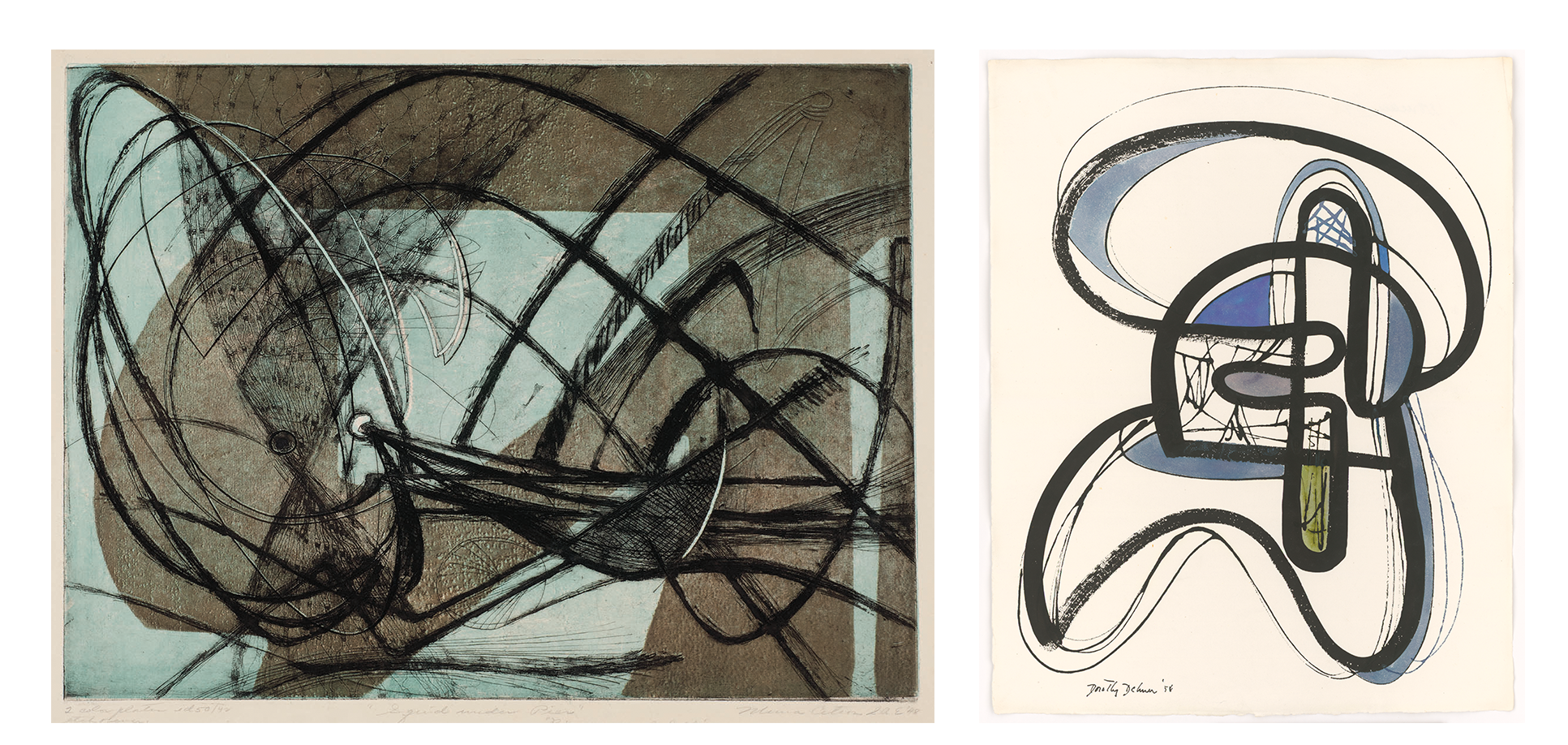 |
| Images: Left: Minna Wright Citron, Squid Under Pier, 1948, color etching, soft-ground, and engraving on paper, edition 42/50, 15 x 17 7/8 inches, 2010 Collections Circle purchase, Asheville Art Museum. © Estate of Minna Citron/Licensed by VAGA at ARS, New York. Right: Dorothy Dehner, Woman #2, 1954, watercolor and ink on paper, 22 3/4 x 18”, courtesy of Dolan Maxwell. |
The Asheville Art Museum is pleased to announce the upcoming exhibition American Art in the Atomic Age: 1940–1960, which explores the groundbreaking contributions of artists who worked at the experimental printmaking studio Atelier 17 in the wake of World War II. Co-curated by Marilyn Laufer and Tom Butler, American Art in the Atomic Age which draws from the holdings of Dolan/Maxwell, the Asheville Art Museum Collection, and private collections will be on view from November 10, 2023–April 29, 2024.
Atelier 17 operated in New York for fifteen years, between 1940 and 1955. The studio’s founder, Stanley William Hayter (1901–1988) established the workshop in Paris but relocated to New York just as the Nazi occupation of Paris began in 1940. Hayter’s new studio attracted European emigrants like André Masson, Yves Tanguy, and Joan Miró, as well as American artists like Dorothy Dehner, Judith Rothschild, and Karl Schrag, allowing for an exchange of artistic ideas and processes between European and American artists.
The Asheville Art Museum will present over 100 works that exemplify the cross-cultural exchange and profound social and political impact of Atelier 17 on American art. Prints made at Atelier 17—including those by Stanley William Hayter, Louise Nevelson, and Perle Fine—will be in conversation with works by European Surrealists who were working at the studio in the 1940s and 1950s. The exhibition will also feature a selection of domestic mid-century objects that exemplify how the ideas and aesthetics of post-war abstraction became a part of everyday life.
Throughout the history of painting from the mid-19th century forward, artists have used an
endless variety of approaches to record their world. Beyond the Lens: Photorealist Perspectives on Looking, Seeing, and Painting continues this thread, offering an opportunity to explore a singular and still forceful aspect of American art. Photorealism shares many of the approaches of historical and modernist realism, with a twist. The use of the camera as a basic tool for organizing visual information in advance of painterly expression is now quite common, but Photorealists embraced the camera as the focal point in their creative process.
Beyond the Lens presents key works from the collection of Louis K. and Susan Pear Meisel,
bringing together paintings and works on paper dating from the 1970s to the present to focus on this profoundly influential art movement. The exhibition includes work by highly acclaimed formative artists of the movement such as Charles Bell, Robert Bechtle, Tom Blackwell, Richard Estes, Audrey Flack, and Ralph Goings as well as paintings by the successive generations of Photorealist artists Anthony Brunelli, Davis Cone, Bertrand Meniel, Rod Penner, and Raphaella Spence. Featured artworks in the exhibition include diverse subject matters, but the primary focus is on the common and every day: urban scenes, “portraits” of cars, trucks, and motorcycles, still life compositions using toys, food, candy wrappers, and salt and pepper shakers. All provide opportunities for virtuoso studies in how light, reflection, and the camera as intermediary shapes our perception of the material world.
This multigenerational survey demonstrates how the 35-mm camera, and later technological
advances in digital image-making, informed and impacted the painterly gesture. Taken together, the paintings and works on paper in Beyond the Lens show how simply spellbinding these virtuosic works of art can be.
“Beyond the Lens offers a fascinating look into the Photorealism movement and delves into the profound connection between the artists’ observation and creative process,” says Pamela L. Myers, Executive Director of Asheville Art Museum. “We are delighted to present this curated collection of artworks encapsulating the creative vision and technical precision that defines this artistic genre.”
Photorealism found its roots in the late 1960s in California and New York, coexisting with an explosion of new ideas in art-making that included Conceptual, Pop, Minimalism, Land and Performance Art. At first, representational realism coexisted with the thematic and conceptual explosion but was eventually relegated to the margins regarding critical and curatorial attention. Often misunderstood and sometimes negatively criticized or lampooned as a betrayal of modernism’s commitment to abstraction, the artists involved in Photorealism remained committed explorers of the trail they had blazed. In the decades of the late twentieth century and early twenty-first century, realistic and symbolic painting experienced a renaissance, as contemporary artists are increasingly drawn to narrative and storytelling. Concurrently, using a camera as a preparatory tool equally legitimate and valuable as pencils and pens has made the rubric of Photorealism increasingly relevant.
This exhibition is organized by the Asheville Art Museum and guest curated by Terrie Sultan.
This exhibition is sponsored in part by Jim and Julia Calkins Peterson.
Romare Bearden (Charlotte, NC 1911–1988 New York, NY), African American writer and artist, is renowned for his collages. He constantly experimented with various techniques to achieve his artistic goals throughout his career. This exhibition highlights works on paper and explores his most frequently used mediums, including screen-printing, lithography, hand-colored etching, collagraph, monotype, relief print, photomontage, and collage.
Bearden’s work reflects his improvisational approach to his practice. He considered his process akin to that of jazz and blues composers. Starting with an open mind, he would let an idea evolve spontaneously.
“Romare Bearden: Ways of Working highlights Bearden’s unique artistic practice and masterful storytelling through art,” says Pamela L. Myers, Executive Director of the Asheville Art Museum. “We are thrilled to collaborate with Jerald Melberg Gallery to present these extraordinary works on paper in conversation with Bearden’s collage Sunset Express, 1984 in the Museum Collection (on view in the Museum’s SECU Collection Hall). This exhibition will also provide a glimpse into the cultural histories and personal interests that influenced his art-making practice, and we hope it encourages introspection and dialogue with our visitors.”
Jerald Melberg states, “Romare Bearden’s groundbreaking artistic practice continues to captivate audiences worldwide. With an unparalleled legacy of creativity and innovation, Bearden’s contributions to art remain deeply influential years beyond his life.” We have enjoyed organizing this exhibition with the Asheville Art Museum to showcase his artistic genius and inspire visitors from the Western North Carolina region and beyond.”
This exhibition is made possible in part by the Judy Appleton Fund. Many thanks to the Jerald Melberg Gallery for the loan of these important artworks and to Mary and Jerald Melberg for their long-standing support of the arts, artists, and the Asheville Art Museum.
|
Western North Carolina is important in the history of American glass art. Several artists of the Studio Glass Movement came to the region, including its founder Harvey K. Littleton. Begun in 1962 in Wisconsin, it was a student of Littleton’s that first came to the area in 1965 and set up a glass studio at the Penland School of Craft in Penland, North Carolina. By 1967, Mark Peiser was the first glass artist resident at the school and taught many notable artists, like Jak Brewer in 1968 and Richard Ritter who came to study in 1971. By 1977, Littleton retired from teaching and moved to nearby Spruce Pine, North Carolina and set up a glass studio at his home. Since that time, glass artists like Ken Carder, Rick and Valerie Beck, Shane Fero, and Yaffa Sikorsky and Jeff Todd—to name only a few—have flocked to the area to reside, collaborate, and teach, making it a significant place for experimentation and education in glass. The next generation of artists like Hayden Wilson and Alex Bernstein continue to create here. The Museum is dedicated to collecting American studio glass and within that umbrella, explores the work of Artists connected to Western North Carolina. Exhibitions, including Intersections of American Art, explore glass art in the context of American Art of the 20th and 21st centuries. A variety of techniques and a willingness to push boundaries of the medium can be seen in this selection of works from the Museum’s Collection. |
PUBLIC TOURS
Join our educators for tours of the Museum’s Collection and special exhibitions. No reservations are required.
Enjoy an evening of live music in the Museum’s Windgate Foundation Atrium featuring Emily Martin and the Innocent Mischief. Em and the Innocent Mischief, formed in Asheville, is a blend of intrepid lyrics and modern folk-mountain sound. The group comprises of Emily Martin (vocals, songwriter), Sarah Schultz (violin, mandolin, vocals, keys), Bryan Streett (guitar, harmonica, vocals), and Charlotte Martin (vocals).
PERFORMANCES
Music, dance, performance art, and other live performances bring artworks in our Museum’s Collection and special exhibitions to life. Performances include discussion of the intersections between art forms. To be added to our Performances mailing list, click here or call 828.253.3227 x124.
Artsville and the Ferguson YMCA Partner as a New Arts Resource for Candler
Announcing Expressionistic Landscape Watercolors by Cynthia Llanes
Saturday, January 13 thru Monday, March 4
Seeking a spot to bring art exhibits, discussions and workshops to Candler, Artsville Collective
has partnered with the Ferguson Family YMCA for a full schedule of year-round events. Kicking
off 2024 will be watercolors from Cynthia Llanes, an expressionistic landscape artist whose work
has become a favorite in the region and commissioned paintings appear in many collections.
The exhibit “Fluid Expressions” seeks to celebrate the sheer joy and excitement that
watercolor brings to the creative process, offering insight into the unique characteristics
of watercolor as a medium. Says Llanes, “Fluid Expressions” invites viewers to revel in
the joy of watercolor and its uncanny ability to capture subtle nuances in landscapes.”
To hear more from Llanes about her work and what captivates her in nature, meet her
at the Ferguson Y for a group presentation, demo and discussion on Monday,
February 5 from 11 am to noon. To learn more from area artists, circle the first
Monday of every other month when Artsville Collective sponsors Art Talks at the
Candler Y.
Llanes’ career as a committed art-preneur has built her brand dramatically since
showing at Artsville Collective in the RAD in 2022. Her versatility in oil and watercolor is
displayed in depth at her new space in the River Arts District. Cynthia Llanes Fine Art
Gallery and Studio is located at Riverview Station, 191 Lyman, Second Floor Studio 324
or cynthiallanesartist.com.
It is not necessary to be a Y member to attend art exhibits and talks and all are
encouraged to bring friends. More than a place to exercise, the YMCA is a community
resource for folks of all ages and backgrounds. The Candler Y also offers nutrition
consulting, childcare, discussions, outdoor activities, and family events. Visit the
Ferguson Family YMCA at 31 Westridge Market Place, Candler NC 28715 or call
828-575-2940.
Included with admission
Embark on a scenic journey across George Vanderbilt’s Italy with a large-scale outdoor display that combines brilliant botanical designs with authentic messages written by Vanderbilt himself.
Beautifully handcrafted of natural elements, each sculptural postcard depicts a location or landmark Vanderbilt visited more than a century ago. This captivating complement to Biltmore’s Italian Renaissance Alive exhibition reveals Vanderbilt’s passions for travel, culture, architecture, and art as well as his personal experience of such renowned Italian cities as Milan, Florence, Venice, Pisa, and Vatican City.
Adding to the charm and visual appeal of Ciao! From Italy—sure to be a hit among kids of all ages—is the G-scale model train that travels in and out of each postcard in this enlightening display!
Historians estimate that skilled Black artisans outnumbered their white counterparts in the antebellum South by a margin of five to one. However, despite their presence and prevalence in all corners of the pre-industrial trade and craft fields, the stories of these skilled workers go largely unacknowledged.
Borrowing its title from a Black culture and politics magazine of the same name, Hammer and Hope celebrates the life and labor of Black chairmakers in early America. Featuring the work of two contemporary furniture makers – Robell Awake and Charlie Ryland – the pieces in this exhibition are based on the artists’ research into ladderback chairs created by the Poynors, a multigenerational family of free and enslaved craftspeople working in central Tennessee between the early nineteenth and early twentieth centuries.
Through the objects featured in Hammer and Hope, Awake and Ryland explore, reinterpret, and reimagine what the field of furniture-making today would look like had the history and legacy of the Poynors – and countless others that have been subject to a similar pattern of erasure – been celebrated rather than hidden. Hammer and Hope represents Awake and Ryland’s attempts, in their own words, “at fighting erasure by making objects that engage with these long-suppressed stories.”
Robell Awake and Charlie Ryland are recipients of the Center for Craft’s 2022 Craft Research Fund Artist Fellowship. This substantial mid-career grant is awarded to two artists to support research projects that advance, expand, and support the creation of new research and knowledge through craft practice.
Preservers, Innovators, and Rescuers of Culture in Chiapas features eleven textiles by acclaimed Indigenous artisanas (artists) from Chiapas, Mexico commissioned by US-based fiber artists and activist Aram Han Sifuentes. As part of their 2022 Craft Research Fund Artist Fellowship, Han Sifuentes traveled to Chiapas to understand the function of garments and textiles within the social and cultural context of the area and to learn the traditional practice of backstrap weaving. Through the works on view, combined with a series of interviews Han Sifuentes conducted during her research, visitors learn about the artisanas and their role as preservers, rescuers, and innovators of culture and as protectors of Mayan ancestral knowledge. Together, these works present an approach to connecting and learning about culture through craft practices.
Han Sifuentes is interested in backstrap weaving because it is one of the oldest forms used across cultures. The vibrant hues and elaborate designs of each textile express the artisanas identities and medium to tell their stories. To understand how these values manifested in textiles made in Chiapas, Han Sifuentes invited the artisanas to create whatever weaving they desired over the course of three months. This is unique because most textiles in the area are created to meet tourist-driven and marketplace demands. Incorporating traditional backstrap weaving and natural dye techniques, some artisans created textiles to rescue or reintroduce weaving practices that are almost or completely lost in their communities, while others were created through material and conceptual experimentation. This range of approaches reflects how artistanas are constantly innovating while at the same time honoring and keeping to tradition.
Preservers, Innovators, and Rescuers of Culture in Chiapas is on view from November 17, 2023 to July 13, 2024.
Aram Han Sifuentes is a recipient of the Center for Craft’s 2022 Craft Research Fund Artist Fellowship. This substantial mid-career grant is awarded to two artists to support research projects that advance, expand, and support the creation of new research and knowledge through craft practice.
The featured artisanas include: Juana Victoria Hernandez Gomez from San Juan Cancuc, Maria Josefina Gómez Sanchez and Maria de Jesus Gómez Sanchez from Oxchujk (Oxchuc), Marcela Gómez Diaz and Cecilia Gómez Diaz from San Andrés Larráinzar, Rosa Margarita Enríquez Bolóm from Huixtán, Cristina García Pérez from Chalchihuitán, Susana Maria Gómez Gonzalez, Maria Gonzalez Guillén, and Anastacia Juana Gómez Gonzalez from Zinacantán, Angelica Leticia Gómez Santiz from Pantelhó, and Susana Guadalupe Méndez Santiz from Aldama
|
| Images: Left: Minna Wright Citron, Squid Under Pier, 1948, color etching, soft-ground, and engraving on paper, edition 42/50, 15 x 17 7/8 inches, 2010 Collections Circle purchase, Asheville Art Museum. © Estate of Minna Citron/Licensed by VAGA at ARS, New York. Right: Dorothy Dehner, Woman #2, 1954, watercolor and ink on paper, 22 3/4 x 18”, courtesy of Dolan Maxwell. |
The Asheville Art Museum is pleased to announce the upcoming exhibition American Art in the Atomic Age: 1940–1960, which explores the groundbreaking contributions of artists who worked at the experimental printmaking studio Atelier 17 in the wake of World War II. Co-curated by Marilyn Laufer and Tom Butler, American Art in the Atomic Age which draws from the holdings of Dolan/Maxwell, the Asheville Art Museum Collection, and private collections will be on view from November 10, 2023–April 29, 2024.
Atelier 17 operated in New York for fifteen years, between 1940 and 1955. The studio’s founder, Stanley William Hayter (1901–1988) established the workshop in Paris but relocated to New York just as the Nazi occupation of Paris began in 1940. Hayter’s new studio attracted European emigrants like André Masson, Yves Tanguy, and Joan Miró, as well as American artists like Dorothy Dehner, Judith Rothschild, and Karl Schrag, allowing for an exchange of artistic ideas and processes between European and American artists.
The Asheville Art Museum will present over 100 works that exemplify the cross-cultural exchange and profound social and political impact of Atelier 17 on American art. Prints made at Atelier 17—including those by Stanley William Hayter, Louise Nevelson, and Perle Fine—will be in conversation with works by European Surrealists who were working at the studio in the 1940s and 1950s. The exhibition will also feature a selection of domestic mid-century objects that exemplify how the ideas and aesthetics of post-war abstraction became a part of everyday life.
Throughout the history of painting from the mid-19th century forward, artists have used an
endless variety of approaches to record their world. Beyond the Lens: Photorealist Perspectives on Looking, Seeing, and Painting continues this thread, offering an opportunity to explore a singular and still forceful aspect of American art. Photorealism shares many of the approaches of historical and modernist realism, with a twist. The use of the camera as a basic tool for organizing visual information in advance of painterly expression is now quite common, but Photorealists embraced the camera as the focal point in their creative process.
Beyond the Lens presents key works from the collection of Louis K. and Susan Pear Meisel,
bringing together paintings and works on paper dating from the 1970s to the present to focus on this profoundly influential art movement. The exhibition includes work by highly acclaimed formative artists of the movement such as Charles Bell, Robert Bechtle, Tom Blackwell, Richard Estes, Audrey Flack, and Ralph Goings as well as paintings by the successive generations of Photorealist artists Anthony Brunelli, Davis Cone, Bertrand Meniel, Rod Penner, and Raphaella Spence. Featured artworks in the exhibition include diverse subject matters, but the primary focus is on the common and every day: urban scenes, “portraits” of cars, trucks, and motorcycles, still life compositions using toys, food, candy wrappers, and salt and pepper shakers. All provide opportunities for virtuoso studies in how light, reflection, and the camera as intermediary shapes our perception of the material world.
This multigenerational survey demonstrates how the 35-mm camera, and later technological
advances in digital image-making, informed and impacted the painterly gesture. Taken together, the paintings and works on paper in Beyond the Lens show how simply spellbinding these virtuosic works of art can be.
“Beyond the Lens offers a fascinating look into the Photorealism movement and delves into the profound connection between the artists’ observation and creative process,” says Pamela L. Myers, Executive Director of Asheville Art Museum. “We are delighted to present this curated collection of artworks encapsulating the creative vision and technical precision that defines this artistic genre.”
Photorealism found its roots in the late 1960s in California and New York, coexisting with an explosion of new ideas in art-making that included Conceptual, Pop, Minimalism, Land and Performance Art. At first, representational realism coexisted with the thematic and conceptual explosion but was eventually relegated to the margins regarding critical and curatorial attention. Often misunderstood and sometimes negatively criticized or lampooned as a betrayal of modernism’s commitment to abstraction, the artists involved in Photorealism remained committed explorers of the trail they had blazed. In the decades of the late twentieth century and early twenty-first century, realistic and symbolic painting experienced a renaissance, as contemporary artists are increasingly drawn to narrative and storytelling. Concurrently, using a camera as a preparatory tool equally legitimate and valuable as pencils and pens has made the rubric of Photorealism increasingly relevant.
This exhibition is organized by the Asheville Art Museum and guest curated by Terrie Sultan.
This exhibition is sponsored in part by Jim and Julia Calkins Peterson.
Romare Bearden (Charlotte, NC 1911–1988 New York, NY), African American writer and artist, is renowned for his collages. He constantly experimented with various techniques to achieve his artistic goals throughout his career. This exhibition highlights works on paper and explores his most frequently used mediums, including screen-printing, lithography, hand-colored etching, collagraph, monotype, relief print, photomontage, and collage.
Bearden’s work reflects his improvisational approach to his practice. He considered his process akin to that of jazz and blues composers. Starting with an open mind, he would let an idea evolve spontaneously.
“Romare Bearden: Ways of Working highlights Bearden’s unique artistic practice and masterful storytelling through art,” says Pamela L. Myers, Executive Director of the Asheville Art Museum. “We are thrilled to collaborate with Jerald Melberg Gallery to present these extraordinary works on paper in conversation with Bearden’s collage Sunset Express, 1984 in the Museum Collection (on view in the Museum’s SECU Collection Hall). This exhibition will also provide a glimpse into the cultural histories and personal interests that influenced his art-making practice, and we hope it encourages introspection and dialogue with our visitors.”
Jerald Melberg states, “Romare Bearden’s groundbreaking artistic practice continues to captivate audiences worldwide. With an unparalleled legacy of creativity and innovation, Bearden’s contributions to art remain deeply influential years beyond his life.” We have enjoyed organizing this exhibition with the Asheville Art Museum to showcase his artistic genius and inspire visitors from the Western North Carolina region and beyond.”
This exhibition is made possible in part by the Judy Appleton Fund. Many thanks to the Jerald Melberg Gallery for the loan of these important artworks and to Mary and Jerald Melberg for their long-standing support of the arts, artists, and the Asheville Art Museum.
|
Western North Carolina is important in the history of American glass art. Several artists of the Studio Glass Movement came to the region, including its founder Harvey K. Littleton. Begun in 1962 in Wisconsin, it was a student of Littleton’s that first came to the area in 1965 and set up a glass studio at the Penland School of Craft in Penland, North Carolina. By 1967, Mark Peiser was the first glass artist resident at the school and taught many notable artists, like Jak Brewer in 1968 and Richard Ritter who came to study in 1971. By 1977, Littleton retired from teaching and moved to nearby Spruce Pine, North Carolina and set up a glass studio at his home. Since that time, glass artists like Ken Carder, Rick and Valerie Beck, Shane Fero, and Yaffa Sikorsky and Jeff Todd—to name only a few—have flocked to the area to reside, collaborate, and teach, making it a significant place for experimentation and education in glass. The next generation of artists like Hayden Wilson and Alex Bernstein continue to create here. The Museum is dedicated to collecting American studio glass and within that umbrella, explores the work of Artists connected to Western North Carolina. Exhibitions, including Intersections of American Art, explore glass art in the context of American Art of the 20th and 21st centuries. A variety of techniques and a willingness to push boundaries of the medium can be seen in this selection of works from the Museum’s Collection. |
Boris Khaykin was listed by Time Out NY as one of Brooklyn Comedy Festival’s Biggest stars and is a regular guest at The Comedy Cellar
Every Friday Modelface Comedy brings you the best comedians from all over the country. This week we have Boris Khaykin from NYC!!
Boris Khaykin was listed by Time Out NY as one of Brooklyn Comedy Festival’s Biggest stars and is a regular guest on The Comedy Cellar’s “Live From America Podcast. He has performed on CollegeHumor Live, as a warm for The Opposition with Jordan Klepper, and has been seen in Bull, The First Purge, Broad City, and Amazon Prime’s Red Oaks. He has won a webby for his work as a writer and director at We The Internet, and can most recently be heard doing several characters on the Audible/Broadway Video podcast Blood Weed.
Featuring Ryan Cox
ages 18+
Doors at 6:30, show at 7pm
Explore the dark side of Beer City on LaZoom’s Ghosted Tour!
Duration
1 hour
About
Come enjoy our most popular Asheville tour!
About
Bachelorette/Bachelor Parties are not permitted on this tour. The Fender Bender Bus is bachelorette/bachelor friendly!
Learn about Asheville’s strange, sometimes sordid past from our ghoulish guides. You’ll laugh! You’ll scream! You’ll discover mysteries and chilling tales of scandal and murder on the blood-stained streets of this picturesque town!
Ghosted runs approximately 60 minutes. Beer and wine are welcome onboard, but no open containers, and absolutely no liquor, please! All beer and wine must be purchased from the LaZoom Room. (Passengers must be at least 21 years old to drink on the bus, and must have valid ID.)
Age Restrictions
17 and up. No exceptions.
What’s Included
A bunch of bus seats
History of murders, ghosts and tragedies in the Land of the Sky
Tongue-in-cheek comedy
A live (not dead) tour guide
What’s Not Included
Bathroom breaks (It’s 60 minutes long – plan accordingly!)
Beer or Wine (Purchase at our bar, the LaZoom Room, and take on the bus)
Laughing (we’ll give you the funny, but it’s up to you to laugh)
Gratuity (guides only accept dead president currency)
Waitlist
If your desired time and availability is full, then please give us a call to be added to the waitlist.
The nation’s largest comedy club network is back! After a popular run last season, this hilarious collective returns to bring top-notch comedians for four weekends of side-splitting laughter. Some of the hottest stand-up comedians of today — seen in specials on Comedy Central, HBO Comedy, Netflix, Hulu and more — deliver witty one-liners, preposterous punchlines and hysterical anecdotes that will keep you laughing all night long. Contains adult content.
The nation’s largest comedy club network is back! After a popular run last season, this hilarious collective returns to bring top-notch comedians for four weekends of side-splitting laughter. Some of the hottest stand-up comedians of today — seen in specials on Comedy Central, HBO Comedy, Netflix, Hulu and more — deliver witty one-liners, preposterous punchlines and hysterical anecdotes that will keep you laughing all night long. Contains adult content.
Lace Larrabee is an actor, nationally touring stand-up comedian and former southern beauty queen who can be seen at clubs from coast to coast. Lace was a season 17 semifinalist on America’s Got Talent and was brought back at the finale show to roast judge Simon Cowell alongside the Roastmaster General himself, Jeff Ross!
Lace’s debut comedy album, White Trash Cinderella, produced by 800 Pound Gorilla Records, was released in September 2022 at the number 1 spot on the comedy charts. The accompanying YouTube special garnered over 190k views in the first month and continues to climb.
Lace and fellow Atlanta comedian Katherine Blanford (The Tonight Show) co-host the hilariously healing podcast, CHEATIES! CHEATIES is a delicious, juicy part of a well-balanced diet. Every week, these two snarky co-hosts interview a guest who’s either been cheated on or been the cheater. This podcast focuses on the mistakes we all make in relationships and, more importantly, how we overcome them and make it out on top.
Lace is also very passionate about helping to elevate the voices of other women. She founded Atlanta’s first and only all female stand-up comedy class Laugh Lab at the legendary Punchline Comedy Club. Laugh Lab now offers coed classes as well and was voted “2019 Best Comedy Class” by Atlanta Magazine.
Artsville and the Ferguson YMCA Partner as a New Arts Resource for Candler
Announcing Expressionistic Landscape Watercolors by Cynthia Llanes
Saturday, January 13 thru Monday, March 4
Seeking a spot to bring art exhibits, discussions and workshops to Candler, Artsville Collective
has partnered with the Ferguson Family YMCA for a full schedule of year-round events. Kicking
off 2024 will be watercolors from Cynthia Llanes, an expressionistic landscape artist whose work
has become a favorite in the region and commissioned paintings appear in many collections.
The exhibit “Fluid Expressions” seeks to celebrate the sheer joy and excitement that
watercolor brings to the creative process, offering insight into the unique characteristics
of watercolor as a medium. Says Llanes, “Fluid Expressions” invites viewers to revel in
the joy of watercolor and its uncanny ability to capture subtle nuances in landscapes.”
To hear more from Llanes about her work and what captivates her in nature, meet her
at the Ferguson Y for a group presentation, demo and discussion on Monday,
February 5 from 11 am to noon. To learn more from area artists, circle the first
Monday of every other month when Artsville Collective sponsors Art Talks at the
Candler Y.
Llanes’ career as a committed art-preneur has built her brand dramatically since
showing at Artsville Collective in the RAD in 2022. Her versatility in oil and watercolor is
displayed in depth at her new space in the River Arts District. Cynthia Llanes Fine Art
Gallery and Studio is located at Riverview Station, 191 Lyman, Second Floor Studio 324
or cynthiallanesartist.com.
It is not necessary to be a Y member to attend art exhibits and talks and all are
encouraged to bring friends. More than a place to exercise, the YMCA is a community
resource for folks of all ages and backgrounds. The Candler Y also offers nutrition
consulting, childcare, discussions, outdoor activities, and family events. Visit the
Ferguson Family YMCA at 31 Westridge Market Place, Candler NC 28715 or call
828-575-2940.
Included with admission
Embark on a scenic journey across George Vanderbilt’s Italy with a large-scale outdoor display that combines brilliant botanical designs with authentic messages written by Vanderbilt himself.
Beautifully handcrafted of natural elements, each sculptural postcard depicts a location or landmark Vanderbilt visited more than a century ago. This captivating complement to Biltmore’s Italian Renaissance Alive exhibition reveals Vanderbilt’s passions for travel, culture, architecture, and art as well as his personal experience of such renowned Italian cities as Milan, Florence, Venice, Pisa, and Vatican City.
Adding to the charm and visual appeal of Ciao! From Italy—sure to be a hit among kids of all ages—is the G-scale model train that travels in and out of each postcard in this enlightening display!
In collaboration with West Asheville Yoga join us in the Museum’s galleries for a Creative Flow experience that combines the beauty of art with the power of mindful movement.
All-levels are welcome. Please bring your own mat. Loose-fitting clothing is recommended.
Historians estimate that skilled Black artisans outnumbered their white counterparts in the antebellum South by a margin of five to one. However, despite their presence and prevalence in all corners of the pre-industrial trade and craft fields, the stories of these skilled workers go largely unacknowledged.
Borrowing its title from a Black culture and politics magazine of the same name, Hammer and Hope celebrates the life and labor of Black chairmakers in early America. Featuring the work of two contemporary furniture makers – Robell Awake and Charlie Ryland – the pieces in this exhibition are based on the artists’ research into ladderback chairs created by the Poynors, a multigenerational family of free and enslaved craftspeople working in central Tennessee between the early nineteenth and early twentieth centuries.
Through the objects featured in Hammer and Hope, Awake and Ryland explore, reinterpret, and reimagine what the field of furniture-making today would look like had the history and legacy of the Poynors – and countless others that have been subject to a similar pattern of erasure – been celebrated rather than hidden. Hammer and Hope represents Awake and Ryland’s attempts, in their own words, “at fighting erasure by making objects that engage with these long-suppressed stories.”
Robell Awake and Charlie Ryland are recipients of the Center for Craft’s 2022 Craft Research Fund Artist Fellowship. This substantial mid-career grant is awarded to two artists to support research projects that advance, expand, and support the creation of new research and knowledge through craft practice.
Preservers, Innovators, and Rescuers of Culture in Chiapas features eleven textiles by acclaimed Indigenous artisanas (artists) from Chiapas, Mexico commissioned by US-based fiber artists and activist Aram Han Sifuentes. As part of their 2022 Craft Research Fund Artist Fellowship, Han Sifuentes traveled to Chiapas to understand the function of garments and textiles within the social and cultural context of the area and to learn the traditional practice of backstrap weaving. Through the works on view, combined with a series of interviews Han Sifuentes conducted during her research, visitors learn about the artisanas and their role as preservers, rescuers, and innovators of culture and as protectors of Mayan ancestral knowledge. Together, these works present an approach to connecting and learning about culture through craft practices.
Han Sifuentes is interested in backstrap weaving because it is one of the oldest forms used across cultures. The vibrant hues and elaborate designs of each textile express the artisanas identities and medium to tell their stories. To understand how these values manifested in textiles made in Chiapas, Han Sifuentes invited the artisanas to create whatever weaving they desired over the course of three months. This is unique because most textiles in the area are created to meet tourist-driven and marketplace demands. Incorporating traditional backstrap weaving and natural dye techniques, some artisans created textiles to rescue or reintroduce weaving practices that are almost or completely lost in their communities, while others were created through material and conceptual experimentation. This range of approaches reflects how artistanas are constantly innovating while at the same time honoring and keeping to tradition.
Preservers, Innovators, and Rescuers of Culture in Chiapas is on view from November 17, 2023 to July 13, 2024.
Aram Han Sifuentes is a recipient of the Center for Craft’s 2022 Craft Research Fund Artist Fellowship. This substantial mid-career grant is awarded to two artists to support research projects that advance, expand, and support the creation of new research and knowledge through craft practice.
The featured artisanas include: Juana Victoria Hernandez Gomez from San Juan Cancuc, Maria Josefina Gómez Sanchez and Maria de Jesus Gómez Sanchez from Oxchujk (Oxchuc), Marcela Gómez Diaz and Cecilia Gómez Diaz from San Andrés Larráinzar, Rosa Margarita Enríquez Bolóm from Huixtán, Cristina García Pérez from Chalchihuitán, Susana Maria Gómez Gonzalez, Maria Gonzalez Guillén, and Anastacia Juana Gómez Gonzalez from Zinacantán, Angelica Leticia Gómez Santiz from Pantelhó, and Susana Guadalupe Méndez Santiz from Aldama
Saturdays from 10:30 AM – 12 PM
|
| Images: Left: Minna Wright Citron, Squid Under Pier, 1948, color etching, soft-ground, and engraving on paper, edition 42/50, 15 x 17 7/8 inches, 2010 Collections Circle purchase, Asheville Art Museum. © Estate of Minna Citron/Licensed by VAGA at ARS, New York. Right: Dorothy Dehner, Woman #2, 1954, watercolor and ink on paper, 22 3/4 x 18”, courtesy of Dolan Maxwell. |
The Asheville Art Museum is pleased to announce the upcoming exhibition American Art in the Atomic Age: 1940–1960, which explores the groundbreaking contributions of artists who worked at the experimental printmaking studio Atelier 17 in the wake of World War II. Co-curated by Marilyn Laufer and Tom Butler, American Art in the Atomic Age which draws from the holdings of Dolan/Maxwell, the Asheville Art Museum Collection, and private collections will be on view from November 10, 2023–April 29, 2024.
Atelier 17 operated in New York for fifteen years, between 1940 and 1955. The studio’s founder, Stanley William Hayter (1901–1988) established the workshop in Paris but relocated to New York just as the Nazi occupation of Paris began in 1940. Hayter’s new studio attracted European emigrants like André Masson, Yves Tanguy, and Joan Miró, as well as American artists like Dorothy Dehner, Judith Rothschild, and Karl Schrag, allowing for an exchange of artistic ideas and processes between European and American artists.
The Asheville Art Museum will present over 100 works that exemplify the cross-cultural exchange and profound social and political impact of Atelier 17 on American art. Prints made at Atelier 17—including those by Stanley William Hayter, Louise Nevelson, and Perle Fine—will be in conversation with works by European Surrealists who were working at the studio in the 1940s and 1950s. The exhibition will also feature a selection of domestic mid-century objects that exemplify how the ideas and aesthetics of post-war abstraction became a part of everyday life.
Throughout the history of painting from the mid-19th century forward, artists have used an
endless variety of approaches to record their world. Beyond the Lens: Photorealist Perspectives on Looking, Seeing, and Painting continues this thread, offering an opportunity to explore a singular and still forceful aspect of American art. Photorealism shares many of the approaches of historical and modernist realism, with a twist. The use of the camera as a basic tool for organizing visual information in advance of painterly expression is now quite common, but Photorealists embraced the camera as the focal point in their creative process.
Beyond the Lens presents key works from the collection of Louis K. and Susan Pear Meisel,
bringing together paintings and works on paper dating from the 1970s to the present to focus on this profoundly influential art movement. The exhibition includes work by highly acclaimed formative artists of the movement such as Charles Bell, Robert Bechtle, Tom Blackwell, Richard Estes, Audrey Flack, and Ralph Goings as well as paintings by the successive generations of Photorealist artists Anthony Brunelli, Davis Cone, Bertrand Meniel, Rod Penner, and Raphaella Spence. Featured artworks in the exhibition include diverse subject matters, but the primary focus is on the common and every day: urban scenes, “portraits” of cars, trucks, and motorcycles, still life compositions using toys, food, candy wrappers, and salt and pepper shakers. All provide opportunities for virtuoso studies in how light, reflection, and the camera as intermediary shapes our perception of the material world.
This multigenerational survey demonstrates how the 35-mm camera, and later technological
advances in digital image-making, informed and impacted the painterly gesture. Taken together, the paintings and works on paper in Beyond the Lens show how simply spellbinding these virtuosic works of art can be.
“Beyond the Lens offers a fascinating look into the Photorealism movement and delves into the profound connection between the artists’ observation and creative process,” says Pamela L. Myers, Executive Director of Asheville Art Museum. “We are delighted to present this curated collection of artworks encapsulating the creative vision and technical precision that defines this artistic genre.”
Photorealism found its roots in the late 1960s in California and New York, coexisting with an explosion of new ideas in art-making that included Conceptual, Pop, Minimalism, Land and Performance Art. At first, representational realism coexisted with the thematic and conceptual explosion but was eventually relegated to the margins regarding critical and curatorial attention. Often misunderstood and sometimes negatively criticized or lampooned as a betrayal of modernism’s commitment to abstraction, the artists involved in Photorealism remained committed explorers of the trail they had blazed. In the decades of the late twentieth century and early twenty-first century, realistic and symbolic painting experienced a renaissance, as contemporary artists are increasingly drawn to narrative and storytelling. Concurrently, using a camera as a preparatory tool equally legitimate and valuable as pencils and pens has made the rubric of Photorealism increasingly relevant.
This exhibition is organized by the Asheville Art Museum and guest curated by Terrie Sultan.
This exhibition is sponsored in part by Jim and Julia Calkins Peterson.