

Calendar of Events
Upcoming events and things to do in Asheville, NC. Below is a list of events for festivals, concerts, art exhibitions, group meetups and more.
Interested in adding an event to our calendar? Please click the green “Post Your Event” button below.
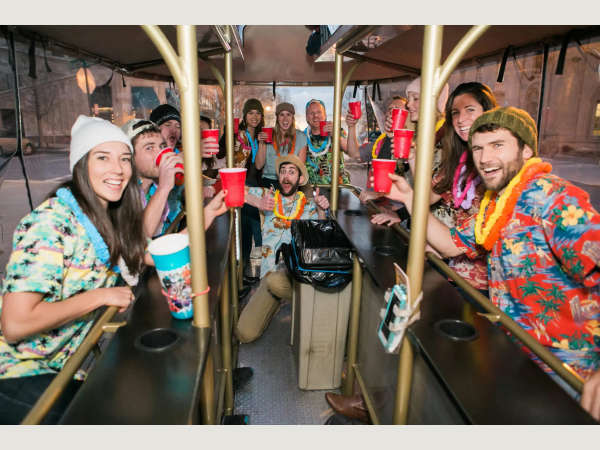
Imagine a solid trivia stack with a magnetic host in an outdoor intimate setting. Then add the excitement of BYOB and pedaling around the City on a one-of-a-kind contraption.
Kinda like if Willy Wonka did Trivia… you will be completely entertained, with no sense left unfulfilled.
And come back for more as we have several questions sets available with a good ole just for locals option!
Trivia tours seat up to 15 people, 1.5 or 40 mins hours long. Bring your own beer in cans or wine and your thinking while drinking caps on let’s do this thing!
|

|
Inspired by nature and following the self-published released of How to Heal the Planet from Wherever You Are, Cortina Jenelle introduces Oshanna Church of Spiritual Activism, with Oshanna debuting as a dynamic experience rooted in ceremony and inviting nature as a co-facilitator through theater, art and spoken word. After each production, all ticket proceeds are donated to a mission partner who is doing work in service to Mother Earth while also furthering truth, healing and reconciliation across race, gender and class.
Black Starseed: Immaculate Conception is the second installment of the Black Starseed series, which goes back in time as a prelude to Black Starseed: Revolutionary Reimagination (2020) – a debut partnership between adé PROJECT and PechaKucha Asheville co-creating a storytelling experience in voice of Black women at the intersection of creativity x spirituality. In this prelude, the life story of Cortina Jenelle becomes a moving memoir and an embodiment of a shared story from the matriarchs of Black, indigenous descent in a world where femininity, Blackness, sovereignty and indigeneity were not just criminal, but a threat to society. Black Starseed: Immaculate Conception may appear to just tell the story of one, yet is actually one version of the same story that constantly loops through time. Do you know how purposeful, brilliant and divine you already are, Starseed? This is heart song of the black sheep generation + millennials, and those born torn between ancestral remembrance and playing the game of life to win. Join us in a gathering of art, theater, ceremony (with a bonus book signing post-show) and storytelling and leave reminded of how to heal the planet from wherever you are.
Ticket proceeds benefit cleanup of the French Broad River with our mission partner for this show, Asheville Greenworks.

TAPAAS is an arts-integration program that implements high quality artist residencies to create craft and performance experiences across all curriculum. Since 2010, TAPAAS has impacted more than 9,000 students, trained over 55 artists, and provided more than 850 days of artists in residence. Teachers report that 94% of TAPAAS residencies scored as ‘excellent’ in student enthusiasm and participation; student understanding of the curriculum was deeper when taught as a creative project, and there was increased parent engagement in the classroom. Now in its 11th year, TAPAAS has maintained the ability to be a cost-effective, far-reaching program with a profound impact on both individual artists and students in our community. In 2021, Asheville Area Arts Council partnered with the Asheville City Schools Foundation and the Buncombe County School District to expand programming into Buncombe County Schools– increasing the depth and breadth of this program.
 |
TAPAAS for BCS EducatorsApply by November 18 | TAPAAS is an arts-integration program that implements high quality artist residencies to create craft and performance experiences across all curriculum. Since 2010, TAPAAS has impacted more than 9,000 students, trained over 55 artists, and provided more than 850 days of artists in residence. All teachers in the Buncombe County Schools district are welcome to apply — application opens October 17. |
Old Kentucky Home -The Thomas Wolfe Memorial
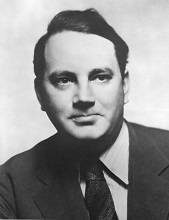
American Novelist Thomas Wolfe (1900-1938)
Considered by many to be one of the giants of 20th-century American literature, Thomas Wolfe immortalized his childhood home in his epic autobiographical novel, Look Homeward, Angel. Wolfe’s colorful portrayal of his family, his hometown of “Altamont” Asheville, North Carolina, and “Dixieland” the Old Kentucky Home boardinghouse, earned the Victorian period house a place as one of American literature’s most famous landmarks.
House tours are offered daily at half past each hour. Last tour leaves at 4:30 pm.
Group tours by reservation.
Adult – $5.00
Student (ages 7-17) – $2.00
Adult Group (10+) – $2.50 each
Student Group – $2.00 each
6 & under – Free
Hours of Operation
Limited Capacity: 12 Guests per Tour
A truly memorable experience featuring rare photo opportunities, this exclusive guided tour offers a behind-the-scenes look at the design and construction of Biltmore House in areas unavailable on the regular house visit. Imagine yourself a Vanderbilt (or cherished Vanderbilt guest) as you take in stunning views seen only from the house’s rooftop and balconies.
Advance reservation required. Tour includes 250 stairs with no elevator access. Wheelchairs, strollers, and baby backpacks are prohibited. Backpacks are not allowed on any guided tours. Guests are required to leave backpacks in a locker or in their vehicle. To participate in this tour, guest must have a daytime ticket, a Biltmore Annual Pass, or a stay at one of the estate’s splendid overnight properties.
The Fall Studio Tour Preview Exhibition opens in the Kokol Gallery, in Toe River Arts’ Spruce Pine location at 269 Oak Ave, October 29 and runs through the end December 2022. This exhibition gives visitors an opportunity to have a glimpse into each studio and plan their route. It’s also a great place to begin the tour or take a break from a day of non-stop art and artists.
There’s something breathtaking and awe-inspiring about driving through the mountains of western North Carolina in the Fall. The way the trees show off by turning vibrant shades of red, yellow, and orange before leaving bare branches to the crisp winds and snowy days of winter, reminds us that nature herself is the original artist.
For more than a quarter century, the Toe River Arts Studio Tour has intrigued those who make the journey to visit places of inspiration and creation. Situated between Roan Mountain which boasts the world’s largest rhododendron garden and Mt. Mitchell, the highest peak east of the Mississippi, the Toe River Arts Studio Tour is a free, self-guided journey of the arts. This arts adventure through Mitchell and Yancey Counties will take visitors along the meandering Toe River, across its many bridges, around barns, acres of fields and miles of forests all while visiting the 83 talented studio artists who often take inspiration from the mountains they call home and 8 galleries featuring local and international art.
It doesn’t matter if you live up the hill or across the state. The Studio Tour provides an adventure for the intrepid seeker of the art experience. Artist studios come in many iterations—the building off to the side of the house, or across the field or down the road or right off the main road or down a gravel one-lane. Two-stories with a gallery space or small and cozy with a table set up or cleared off for display. Still there are others that devote a corner to each artist sharing the space. Wherever and however they are set up, the studios are exciting places to visit because they demonstrate the dynamic process used to create a finished piece. Every artist has their own way of telling a story, inviting visitors to ask questions, hold their work, and share a moment.
The art is as diverse as the artists who create it and features the work of glassblowers, jewelers, printmakers, potters, fiber artists, ironworkers, painters, sculptors, and woodworkers.
Collage paintings, assemblages, textiles, & faux artifacts designed by Jean Hess to explore the 1920 WV mining labor dispute as metaphor for the human condition.
Three rooms are filled with an eclectic mix of collage paintings ranging in scale from 6×6” to 50×70”; 3-D assemblages and faux artifacts; hand-stitched textiles; documentation in the form of historic notes, catalog entries for a collection of ephemera, photographs.
Call 828-273-3332 for weekend hours or to make an appointment. Exhibits through November 30, 2022.
Flood Gallery Fine Art Center is a non-profit 501(c)3 organization, and educates, encourages, challenges and inspires the community through music, film, literary, and contemporary art.
“Matewan as Metaphor” is an experiment in artistic license. Mixed-media artist Jean Hess creates a personal story by combining real and imagined resources with the intention of healing her own memory and transcending limits on what is possible and allowed in creative and scholarly endeavors as well as in visual art. The 1920 mining labor dispute in Matewan, West Virginia, which involved her own family, stands for a full life and its adversities.
Matewan was, in 1920, the scene of an armed skirmish between coal miners, mining companies, local union officials and hired strike-breakers. Baldwin-Felts Detective Agency thugs hired by the coal operators traveled by train to cast striking miners and their families out of their homes. The local mayor and several Baldwin-Felts agents were killed. The chief of police, the Matewan mayor, and several other locals gathered at the train station to confront the hired guns about the unlawful evictions. The Baldwin-Felts agents refused to recognize the local authority, and a shootout ensued. The mayor, some miners, and several detectives were killed. This was one of many violent conflicts that took place in Southern WV between pro-union miners and men hired by coal companies to use force and intimidation to prevent miners from unionizing.
Jean Hess takes serious training in cultural anthropology and visual art to playful levels. Her mixed-media paintings and constructions come from personal memory and nostalgia, ancestral ties and historical fact. Mining illustrations and maps signify coal mining in early twentieth century Appalachia, as well as issues concerning extractive industries, population displacement, exploitative labor practices, suffering and loss. Using collage, paint, layered resins and found ephemera Hess experiments with myriad ways one can obfuscate, surprise and entice. Found imagery is from geography and history textbooks from the early 1900’s and before. Dimensional objects are from her family or found in junk shops over time. Much of her material may be deconstructed, obscured, scrambled or carefully embellished.
Jean Hess’ multi-variant creative output segues with an equally unpredictable life. She has lived in Washington, DC, Baltimore, Albuquerque, Santa Fe and Abiquiu, New Mexico as well as Atlanta, Dallas and now Knoxville, Tennessee. Her work-for-pay background includes stints as a computer programmer, Montessori teacher, museum registrar, writer and research consultant for government and private industry. With degrees [BA, MA] in cultural anthropology she tends to draw inspiration from wide-ranging interests, and not always according to established rules.
Hess is well-known for experimental mixed-media collage paintings and assemblages that combine the skillful use of layered paint and resins, light refraction and found materials such as antique ephemera and pressed plants. Because her palette, surface and touch are consistent, one can always tell a work of art is hers. And yet Hess likes surprises, plays with materials that are sometimes unfamiliar, operates in a controlled-experiment spirit and likes accidental detours that energize her work. While she took some undergraduate art courses she is largely self-taught.
Public collections include: Huntsville Museum of Art; Evansville Museum of Art, History and Science; Knoxville Museum of Art; University of Virginia; Farm Credit Administration; Knoxville Convention Center; City of Chattanooga; St. Mary’s Hospital Heart Institute [IN]; Canon USA.
Jean Hess is proud that much of her work is in private collections, cared for by sympathetic individuals.
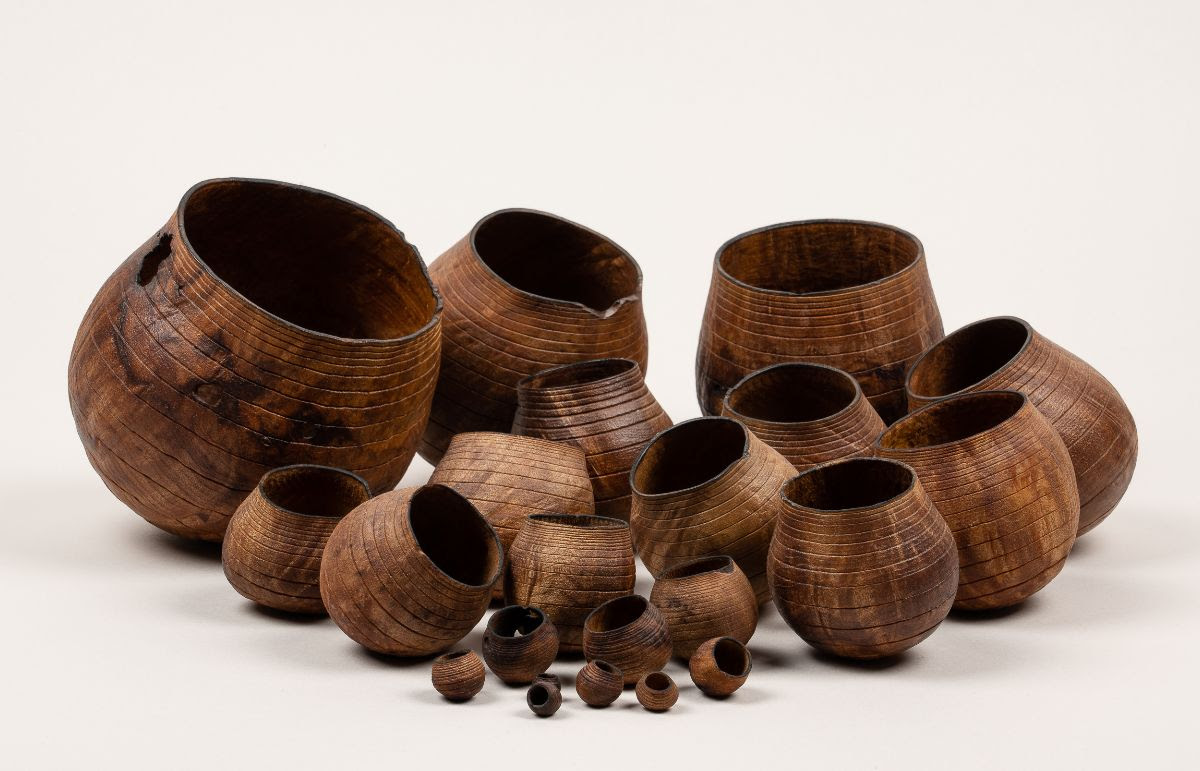
Natural Collector is organized by the Asheville Art Museum. IMAGE: Christian Burchard, Untitled (nesting bowls), 1998, madrone burl, various from 6 × 6 × 6 to ⅜ × ⅜ × ⅜ inches. Gift of Fleur S. Bresler, 2021.76.01.
Natural Collector | Gifts of Fleur S. Bresler features around 15 artworks from the collection of Fleur S. Bresler, which include important examples of modern and contemporary American craft including wood and fiber art, as well as glass and ceramics. These works that were generously donated by contemporary craft collector Bresler to the Asheville Art Museum over the years reflect her strong interest in wood-based art and themes of nature. According to Associate Curator Whitney Richardson, “This exhibition highlights artworks that consider the natural element from which they were created or replicate known flora and fauna in unexpected materials. The selection of objects displayed illustrates how Bresler’s eye for collecting craft not only draws attention to nature and artists’ interest in it, but also accentuates her role as a natural collector with an intuitive ability to identify themes and ideas that speak to one another.”
This exhibition presents work from the Collection representing the first generation of American wood turners like Rude Osolnik and Ed Moulthrop, as well as those that came after and learned from them, such as Philip Moulthrop, John Jordan, and local Western North Carolina (WNC) artist Stoney Lamar. Other WNC-based artists in Natural Collector include Anne Lemanski, whose paper sculpture of a snake captures the viewer’s imagination, and Michael Sherrill’s multimedia work that tricks the eye with its similarity to true-to-life berries. Also represented are beadwork and sculpture by Joyce J. Scott and Jack and Linda Fifield.
|
|
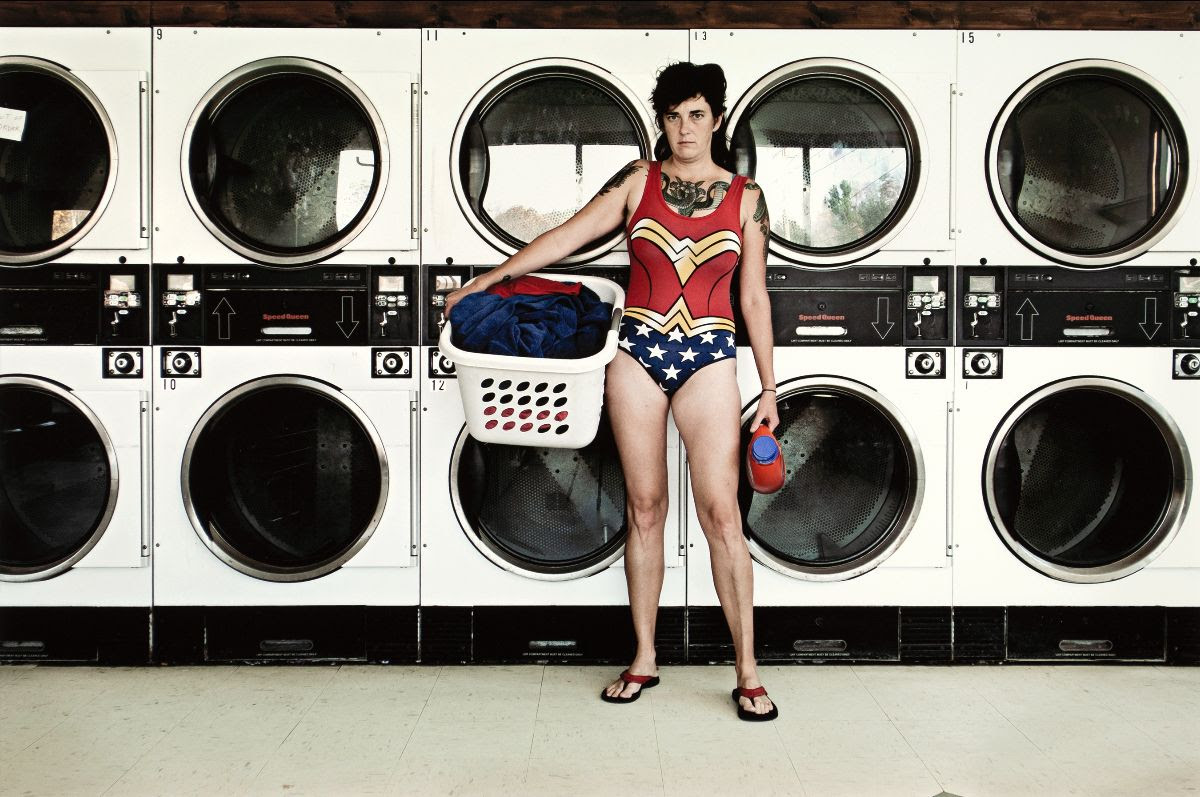
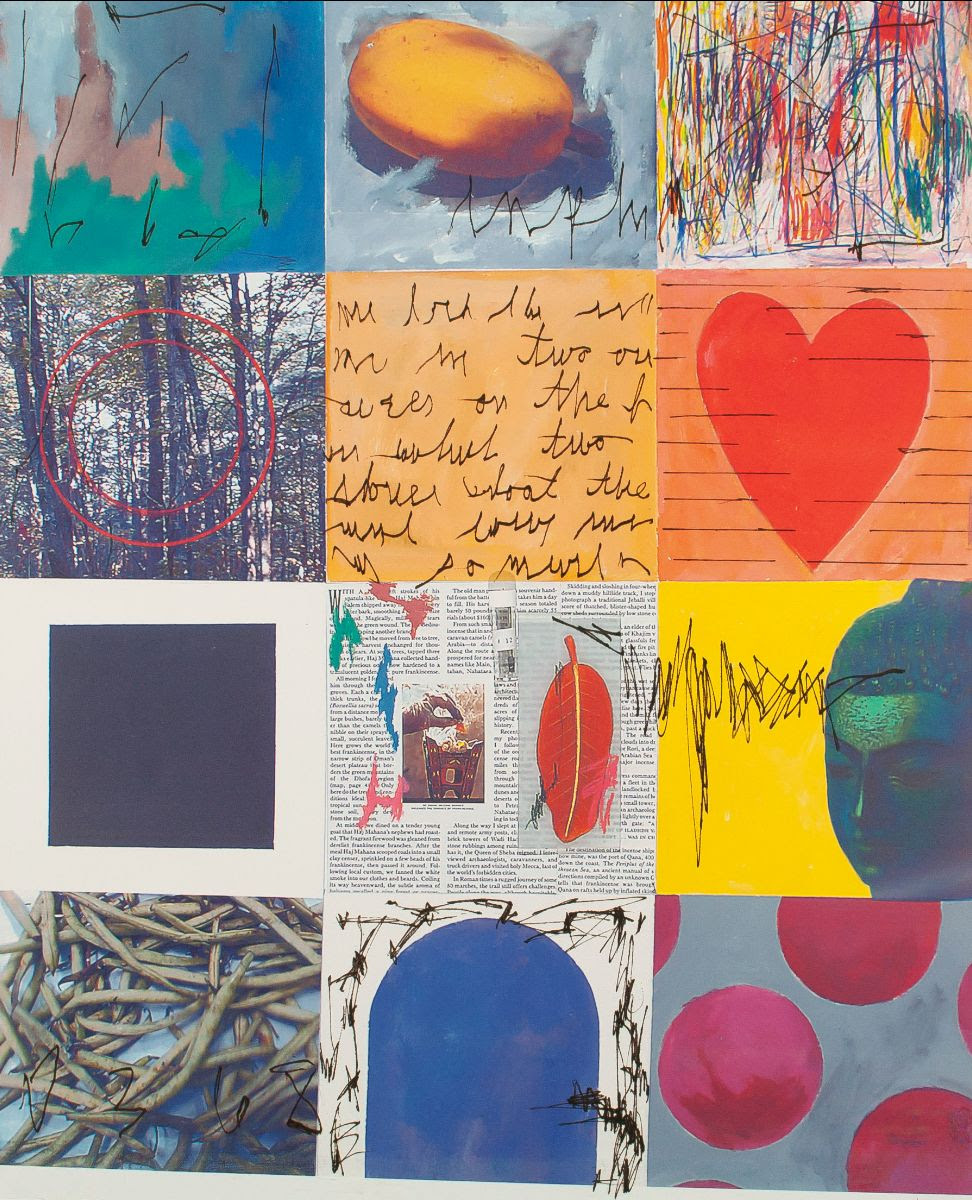
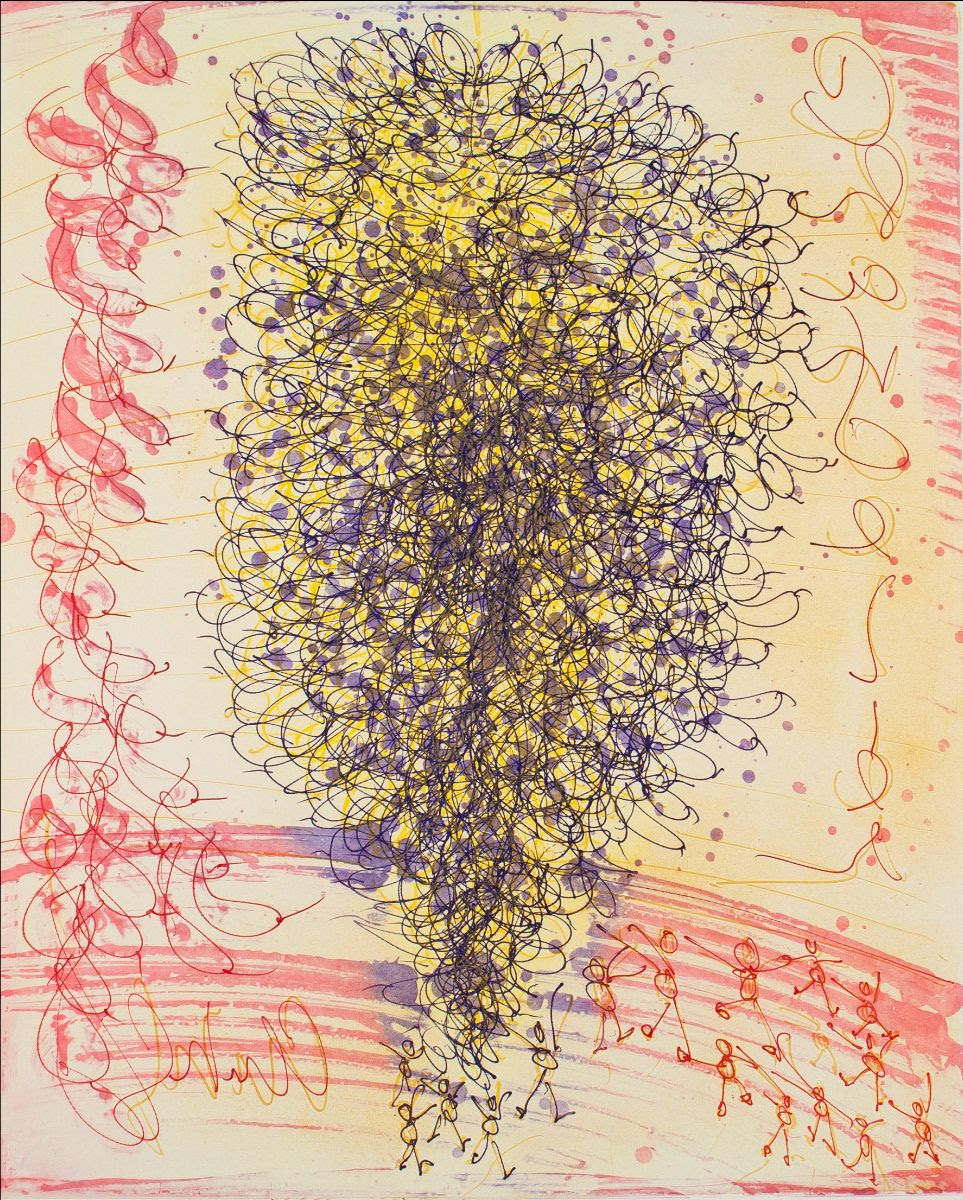
Rebel/Re-Belle: Exploring Gender, Agency, and Identity | Selections from the Asheville Art Museum and Rubell Museum combines works, primarily created by women, from two significant collections of contemporary art to explore how artists have innovated, influenced, interrogated, and inspired visual culture in the past 100 years.
|
|
|
|
|
TAPAAS is an arts-integration program that implements high quality artist residencies to create craft and performance experiences across all curriculum. Since 2010, TAPAAS has impacted more than 9,000 students, trained over 55 artists, and provided more than 850 days of artists in residence. Teachers report that 94% of TAPAAS residencies scored as ‘excellent’ in student enthusiasm and participation; student understanding of the curriculum was deeper when taught as a creative project, and there was increased parent engagement in the classroom. Now in its 11th year, TAPAAS has maintained the ability to be a cost-effective, far-reaching program with a profound impact on both individual artists and students in our community. In 2021, Asheville Area Arts Council partnered with the Asheville City Schools Foundation and the Buncombe County School District to expand programming into Buncombe County Schools– increasing the depth and breadth of this program.
|
TAPAAS for BCS EducatorsApply by November 18 | TAPAAS is an arts-integration program that implements high quality artist residencies to create craft and performance experiences across all curriculum. Since 2010, TAPAAS has impacted more than 9,000 students, trained over 55 artists, and provided more than 850 days of artists in residence. All teachers in the Buncombe County Schools district are welcome to apply — application opens October 17. |
Old Kentucky Home -The Thomas Wolfe Memorial
American Novelist Thomas Wolfe (1900-1938)
Considered by many to be one of the giants of 20th-century American literature, Thomas Wolfe immortalized his childhood home in his epic autobiographical novel, Look Homeward, Angel. Wolfe’s colorful portrayal of his family, his hometown of “Altamont” Asheville, North Carolina, and “Dixieland” the Old Kentucky Home boardinghouse, earned the Victorian period house a place as one of American literature’s most famous landmarks.
House tours are offered daily at half past each hour. Last tour leaves at 4:30 pm.
Group tours by reservation.
Adult – $5.00
Student (ages 7-17) – $2.00
Adult Group (10+) – $2.50 each
Student Group – $2.00 each
6 & under – Free
Hours of Operation
Limited Capacity: 12 Guests per Tour
A truly memorable experience featuring rare photo opportunities, this exclusive guided tour offers a behind-the-scenes look at the design and construction of Biltmore House in areas unavailable on the regular house visit. Imagine yourself a Vanderbilt (or cherished Vanderbilt guest) as you take in stunning views seen only from the house’s rooftop and balconies.
Advance reservation required. Tour includes 250 stairs with no elevator access. Wheelchairs, strollers, and baby backpacks are prohibited. Backpacks are not allowed on any guided tours. Guests are required to leave backpacks in a locker or in their vehicle. To participate in this tour, guest must have a daytime ticket, a Biltmore Annual Pass, or a stay at one of the estate’s splendid overnight properties.
The Fall Studio Tour Preview Exhibition opens in the Kokol Gallery, in Toe River Arts’ Spruce Pine location at 269 Oak Ave, October 29 and runs through the end December 2022. This exhibition gives visitors an opportunity to have a glimpse into each studio and plan their route. It’s also a great place to begin the tour or take a break from a day of non-stop art and artists.
There’s something breathtaking and awe-inspiring about driving through the mountains of western North Carolina in the Fall. The way the trees show off by turning vibrant shades of red, yellow, and orange before leaving bare branches to the crisp winds and snowy days of winter, reminds us that nature herself is the original artist.
For more than a quarter century, the Toe River Arts Studio Tour has intrigued those who make the journey to visit places of inspiration and creation. Situated between Roan Mountain which boasts the world’s largest rhododendron garden and Mt. Mitchell, the highest peak east of the Mississippi, the Toe River Arts Studio Tour is a free, self-guided journey of the arts. This arts adventure through Mitchell and Yancey Counties will take visitors along the meandering Toe River, across its many bridges, around barns, acres of fields and miles of forests all while visiting the 83 talented studio artists who often take inspiration from the mountains they call home and 8 galleries featuring local and international art.
It doesn’t matter if you live up the hill or across the state. The Studio Tour provides an adventure for the intrepid seeker of the art experience. Artist studios come in many iterations—the building off to the side of the house, or across the field or down the road or right off the main road or down a gravel one-lane. Two-stories with a gallery space or small and cozy with a table set up or cleared off for display. Still there are others that devote a corner to each artist sharing the space. Wherever and however they are set up, the studios are exciting places to visit because they demonstrate the dynamic process used to create a finished piece. Every artist has their own way of telling a story, inviting visitors to ask questions, hold their work, and share a moment.
The art is as diverse as the artists who create it and features the work of glassblowers, jewelers, printmakers, potters, fiber artists, ironworkers, painters, sculptors, and woodworkers.
Collage paintings, assemblages, textiles, & faux artifacts designed by Jean Hess to explore the 1920 WV mining labor dispute as metaphor for the human condition.
Three rooms are filled with an eclectic mix of collage paintings ranging in scale from 6×6” to 50×70”; 3-D assemblages and faux artifacts; hand-stitched textiles; documentation in the form of historic notes, catalog entries for a collection of ephemera, photographs.
Call 828-273-3332 for weekend hours or to make an appointment. Exhibits through November 30, 2022.
Flood Gallery Fine Art Center is a non-profit 501(c)3 organization, and educates, encourages, challenges and inspires the community through music, film, literary, and contemporary art.
“Matewan as Metaphor” is an experiment in artistic license. Mixed-media artist Jean Hess creates a personal story by combining real and imagined resources with the intention of healing her own memory and transcending limits on what is possible and allowed in creative and scholarly endeavors as well as in visual art. The 1920 mining labor dispute in Matewan, West Virginia, which involved her own family, stands for a full life and its adversities.
Matewan was, in 1920, the scene of an armed skirmish between coal miners, mining companies, local union officials and hired strike-breakers. Baldwin-Felts Detective Agency thugs hired by the coal operators traveled by train to cast striking miners and their families out of their homes. The local mayor and several Baldwin-Felts agents were killed. The chief of police, the Matewan mayor, and several other locals gathered at the train station to confront the hired guns about the unlawful evictions. The Baldwin-Felts agents refused to recognize the local authority, and a shootout ensued. The mayor, some miners, and several detectives were killed. This was one of many violent conflicts that took place in Southern WV between pro-union miners and men hired by coal companies to use force and intimidation to prevent miners from unionizing.
Jean Hess takes serious training in cultural anthropology and visual art to playful levels. Her mixed-media paintings and constructions come from personal memory and nostalgia, ancestral ties and historical fact. Mining illustrations and maps signify coal mining in early twentieth century Appalachia, as well as issues concerning extractive industries, population displacement, exploitative labor practices, suffering and loss. Using collage, paint, layered resins and found ephemera Hess experiments with myriad ways one can obfuscate, surprise and entice. Found imagery is from geography and history textbooks from the early 1900’s and before. Dimensional objects are from her family or found in junk shops over time. Much of her material may be deconstructed, obscured, scrambled or carefully embellished.
Jean Hess’ multi-variant creative output segues with an equally unpredictable life. She has lived in Washington, DC, Baltimore, Albuquerque, Santa Fe and Abiquiu, New Mexico as well as Atlanta, Dallas and now Knoxville, Tennessee. Her work-for-pay background includes stints as a computer programmer, Montessori teacher, museum registrar, writer and research consultant for government and private industry. With degrees [BA, MA] in cultural anthropology she tends to draw inspiration from wide-ranging interests, and not always according to established rules.
Hess is well-known for experimental mixed-media collage paintings and assemblages that combine the skillful use of layered paint and resins, light refraction and found materials such as antique ephemera and pressed plants. Because her palette, surface and touch are consistent, one can always tell a work of art is hers. And yet Hess likes surprises, plays with materials that are sometimes unfamiliar, operates in a controlled-experiment spirit and likes accidental detours that energize her work. While she took some undergraduate art courses she is largely self-taught.
Public collections include: Huntsville Museum of Art; Evansville Museum of Art, History and Science; Knoxville Museum of Art; University of Virginia; Farm Credit Administration; Knoxville Convention Center; City of Chattanooga; St. Mary’s Hospital Heart Institute [IN]; Canon USA.
Jean Hess is proud that much of her work is in private collections, cared for by sympathetic individuals.
Natural Collector is organized by the Asheville Art Museum. IMAGE: Christian Burchard, Untitled (nesting bowls), 1998, madrone burl, various from 6 × 6 × 6 to ⅜ × ⅜ × ⅜ inches. Gift of Fleur S. Bresler, 2021.76.01.
Natural Collector | Gifts of Fleur S. Bresler features around 15 artworks from the collection of Fleur S. Bresler, which include important examples of modern and contemporary American craft including wood and fiber art, as well as glass and ceramics. These works that were generously donated by contemporary craft collector Bresler to the Asheville Art Museum over the years reflect her strong interest in wood-based art and themes of nature. According to Associate Curator Whitney Richardson, “This exhibition highlights artworks that consider the natural element from which they were created or replicate known flora and fauna in unexpected materials. The selection of objects displayed illustrates how Bresler’s eye for collecting craft not only draws attention to nature and artists’ interest in it, but also accentuates her role as a natural collector with an intuitive ability to identify themes and ideas that speak to one another.”
This exhibition presents work from the Collection representing the first generation of American wood turners like Rude Osolnik and Ed Moulthrop, as well as those that came after and learned from them, such as Philip Moulthrop, John Jordan, and local Western North Carolina (WNC) artist Stoney Lamar. Other WNC-based artists in Natural Collector include Anne Lemanski, whose paper sculpture of a snake captures the viewer’s imagination, and Michael Sherrill’s multimedia work that tricks the eye with its similarity to true-to-life berries. Also represented are beadwork and sculpture by Joyce J. Scott and Jack and Linda Fifield.
|
|
Rebel/Re-Belle: Exploring Gender, Agency, and Identity | Selections from the Asheville Art Museum and Rubell Museum combines works, primarily created by women, from two significant collections of contemporary art to explore how artists have innovated, influenced, interrogated, and inspired visual culture in the past 100 years.
|
|
|
|
|
Imagine a solid trivia stack with a magnetic host in an outdoor intimate setting. Then add the excitement of BYOB and pedaling around the City on a one-of-a-kind contraption.
Kinda like if Willy Wonka did Trivia… you will be completely entertained, with no sense left unfulfilled.
And come back for more as we have several questions sets available with a good ole just for locals option!
Trivia tours seat up to 15 people, 1.5 or 40 mins hours long. Bring your own beer in cans or wine and your thinking while drinking caps on let’s do this thing!
Drop into our studio to experiment freely and collaborate using different materials, tools, and techniques! Visit a chosen artwork in the galleries for inspiration, then head to the studio to create. All ages and abilities are welcome (children must be accompanied by an adult); no reservations are required.
This month, participants will work with local artist Aspen Johnston. Working with recycled materials, come experiment with wire sculpture, recycled materials, and hot glue, to express your unique inner animal turning what we view as “trash” into art.
Make sure to check out our newest exhibition, Rebel/Re-Belle for inspiration for the upcycled MakerSpace.
Please note:
- In accordance with Buncombe County and city directives, a limited number of people can be in the studio at one time. To ensure all participants have time to create, we may ask you to limit your time.
TAPAAS is an arts-integration program that implements high quality artist residencies to create craft and performance experiences across all curriculum. Since 2010, TAPAAS has impacted more than 9,000 students, trained over 55 artists, and provided more than 850 days of artists in residence. Teachers report that 94% of TAPAAS residencies scored as ‘excellent’ in student enthusiasm and participation; student understanding of the curriculum was deeper when taught as a creative project, and there was increased parent engagement in the classroom. Now in its 11th year, TAPAAS has maintained the ability to be a cost-effective, far-reaching program with a profound impact on both individual artists and students in our community. In 2021, Asheville Area Arts Council partnered with the Asheville City Schools Foundation and the Buncombe County School District to expand programming into Buncombe County Schools– increasing the depth and breadth of this program.
|
TAPAAS for BCS EducatorsApply by November 18 | TAPAAS is an arts-integration program that implements high quality artist residencies to create craft and performance experiences across all curriculum. Since 2010, TAPAAS has impacted more than 9,000 students, trained over 55 artists, and provided more than 850 days of artists in residence. All teachers in the Buncombe County Schools district are welcome to apply — application opens October 17. |
Old Kentucky Home -The Thomas Wolfe Memorial
American Novelist Thomas Wolfe (1900-1938)
Considered by many to be one of the giants of 20th-century American literature, Thomas Wolfe immortalized his childhood home in his epic autobiographical novel, Look Homeward, Angel. Wolfe’s colorful portrayal of his family, his hometown of “Altamont” Asheville, North Carolina, and “Dixieland” the Old Kentucky Home boardinghouse, earned the Victorian period house a place as one of American literature’s most famous landmarks.
House tours are offered daily at half past each hour. Last tour leaves at 4:30 pm.
Group tours by reservation.
Adult – $5.00
Student (ages 7-17) – $2.00
Adult Group (10+) – $2.50 each
Student Group – $2.00 each
6 & under – Free
Hours of Operation

IT’S BEGINNING TO LOOK A LOT LIKE CHRISTMAS HERE IN THE BEAUTIFUL WESTERN NORTH CAROLINA MOUNTAINS.
Limited Capacity: 12 Guests per Tour
A truly memorable experience featuring rare photo opportunities, this exclusive guided tour offers a behind-the-scenes look at the design and construction of Biltmore House in areas unavailable on the regular house visit. Imagine yourself a Vanderbilt (or cherished Vanderbilt guest) as you take in stunning views seen only from the house’s rooftop and balconies.
Advance reservation required. Tour includes 250 stairs with no elevator access. Wheelchairs, strollers, and baby backpacks are prohibited. Backpacks are not allowed on any guided tours. Guests are required to leave backpacks in a locker or in their vehicle. To participate in this tour, guest must have a daytime ticket, a Biltmore Annual Pass, or a stay at one of the estate’s splendid overnight properties.
The Fall Studio Tour Preview Exhibition opens in the Kokol Gallery, in Toe River Arts’ Spruce Pine location at 269 Oak Ave, October 29 and runs through the end December 2022. This exhibition gives visitors an opportunity to have a glimpse into each studio and plan their route. It’s also a great place to begin the tour or take a break from a day of non-stop art and artists.
There’s something breathtaking and awe-inspiring about driving through the mountains of western North Carolina in the Fall. The way the trees show off by turning vibrant shades of red, yellow, and orange before leaving bare branches to the crisp winds and snowy days of winter, reminds us that nature herself is the original artist.
For more than a quarter century, the Toe River Arts Studio Tour has intrigued those who make the journey to visit places of inspiration and creation. Situated between Roan Mountain which boasts the world’s largest rhododendron garden and Mt. Mitchell, the highest peak east of the Mississippi, the Toe River Arts Studio Tour is a free, self-guided journey of the arts. This arts adventure through Mitchell and Yancey Counties will take visitors along the meandering Toe River, across its many bridges, around barns, acres of fields and miles of forests all while visiting the 83 talented studio artists who often take inspiration from the mountains they call home and 8 galleries featuring local and international art.
It doesn’t matter if you live up the hill or across the state. The Studio Tour provides an adventure for the intrepid seeker of the art experience. Artist studios come in many iterations—the building off to the side of the house, or across the field or down the road or right off the main road or down a gravel one-lane. Two-stories with a gallery space or small and cozy with a table set up or cleared off for display. Still there are others that devote a corner to each artist sharing the space. Wherever and however they are set up, the studios are exciting places to visit because they demonstrate the dynamic process used to create a finished piece. Every artist has their own way of telling a story, inviting visitors to ask questions, hold their work, and share a moment.
The art is as diverse as the artists who create it and features the work of glassblowers, jewelers, printmakers, potters, fiber artists, ironworkers, painters, sculptors, and woodworkers.
Collage paintings, assemblages, textiles, & faux artifacts designed by Jean Hess to explore the 1920 WV mining labor dispute as metaphor for the human condition.
Three rooms are filled with an eclectic mix of collage paintings ranging in scale from 6×6” to 50×70”; 3-D assemblages and faux artifacts; hand-stitched textiles; documentation in the form of historic notes, catalog entries for a collection of ephemera, photographs.
Call 828-273-3332 for weekend hours or to make an appointment. Exhibits through November 30, 2022.
Flood Gallery Fine Art Center is a non-profit 501(c)3 organization, and educates, encourages, challenges and inspires the community through music, film, literary, and contemporary art.
“Matewan as Metaphor” is an experiment in artistic license. Mixed-media artist Jean Hess creates a personal story by combining real and imagined resources with the intention of healing her own memory and transcending limits on what is possible and allowed in creative and scholarly endeavors as well as in visual art. The 1920 mining labor dispute in Matewan, West Virginia, which involved her own family, stands for a full life and its adversities.
Matewan was, in 1920, the scene of an armed skirmish between coal miners, mining companies, local union officials and hired strike-breakers. Baldwin-Felts Detective Agency thugs hired by the coal operators traveled by train to cast striking miners and their families out of their homes. The local mayor and several Baldwin-Felts agents were killed. The chief of police, the Matewan mayor, and several other locals gathered at the train station to confront the hired guns about the unlawful evictions. The Baldwin-Felts agents refused to recognize the local authority, and a shootout ensued. The mayor, some miners, and several detectives were killed. This was one of many violent conflicts that took place in Southern WV between pro-union miners and men hired by coal companies to use force and intimidation to prevent miners from unionizing.
Jean Hess takes serious training in cultural anthropology and visual art to playful levels. Her mixed-media paintings and constructions come from personal memory and nostalgia, ancestral ties and historical fact. Mining illustrations and maps signify coal mining in early twentieth century Appalachia, as well as issues concerning extractive industries, population displacement, exploitative labor practices, suffering and loss. Using collage, paint, layered resins and found ephemera Hess experiments with myriad ways one can obfuscate, surprise and entice. Found imagery is from geography and history textbooks from the early 1900’s and before. Dimensional objects are from her family or found in junk shops over time. Much of her material may be deconstructed, obscured, scrambled or carefully embellished.
Jean Hess’ multi-variant creative output segues with an equally unpredictable life. She has lived in Washington, DC, Baltimore, Albuquerque, Santa Fe and Abiquiu, New Mexico as well as Atlanta, Dallas and now Knoxville, Tennessee. Her work-for-pay background includes stints as a computer programmer, Montessori teacher, museum registrar, writer and research consultant for government and private industry. With degrees [BA, MA] in cultural anthropology she tends to draw inspiration from wide-ranging interests, and not always according to established rules.
Hess is well-known for experimental mixed-media collage paintings and assemblages that combine the skillful use of layered paint and resins, light refraction and found materials such as antique ephemera and pressed plants. Because her palette, surface and touch are consistent, one can always tell a work of art is hers. And yet Hess likes surprises, plays with materials that are sometimes unfamiliar, operates in a controlled-experiment spirit and likes accidental detours that energize her work. While she took some undergraduate art courses she is largely self-taught.
Public collections include: Huntsville Museum of Art; Evansville Museum of Art, History and Science; Knoxville Museum of Art; University of Virginia; Farm Credit Administration; Knoxville Convention Center; City of Chattanooga; St. Mary’s Hospital Heart Institute [IN]; Canon USA.
Jean Hess is proud that much of her work is in private collections, cared for by sympathetic individuals.