MATCHES
- A generous, anonymous gift will match all donations up to $5,000.
Ad Blocker Detected
It looks like you're using ad blocking technology. We are a local company, and our advertisers are local as well. Please consider allow listing our website in the future.
Upcoming events and things to do in Asheville, NC. Below is a list of events for festivals, concerts, art exhibitions, group meetups and more.
Interested in adding an event to our calendar? Please click the green “Post Your Event” button below.

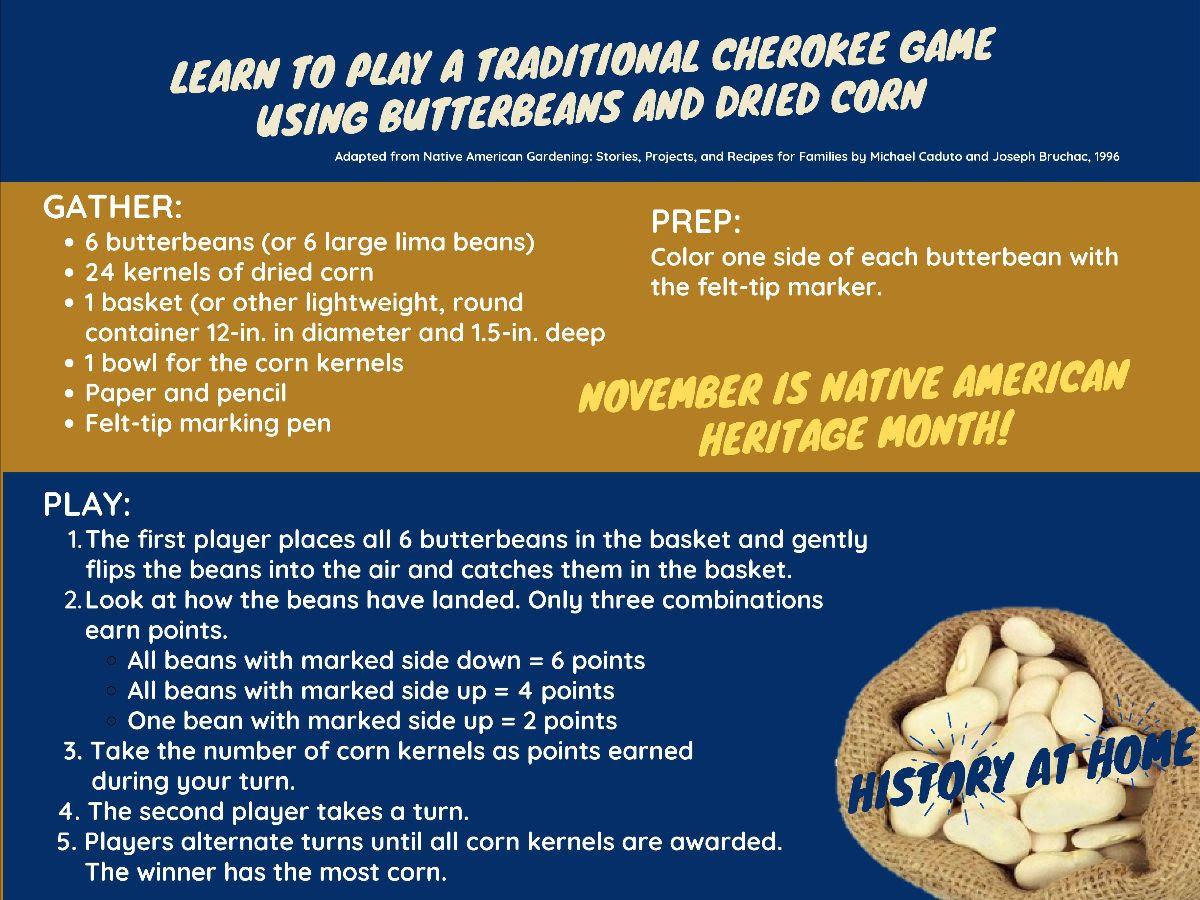
This is a variation on the tradition Cherokee Butterbean Game. It can be played by several individual players or several teams. Traditionally, this game uses three butterbeans that have been split in half. More…
From the Museum of the Cherokee Indian: Cherokee people began growing a form of corn two thousand years ago. By about a thousand years ago, or 1000 AD, they were growing corn and beans, as we know them today. Corn, beans, and squash was always grown together and was known as the “Three Sisters.” Beans restore nitrogen to the soil while corn depletes nitrogen. The vines of the beans and squash twined up the cornstalks. When corn and beans are eaten together, they provide complete proteins and amino acids for our diet.
Corn was so important to the Cherokee that they had important celebrations and ceremonies called “Green Corn Festivals.” The first of these was held in August, before the sweet corn was ready to eat. The last was held in October or November, when the
field corn was ready to be picked. At these ceremonies, people purified themselves physically and spiritually before feasting together. At this time, people got married and divorced. All old scores were settled and everyone started a new year together.

This is a variation on the tradition Cherokee Butterbean Game. It can be played by several individual players or several teams. Traditionally, this game uses three butterbeans that have been split in half. More…
From the Museum of the Cherokee Indian: Cherokee people began growing a form of corn two thousand years ago. By about a thousand years ago, or 1000 AD, they were growing corn and beans, as we know them today. Corn, beans, and squash was always grown together and was known as the “Three Sisters.” Beans restore nitrogen to the soil while corn depletes nitrogen. The vines of the beans and squash twined up the cornstalks. When corn and beans are eaten together, they provide complete proteins and amino acids for our diet.
Corn was so important to the Cherokee that they had important celebrations and ceremonies called “Green Corn Festivals.” The first of these was held in August, before the sweet corn was ready to eat. The last was held in October or November, when the
field corn was ready to be picked. At these ceremonies, people purified themselves physically and spiritually before feasting together. At this time, people got married and divorced. All old scores were settled and everyone started a new year together.

This is a variation on the tradition Cherokee Butterbean Game. It can be played by several individual players or several teams. Traditionally, this game uses three butterbeans that have been split in half. More…
From the Museum of the Cherokee Indian: Cherokee people began growing a form of corn two thousand years ago. By about a thousand years ago, or 1000 AD, they were growing corn and beans, as we know them today. Corn, beans, and squash was always grown together and was known as the “Three Sisters.” Beans restore nitrogen to the soil while corn depletes nitrogen. The vines of the beans and squash twined up the cornstalks. When corn and beans are eaten together, they provide complete proteins and amino acids for our diet.
Corn was so important to the Cherokee that they had important celebrations and ceremonies called “Green Corn Festivals.” The first of these was held in August, before the sweet corn was ready to eat. The last was held in October or November, when the
field corn was ready to be picked. At these ceremonies, people purified themselves physically and spiritually before feasting together. At this time, people got married and divorced. All old scores were settled and everyone started a new year together.

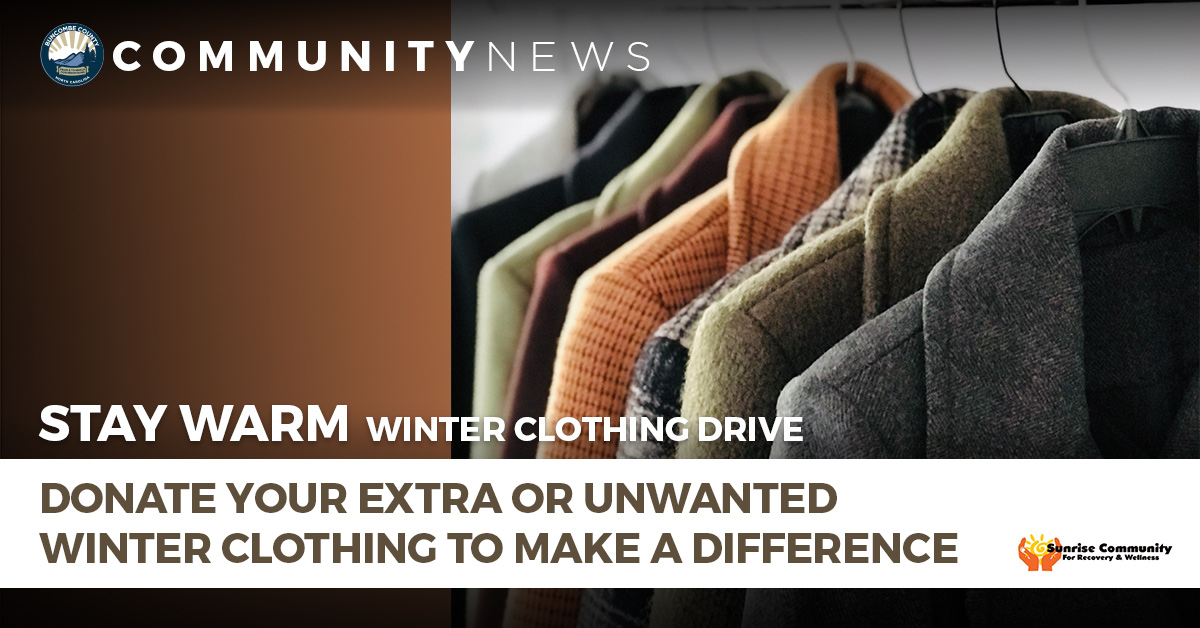
Is it time to give your winter wardrobe an upgrade? Do you have more winter clothing than you want or need? Are some of your winter clothes too small or too big? If you answered yes to any of these questions, consider donating your extra or unwanted winter clothing items to the Stay Warm Winter Clothing Drive hosted by Buncombe County Health and Human Services in partnership with Sunrise Community for Recovery and Wellness.
Donations will be accepted Nov. 1-30, Monday-Friday from noon-4 p.m. in our Syringe Service Program (Disease Control) located at 40 Coxe Ave. We will accept gently used donations of the following items:
For your safety and ours, we are offering no contact donation drop off. We have donation bins located at The Syringe Service Program (Disease Control). Donations will be collected daily by our Harm Reduction Coordinator, cleaned, and prepared to be distributed to clients in need of warm clothing this winter.

Is it time to give your winter wardrobe an upgrade? Do you have more winter clothing than you want or need? Are some of your winter clothes too small or too big? If you answered yes to any of these questions, consider donating your extra or unwanted winter clothing items to the Stay Warm Winter Clothing Drive hosted by Buncombe County Health and Human Services in partnership with Sunrise Community for Recovery and Wellness.
Donations will be accepted Nov. 1-30, Monday-Friday from noon-4 p.m. in our Syringe Service Program (Disease Control) located at 40 Coxe Ave. We will accept gently used donations of the following items:
For your safety and ours, we are offering no contact donation drop off. We have donation bins located at The Syringe Service Program (Disease Control). Donations will be collected daily by our Harm Reduction Coordinator, cleaned, and prepared to be distributed to clients in need of warm clothing this winter.

Is it time to give your winter wardrobe an upgrade? Do you have more winter clothing than you want or need? Are some of your winter clothes too small or too big? If you answered yes to any of these questions, consider donating your extra or unwanted winter clothing items to the Stay Warm Winter Clothing Drive hosted by Buncombe County Health and Human Services in partnership with Sunrise Community for Recovery and Wellness.
Donations will be accepted Nov. 1-30, Monday-Friday from noon-4 p.m. in our Syringe Service Program (Disease Control) located at 40 Coxe Ave. We will accept gently used donations of the following items:
For your safety and ours, we are offering no contact donation drop off. We have donation bins located at The Syringe Service Program (Disease Control). Donations will be collected daily by our Harm Reduction Coordinator, cleaned, and prepared to be distributed to clients in need of warm clothing this winter.

Is it time to give your winter wardrobe an upgrade? Do you have more winter clothing than you want or need? Are some of your winter clothes too small or too big? If you answered yes to any of these questions, consider donating your extra or unwanted winter clothing items to the Stay Warm Winter Clothing Drive hosted by Buncombe County Health and Human Services in partnership with Sunrise Community for Recovery and Wellness.
Donations will be accepted Nov. 1-30, Monday-Friday from noon-4 p.m. in our Syringe Service Program (Disease Control) located at 40 Coxe Ave. We will accept gently used donations of the following items:
For your safety and ours, we are offering no contact donation drop off. We have donation bins located at The Syringe Service Program (Disease Control). Donations will be collected daily by our Harm Reduction Coordinator, cleaned, and prepared to be distributed to clients in need of warm clothing this winter.

This is a variation on the tradition Cherokee Butterbean Game. It can be played by several individual players or several teams. Traditionally, this game uses three butterbeans that have been split in half. More…
From the Museum of the Cherokee Indian: Cherokee people began growing a form of corn two thousand years ago. By about a thousand years ago, or 1000 AD, they were growing corn and beans, as we know them today. Corn, beans, and squash was always grown together and was known as the “Three Sisters.” Beans restore nitrogen to the soil while corn depletes nitrogen. The vines of the beans and squash twined up the cornstalks. When corn and beans are eaten together, they provide complete proteins and amino acids for our diet.
Corn was so important to the Cherokee that they had important celebrations and ceremonies called “Green Corn Festivals.” The first of these was held in August, before the sweet corn was ready to eat. The last was held in October or November, when the
field corn was ready to be picked. At these ceremonies, people purified themselves physically and spiritually before feasting together. At this time, people got married and divorced. All old scores were settled and everyone started a new year together.

Is it time to give your winter wardrobe an upgrade? Do you have more winter clothing than you want or need? Are some of your winter clothes too small or too big? If you answered yes to any of these questions, consider donating your extra or unwanted winter clothing items to the Stay Warm Winter Clothing Drive hosted by Buncombe County Health and Human Services in partnership with Sunrise Community for Recovery and Wellness.
Donations will be accepted Nov. 1-30, Monday-Friday from noon-4 p.m. in our Syringe Service Program (Disease Control) located at 40 Coxe Ave. We will accept gently used donations of the following items:
For your safety and ours, we are offering no contact donation drop off. We have donation bins located at The Syringe Service Program (Disease Control). Donations will be collected daily by our Harm Reduction Coordinator, cleaned, and prepared to be distributed to clients in need of warm clothing this winter.

|

This is a variation on the tradition Cherokee Butterbean Game. It can be played by several individual players or several teams. Traditionally, this game uses three butterbeans that have been split in half. More…
From the Museum of the Cherokee Indian: Cherokee people began growing a form of corn two thousand years ago. By about a thousand years ago, or 1000 AD, they were growing corn and beans, as we know them today. Corn, beans, and squash was always grown together and was known as the “Three Sisters.” Beans restore nitrogen to the soil while corn depletes nitrogen. The vines of the beans and squash twined up the cornstalks. When corn and beans are eaten together, they provide complete proteins and amino acids for our diet.
Corn was so important to the Cherokee that they had important celebrations and ceremonies called “Green Corn Festivals.” The first of these was held in August, before the sweet corn was ready to eat. The last was held in October or November, when the
field corn was ready to be picked. At these ceremonies, people purified themselves physically and spiritually before feasting together. At this time, people got married and divorced. All old scores were settled and everyone started a new year together.

|

This is a variation on the tradition Cherokee Butterbean Game. It can be played by several individual players or several teams. Traditionally, this game uses three butterbeans that have been split in half. More…
From the Museum of the Cherokee Indian: Cherokee people began growing a form of corn two thousand years ago. By about a thousand years ago, or 1000 AD, they were growing corn and beans, as we know them today. Corn, beans, and squash was always grown together and was known as the “Three Sisters.” Beans restore nitrogen to the soil while corn depletes nitrogen. The vines of the beans and squash twined up the cornstalks. When corn and beans are eaten together, they provide complete proteins and amino acids for our diet.
Corn was so important to the Cherokee that they had important celebrations and ceremonies called “Green Corn Festivals.” The first of these was held in August, before the sweet corn was ready to eat. The last was held in October or November, when the
field corn was ready to be picked. At these ceremonies, people purified themselves physically and spiritually before feasting together. At this time, people got married and divorced. All old scores were settled and everyone started a new year together.

|

Is it time to give your winter wardrobe an upgrade? Do you have more winter clothing than you want or need? Are some of your winter clothes too small or too big? If you answered yes to any of these questions, consider donating your extra or unwanted winter clothing items to the Stay Warm Winter Clothing Drive hosted by Buncombe County Health and Human Services in partnership with Sunrise Community for Recovery and Wellness.
Donations will be accepted Nov. 1-30, Monday-Friday from noon-4 p.m. in our Syringe Service Program (Disease Control) located at 40 Coxe Ave. We will accept gently used donations of the following items:
For your safety and ours, we are offering no contact donation drop off. We have donation bins located at The Syringe Service Program (Disease Control). Donations will be collected daily by our Harm Reduction Coordinator, cleaned, and prepared to be distributed to clients in need of warm clothing this winter.

|

Is it time to give your winter wardrobe an upgrade? Do you have more winter clothing than you want or need? Are some of your winter clothes too small or too big? If you answered yes to any of these questions, consider donating your extra or unwanted winter clothing items to the Stay Warm Winter Clothing Drive hosted by Buncombe County Health and Human Services in partnership with Sunrise Community for Recovery and Wellness.
Donations will be accepted Nov. 1-30, Monday-Friday from noon-4 p.m. in our Syringe Service Program (Disease Control) located at 40 Coxe Ave. We will accept gently used donations of the following items:
For your safety and ours, we are offering no contact donation drop off. We have donation bins located at The Syringe Service Program (Disease Control). Donations will be collected daily by our Harm Reduction Coordinator, cleaned, and prepared to be distributed to clients in need of warm clothing this winter.

|

Is it time to give your winter wardrobe an upgrade? Do you have more winter clothing than you want or need? Are some of your winter clothes too small or too big? If you answered yes to any of these questions, consider donating your extra or unwanted winter clothing items to the Stay Warm Winter Clothing Drive hosted by Buncombe County Health and Human Services in partnership with Sunrise Community for Recovery and Wellness.
Donations will be accepted Nov. 1-30, Monday-Friday from noon-4 p.m. in our Syringe Service Program (Disease Control) located at 40 Coxe Ave. We will accept gently used donations of the following items:
For your safety and ours, we are offering no contact donation drop off. We have donation bins located at The Syringe Service Program (Disease Control). Donations will be collected daily by our Harm Reduction Coordinator, cleaned, and prepared to be distributed to clients in need of warm clothing this winter.

|
As with the book sales, everything at the bookstore is in excellent condition. Books are
shelved by author or subject so they are easy to find, and books are restocked
throughout the week. The store also sells CDs and DVDs.
The bookstore follows health guidelines. Anyone entering must wear a mask and
practice social distancing. Hand sanitizers are available. When the store is busy,
shopping is limited to 30 minutes.

Is it time to give your winter wardrobe an upgrade? Do you have more winter clothing than you want or need? Are some of your winter clothes too small or too big? If you answered yes to any of these questions, consider donating your extra or unwanted winter clothing items to the Stay Warm Winter Clothing Drive hosted by Buncombe County Health and Human Services in partnership with Sunrise Community for Recovery and Wellness.
Donations will be accepted Nov. 1-30, Monday-Friday from noon-4 p.m. in our Syringe Service Program (Disease Control) located at 40 Coxe Ave. We will accept gently used donations of the following items:
For your safety and ours, we are offering no contact donation drop off. We have donation bins located at The Syringe Service Program (Disease Control). Donations will be collected daily by our Harm Reduction Coordinator, cleaned, and prepared to be distributed to clients in need of warm clothing this winter.

Come play with us at the Museum’s next game night! Stop by the welcome desk or café counter to pick up some socially distanced fun activities for individuals, pairs, or small groups. No reservations needed.
Each third Thursday, the Museum and community partners offer fun events for adults to socialize through interactive art-related activities, delicious drinks, and tasty treats.
Generous support for this program is provided by Art Bridges.
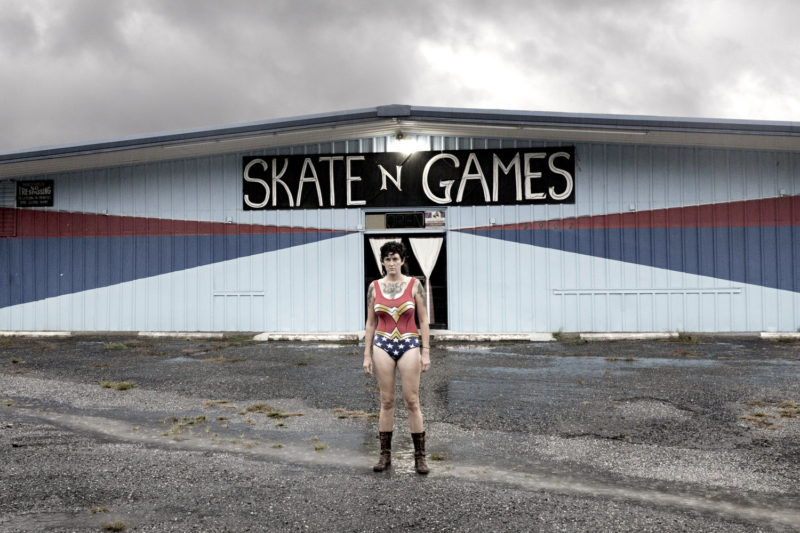
Cornwagon Thunder, SkateNGames from the Wonder Series, 2017, archival print on Epson Ultra Premium Presentation Matte paper, 10 × 15 inches. Museum purchase with funds provided by the 2019 Collectors’ Circle, 2020.02.01. © Cornwagon Thunder.

|

This is a variation on the tradition Cherokee Butterbean Game. It can be played by several individual players or several teams. Traditionally, this game uses three butterbeans that have been split in half. More…
From the Museum of the Cherokee Indian: Cherokee people began growing a form of corn two thousand years ago. By about a thousand years ago, or 1000 AD, they were growing corn and beans, as we know them today. Corn, beans, and squash was always grown together and was known as the “Three Sisters.” Beans restore nitrogen to the soil while corn depletes nitrogen. The vines of the beans and squash twined up the cornstalks. When corn and beans are eaten together, they provide complete proteins and amino acids for our diet.
Corn was so important to the Cherokee that they had important celebrations and ceremonies called “Green Corn Festivals.” The first of these was held in August, before the sweet corn was ready to eat. The last was held in October or November, when the
field corn was ready to be picked. At these ceremonies, people purified themselves physically and spiritually before feasting together. At this time, people got married and divorced. All old scores were settled and everyone started a new year together.
As with the book sales, everything at the bookstore is in excellent condition. Books are
shelved by author or subject so they are easy to find, and books are restocked
throughout the week. The store also sells CDs and DVDs.
The bookstore follows health guidelines. Anyone entering must wear a mask and
practice social distancing. Hand sanitizers are available. When the store is busy,
shopping is limited to 30 minutes.

Is it time to give your winter wardrobe an upgrade? Do you have more winter clothing than you want or need? Are some of your winter clothes too small or too big? If you answered yes to any of these questions, consider donating your extra or unwanted winter clothing items to the Stay Warm Winter Clothing Drive hosted by Buncombe County Health and Human Services in partnership with Sunrise Community for Recovery and Wellness.
Donations will be accepted Nov. 1-30, Monday-Friday from noon-4 p.m. in our Syringe Service Program (Disease Control) located at 40 Coxe Ave. We will accept gently used donations of the following items:
For your safety and ours, we are offering no contact donation drop off. We have donation bins located at The Syringe Service Program (Disease Control). Donations will be collected daily by our Harm Reduction Coordinator, cleaned, and prepared to be distributed to clients in need of warm clothing this winter.

The Fall Community Engagement Event is the one night a year when the community comes together in a fun, friendly competition to help raise awareness of our collective work to reduce the root causes and consequences of poverty. The event also serves as a call-to-action for both businesses and individuals to pledge their time and financial resources in support of the LIVE UNITED Fund.
Because of health concerns, this year’s event (The Carpool Karaoke Challenge) is being held virtually. Ten teams have pre-submitted their Carpool Karaoke videos, and each submission will be shown during the event. The kicker? This year you, the audience, will vote to decide 1st, 2nd, and 3rd place winners.
WHO: You, your friends, family, and neighbors
WHAT: United Way’s Carpool Karaoke Challenge Event
WHERE: Virtual
WHEN: Friday, November 20, 4:30 pm-5:45 pm
COST: FREE. You’ll also be eligible to win cash door-prizes just for attending
*Seating for this event is limited, so don’t wait, register below — you must register to attend the event. A link will be shared with registered attendees the day before the event and will allow you access.
This is the one virtual event you’ll actually want to attend this year! Ten teams, 10 Carpool Karaoke submissions, 1 champion: YOU DECIDE!


|

This is a variation on the tradition Cherokee Butterbean Game. It can be played by several individual players or several teams. Traditionally, this game uses three butterbeans that have been split in half. More…
From the Museum of the Cherokee Indian: Cherokee people began growing a form of corn two thousand years ago. By about a thousand years ago, or 1000 AD, they were growing corn and beans, as we know them today. Corn, beans, and squash was always grown together and was known as the “Three Sisters.” Beans restore nitrogen to the soil while corn depletes nitrogen. The vines of the beans and squash twined up the cornstalks. When corn and beans are eaten together, they provide complete proteins and amino acids for our diet.
Corn was so important to the Cherokee that they had important celebrations and ceremonies called “Green Corn Festivals.” The first of these was held in August, before the sweet corn was ready to eat. The last was held in October or November, when the
field corn was ready to be picked. At these ceremonies, people purified themselves physically and spiritually before feasting together. At this time, people got married and divorced. All old scores were settled and everyone started a new year together.