Upcoming events and things to do in Asheville, NC. Below is a list of events for festivals, concerts, art exhibitions, group meetups and more.

Interested in adding an event to our calendar? Please click the green “Post Your Event” button below.

Saturday, October 31, 2020
Leave it Better Sweepstake Eno + Explore Brevard
Oct 31 all-day
Online

LEAVE IT BETTER SWEEPSTAKES

Enter to win an ENO Leave No Trace Double Nest hammock and suspension system today! ENO and Explore Brevard are excited to partner in the effort to promote our new Leave It Better campaign. Entering is easy. Simply follow these steps and you’ll be automatically entered into the sweepstakes:


STEP 1
Follow ENO Hammocks and Explore Brevard on Instagram or Facebook.


Step 2
Post an example of how you Leave No Trace and go the extra step to Leave It Better on your own social media account with the hashtag #ILeaveItBetter


Step 3
Watch our social media accounts for winner announcements at the end of August, September and October!


Each month will have multiple winners so stay tuned.

See below for official contest rules and alternate form of entry.

 Guess Who: A Costume Quest In-person Outdoor
Oct 31 @ 6:00 pm – 9:00 pm
Asheville Community Theatre

We’re flipping the script on trick or treating this year! Guess Who: A Costume Quest is an outdoor walking tour and interactive game that features costumed actors from past ACT plays and musicals. Guess who’s who, and after you do, there’s a take-home bag of candy and treats for you! This family-friendly night of fun will be held in the parking lots and surrounding grounds of Asheville Community Theatre and the Thomas Wolfe House. Tours will begin at 6:00 pm and start times will be staggered to maintain social distancing.

How will this work? Chanda Calentine explains: “You’ll walk on a path around our building and will encounter 12 different characters along the way. They’ll each share a clue or two about themselves, and you’ll try to guess who they are and which show they’re from. These are recognizable characters from our family friendly shows, and even if you haven’t seen these shows at ACT, we think you’ll still be able to make a good guess! And, at the end of the tour, we’ll have treats for you to take home.

Sunday, November 1, 2020
Deep Remembering – 10 month Nature Immersion Program
Nov 1 all-day
Holistic Survival School

2021 Earth-Skills
Adult Immersion Course

With Nature-Connected Community
Led by Luke McLaughlin

Ten month program running March – December of 2021.

One, four-day weekend, per month.

Blue Ridge Mountains, near Asheville, North Carolina

(traditional Cherokee territory )

Monday, November 2, 2020
Deep Remembering – 10 month Nature Immersion Program
Nov 2 all-day
Holistic Survival School

2021 Earth-Skills
Adult Immersion Course

With Nature-Connected Community
Led by Luke McLaughlin

Ten month program running March – December of 2021.

One, four-day weekend, per month.

Blue Ridge Mountains, near Asheville, North Carolina

(traditional Cherokee territory )

Tuesday, November 3, 2020
History at Home: Play the Butter Bean Game!
Nov 3 all-day
Online

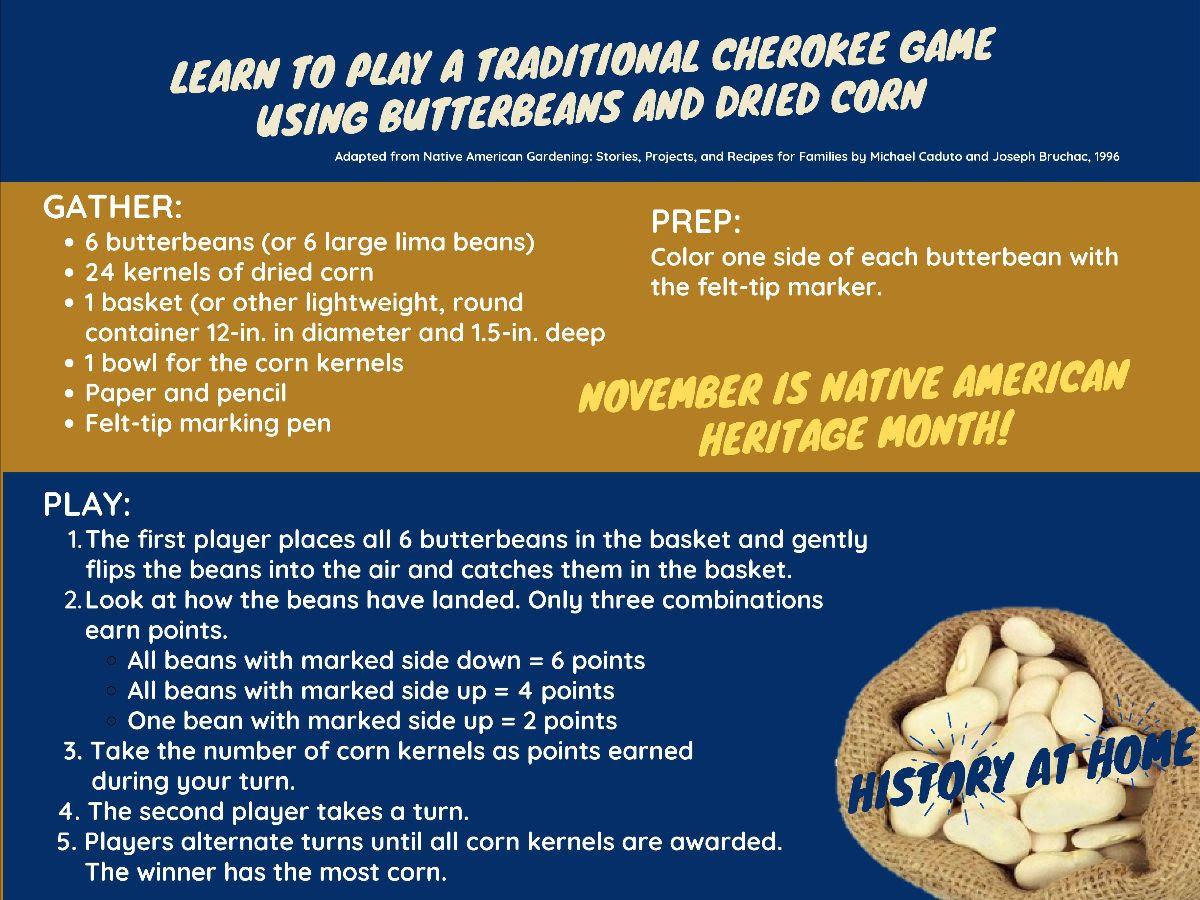
This is a variation on the tradition Cherokee Butterbean Game. It can be played by several individual players or several teams. Traditionally, this game uses three butterbeans that have been split in half. More…

From the Museum of the Cherokee Indian: Cherokee people began growing a form of corn two thousand years ago. By about a thousand years ago, or 1000 AD, they were growing corn and beans, as we know them today. Corn, beans, and squash was always grown together and was known as the “Three Sisters.” Beans restore nitrogen to the soil while corn depletes nitrogen. The vines of the beans and squash twined up the cornstalks. When corn and beans are eaten together, they provide complete proteins and amino acids for our diet.

Corn was so important to the Cherokee that they had important celebrations and ceremonies called “Green Corn Festivals.” The first of these was held in August, before the sweet corn was ready to eat. The last was held in October or November, when the
field corn was ready to be picked. At these ceremonies, people purified themselves physically and spiritually before feasting together. At this time, people got married and divorced. All old scores were settled and everyone started a new year together.

Wednesday, November 4, 2020
History at Home: Play the Butter Bean Game!
Nov 4 all-day
Online

This is a variation on the tradition Cherokee Butterbean Game. It can be played by several individual players or several teams. Traditionally, this game uses three butterbeans that have been split in half. More…

From the Museum of the Cherokee Indian: Cherokee people began growing a form of corn two thousand years ago. By about a thousand years ago, or 1000 AD, they were growing corn and beans, as we know them today. Corn, beans, and squash was always grown together and was known as the “Three Sisters.” Beans restore nitrogen to the soil while corn depletes nitrogen. The vines of the beans and squash twined up the cornstalks. When corn and beans are eaten together, they provide complete proteins and amino acids for our diet.

Corn was so important to the Cherokee that they had important celebrations and ceremonies called “Green Corn Festivals.” The first of these was held in August, before the sweet corn was ready to eat. The last was held in October or November, when the
field corn was ready to be picked. At these ceremonies, people purified themselves physically and spiritually before feasting together. At this time, people got married and divorced. All old scores were settled and everyone started a new year together.

Thursday, November 5, 2020
History at Home: Play the Butter Bean Game!
Nov 5 all-day
Online

This is a variation on the tradition Cherokee Butterbean Game. It can be played by several individual players or several teams. Traditionally, this game uses three butterbeans that have been split in half. More…

From the Museum of the Cherokee Indian: Cherokee people began growing a form of corn two thousand years ago. By about a thousand years ago, or 1000 AD, they were growing corn and beans, as we know them today. Corn, beans, and squash was always grown together and was known as the “Three Sisters.” Beans restore nitrogen to the soil while corn depletes nitrogen. The vines of the beans and squash twined up the cornstalks. When corn and beans are eaten together, they provide complete proteins and amino acids for our diet.

Corn was so important to the Cherokee that they had important celebrations and ceremonies called “Green Corn Festivals.” The first of these was held in August, before the sweet corn was ready to eat. The last was held in October or November, when the
field corn was ready to be picked. At these ceremonies, people purified themselves physically and spiritually before feasting together. At this time, people got married and divorced. All old scores were settled and everyone started a new year together.

Friday, November 6, 2020
Deep Remembering – 10 month Nature Immersion Program
Nov 6 all-day
Holistic Survival School

2021 Earth-Skills
Adult Immersion Course

With Nature-Connected Community
Led by Luke McLaughlin

Ten month program running March – December of 2021.

One, four-day weekend, per month.

Blue Ridge Mountains, near Asheville, North Carolina

(traditional Cherokee territory )

History at Home: Play the Butter Bean Game!
Nov 6 all-day
Online

This is a variation on the tradition Cherokee Butterbean Game. It can be played by several individual players or several teams. Traditionally, this game uses three butterbeans that have been split in half. More…

From the Museum of the Cherokee Indian: Cherokee people began growing a form of corn two thousand years ago. By about a thousand years ago, or 1000 AD, they were growing corn and beans, as we know them today. Corn, beans, and squash was always grown together and was known as the “Three Sisters.” Beans restore nitrogen to the soil while corn depletes nitrogen. The vines of the beans and squash twined up the cornstalks. When corn and beans are eaten together, they provide complete proteins and amino acids for our diet.

Corn was so important to the Cherokee that they had important celebrations and ceremonies called “Green Corn Festivals.” The first of these was held in August, before the sweet corn was ready to eat. The last was held in October or November, when the
field corn was ready to be picked. At these ceremonies, people purified themselves physically and spiritually before feasting together. At this time, people got married and divorced. All old scores were settled and everyone started a new year together.

Virtual Guest Teachers: Buddhism in the South
Nov 6 @ 7:00 pm – 8:15 pm
Online

Virtual Guest Teachers: Buddhism in the South

Friday Nights October 30 – November 20. 7pm ~ 8:15pm. Each talk will be available for one Week.

Modern Kadampa Buddhism is flourishing across the South, because folks have discovered that meditation is a powerful and practical method to maintain a peaceful mind no matter what.

Please join these Southern teachers from across NC, GA and SC (online)! They will share their love for meditation by offering practical advice and simple tips for finding happiness within our own good hearts.

You’re welcome to register for any individual week or the entire series at a discount. Individual weeks $10 each. Package $30, Discounts for Monthly Members.

October 30 Letting Go with Gen Tilopa from KMC North Carolina
November 6 What’s the Meaning of Life with Gen Norden from KMC Georgia
November 13 From Anger to Compassion with Kelsang Jangchen from KMC South Carolina
November 19 TBD: Ethan Lechner from Kosala Buddhist Center

Saturday, November 7, 2020
Deep Remembering – 10 month Nature Immersion Program
Nov 7 all-day
Holistic Survival School

2021 Earth-Skills
Adult Immersion Course

With Nature-Connected Community
Led by Luke McLaughlin

Ten month program running March – December of 2021.

One, four-day weekend, per month.

Blue Ridge Mountains, near Asheville, North Carolina

(traditional Cherokee territory )

Guided Hikes: Grandfather Mountain
Nov 7 all-day
Grandfather Mountain

Interpretive Rangers are available to lead guided hikes, bird walks and wildflower walks for families and groups that visit Grandfather Mountain. To see the mountain in this whole new way, you can schedule an appointment by calling the interpretive ranger office at (828) 737-0833 or emailing [email protected].

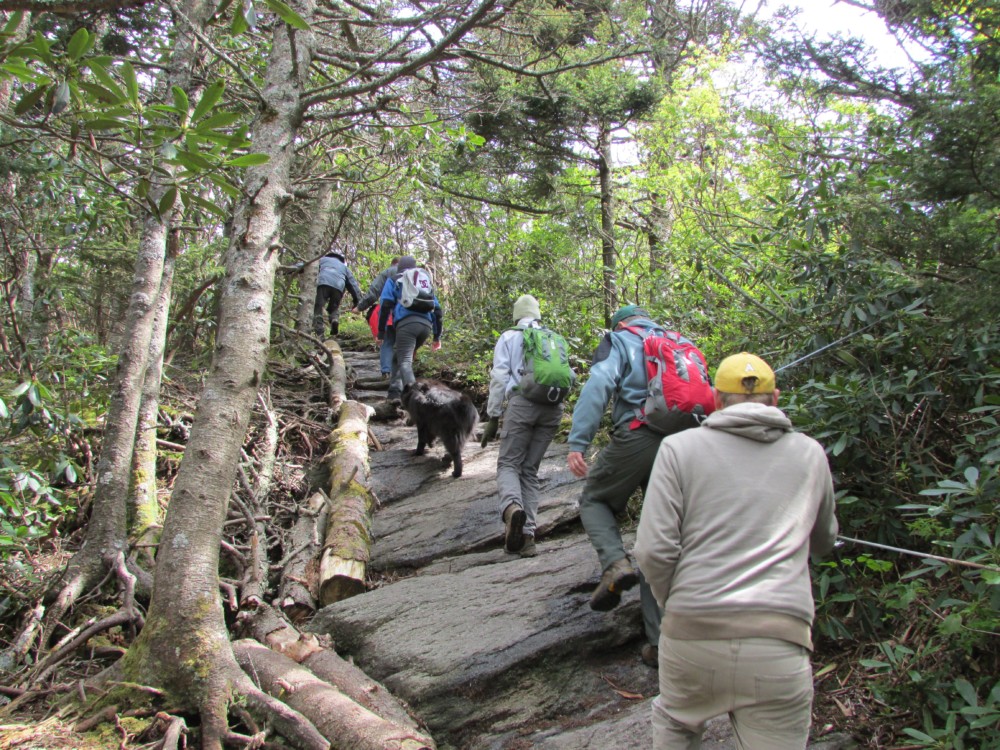
Please note that walks and hikes are available for all ability levels, but hikes that take you into Grandfather Mountain’s backcountry require careful footwork, proper footwear and the ability to handle heights. All backcountry hikes require participants to traverse ladders and use cables to navigate steep sections of the trail.

Interpretive Rangers are available year-round (weather permitting) to lead guided hikes to:

MacRae Peak ($15 + park admission)
Attic Window ($25 + park admission)
Calloway Peak ($35 + park admission)

Reservations must be made at least two weeks in advance, and a minimum of two participants per hike are required. For more information, please call (828) 737-0833.

History at Home: Play the Butter Bean Game!
Nov 7 all-day
Online

This is a variation on the tradition Cherokee Butterbean Game. It can be played by several individual players or several teams. Traditionally, this game uses three butterbeans that have been split in half. More…

From the Museum of the Cherokee Indian: Cherokee people began growing a form of corn two thousand years ago. By about a thousand years ago, or 1000 AD, they were growing corn and beans, as we know them today. Corn, beans, and squash was always grown together and was known as the “Three Sisters.” Beans restore nitrogen to the soil while corn depletes nitrogen. The vines of the beans and squash twined up the cornstalks. When corn and beans are eaten together, they provide complete proteins and amino acids for our diet.

Corn was so important to the Cherokee that they had important celebrations and ceremonies called “Green Corn Festivals.” The first of these was held in August, before the sweet corn was ready to eat. The last was held in October or November, when the
field corn was ready to be picked. At these ceremonies, people purified themselves physically and spiritually before feasting together. At this time, people got married and divorced. All old scores were settled and everyone started a new year together.

Chimney Rock State Park Naturalist Niche: Fall Ridge Hike
Nov 7 @ 9:30 am – 1:00 pm
Chimney Rock Park

The trails of Chimney Rock in the fall are amazing, but a guided hike off-the-beaten-path can lead you to places you never knew existed. Join us for this autumn adventure on one of our most popular excursions. You’ll discover seasonal changes along your trek that will introduce you to a whole new perspective of the Park. This hike is considered moderately strenuous. Space is limited for this, so book now.

Chimney Rock State Park Hike with a Naturalist
Nov 7 @ 11:00 am – 12:00 pm
Chimney Rock Park

Spend an hour hiking one of our six different trails with a Naturalist. This is educational excursion will give you a better understanding of the flora and fauna that can be found in the Park. You may even learn some of the Park’s history as well.

Sunday, November 8, 2020
History at Home: Play the Butter Bean Game!
Nov 8 all-day
Online

This is a variation on the tradition Cherokee Butterbean Game. It can be played by several individual players or several teams. Traditionally, this game uses three butterbeans that have been split in half. More…

From the Museum of the Cherokee Indian: Cherokee people began growing a form of corn two thousand years ago. By about a thousand years ago, or 1000 AD, they were growing corn and beans, as we know them today. Corn, beans, and squash was always grown together and was known as the “Three Sisters.” Beans restore nitrogen to the soil while corn depletes nitrogen. The vines of the beans and squash twined up the cornstalks. When corn and beans are eaten together, they provide complete proteins and amino acids for our diet.

Corn was so important to the Cherokee that they had important celebrations and ceremonies called “Green Corn Festivals.” The first of these was held in August, before the sweet corn was ready to eat. The last was held in October or November, when the
field corn was ready to be picked. At these ceremonies, people purified themselves physically and spiritually before feasting together. At this time, people got married and divorced. All old scores were settled and everyone started a new year together.

Friday, November 13, 2020
Deep Remembering – 10 month Nature Immersion Program
Nov 13 all-day
Holistic Survival School

2021 Earth-Skills
Adult Immersion Course

With Nature-Connected Community
Led by Luke McLaughlin

Ten month program running March – December of 2021.

One, four-day weekend, per month.

Blue Ridge Mountains, near Asheville, North Carolina

(traditional Cherokee territory )

History at Home: Play the Butter Bean Game!
Nov 13 all-day
Online

This is a variation on the tradition Cherokee Butterbean Game. It can be played by several individual players or several teams. Traditionally, this game uses three butterbeans that have been split in half. More…

From the Museum of the Cherokee Indian: Cherokee people began growing a form of corn two thousand years ago. By about a thousand years ago, or 1000 AD, they were growing corn and beans, as we know them today. Corn, beans, and squash was always grown together and was known as the “Three Sisters.” Beans restore nitrogen to the soil while corn depletes nitrogen. The vines of the beans and squash twined up the cornstalks. When corn and beans are eaten together, they provide complete proteins and amino acids for our diet.

Corn was so important to the Cherokee that they had important celebrations and ceremonies called “Green Corn Festivals.” The first of these was held in August, before the sweet corn was ready to eat. The last was held in October or November, when the
field corn was ready to be picked. At these ceremonies, people purified themselves physically and spiritually before feasting together. At this time, people got married and divorced. All old scores were settled and everyone started a new year together.

Virtual Guest Teachers: Buddhism in the South
Nov 13 @ 7:00 pm – 8:15 pm
Online

Virtual Guest Teachers: Buddhism in the South

Friday Nights October 30 – November 20. 7pm ~ 8:15pm. Each talk will be available for one Week.

Modern Kadampa Buddhism is flourishing across the South, because folks have discovered that meditation is a powerful and practical method to maintain a peaceful mind no matter what.

Please join these Southern teachers from across NC, GA and SC (online)! They will share their love for meditation by offering practical advice and simple tips for finding happiness within our own good hearts.

You’re welcome to register for any individual week or the entire series at a discount. Individual weeks $10 each. Package $30, Discounts for Monthly Members.

October 30 Letting Go with Gen Tilopa from KMC North Carolina
November 6 What’s the Meaning of Life with Gen Norden from KMC Georgia
November 13 From Anger to Compassion with Kelsang Jangchen from KMC South Carolina
November 19 TBD: Ethan Lechner from Kosala Buddhist Center

Saturday, November 14, 2020
Deep Remembering – 10 month Nature Immersion Program
Nov 14 all-day
Holistic Survival School

2021 Earth-Skills
Adult Immersion Course

With Nature-Connected Community
Led by Luke McLaughlin

Ten month program running March – December of 2021.

One, four-day weekend, per month.

Blue Ridge Mountains, near Asheville, North Carolina

(traditional Cherokee territory )

Guided Hikes: Grandfather Mountain
Nov 14 all-day
Grandfather Mountain

Interpretive Rangers are available to lead guided hikes, bird walks and wildflower walks for families and groups that visit Grandfather Mountain. To see the mountain in this whole new way, you can schedule an appointment by calling the interpretive ranger office at (828) 737-0833 or emailing [email protected].

Please note that walks and hikes are available for all ability levels, but hikes that take you into Grandfather Mountain’s backcountry require careful footwork, proper footwear and the ability to handle heights. All backcountry hikes require participants to traverse ladders and use cables to navigate steep sections of the trail.

Interpretive Rangers are available year-round (weather permitting) to lead guided hikes to:

MacRae Peak ($15 + park admission)
Attic Window ($25 + park admission)
Calloway Peak ($35 + park admission)

Reservations must be made at least two weeks in advance, and a minimum of two participants per hike are required. For more information, please call (828) 737-0833.

History at Home: Play the Butter Bean Game!
Nov 14 all-day
Online

This is a variation on the tradition Cherokee Butterbean Game. It can be played by several individual players or several teams. Traditionally, this game uses three butterbeans that have been split in half. More…

From the Museum of the Cherokee Indian: Cherokee people began growing a form of corn two thousand years ago. By about a thousand years ago, or 1000 AD, they were growing corn and beans, as we know them today. Corn, beans, and squash was always grown together and was known as the “Three Sisters.” Beans restore nitrogen to the soil while corn depletes nitrogen. The vines of the beans and squash twined up the cornstalks. When corn and beans are eaten together, they provide complete proteins and amino acids for our diet.

Corn was so important to the Cherokee that they had important celebrations and ceremonies called “Green Corn Festivals.” The first of these was held in August, before the sweet corn was ready to eat. The last was held in October or November, when the
field corn was ready to be picked. At these ceremonies, people purified themselves physically and spiritually before feasting together. At this time, people got married and divorced. All old scores were settled and everyone started a new year together.

Seven Sisters Peaks Hike
Nov 14 @ 8:00 am – 5:00 pm
Swannanoa Valley Museum & History Center

The Seven Sisters peaks are a familiar sight from Lake Tomahawk. While the Seven Sisters span an expanse of only 3.5 miles, hiking up to and across the range is a strenuous, 9.5-mile distance.  Along the way, hike leaders will share historical anecdotes about the peak’s nomenclature, social history, geography, and ecology. The hike has several panoramic views. This hike is recommended only for experienced hikers.

Difficulty: Strenuous, 9.5 miles; This will be a daylong hike across all seven peaks.

Before registering, please contact the Museum at 828-669-9566 or [email protected]. All participants must pass pre-screening by hike leader because of the difficulty of this hike.

Sunday, November 15, 2020
History at Home: Play the Butter Bean Game!
Nov 15 all-day
Online

This is a variation on the tradition Cherokee Butterbean Game. It can be played by several individual players or several teams. Traditionally, this game uses three butterbeans that have been split in half. More…

From the Museum of the Cherokee Indian: Cherokee people began growing a form of corn two thousand years ago. By about a thousand years ago, or 1000 AD, they were growing corn and beans, as we know them today. Corn, beans, and squash was always grown together and was known as the “Three Sisters.” Beans restore nitrogen to the soil while corn depletes nitrogen. The vines of the beans and squash twined up the cornstalks. When corn and beans are eaten together, they provide complete proteins and amino acids for our diet.

Corn was so important to the Cherokee that they had important celebrations and ceremonies called “Green Corn Festivals.” The first of these was held in August, before the sweet corn was ready to eat. The last was held in October or November, when the
field corn was ready to be picked. At these ceremonies, people purified themselves physically and spiritually before feasting together. At this time, people got married and divorced. All old scores were settled and everyone started a new year together.

Monday, November 16, 2020
Green Mother Activations
Nov 16 @ 11:00 am – 12:30 pm
Online

RECEIVE YOUR GREEN MOTHER LIGHT CODES!
Join us in this new series of Goddess Channeling and Alignment Circles that will occur every Monday at 11:00 am EST for 13 weeks beginning Sept 21st.

The GREEN MOTHER ACTIVATIONS are being transmitted specifically at this time in our evolution as a way to offer Divine Support to seekers throughout the current global paradigm shift. Through the Green Mother Activations, we will ground into a solid foundation of unity consciousness and power that will support and sustain us through times of uncertainty in our world.

Throughout this series of 13 Green Mother Activations, we receive deeper understandings and practical tools that dissolve fear and resistance to the ascension process. We awaken to our gifts and talents, new forms of expression we may not have had access to before. We can then move forward with ease and grace, navigating challenging emotions and experiences from an inner place of strength, clarity and alignment with GAIA. Instead of disconnecting from ourselves, which often feels like we are falling apart, we will choose to come into alignment with our own Divine Source.

Ana Estrada is a Quantum Light Practitioner with more than 25 years experience of working consciously with Beings of Light and Ascended Masters. Her graduate degrees in Transformative Art and Spirituality took her to the Amazon jungles and the temples of India where she studied shamanic cultures and visionary art making processes. She is certified as an Intuitive Energy Healer in various healing modalities and serves as a channel for the Divine Mother and her sacred Light Language. Ana offers Quantum Light Alignment Sessions privately and at sacred sites around the world.

For more information or to schedule a private Channeling and Alignment Session, please visit:
http://www.QuantumLightPractice.com/private-practice


Thursday, November 19, 2020
Third Thursday with Asheville Art Museum: Game Night
Nov 19 @ 6:00 pm – 9:00 pm
Asheville Art Museum

Come play with us at the Museum’s next game night! Stop by the welcome desk or café counter to pick up some socially distanced fun activities for individuals, pairs, or small groups. No reservations needed.

THIRD THURSDAYS

Each third Thursday, the Museum and community partners offer fun events for adults to socialize through interactive art-related activities, delicious drinks, and tasty treats.

Generous support for this program is provided by Art Bridges.

Cornwagon Thunder, SkateNGames from the Wonder Series, 2017, archival print on Epson Ultra Premium Presentation Matte paper, 10 × 15 inches. Museum purchase with funds provided by the 2019 Collectors’ Circle, 2020.02.01. © Cornwagon Thunder.


Friday, November 20, 2020
Deep Remembering – 10 month Nature Immersion Program
Nov 20 all-day
Holistic Survival School

2021 Earth-Skills
Adult Immersion Course

With Nature-Connected Community
Led by Luke McLaughlin

Ten month program running March – December of 2021.

One, four-day weekend, per month.

Blue Ridge Mountains, near Asheville, North Carolina

(traditional Cherokee territory )

History at Home: Play the Butter Bean Game!
Nov 20 all-day
Online

This is a variation on the tradition Cherokee Butterbean Game. It can be played by several individual players or several teams. Traditionally, this game uses three butterbeans that have been split in half. More…

From the Museum of the Cherokee Indian: Cherokee people began growing a form of corn two thousand years ago. By about a thousand years ago, or 1000 AD, they were growing corn and beans, as we know them today. Corn, beans, and squash was always grown together and was known as the “Three Sisters.” Beans restore nitrogen to the soil while corn depletes nitrogen. The vines of the beans and squash twined up the cornstalks. When corn and beans are eaten together, they provide complete proteins and amino acids for our diet.

Corn was so important to the Cherokee that they had important celebrations and ceremonies called “Green Corn Festivals.” The first of these was held in August, before the sweet corn was ready to eat. The last was held in October or November, when the
field corn was ready to be picked. At these ceremonies, people purified themselves physically and spiritually before feasting together. At this time, people got married and divorced. All old scores were settled and everyone started a new year together.

Carpool Karaoke Challenge
Nov 20 @ 4:30 pm – 5:45 pm
Online

                        Join us for the virtual event of the year:
United Way’s Carpool Karaoke Challenge

The Fall Community Engagement Event is the one night a year when the community comes together in a fun, friendly competition to help raise awareness of our collective work to reduce the root causes and consequences of poverty. The event also serves as a call-to-action for both businesses and individuals to pledge their time and financial resources in support of the LIVE UNITED Fund.

Because of health concerns, this year’s event (The Carpool Karaoke Challenge) is being held virtually. Ten teams have pre-submitted their Carpool Karaoke videos, and each submission will be shown during the event. The kicker? This year you, the audience, will vote to decide 1st, 2nd, and 3rd place winners. 

YOU’RE INVITED

WHO: You, your friends, family, and neighbors
WHAT: United Way’s Carpool Karaoke Challenge Event
WHERE: Virtual
WHEN: Friday, November 20, 4:30 pm-5:45 pm
COST: FREE. You’ll also be eligible to win cash door-prizes just for attending
*Seating for this event is limited, so don’t wait, register below — you must register to attend the event. A link will be shared with registered attendees the day before the event and will allow you access. 

This is the one virtual event you’ll actually want to attend this year! Ten teams, 10 Carpool Karaoke submissions, 1 champion: YOU DECIDE!

See What 2021 Will Bring–Benjamin Bernstein’s Annual Astrological Forecast
Nov 20 @ 7:00 pm – 9:00 pm
Online

See What 2021 Will Bring--Benjamin Bernstein's Annual Astrological Forecast

The astrology of 2020 has already turned the world upside down. So what can we expect in 2021?

AFOA founding member Benjamin Bernstein will give his annual forecast lecture via Zoom on Friday, November 20 at 7 PM US Eastern Time. This call may reach capacity, so consider joining 10 minutes early to guarantee your space. The Zoom info is at the end of this announcement.

Benjamin will put special focus on 2021’s headline event, a powerful Saturn-Uranus square that lasts the entire year. (One of its central themes will be the rapid breakdown of existing structures, as well as the quick rise of new ones.) He’ll also predict when this square’s effects will be most powerful, based on the timing of Mars-Saturn-Uranus T-squares and other catalyzing events.

Benjamin will also discuss the Jupiter-Saturn conjunction in the first degree of Aquarius on 12/21/20, and its continuing effects in 2021. Does the extraordinary timing of this Great Conjunction mark the true beginning of the Aquarian Age?

Additional topics will include Saturn in Aquarius and Jupiter in Aquarius and Pisces. We’ll also explore the 2021 eclipses and the surprising prominence of Vesta in 2021’s aspect patterns. Is it time to devote more time and energy to serving the greater good?