

Calendar of Events
Upcoming events and things to do in Asheville, NC. Below is a list of events for festivals, concerts, art exhibitions, group meetups and more.
Interested in adding an event to our calendar? Please click the green “Post Your Event” button below.
Tuesday, January
30, 2024
Consent Book Club
December – January Consent Book Club
Hybrid | Book Club Fair
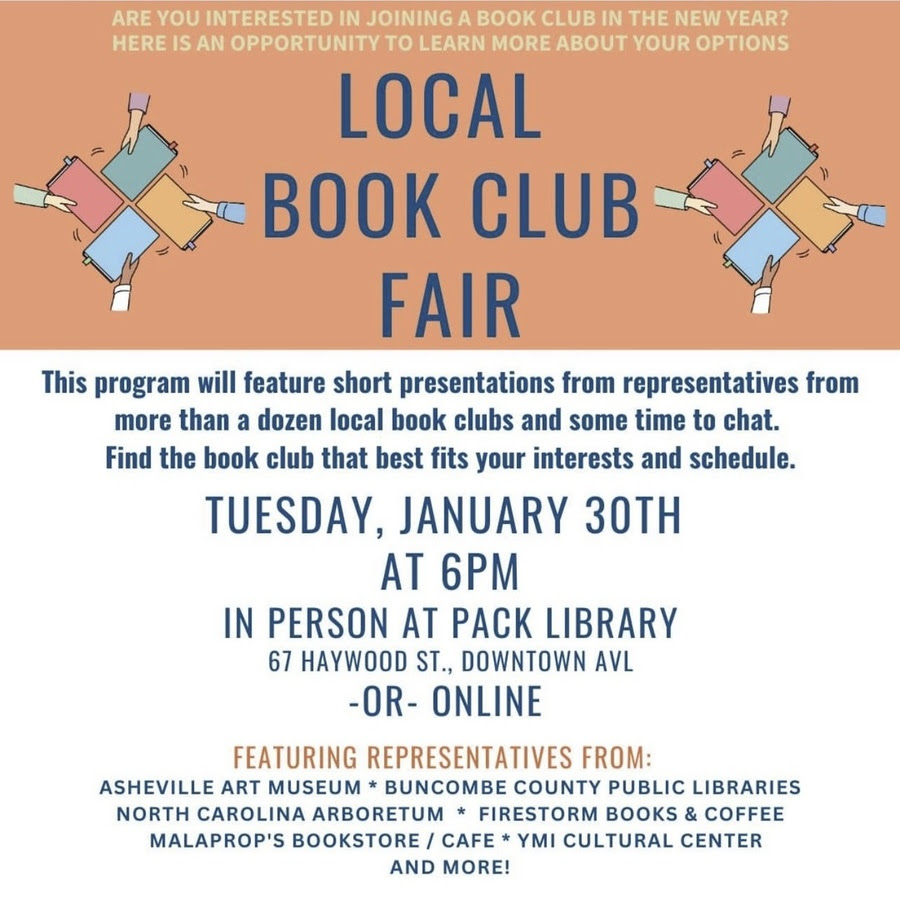
Local Book Club Fair
Mental Health + Wellness Series: Mindfulness
Register so we can reach out and contact you as we prepare for our first meeting! Books will be distributed at the first meeting. This book club is for adults 18+.
Meetings will be on Tuesday evenings from 5:30-7pm (meeting location will be emailed once attendance is finalized)
Below are all the meeting dates:
December 5th
December 12th
December 19th
Skipping December 26th
January 2nd
January 9th
January 16th
Skipping January 22nd
January 30th
Our VOICE will be hosting a book club beginning this winter! Fill out the form to sign up as we have a limited amount of space!. Our first book selection will be Creating Consent Culture by Erica Scott and Marcia Baczynski. Books will be distributed at the first meeting and bus passes will be provided. This club will be offered in English, but we are looking to provide more opportunities in the future!
Books will be distributed at the first meeting. This book club is for adults 18+.
Meetings will be on Tuesday evenings from 5:30-7pm (meeting location will be emailed once attendance is finalized)
Below are all the meeting dates:
December 5th
December 12th
December 19th
Skipping December 26th
January 2nd
January 9th
January 16th
Skipping January 22nd
January 30th
This free Book Club Fair event has the option to attend either in-person at the Pack Memorial Library (no registration needed) or online.
Registration is required for virtual attendance.
Please click here to register. The link required to attend will be emailed to registrants prior to the event.
|
|
|
Join us for the next four months as professional counselors discuss mental health and wellness Mindfulness with Amy Daniels |
Wednesday, January
31, 2024
BCAlerts From CodeRED
Stay informed. Get emergency notifications and general Buncombe County information on your smartphone, telephone, or email.
Sign up for BCAlerts today
Qualify Free: Vaccination and Testing, Screening Cervical Cancer
Vera B. Williams / STORIES Eight Decades of Politics and Picture Making
When the Jessamine Grows with Donna Everhart
Sign up for BCAlerts today
Here is what you need to know.
What is CodeRED?
Along with emergency and critical messages, the CodeRED notification system will also enhance community engagement via the release of important but non-emergency information such as vaccine site notifications, inclement weather closures and schedule changes, and other county service information.
Sign up for BC Alerts by texting BCAlert(not case sensitive) to 99411 or visit to sign up for the new system. If residents have previously signed up for Nixle BC Alerts, they will need to re-register in order to continue receiving notifications after June 30.
Alerts to choose from:
- Emergency
- General
- Recreation Services
- Election Reminders
- Governing
- Weather
NOTICE: For CodeRED support, please call 1-866-939-0911. For all other questions email [email protected].
More than 14,000 women in the United States are diagnosed with invasive cervical cancer each year, but the disease is preventable with vaccination and appropriate screening.
January is Cervical Health Awareness Month, a time to learn more about cervical health and cervical cancer prevention and take steps to help eliminate this preventable cancer.
The two most important tools to remember when it comes to cervical health are vaccination and testing.
Vaccination
The HPV vaccine has been around since 2006. In that time, rates of cervical cancer incidence have dropped significantly among vaccinated women. One study from Sweden looked at 11 years (2006 through 2017) and found 90% reduction in cervical cancer incidence compared with the incidence in women who had not been vaccinated.
HPV vaccines help prevent infection from both high-risk HPV types that can lead to cervical cancer and low-risk types that cause genital warts.
The CDC recommends all boys and girls get HPV vaccine at age 11 or 12. The vaccine produces a stronger immune response when taken during the preteen years. For this reason, up until age 14, only two doses are the vaccine are required. Women and men can get the vaccine up to age 45 but for those 15 and older, a full three-dose series is needed.
You can get the vaccine at your doctor’s office or the Buncombe County Health and Human Services Department at 40 Coxe Avenue in Asheville.
Learn more about the HPV vaccine here.
Screening
The goal of cervical cancer screening—Pap tests and HPV tests—is to find problems, like cell changes, so they can be treated before they turn into cancer.
The traditional test for early detection has been the Pap test. For women aged 30 and over, an HPV test is also recommended. HPV tests can find any of the high-risk types of HPV that are commonly found in cervical cancer.
Women should start screening with the Pap test at age 21, according to current guidelines for cervical cancer screening.
Starting at age 30, women have three options available for screening:
- A Pap test alone every three years.
- Co-testing with a Pap and HPV test, every five years.
- An HPV test alone, every five years.
Depending on the results of the Pap and/or HPV tests, a healthcare provider may recommend additional screening or procedures, so some women may be screened more often.
After age 65, women older than 65 who have had adequate prior screening and are not otherwise at high risk can stop screening. Women who have had a hysterectomy (with removal of the cervix) also do not need to be screened, unless they have a have a history of a high-grade precancerous lesions.
To learn more about each type of screening, click here.
Breast And Cervical Cancer Control Program (BCCCP)
The Buncombe County Health and Human Services BCCCP is a program serving women and transgender people providing free chest and cervical exams, pap smears and HPV testing, and mammograms. This program is open to those:
- Between the ages of 40-64.
- Who have no insurance.
- Income below 250% of the federal poverty level.
- A Buncombe County resident. Local NC BCCCP contact information can be found here.
- Other women and transgender people ages 21 to 39 may be eligible.
To learn more about eligibility or schedule an appointment, call (828) 250-6006.
Exhibition and Public Programming
Vera B. Williams, an award-winning author and illustrator of children’s books, started making pictures almost as soon as she could walk. She studied at Black Mountain College in a time where summer institutes were held with classes taught by John Cage and Merce Cunningham. Williams studied under the Bauhaus luminary Josef Albers and went on to make art for the rest of her life. At the time of her death, The New York Times wrote: “Her illustrations, known for bold colors and a style reminiscent of folk art, were praised by reviewers for their great tenderness and crackling vitality.” Despite numerous awards and recognition for her children’s books, much of her wider life and work remains unexplored. This retrospective will showcase the complete range of Williams’ life and work. It will highlight her time at Black Mountain College, her political activism, and her establishment, with Paul Williams, of an influential yet little-known artist community, in addition to her work as an author and illustrator.
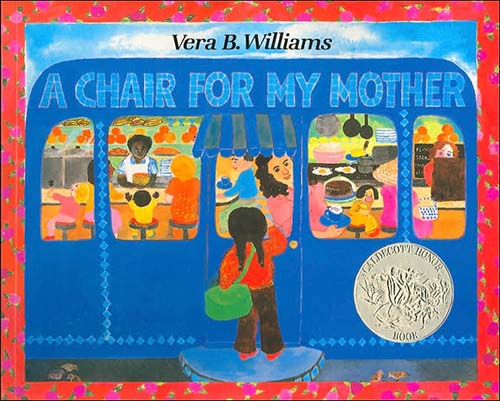
Author and illustrator of 17 children’s books, including Caldecott medal winner, A Chair for My Mother, Vera B. Williams always had a passion for the arts. Williams grew up in the Bronx, NY, and in 1936, when she was nine years old, one of her paintings, called Yentas, opens a new window, was included in an exhibition at the Museum of Modern Art. While Williams is widely known for her children’s books today, this exhibition’s expansive scope highlights unexplored aspects of her artistic practice and eight decades of life. From groundbreaking, powerful covers for Liberation Magazine, to Peace calendar collaborations with writer activist Grace Paley, to scenic sketches for Julian Beck and Judith Malina’s Living Theater, to hundreds of late life “Aging and Illness” cartoons sketches and doodles, Vera never sat still.
Williams arrived at Black Mountain College in 1945. While there, she embraced all aspects of living, working, and learning in the intensely creative college community. She was at BMC during a particularly fertile period, which allowed her to study with faculty members Buckminster Fuller and Josef Albers, and to participate in the famed summer sessions with John Cage, Merce Cunningham, M.C. Richards, and Robert Rauschenberg. In 1948, she graduated with Josef Albers as her advisor and sculptor Richard Lippold as her outside examiner. Forever one of the College’s shining stars, Vera graduated from BMC with just six semesters of coursework, at only twenty-one years old. She continued to visit BMC for years afterward, staying deeply involved with the artistic community that BMC incubated.
Anticipating the eventual closure of BMC, Williams, alongside her husband Paul Williams and a group of influential former BMC figures, founded The Gate Hill Cooperative Artists community located 30 miles north of NYC on the outskirts of Stony Point, NY. The Gate Hill Cooperative, also known as The Land, became an outcropping of Black Mountain College’s experimental ethos. Students and faculty including John Cage, M.C. Richards, David Tudor, Karen Karnes, David Weinrib, Stan VanDerBeek, and Patsy Lynch Wood shaped Gate Hill as founding members of the community. Vera B. Williams raised her three children at Gate Hill while continuing to make work.
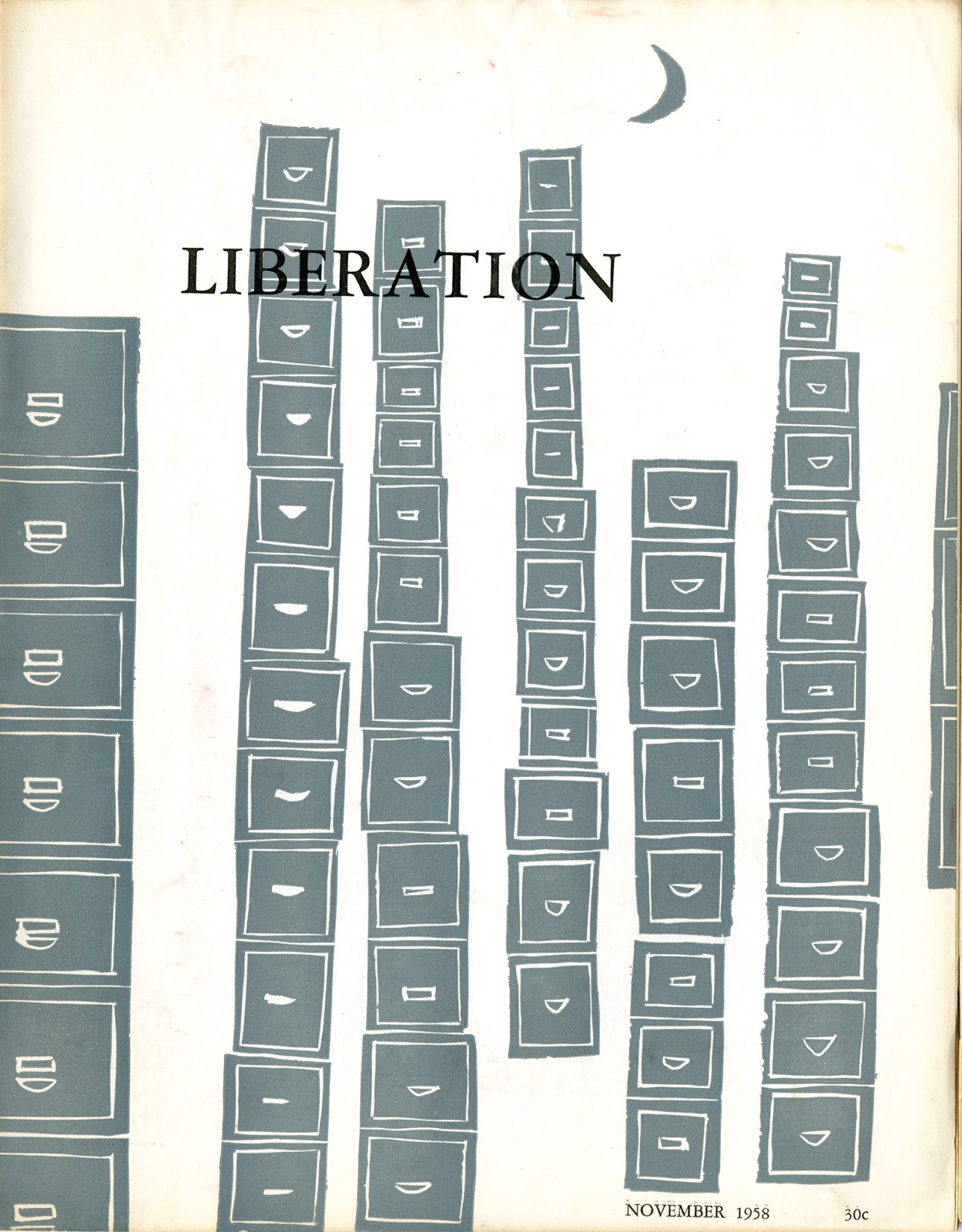
The early Gate Hill era represented an especially creative phase for the BMC group. For Williams, this period saw the creation of 76 covers for Liberation Magazine, a radical, groundbreaking publication. This exhibition will feature some of Williams’ most powerful Liberation covers including a design for the June 1963 edition, which contained the first full publication of MLK’s “Letter from Birmingham Jail.” Williams’ activism work continued throughout her life. As president of PEN’s Children Committee and member of The War Resisters league, she created a wide range of political and educational posters and journal covers. Williams protested the war in Vietnam and nuclear proliferation while supporting women’s causes and racial equality. In 1981, Williams was arrested and spent a month in a federal prison on charges stemming from her political activism.
In her late 40’s, Williams embarked in earnest on her career as a children’s book author and illustrator, a career which garnered the NY Public Library’s recognition of A Chair for My Mother as one of the greatest 100 children’s books of all time. Infinitely curious and always a wanderer at heart, Williams’ personal life was as expansive as her art. In addition to her prolific picture making, Williams started and helped run a Summerhill-based alternative school, canoed the Yukon, and lived alone on a houseboat in Vancouver Harbor. She helped to organize and attended dozens of political demonstrations throughout her adult life.
Her books won many awards including the Caldecott Medal Honor Book for A Chair for My Mother in 1983, the Boston Globe–Horn Book Award– Fiction category– for Scooter in 1994, the Jane Addams Honor for Amber Was Brave, Essie Was Smart in 2002, and the NSK Neustadt Prize for Children’s Literature in 2009. Her books reflected her values, emphasizing love, compassion, kindness, joy, strength, individuality, and courage.
Images:
Cover of Vera B. Williams’ A Chair for My Mother, published in 1982.
Vera B. Williams, Cover for Liberation Magazine, November 1958.
This is a hybrid event with limited in-store seating and the option to attend online.
The event is free but registration is required for both in-person and virtual attendance.
Please click here to register for the VIRTUAL event. The link required to attend will be emailed to registrants prior to the event.
Please click here to register for the IN-PERSON event. Note the important event details on the RSVP form.
This event includes a book signing. If you would like a signed book but can’t attend in person, you may order a signed copy online below. If you would like to have your book personalized, please order online or call the store at least two hours before the start of the event. When ordering online, use the comments field to provide a name for personalization, e.g. “To Paul.” NOTE: We do our best to get books personalized when requested but personalization is not guaranteed.
If you decide to attend and to purchase books, we ask that you purchase from Malaprop’s. When you do this you make it possible for us to continue hosting author events and you keep more dollars in our community. You may also support our work by purchasing a gift card or making a donation of any amount below. Thank you!
For readers of Cold Mountain by Charles Frazier and Enemy Women by Paulette Jiles, an evocative, morally complex novel set in rural 19th century North Carolina, as one woman fights to keep her family united, her farm running, and her convictions whole during the most devastating and divisive period in American history.
Talk of impending war is a steady drumbeat throughout North Carolina, though Joetta McBride pays it little heed. She and her husband, Ennis, have built a modest but happy life for themselves, raising two sons, fifteen-year-old Henry, and eleven-year-old Robert, on their small subsistence farm. They do not support the Confederacy’s position on slavery, but Joetta considers her family to be neutral, believing this is simply not their fight.
Her opinion is not favored by many in their community, including Joetta’s own father-in-law, Rudean. A staunch Confederate supporter, he fills his grandsons’ heads with stories about the glory of battle and the Southern cause until one night Henry runs off to join the war. At Joetta’s frantic insistence, Ennis leaves to find their son and bring him home.
But soon weeks pass with no word from father or son and Joetta is battered by the strain of running a farm with so little help. As the country becomes further entangled in the ramifications of war, Joetta finds herself increasingly at odds with those around her – until one act of kindness brings her family to the edge of even greater disaster.
Though shunned and struggling to survive, Joetta remains committed to her principles, and to her belief that her family will survive. But the greatest tests are still to come – for a fractured nation, for Joetta, and for those she loves . . .
Donna Everhart is a USA Today bestselling author known for vividly evoking the complexities of the heart and a gritty fascination of the American South in her acclaimed novels. She is the recipient of the prestigious SELA Outstanding Southeastern Author Award from the Southeastern Library Association and her novels have received a SIBA Okra Pick, an Indie Next Pick, and two Publishers Marketplace Buzz Books selections. Born and raised in Raleigh, she has stayed close to her hometown for much of her life and now lives just an hour away in Dunn, North Carolina. Please visit Donna Everhart online at DonnaEverhart.com.
Thursday, February
1, 2024
Vera B. Williams / STORIES Eight Decades of Politics and Picture Making
Exhibition and Public Programming
Vera B. Williams, an award-winning author and illustrator of children’s books, started making pictures almost as soon as she could walk. She studied at Black Mountain College in a time where summer institutes were held with classes taught by John Cage and Merce Cunningham. Williams studied under the Bauhaus luminary Josef Albers and went on to make art for the rest of her life. At the time of her death, The New York Times wrote: “Her illustrations, known for bold colors and a style reminiscent of folk art, were praised by reviewers for their great tenderness and crackling vitality.” Despite numerous awards and recognition for her children’s books, much of her wider life and work remains unexplored. This retrospective will showcase the complete range of Williams’ life and work. It will highlight her time at Black Mountain College, her political activism, and her establishment, with Paul Williams, of an influential yet little-known artist community, in addition to her work as an author and illustrator.
Author and illustrator of 17 children’s books, including Caldecott medal winner, A Chair for My Mother, Vera B. Williams always had a passion for the arts. Williams grew up in the Bronx, NY, and in 1936, when she was nine years old, one of her paintings, called Yentas, opens a new window, was included in an exhibition at the Museum of Modern Art. While Williams is widely known for her children’s books today, this exhibition’s expansive scope highlights unexplored aspects of her artistic practice and eight decades of life. From groundbreaking, powerful covers for Liberation Magazine, to Peace calendar collaborations with writer activist Grace Paley, to scenic sketches for Julian Beck and Judith Malina’s Living Theater, to hundreds of late life “Aging and Illness” cartoons sketches and doodles, Vera never sat still.
Williams arrived at Black Mountain College in 1945. While there, she embraced all aspects of living, working, and learning in the intensely creative college community. She was at BMC during a particularly fertile period, which allowed her to study with faculty members Buckminster Fuller and Josef Albers, and to participate in the famed summer sessions with John Cage, Merce Cunningham, M.C. Richards, and Robert Rauschenberg. In 1948, she graduated with Josef Albers as her advisor and sculptor Richard Lippold as her outside examiner. Forever one of the College’s shining stars, Vera graduated from BMC with just six semesters of coursework, at only twenty-one years old. She continued to visit BMC for years afterward, staying deeply involved with the artistic community that BMC incubated.
Anticipating the eventual closure of BMC, Williams, alongside her husband Paul Williams and a group of influential former BMC figures, founded The Gate Hill Cooperative Artists community located 30 miles north of NYC on the outskirts of Stony Point, NY. The Gate Hill Cooperative, also known as The Land, became an outcropping of Black Mountain College’s experimental ethos. Students and faculty including John Cage, M.C. Richards, David Tudor, Karen Karnes, David Weinrib, Stan VanDerBeek, and Patsy Lynch Wood shaped Gate Hill as founding members of the community. Vera B. Williams raised her three children at Gate Hill while continuing to make work.
The early Gate Hill era represented an especially creative phase for the BMC group. For Williams, this period saw the creation of 76 covers for Liberation Magazine, a radical, groundbreaking publication. This exhibition will feature some of Williams’ most powerful Liberation covers including a design for the June 1963 edition, which contained the first full publication of MLK’s “Letter from Birmingham Jail.” Williams’ activism work continued throughout her life. As president of PEN’s Children Committee and member of The War Resisters league, she created a wide range of political and educational posters and journal covers. Williams protested the war in Vietnam and nuclear proliferation while supporting women’s causes and racial equality. In 1981, Williams was arrested and spent a month in a federal prison on charges stemming from her political activism.
In her late 40’s, Williams embarked in earnest on her career as a children’s book author and illustrator, a career which garnered the NY Public Library’s recognition of A Chair for My Mother as one of the greatest 100 children’s books of all time. Infinitely curious and always a wanderer at heart, Williams’ personal life was as expansive as her art. In addition to her prolific picture making, Williams started and helped run a Summerhill-based alternative school, canoed the Yukon, and lived alone on a houseboat in Vancouver Harbor. She helped to organize and attended dozens of political demonstrations throughout her adult life.
Her books won many awards including the Caldecott Medal Honor Book for A Chair for My Mother in 1983, the Boston Globe–Horn Book Award– Fiction category– for Scooter in 1994, the Jane Addams Honor for Amber Was Brave, Essie Was Smart in 2002, and the NSK Neustadt Prize for Children’s Literature in 2009. Her books reflected her values, emphasizing love, compassion, kindness, joy, strength, individuality, and courage.
Images:
Cover of Vera B. Williams’ A Chair for My Mother, published in 1982.
Vera B. Williams, Cover for Liberation Magazine, November 1958.
Friday, February
2, 2024
Massage Specials
Vera B. Williams / STORIES Eight Decades of Politics and Picture Making
Celebrate the season of love with our exclusive massage offers at Happy Body, available until February 18.
1. Purchase a 10-pack of Pilates sessions and enjoy a fantastic 50% discount on your next massage booked within the next month.
2. Not interested in Pilates? No worries! Enjoy our buy one, get one 50% off offer on massages booked within the next month. Pamper yourself or share the love with a special someone.
Email us at [email protected] or call 828-2775741.
Exhibition and Public Programming
Vera B. Williams, an award-winning author and illustrator of children’s books, started making pictures almost as soon as she could walk. She studied at Black Mountain College in a time where summer institutes were held with classes taught by John Cage and Merce Cunningham. Williams studied under the Bauhaus luminary Josef Albers and went on to make art for the rest of her life. At the time of her death, The New York Times wrote: “Her illustrations, known for bold colors and a style reminiscent of folk art, were praised by reviewers for their great tenderness and crackling vitality.” Despite numerous awards and recognition for her children’s books, much of her wider life and work remains unexplored. This retrospective will showcase the complete range of Williams’ life and work. It will highlight her time at Black Mountain College, her political activism, and her establishment, with Paul Williams, of an influential yet little-known artist community, in addition to her work as an author and illustrator.
Author and illustrator of 17 children’s books, including Caldecott medal winner, A Chair for My Mother, Vera B. Williams always had a passion for the arts. Williams grew up in the Bronx, NY, and in 1936, when she was nine years old, one of her paintings, called Yentas, opens a new window, was included in an exhibition at the Museum of Modern Art. While Williams is widely known for her children’s books today, this exhibition’s expansive scope highlights unexplored aspects of her artistic practice and eight decades of life. From groundbreaking, powerful covers for Liberation Magazine, to Peace calendar collaborations with writer activist Grace Paley, to scenic sketches for Julian Beck and Judith Malina’s Living Theater, to hundreds of late life “Aging and Illness” cartoons sketches and doodles, Vera never sat still.
Williams arrived at Black Mountain College in 1945. While there, she embraced all aspects of living, working, and learning in the intensely creative college community. She was at BMC during a particularly fertile period, which allowed her to study with faculty members Buckminster Fuller and Josef Albers, and to participate in the famed summer sessions with John Cage, Merce Cunningham, M.C. Richards, and Robert Rauschenberg. In 1948, she graduated with Josef Albers as her advisor and sculptor Richard Lippold as her outside examiner. Forever one of the College’s shining stars, Vera graduated from BMC with just six semesters of coursework, at only twenty-one years old. She continued to visit BMC for years afterward, staying deeply involved with the artistic community that BMC incubated.
Anticipating the eventual closure of BMC, Williams, alongside her husband Paul Williams and a group of influential former BMC figures, founded The Gate Hill Cooperative Artists community located 30 miles north of NYC on the outskirts of Stony Point, NY. The Gate Hill Cooperative, also known as The Land, became an outcropping of Black Mountain College’s experimental ethos. Students and faculty including John Cage, M.C. Richards, David Tudor, Karen Karnes, David Weinrib, Stan VanDerBeek, and Patsy Lynch Wood shaped Gate Hill as founding members of the community. Vera B. Williams raised her three children at Gate Hill while continuing to make work.
The early Gate Hill era represented an especially creative phase for the BMC group. For Williams, this period saw the creation of 76 covers for Liberation Magazine, a radical, groundbreaking publication. This exhibition will feature some of Williams’ most powerful Liberation covers including a design for the June 1963 edition, which contained the first full publication of MLK’s “Letter from Birmingham Jail.” Williams’ activism work continued throughout her life. As president of PEN’s Children Committee and member of The War Resisters league, she created a wide range of political and educational posters and journal covers. Williams protested the war in Vietnam and nuclear proliferation while supporting women’s causes and racial equality. In 1981, Williams was arrested and spent a month in a federal prison on charges stemming from her political activism.
In her late 40’s, Williams embarked in earnest on her career as a children’s book author and illustrator, a career which garnered the NY Public Library’s recognition of A Chair for My Mother as one of the greatest 100 children’s books of all time. Infinitely curious and always a wanderer at heart, Williams’ personal life was as expansive as her art. In addition to her prolific picture making, Williams started and helped run a Summerhill-based alternative school, canoed the Yukon, and lived alone on a houseboat in Vancouver Harbor. She helped to organize and attended dozens of political demonstrations throughout her adult life.
Her books won many awards including the Caldecott Medal Honor Book for A Chair for My Mother in 1983, the Boston Globe–Horn Book Award– Fiction category– for Scooter in 1994, the Jane Addams Honor for Amber Was Brave, Essie Was Smart in 2002, and the NSK Neustadt Prize for Children’s Literature in 2009. Her books reflected her values, emphasizing love, compassion, kindness, joy, strength, individuality, and courage.
Images:
Cover of Vera B. Williams’ A Chair for My Mother, published in 1982.
Vera B. Williams, Cover for Liberation Magazine, November 1958.
Saturday, February
3, 2024
Kinēsa Workshop
Vera B. Williams / STORIES Eight Decades of Politics and Picture Making
Fall in Love with Kinēsa
Discover Your Physical Body – reduce pain and create flexibility in the spine by understanding the language of your nervous system. Sensation and movement are essential when moving from discomfort and stiffness to pleasure and ease. This workshop will focus on lower back sensations working through the gifts of spinal twisting. Christina will explain how the pain loop can be interrupted with gentle and safe movements that direct your nervous system’s attention to healthier and organized functional movement patterns. A powerful movement lesson that can help assist in relieving back pain.
“Nothing is permanent about our behavior patterns except our belief that they are so.” – Moshe Feldenkrais
Exhibition and Public Programming
Vera B. Williams, an award-winning author and illustrator of children’s books, started making pictures almost as soon as she could walk. She studied at Black Mountain College in a time where summer institutes were held with classes taught by John Cage and Merce Cunningham. Williams studied under the Bauhaus luminary Josef Albers and went on to make art for the rest of her life. At the time of her death, The New York Times wrote: “Her illustrations, known for bold colors and a style reminiscent of folk art, were praised by reviewers for their great tenderness and crackling vitality.” Despite numerous awards and recognition for her children’s books, much of her wider life and work remains unexplored. This retrospective will showcase the complete range of Williams’ life and work. It will highlight her time at Black Mountain College, her political activism, and her establishment, with Paul Williams, of an influential yet little-known artist community, in addition to her work as an author and illustrator.
Author and illustrator of 17 children’s books, including Caldecott medal winner, A Chair for My Mother, Vera B. Williams always had a passion for the arts. Williams grew up in the Bronx, NY, and in 1936, when she was nine years old, one of her paintings, called Yentas, opens a new window, was included in an exhibition at the Museum of Modern Art. While Williams is widely known for her children’s books today, this exhibition’s expansive scope highlights unexplored aspects of her artistic practice and eight decades of life. From groundbreaking, powerful covers for Liberation Magazine, to Peace calendar collaborations with writer activist Grace Paley, to scenic sketches for Julian Beck and Judith Malina’s Living Theater, to hundreds of late life “Aging and Illness” cartoons sketches and doodles, Vera never sat still.
Williams arrived at Black Mountain College in 1945. While there, she embraced all aspects of living, working, and learning in the intensely creative college community. She was at BMC during a particularly fertile period, which allowed her to study with faculty members Buckminster Fuller and Josef Albers, and to participate in the famed summer sessions with John Cage, Merce Cunningham, M.C. Richards, and Robert Rauschenberg. In 1948, she graduated with Josef Albers as her advisor and sculptor Richard Lippold as her outside examiner. Forever one of the College’s shining stars, Vera graduated from BMC with just six semesters of coursework, at only twenty-one years old. She continued to visit BMC for years afterward, staying deeply involved with the artistic community that BMC incubated.
Anticipating the eventual closure of BMC, Williams, alongside her husband Paul Williams and a group of influential former BMC figures, founded The Gate Hill Cooperative Artists community located 30 miles north of NYC on the outskirts of Stony Point, NY. The Gate Hill Cooperative, also known as The Land, became an outcropping of Black Mountain College’s experimental ethos. Students and faculty including John Cage, M.C. Richards, David Tudor, Karen Karnes, David Weinrib, Stan VanDerBeek, and Patsy Lynch Wood shaped Gate Hill as founding members of the community. Vera B. Williams raised her three children at Gate Hill while continuing to make work.
The early Gate Hill era represented an especially creative phase for the BMC group. For Williams, this period saw the creation of 76 covers for Liberation Magazine, a radical, groundbreaking publication. This exhibition will feature some of Williams’ most powerful Liberation covers including a design for the June 1963 edition, which contained the first full publication of MLK’s “Letter from Birmingham Jail.” Williams’ activism work continued throughout her life. As president of PEN’s Children Committee and member of The War Resisters league, she created a wide range of political and educational posters and journal covers. Williams protested the war in Vietnam and nuclear proliferation while supporting women’s causes and racial equality. In 1981, Williams was arrested and spent a month in a federal prison on charges stemming from her political activism.
In her late 40’s, Williams embarked in earnest on her career as a children’s book author and illustrator, a career which garnered the NY Public Library’s recognition of A Chair for My Mother as one of the greatest 100 children’s books of all time. Infinitely curious and always a wanderer at heart, Williams’ personal life was as expansive as her art. In addition to her prolific picture making, Williams started and helped run a Summerhill-based alternative school, canoed the Yukon, and lived alone on a houseboat in Vancouver Harbor. She helped to organize and attended dozens of political demonstrations throughout her adult life.
Her books won many awards including the Caldecott Medal Honor Book for A Chair for My Mother in 1983, the Boston Globe–Horn Book Award– Fiction category– for Scooter in 1994, the Jane Addams Honor for Amber Was Brave, Essie Was Smart in 2002, and the NSK Neustadt Prize for Children’s Literature in 2009. Her books reflected her values, emphasizing love, compassion, kindness, joy, strength, individuality, and courage.
Images:
Cover of Vera B. Williams’ A Chair for My Mother, published in 1982.
Vera B. Williams, Cover for Liberation Magazine, November 1958.
Monday, February
5, 2024
Vera B. Williams / STORIES Eight Decades of Politics and Picture Making
Dementia Partners Support Group
Hybrid | The American Queen with Vanessa Miller
Exhibition and Public Programming
Vera B. Williams, an award-winning author and illustrator of children’s books, started making pictures almost as soon as she could walk. She studied at Black Mountain College in a time where summer institutes were held with classes taught by John Cage and Merce Cunningham. Williams studied under the Bauhaus luminary Josef Albers and went on to make art for the rest of her life. At the time of her death, The New York Times wrote: “Her illustrations, known for bold colors and a style reminiscent of folk art, were praised by reviewers for their great tenderness and crackling vitality.” Despite numerous awards and recognition for her children’s books, much of her wider life and work remains unexplored. This retrospective will showcase the complete range of Williams’ life and work. It will highlight her time at Black Mountain College, her political activism, and her establishment, with Paul Williams, of an influential yet little-known artist community, in addition to her work as an author and illustrator.
Author and illustrator of 17 children’s books, including Caldecott medal winner, A Chair for My Mother, Vera B. Williams always had a passion for the arts. Williams grew up in the Bronx, NY, and in 1936, when she was nine years old, one of her paintings, called Yentas, opens a new window, was included in an exhibition at the Museum of Modern Art. While Williams is widely known for her children’s books today, this exhibition’s expansive scope highlights unexplored aspects of her artistic practice and eight decades of life. From groundbreaking, powerful covers for Liberation Magazine, to Peace calendar collaborations with writer activist Grace Paley, to scenic sketches for Julian Beck and Judith Malina’s Living Theater, to hundreds of late life “Aging and Illness” cartoons sketches and doodles, Vera never sat still.
Williams arrived at Black Mountain College in 1945. While there, she embraced all aspects of living, working, and learning in the intensely creative college community. She was at BMC during a particularly fertile period, which allowed her to study with faculty members Buckminster Fuller and Josef Albers, and to participate in the famed summer sessions with John Cage, Merce Cunningham, M.C. Richards, and Robert Rauschenberg. In 1948, she graduated with Josef Albers as her advisor and sculptor Richard Lippold as her outside examiner. Forever one of the College’s shining stars, Vera graduated from BMC with just six semesters of coursework, at only twenty-one years old. She continued to visit BMC for years afterward, staying deeply involved with the artistic community that BMC incubated.
Anticipating the eventual closure of BMC, Williams, alongside her husband Paul Williams and a group of influential former BMC figures, founded The Gate Hill Cooperative Artists community located 30 miles north of NYC on the outskirts of Stony Point, NY. The Gate Hill Cooperative, also known as The Land, became an outcropping of Black Mountain College’s experimental ethos. Students and faculty including John Cage, M.C. Richards, David Tudor, Karen Karnes, David Weinrib, Stan VanDerBeek, and Patsy Lynch Wood shaped Gate Hill as founding members of the community. Vera B. Williams raised her three children at Gate Hill while continuing to make work.
The early Gate Hill era represented an especially creative phase for the BMC group. For Williams, this period saw the creation of 76 covers for Liberation Magazine, a radical, groundbreaking publication. This exhibition will feature some of Williams’ most powerful Liberation covers including a design for the June 1963 edition, which contained the first full publication of MLK’s “Letter from Birmingham Jail.” Williams’ activism work continued throughout her life. As president of PEN’s Children Committee and member of The War Resisters league, she created a wide range of political and educational posters and journal covers. Williams protested the war in Vietnam and nuclear proliferation while supporting women’s causes and racial equality. In 1981, Williams was arrested and spent a month in a federal prison on charges stemming from her political activism.
In her late 40’s, Williams embarked in earnest on her career as a children’s book author and illustrator, a career which garnered the NY Public Library’s recognition of A Chair for My Mother as one of the greatest 100 children’s books of all time. Infinitely curious and always a wanderer at heart, Williams’ personal life was as expansive as her art. In addition to her prolific picture making, Williams started and helped run a Summerhill-based alternative school, canoed the Yukon, and lived alone on a houseboat in Vancouver Harbor. She helped to organize and attended dozens of political demonstrations throughout her adult life.
Her books won many awards including the Caldecott Medal Honor Book for A Chair for My Mother in 1983, the Boston Globe–Horn Book Award– Fiction category– for Scooter in 1994, the Jane Addams Honor for Amber Was Brave, Essie Was Smart in 2002, and the NSK Neustadt Prize for Children’s Literature in 2009. Her books reflected her values, emphasizing love, compassion, kindness, joy, strength, individuality, and courage.
Images:
Cover of Vera B. Williams’ A Chair for My Mother, published in 1982.
Vera B. Williams, Cover for Liberation Magazine, November 1958.
Join us for the Dementia Partners support group with Dementia Partners AVL. This group meets on the first Monday of every month from 6-7 p.m.
This event is free and open to everyone in the community.
Based on a true story, The American Queen is a breathtaking novel set between 1865-1886. This captivating narrative unveils the inspiring story of Louella, a resilient black woman who becomes the only known queen of a kingdom built on American soil. An emotional journey, The American Queen reveals the remarkable and unsung history of individuals who dared to dream of a better life and built a refuge for themselves and others as they fought tirelessly for the freedom and dignity of all.
Vanessa Miller is a bestselling author, with several books appearing on Essence Magazine’s Bestseller’s List. She has also been a Black Expressions Book Club Alternate pick and #1 on BCNN/BCBC Bestsellers’ List. Most of Vanessa’s published novels depict characters that are lost and in need of redemption. The books have received countless favorable reviews: “Heartwarming, drama-packed and tender in just the right places” (Romantic Times Book Review) and “Recommended for readers of redemption stories” (Library Journal). Visit her online at vanessamiller.com
This is a hybrid event with limited in-store seating and the option to attend online.
The event is free but registration is required for both in-person and virtual attendance.
Tuesday, February
6, 2024
Free Acupuncture Sessions
Parkinson’s Support Group
Vera B. Williams / STORIES Eight Decades of Politics and Picture Making
Books to Action Book Club: Poverty Simulation by Just Economics
|
Lisa Laney’s 35 year career in medical social work, has included home health care social worker in WNC, a Palliative Care social worker, and currently her private practice of Care Management, Mountain Area Premier Care Navigation, which opened in 2014. Three years later she co-founded Choice Care Your Way, a caregiver registry, which helps match high quality caregivers to clients in need.
Although you may not need Lisa’s services now, knowing what resources are available, and how to find them should the need arise, provides peace of mind. If you have a question you would Lisa to answer, please submit it through the Parkinson’s Support group email in advance: [email protected].
Time: 10:00 AM – 12:00 PM
Exhibition and Public Programming
Vera B. Williams, an award-winning author and illustrator of children’s books, started making pictures almost as soon as she could walk. She studied at Black Mountain College in a time where summer institutes were held with classes taught by John Cage and Merce Cunningham. Williams studied under the Bauhaus luminary Josef Albers and went on to make art for the rest of her life. At the time of her death, The New York Times wrote: “Her illustrations, known for bold colors and a style reminiscent of folk art, were praised by reviewers for their great tenderness and crackling vitality.” Despite numerous awards and recognition for her children’s books, much of her wider life and work remains unexplored. This retrospective will showcase the complete range of Williams’ life and work. It will highlight her time at Black Mountain College, her political activism, and her establishment, with Paul Williams, of an influential yet little-known artist community, in addition to her work as an author and illustrator.
Author and illustrator of 17 children’s books, including Caldecott medal winner, A Chair for My Mother, Vera B. Williams always had a passion for the arts. Williams grew up in the Bronx, NY, and in 1936, when she was nine years old, one of her paintings, called Yentas, opens a new window, was included in an exhibition at the Museum of Modern Art. While Williams is widely known for her children’s books today, this exhibition’s expansive scope highlights unexplored aspects of her artistic practice and eight decades of life. From groundbreaking, powerful covers for Liberation Magazine, to Peace calendar collaborations with writer activist Grace Paley, to scenic sketches for Julian Beck and Judith Malina’s Living Theater, to hundreds of late life “Aging and Illness” cartoons sketches and doodles, Vera never sat still.
Williams arrived at Black Mountain College in 1945. While there, she embraced all aspects of living, working, and learning in the intensely creative college community. She was at BMC during a particularly fertile period, which allowed her to study with faculty members Buckminster Fuller and Josef Albers, and to participate in the famed summer sessions with John Cage, Merce Cunningham, M.C. Richards, and Robert Rauschenberg. In 1948, she graduated with Josef Albers as her advisor and sculptor Richard Lippold as her outside examiner. Forever one of the College’s shining stars, Vera graduated from BMC with just six semesters of coursework, at only twenty-one years old. She continued to visit BMC for years afterward, staying deeply involved with the artistic community that BMC incubated.
Anticipating the eventual closure of BMC, Williams, alongside her husband Paul Williams and a group of influential former BMC figures, founded The Gate Hill Cooperative Artists community located 30 miles north of NYC on the outskirts of Stony Point, NY. The Gate Hill Cooperative, also known as The Land, became an outcropping of Black Mountain College’s experimental ethos. Students and faculty including John Cage, M.C. Richards, David Tudor, Karen Karnes, David Weinrib, Stan VanDerBeek, and Patsy Lynch Wood shaped Gate Hill as founding members of the community. Vera B. Williams raised her three children at Gate Hill while continuing to make work.
The early Gate Hill era represented an especially creative phase for the BMC group. For Williams, this period saw the creation of 76 covers for Liberation Magazine, a radical, groundbreaking publication. This exhibition will feature some of Williams’ most powerful Liberation covers including a design for the June 1963 edition, which contained the first full publication of MLK’s “Letter from Birmingham Jail.” Williams’ activism work continued throughout her life. As president of PEN’s Children Committee and member of The War Resisters league, she created a wide range of political and educational posters and journal covers. Williams protested the war in Vietnam and nuclear proliferation while supporting women’s causes and racial equality. In 1981, Williams was arrested and spent a month in a federal prison on charges stemming from her political activism.
In her late 40’s, Williams embarked in earnest on her career as a children’s book author and illustrator, a career which garnered the NY Public Library’s recognition of A Chair for My Mother as one of the greatest 100 children’s books of all time. Infinitely curious and always a wanderer at heart, Williams’ personal life was as expansive as her art. In addition to her prolific picture making, Williams started and helped run a Summerhill-based alternative school, canoed the Yukon, and lived alone on a houseboat in Vancouver Harbor. She helped to organize and attended dozens of political demonstrations throughout her adult life.
Her books won many awards including the Caldecott Medal Honor Book for A Chair for My Mother in 1983, the Boston Globe–Horn Book Award– Fiction category– for Scooter in 1994, the Jane Addams Honor for Amber Was Brave, Essie Was Smart in 2002, and the NSK Neustadt Prize for Children’s Literature in 2009. Her books reflected her values, emphasizing love, compassion, kindness, joy, strength, individuality, and courage.
Images:
Cover of Vera B. Williams’ A Chair for My Mother, published in 1982.
Vera B. Williams, Cover for Liberation Magazine, November 1958.
|
Our Books to Action Book Club be exploring the issue of Poverty by reading and discussing “Poverty, By America” by Matthew Desmond. Our examination of these issues will feature a poverty simulation lead by Just Economics. This event will take place in Pack Memorial Library’s Lord Auditorium. Just Economics works to educate, advocate, and organize for a just and sustainable local economy that works for all in Western North Carolina. Just Economics’ Working Poor Simulation is an experiential learning tool that exposes participants to the real life struggles of the working poor in our community. Participants are assigned identities based on real low-income people and must complete the everyday activities of their families, like going to work, paying bills, applying for public benefits, etc. The simulation involves moving between stations, which represent the institutions and businesses individuals typically interact with each month. The simulation includes 3 month-long periods, and is followed by a reflection. About our book, “Poverty, By America” by Matthew Desmond, from the New Yorker: “Urgent and accessible . . . It’s refreshing to read a work of social criticism that eschews the easy and often smug allure of abstraction, in favor of plainspoken practicality. Its moral force is a gut punch.” Our corresponding book discussion will be held online on February 13th at 6pm. Book to Action is a community issue focused book club that explores books centered on issues facing our community. The book discussions take place in conjunction with a community service project, educational field trip, or presentations from local experts active in these key issues. |
Wednesday, February
7, 2024
Vera B. Williams / STORIES Eight Decades of Politics and Picture Making
Energetic and Spiritual Defense Workshop
Wednesday Night Book Group
Exhibition and Public Programming
Vera B. Williams, an award-winning author and illustrator of children’s books, started making pictures almost as soon as she could walk. She studied at Black Mountain College in a time where summer institutes were held with classes taught by John Cage and Merce Cunningham. Williams studied under the Bauhaus luminary Josef Albers and went on to make art for the rest of her life. At the time of her death, The New York Times wrote: “Her illustrations, known for bold colors and a style reminiscent of folk art, were praised by reviewers for their great tenderness and crackling vitality.” Despite numerous awards and recognition for her children’s books, much of her wider life and work remains unexplored. This retrospective will showcase the complete range of Williams’ life and work. It will highlight her time at Black Mountain College, her political activism, and her establishment, with Paul Williams, of an influential yet little-known artist community, in addition to her work as an author and illustrator.
Author and illustrator of 17 children’s books, including Caldecott medal winner, A Chair for My Mother, Vera B. Williams always had a passion for the arts. Williams grew up in the Bronx, NY, and in 1936, when she was nine years old, one of her paintings, called Yentas, opens a new window, was included in an exhibition at the Museum of Modern Art. While Williams is widely known for her children’s books today, this exhibition’s expansive scope highlights unexplored aspects of her artistic practice and eight decades of life. From groundbreaking, powerful covers for Liberation Magazine, to Peace calendar collaborations with writer activist Grace Paley, to scenic sketches for Julian Beck and Judith Malina’s Living Theater, to hundreds of late life “Aging and Illness” cartoons sketches and doodles, Vera never sat still.
Williams arrived at Black Mountain College in 1945. While there, she embraced all aspects of living, working, and learning in the intensely creative college community. She was at BMC during a particularly fertile period, which allowed her to study with faculty members Buckminster Fuller and Josef Albers, and to participate in the famed summer sessions with John Cage, Merce Cunningham, M.C. Richards, and Robert Rauschenberg. In 1948, she graduated with Josef Albers as her advisor and sculptor Richard Lippold as her outside examiner. Forever one of the College’s shining stars, Vera graduated from BMC with just six semesters of coursework, at only twenty-one years old. She continued to visit BMC for years afterward, staying deeply involved with the artistic community that BMC incubated.
Anticipating the eventual closure of BMC, Williams, alongside her husband Paul Williams and a group of influential former BMC figures, founded The Gate Hill Cooperative Artists community located 30 miles north of NYC on the outskirts of Stony Point, NY. The Gate Hill Cooperative, also known as The Land, became an outcropping of Black Mountain College’s experimental ethos. Students and faculty including John Cage, M.C. Richards, David Tudor, Karen Karnes, David Weinrib, Stan VanDerBeek, and Patsy Lynch Wood shaped Gate Hill as founding members of the community. Vera B. Williams raised her three children at Gate Hill while continuing to make work.
The early Gate Hill era represented an especially creative phase for the BMC group. For Williams, this period saw the creation of 76 covers for Liberation Magazine, a radical, groundbreaking publication. This exhibition will feature some of Williams’ most powerful Liberation covers including a design for the June 1963 edition, which contained the first full publication of MLK’s “Letter from Birmingham Jail.” Williams’ activism work continued throughout her life. As president of PEN’s Children Committee and member of The War Resisters league, she created a wide range of political and educational posters and journal covers. Williams protested the war in Vietnam and nuclear proliferation while supporting women’s causes and racial equality. In 1981, Williams was arrested and spent a month in a federal prison on charges stemming from her political activism.
In her late 40’s, Williams embarked in earnest on her career as a children’s book author and illustrator, a career which garnered the NY Public Library’s recognition of A Chair for My Mother as one of the greatest 100 children’s books of all time. Infinitely curious and always a wanderer at heart, Williams’ personal life was as expansive as her art. In addition to her prolific picture making, Williams started and helped run a Summerhill-based alternative school, canoed the Yukon, and lived alone on a houseboat in Vancouver Harbor. She helped to organize and attended dozens of political demonstrations throughout her adult life.
Her books won many awards including the Caldecott Medal Honor Book for A Chair for My Mother in 1983, the Boston Globe–Horn Book Award– Fiction category– for Scooter in 1994, the Jane Addams Honor for Amber Was Brave, Essie Was Smart in 2002, and the NSK Neustadt Prize for Children’s Literature in 2009. Her books reflected her values, emphasizing love, compassion, kindness, joy, strength, individuality, and courage.
Images:
Cover of Vera B. Williams’ A Chair for My Mother, published in 1982.
Vera B. Williams, Cover for Liberation Magazine, November 1958.
Event Details
Energetic & Spiritual Defense Workshop
Embark on a transformative journey with our immersive workshop where the mystical meets the practical and you discover the art of fortifying your energy and spirit. Join us for a captivating experience that goes beyond the ordinary as we delve into the secrets of energetic and spiritual defense.
This workshop isn’t just about defense; it’s about empowerment. Elevate your energetic awareness strengthen your spiritual foundation and step into a life where you navigate the world with confidence and resilience. Join us for an unforgettable experience that transcends the ordinary—where your energy becomes your greatest ally. Embrace the extraordinary within and let the journey begin!
Course Information: This event will host a maximum of 20 attendees and will be part a 3 part series. To participate with Series 2 and 3 all attendees must attend the first Series 1.
Who Is This Workshop For?
This class is for people who have already been on a path of study of energy spirituality consciousness. This is not a beginners class.
These classes are for participants who are familiar or comfortable in with working in the energetic or spiritual realms.
Energetically or spiritually sensitive people who are seeking tools on how to manage and defend against challenging situations and relationships.
People who want to create energetic and spiritual shelters to staff off harmful collective patterns and intrusive energies.
Frontline high stress pressured public facing work environments that cause energetic and spiritual exhaustion.
Challenging interpersonal or family dynamics that cause energetic or spiritual drop outs.
Dynamics We Will Cover
Emotional and Energetic Dumping
Energetic Powerlessness In Conflict
Energetic & Spiritual Boundary Crossing
Money & Relationship Interference
Managing Challenging Dynamics With Others Who Are: Badgering Guilt Ridden Demanding Entitled Dominant and Abusive
What Participants Will Understanding Energetic Boundaries
Mindfulness Practices
Energy Management Tools
Visualization Techniques:
Identifying and Clearing Negative Energies:
Creating Your Sacred Space
Practical Applications in Daily Life
Group Energetic Dynamics
Self-Care and Energetic Hygiene
* Classes are limited to 20 participants per class. Please arrive no later than @ 5:50 to get settled and ready for a fast moving and exciting class. Teaching will begin at 6:00 sharp!. Short breaks are given to help participants process the information and solidify these teachings.
The Wednesday Night Book Group, hosted by Jay Jacoby, explores a diverse selection of fiction and nonfiction books determined by member suggestion. Click here to see a full schedule of what the club is reading. Club attendees get 10% off the book at Malaprop’s!
The club meets the first Wednesday of every month at 7:00 PM and alternates between meeting via Zoom and in-person at a private Asheville location.
To join the club, please email the host at [email protected].
Thursday, February
8, 2024
Vera B. Williams / STORIES Eight Decades of Politics and Picture Making
Exhibition and Public Programming
Vera B. Williams, an award-winning author and illustrator of children’s books, started making pictures almost as soon as she could walk. She studied at Black Mountain College in a time where summer institutes were held with classes taught by John Cage and Merce Cunningham. Williams studied under the Bauhaus luminary Josef Albers and went on to make art for the rest of her life. At the time of her death, The New York Times wrote: “Her illustrations, known for bold colors and a style reminiscent of folk art, were praised by reviewers for their great tenderness and crackling vitality.” Despite numerous awards and recognition for her children’s books, much of her wider life and work remains unexplored. This retrospective will showcase the complete range of Williams’ life and work. It will highlight her time at Black Mountain College, her political activism, and her establishment, with Paul Williams, of an influential yet little-known artist community, in addition to her work as an author and illustrator.
Author and illustrator of 17 children’s books, including Caldecott medal winner, A Chair for My Mother, Vera B. Williams always had a passion for the arts. Williams grew up in the Bronx, NY, and in 1936, when she was nine years old, one of her paintings, called Yentas, opens a new window, was included in an exhibition at the Museum of Modern Art. While Williams is widely known for her children’s books today, this exhibition’s expansive scope highlights unexplored aspects of her artistic practice and eight decades of life. From groundbreaking, powerful covers for Liberation Magazine, to Peace calendar collaborations with writer activist Grace Paley, to scenic sketches for Julian Beck and Judith Malina’s Living Theater, to hundreds of late life “Aging and Illness” cartoons sketches and doodles, Vera never sat still.
Williams arrived at Black Mountain College in 1945. While there, she embraced all aspects of living, working, and learning in the intensely creative college community. She was at BMC during a particularly fertile period, which allowed her to study with faculty members Buckminster Fuller and Josef Albers, and to participate in the famed summer sessions with John Cage, Merce Cunningham, M.C. Richards, and Robert Rauschenberg. In 1948, she graduated with Josef Albers as her advisor and sculptor Richard Lippold as her outside examiner. Forever one of the College’s shining stars, Vera graduated from BMC with just six semesters of coursework, at only twenty-one years old. She continued to visit BMC for years afterward, staying deeply involved with the artistic community that BMC incubated.
Anticipating the eventual closure of BMC, Williams, alongside her husband Paul Williams and a group of influential former BMC figures, founded The Gate Hill Cooperative Artists community located 30 miles north of NYC on the outskirts of Stony Point, NY. The Gate Hill Cooperative, also known as The Land, became an outcropping of Black Mountain College’s experimental ethos. Students and faculty including John Cage, M.C. Richards, David Tudor, Karen Karnes, David Weinrib, Stan VanDerBeek, and Patsy Lynch Wood shaped Gate Hill as founding members of the community. Vera B. Williams raised her three children at Gate Hill while continuing to make work.
The early Gate Hill era represented an especially creative phase for the BMC group. For Williams, this period saw the creation of 76 covers for Liberation Magazine, a radical, groundbreaking publication. This exhibition will feature some of Williams’ most powerful Liberation covers including a design for the June 1963 edition, which contained the first full publication of MLK’s “Letter from Birmingham Jail.” Williams’ activism work continued throughout her life. As president of PEN’s Children Committee and member of The War Resisters league, she created a wide range of political and educational posters and journal covers. Williams protested the war in Vietnam and nuclear proliferation while supporting women’s causes and racial equality. In 1981, Williams was arrested and spent a month in a federal prison on charges stemming from her political activism.
In her late 40’s, Williams embarked in earnest on her career as a children’s book author and illustrator, a career which garnered the NY Public Library’s recognition of A Chair for My Mother as one of the greatest 100 children’s books of all time. Infinitely curious and always a wanderer at heart, Williams’ personal life was as expansive as her art. In addition to her prolific picture making, Williams started and helped run a Summerhill-based alternative school, canoed the Yukon, and lived alone on a houseboat in Vancouver Harbor. She helped to organize and attended dozens of political demonstrations throughout her adult life.
Her books won many awards including the Caldecott Medal Honor Book for A Chair for My Mother in 1983, the Boston Globe–Horn Book Award– Fiction category– for Scooter in 1994, the Jane Addams Honor for Amber Was Brave, Essie Was Smart in 2002, and the NSK Neustadt Prize for Children’s Literature in 2009. Her books reflected her values, emphasizing love, compassion, kindness, joy, strength, individuality, and courage.
Images:
Cover of Vera B. Williams’ A Chair for My Mother, published in 1982.
Vera B. Williams, Cover for Liberation Magazine, November 1958.
Friday, February
9, 2024
Vera B. Williams / STORIES Eight Decades of Politics and Picture Making
Exhibition and Public Programming
Vera B. Williams, an award-winning author and illustrator of children’s books, started making pictures almost as soon as she could walk. She studied at Black Mountain College in a time where summer institutes were held with classes taught by John Cage and Merce Cunningham. Williams studied under the Bauhaus luminary Josef Albers and went on to make art for the rest of her life. At the time of her death, The New York Times wrote: “Her illustrations, known for bold colors and a style reminiscent of folk art, were praised by reviewers for their great tenderness and crackling vitality.” Despite numerous awards and recognition for her children’s books, much of her wider life and work remains unexplored. This retrospective will showcase the complete range of Williams’ life and work. It will highlight her time at Black Mountain College, her political activism, and her establishment, with Paul Williams, of an influential yet little-known artist community, in addition to her work as an author and illustrator.
Author and illustrator of 17 children’s books, including Caldecott medal winner, A Chair for My Mother, Vera B. Williams always had a passion for the arts. Williams grew up in the Bronx, NY, and in 1936, when she was nine years old, one of her paintings, called Yentas, opens a new window, was included in an exhibition at the Museum of Modern Art. While Williams is widely known for her children’s books today, this exhibition’s expansive scope highlights unexplored aspects of her artistic practice and eight decades of life. From groundbreaking, powerful covers for Liberation Magazine, to Peace calendar collaborations with writer activist Grace Paley, to scenic sketches for Julian Beck and Judith Malina’s Living Theater, to hundreds of late life “Aging and Illness” cartoons sketches and doodles, Vera never sat still.
Williams arrived at Black Mountain College in 1945. While there, she embraced all aspects of living, working, and learning in the intensely creative college community. She was at BMC during a particularly fertile period, which allowed her to study with faculty members Buckminster Fuller and Josef Albers, and to participate in the famed summer sessions with John Cage, Merce Cunningham, M.C. Richards, and Robert Rauschenberg. In 1948, she graduated with Josef Albers as her advisor and sculptor Richard Lippold as her outside examiner. Forever one of the College’s shining stars, Vera graduated from BMC with just six semesters of coursework, at only twenty-one years old. She continued to visit BMC for years afterward, staying deeply involved with the artistic community that BMC incubated.
Anticipating the eventual closure of BMC, Williams, alongside her husband Paul Williams and a group of influential former BMC figures, founded The Gate Hill Cooperative Artists community located 30 miles north of NYC on the outskirts of Stony Point, NY. The Gate Hill Cooperative, also known as The Land, became an outcropping of Black Mountain College’s experimental ethos. Students and faculty including John Cage, M.C. Richards, David Tudor, Karen Karnes, David Weinrib, Stan VanDerBeek, and Patsy Lynch Wood shaped Gate Hill as founding members of the community. Vera B. Williams raised her three children at Gate Hill while continuing to make work.
The early Gate Hill era represented an especially creative phase for the BMC group. For Williams, this period saw the creation of 76 covers for Liberation Magazine, a radical, groundbreaking publication. This exhibition will feature some of Williams’ most powerful Liberation covers including a design for the June 1963 edition, which contained the first full publication of MLK’s “Letter from Birmingham Jail.” Williams’ activism work continued throughout her life. As president of PEN’s Children Committee and member of The War Resisters league, she created a wide range of political and educational posters and journal covers. Williams protested the war in Vietnam and nuclear proliferation while supporting women’s causes and racial equality. In 1981, Williams was arrested and spent a month in a federal prison on charges stemming from her political activism.
In her late 40’s, Williams embarked in earnest on her career as a children’s book author and illustrator, a career which garnered the NY Public Library’s recognition of A Chair for My Mother as one of the greatest 100 children’s books of all time. Infinitely curious and always a wanderer at heart, Williams’ personal life was as expansive as her art. In addition to her prolific picture making, Williams started and helped run a Summerhill-based alternative school, canoed the Yukon, and lived alone on a houseboat in Vancouver Harbor. She helped to organize and attended dozens of political demonstrations throughout her adult life.
Her books won many awards including the Caldecott Medal Honor Book for A Chair for My Mother in 1983, the Boston Globe–Horn Book Award– Fiction category– for Scooter in 1994, the Jane Addams Honor for Amber Was Brave, Essie Was Smart in 2002, and the NSK Neustadt Prize for Children’s Literature in 2009. Her books reflected her values, emphasizing love, compassion, kindness, joy, strength, individuality, and courage.
Images:
Cover of Vera B. Williams’ A Chair for My Mother, published in 1982.
Vera B. Williams, Cover for Liberation Magazine, November 1958.
Saturday, February
10, 2024
Vera B. Williams / STORIES Eight Decades of Politics and Picture Making
Restorative Yoga Workshop
Springtime Medicine Making for the Home Apothecary
Exhibition and Public Programming
Vera B. Williams, an award-winning author and illustrator of children’s books, started making pictures almost as soon as she could walk. She studied at Black Mountain College in a time where summer institutes were held with classes taught by John Cage and Merce Cunningham. Williams studied under the Bauhaus luminary Josef Albers and went on to make art for the rest of her life. At the time of her death, The New York Times wrote: “Her illustrations, known for bold colors and a style reminiscent of folk art, were praised by reviewers for their great tenderness and crackling vitality.” Despite numerous awards and recognition for her children’s books, much of her wider life and work remains unexplored. This retrospective will showcase the complete range of Williams’ life and work. It will highlight her time at Black Mountain College, her political activism, and her establishment, with Paul Williams, of an influential yet little-known artist community, in addition to her work as an author and illustrator.
Author and illustrator of 17 children’s books, including Caldecott medal winner, A Chair for My Mother, Vera B. Williams always had a passion for the arts. Williams grew up in the Bronx, NY, and in 1936, when she was nine years old, one of her paintings, called Yentas, opens a new window, was included in an exhibition at the Museum of Modern Art. While Williams is widely known for her children’s books today, this exhibition’s expansive scope highlights unexplored aspects of her artistic practice and eight decades of life. From groundbreaking, powerful covers for Liberation Magazine, to Peace calendar collaborations with writer activist Grace Paley, to scenic sketches for Julian Beck and Judith Malina’s Living Theater, to hundreds of late life “Aging and Illness” cartoons sketches and doodles, Vera never sat still.
Williams arrived at Black Mountain College in 1945. While there, she embraced all aspects of living, working, and learning in the intensely creative college community. She was at BMC during a particularly fertile period, which allowed her to study with faculty members Buckminster Fuller and Josef Albers, and to participate in the famed summer sessions with John Cage, Merce Cunningham, M.C. Richards, and Robert Rauschenberg. In 1948, she graduated with Josef Albers as her advisor and sculptor Richard Lippold as her outside examiner. Forever one of the College’s shining stars, Vera graduated from BMC with just six semesters of coursework, at only twenty-one years old. She continued to visit BMC for years afterward, staying deeply involved with the artistic community that BMC incubated.
Anticipating the eventual closure of BMC, Williams, alongside her husband Paul Williams and a group of influential former BMC figures, founded The Gate Hill Cooperative Artists community located 30 miles north of NYC on the outskirts of Stony Point, NY. The Gate Hill Cooperative, also known as The Land, became an outcropping of Black Mountain College’s experimental ethos. Students and faculty including John Cage, M.C. Richards, David Tudor, Karen Karnes, David Weinrib, Stan VanDerBeek, and Patsy Lynch Wood shaped Gate Hill as founding members of the community. Vera B. Williams raised her three children at Gate Hill while continuing to make work.
The early Gate Hill era represented an especially creative phase for the BMC group. For Williams, this period saw the creation of 76 covers for Liberation Magazine, a radical, groundbreaking publication. This exhibition will feature some of Williams’ most powerful Liberation covers including a design for the June 1963 edition, which contained the first full publication of MLK’s “Letter from Birmingham Jail.” Williams’ activism work continued throughout her life. As president of PEN’s Children Committee and member of The War Resisters league, she created a wide range of political and educational posters and journal covers. Williams protested the war in Vietnam and nuclear proliferation while supporting women’s causes and racial equality. In 1981, Williams was arrested and spent a month in a federal prison on charges stemming from her political activism.
In her late 40’s, Williams embarked in earnest on her career as a children’s book author and illustrator, a career which garnered the NY Public Library’s recognition of A Chair for My Mother as one of the greatest 100 children’s books of all time. Infinitely curious and always a wanderer at heart, Williams’ personal life was as expansive as her art. In addition to her prolific picture making, Williams started and helped run a Summerhill-based alternative school, canoed the Yukon, and lived alone on a houseboat in Vancouver Harbor. She helped to organize and attended dozens of political demonstrations throughout her adult life.
Her books won many awards including the Caldecott Medal Honor Book for A Chair for My Mother in 1983, the Boston Globe–Horn Book Award– Fiction category– for Scooter in 1994, the Jane Addams Honor for Amber Was Brave, Essie Was Smart in 2002, and the NSK Neustadt Prize for Children’s Literature in 2009. Her books reflected her values, emphasizing love, compassion, kindness, joy, strength, individuality, and courage.
Images:
Cover of Vera B. Williams’ A Chair for My Mother, published in 1982.
Vera B. Williams, Cover for Liberation Magazine, November 1958.
Relax, Restore, Renew
Unwind and rejuvenate in our blissful 2-hour Restorative Yoga Workshop designed to melt away stress, promote deep relaxation, and nurture your well-being.
Immerse yourself in a series of gentle, supported yoga poses that encourage relaxation and release tension. Utilize an array of props such as bolsters, blankets, and blocks to fully support your body in each pose.
Learn the art of mindful breathing techniques to calm the nervous system, reduce anxiety, and enhance your overall sense of peace.
Indulge in a guided meditation journey to promote mental clarity and inner calmness.
Sign up for an amazing class taught by Lori Jenkins of Sister of Mother Earth. She will guide you through making a Springtime fire cider, a blood-moving oxymel, and herbal honey to awaken your body out of Wintertime slumber.
Discuss wild herbs that pop up in late Winter and early Spring to harvest and enjoy, and partake in a bit of Springtime magick to help celebrate this time of year.
All you need to bring is a basket to carry your goodies home in and a learning spirit!
The class will be held on February 10th, 2024 from 3 – 5 pm
*Must have 10 registrants to hold class
Class items you will go home with:
*1 quart of fire cider
* 8oz herbal oxymel
* 6oz herbal honey
* 1oz herbal tea blend
* sample of stinging nettles salt blend
* worksheet filled with information and recipes
* and a few other surprises!
Monday, February
12, 2024
Vera B. Williams / STORIES Eight Decades of Politics and Picture Making
Exhibition and Public Programming
Vera B. Williams, an award-winning author and illustrator of children’s books, started making pictures almost as soon as she could walk. She studied at Black Mountain College in a time where summer institutes were held with classes taught by John Cage and Merce Cunningham. Williams studied under the Bauhaus luminary Josef Albers and went on to make art for the rest of her life. At the time of her death, The New York Times wrote: “Her illustrations, known for bold colors and a style reminiscent of folk art, were praised by reviewers for their great tenderness and crackling vitality.” Despite numerous awards and recognition for her children’s books, much of her wider life and work remains unexplored. This retrospective will showcase the complete range of Williams’ life and work. It will highlight her time at Black Mountain College, her political activism, and her establishment, with Paul Williams, of an influential yet little-known artist community, in addition to her work as an author and illustrator.
Author and illustrator of 17 children’s books, including Caldecott medal winner, A Chair for My Mother, Vera B. Williams always had a passion for the arts. Williams grew up in the Bronx, NY, and in 1936, when she was nine years old, one of her paintings, called Yentas, opens a new window, was included in an exhibition at the Museum of Modern Art. While Williams is widely known for her children’s books today, this exhibition’s expansive scope highlights unexplored aspects of her artistic practice and eight decades of life. From groundbreaking, powerful covers for Liberation Magazine, to Peace calendar collaborations with writer activist Grace Paley, to scenic sketches for Julian Beck and Judith Malina’s Living Theater, to hundreds of late life “Aging and Illness” cartoons sketches and doodles, Vera never sat still.
Williams arrived at Black Mountain College in 1945. While there, she embraced all aspects of living, working, and learning in the intensely creative college community. She was at BMC during a particularly fertile period, which allowed her to study with faculty members Buckminster Fuller and Josef Albers, and to participate in the famed summer sessions with John Cage, Merce Cunningham, M.C. Richards, and Robert Rauschenberg. In 1948, she graduated with Josef Albers as her advisor and sculptor Richard Lippold as her outside examiner. Forever one of the College’s shining stars, Vera graduated from BMC with just six semesters of coursework, at only twenty-one years old. She continued to visit BMC for years afterward, staying deeply involved with the artistic community that BMC incubated.
Anticipating the eventual closure of BMC, Williams, alongside her husband Paul Williams and a group of influential former BMC figures, founded The Gate Hill Cooperative Artists community located 30 miles north of NYC on the outskirts of Stony Point, NY. The Gate Hill Cooperative, also known as The Land, became an outcropping of Black Mountain College’s experimental ethos. Students and faculty including John Cage, M.C. Richards, David Tudor, Karen Karnes, David Weinrib, Stan VanDerBeek, and Patsy Lynch Wood shaped Gate Hill as founding members of the community. Vera B. Williams raised her three children at Gate Hill while continuing to make work.
The early Gate Hill era represented an especially creative phase for the BMC group. For Williams, this period saw the creation of 76 covers for Liberation Magazine, a radical, groundbreaking publication. This exhibition will feature some of Williams’ most powerful Liberation covers including a design for the June 1963 edition, which contained the first full publication of MLK’s “Letter from Birmingham Jail.” Williams’ activism work continued throughout her life. As president of PEN’s Children Committee and member of The War Resisters league, she created a wide range of political and educational posters and journal covers. Williams protested the war in Vietnam and nuclear proliferation while supporting women’s causes and racial equality. In 1981, Williams was arrested and spent a month in a federal prison on charges stemming from her political activism.
In her late 40’s, Williams embarked in earnest on her career as a children’s book author and illustrator, a career which garnered the NY Public Library’s recognition of A Chair for My Mother as one of the greatest 100 children’s books of all time. Infinitely curious and always a wanderer at heart, Williams’ personal life was as expansive as her art. In addition to her prolific picture making, Williams started and helped run a Summerhill-based alternative school, canoed the Yukon, and lived alone on a houseboat in Vancouver Harbor. She helped to organize and attended dozens of political demonstrations throughout her adult life.
Her books won many awards including the Caldecott Medal Honor Book for A Chair for My Mother in 1983, the Boston Globe–Horn Book Award– Fiction category– for Scooter in 1994, the Jane Addams Honor for Amber Was Brave, Essie Was Smart in 2002, and the NSK Neustadt Prize for Children’s Literature in 2009. Her books reflected her values, emphasizing love, compassion, kindness, joy, strength, individuality, and courage.
Images:
Cover of Vera B. Williams’ A Chair for My Mother, published in 1982.
Vera B. Williams, Cover for Liberation Magazine, November 1958.