Upcoming events and things to do in Asheville, NC. Below is a list of events for festivals, concerts, art exhibitions, group meetups and more.

Interested in adding an event to our calendar? Please click the green “Post Your Event” button below.
Thursday, December 9, 2021
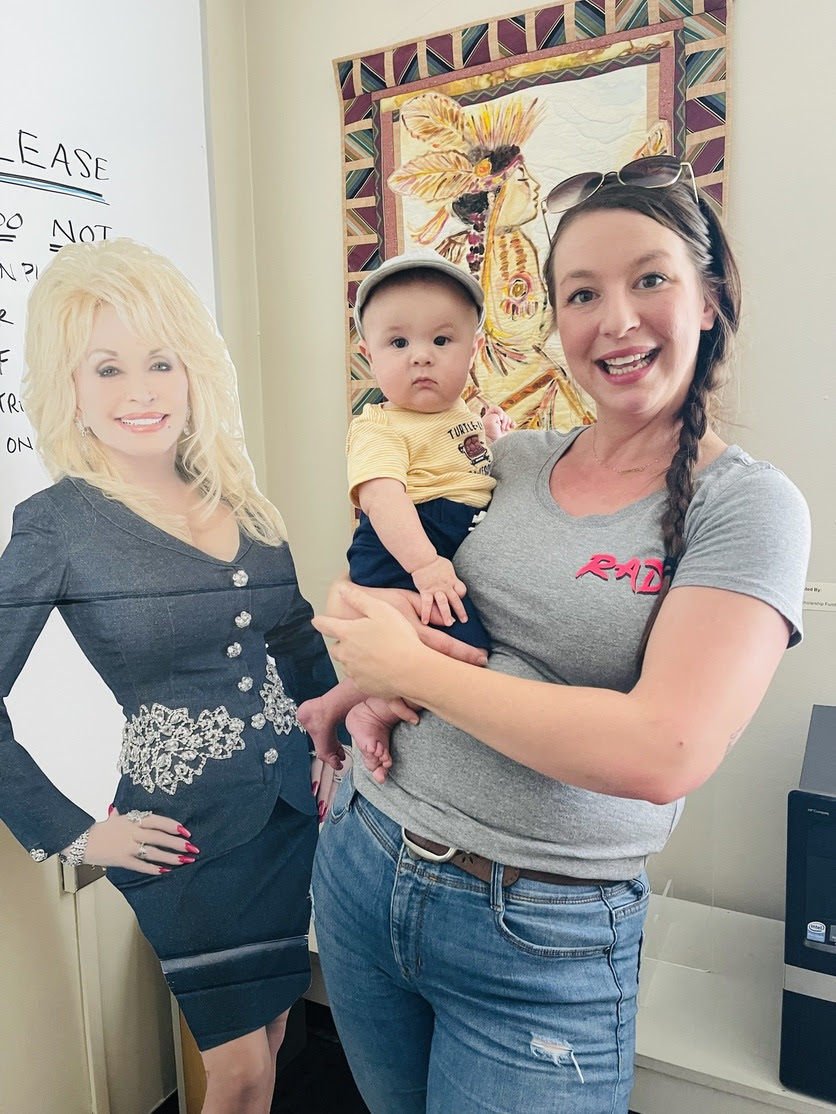
Dolly Parton’s Imagination Library
Dec 9 all-day
online

On this Day in WNC History Tidbit
Dec 9 all-day
online
On this Day in WNC History Tidbit
Do you follow us on social media? If not, you’ve missed our new 2021 series –
On This Day in WNC History!

Every week we explore the headlines and overlooked events that happened
on a particular day in Western North Carolina history.

Follow us on social media for more!

Facebook
Instagram
Twitter
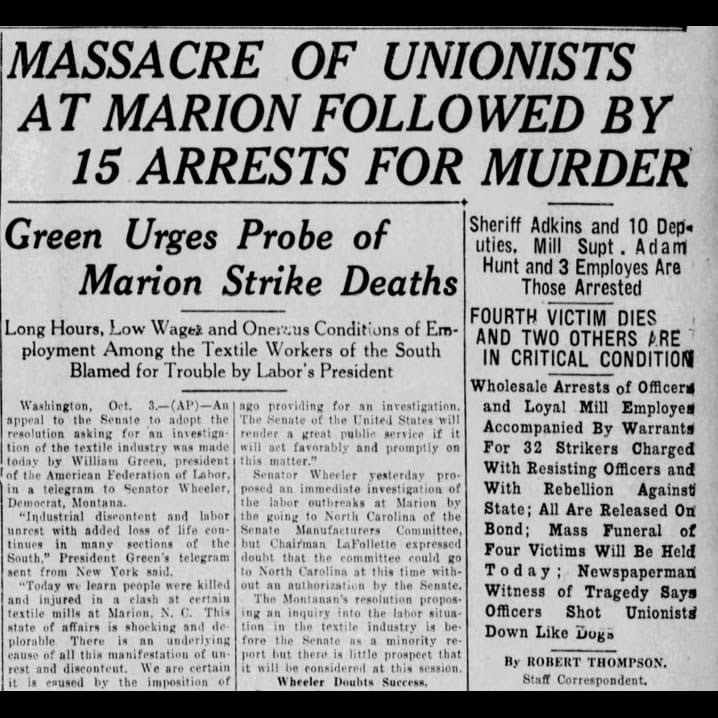
ON THIS DAY in WNC history: On October 2, 1929, deputies fired into a crowd of striking workers in Marion, NC. Six were killed and even more wounded at the Marion Manufacturing Company in one of the deadliest acts of strike busting in the South.

This year marked an apogee of strikes and labor organization in southern textile mills. Eight years prior, over 100 miners were killed at the Battle of Blair Mountain in West Virginia in a period of coal clashes and unionization attempts. Later in the 1920s, many textile workers reacting to grueling and dirty work conditions under the “stretch-out” system, along with a reduction of their pay in company scrip, began organizing and demanding better conditions. Spearheaded by the National Textile Workers Union (an organization supported by the Communist Party), concurrent strikes began early in 1929 at the Bemberg-Glanzstoff Rayon Corporation in Elizabethton, Tennessee and at Loray Mills in Gastonia, North Carolina. Female employees were key to the organization of both strikes, and the latter is most famously remembered for the death of Ella May Wiggins. National Guard members, local police, and union-busting mobs were called to both of these events.

The Marion strikes (which occurred at the neighboring Clinchfield Mill as well) began July 11. Workers struck without official union support, resisting involvement by communist organizers. After frequent violence and threats, with two National Guard units present, workers returned to these mills September 11, with no raise in pay and a mandated 55-hour workweek. Marion Manufacturing Mill refused to rehire 114 of the strikers, leading to further anger. Workers struck again on October 2, and deputies were dispatched by the local sheriff. Though some details are murky, deputies shot into a crowd of strikers, killing four on site, wounding at least fifteen, with two others dying later. Nearby hospitals refused medical care to strikers, and churches of the mill village refused to administer their funerals. Eight deputies were charged, but acquitted in December. They contended the strikers were armed, but no guns were found, and the New York Times reported those killed were shot in the back.

The memory of these events will be examined in our upcoming event, Marion Mill Massacre in Memory, on Thursday, Oct 14.

Image: Raleigh News and Observer, Oct. 4, 1929

Facebook
Instagram
Twitter
Friday, December 10, 2021
Dolly Parton’s Imagination Library
Dec 10 all-day
online

Driving Tour with Smith-McDowell House
Dec 10 all-day
Online w/ Western North Carolina Historical Association
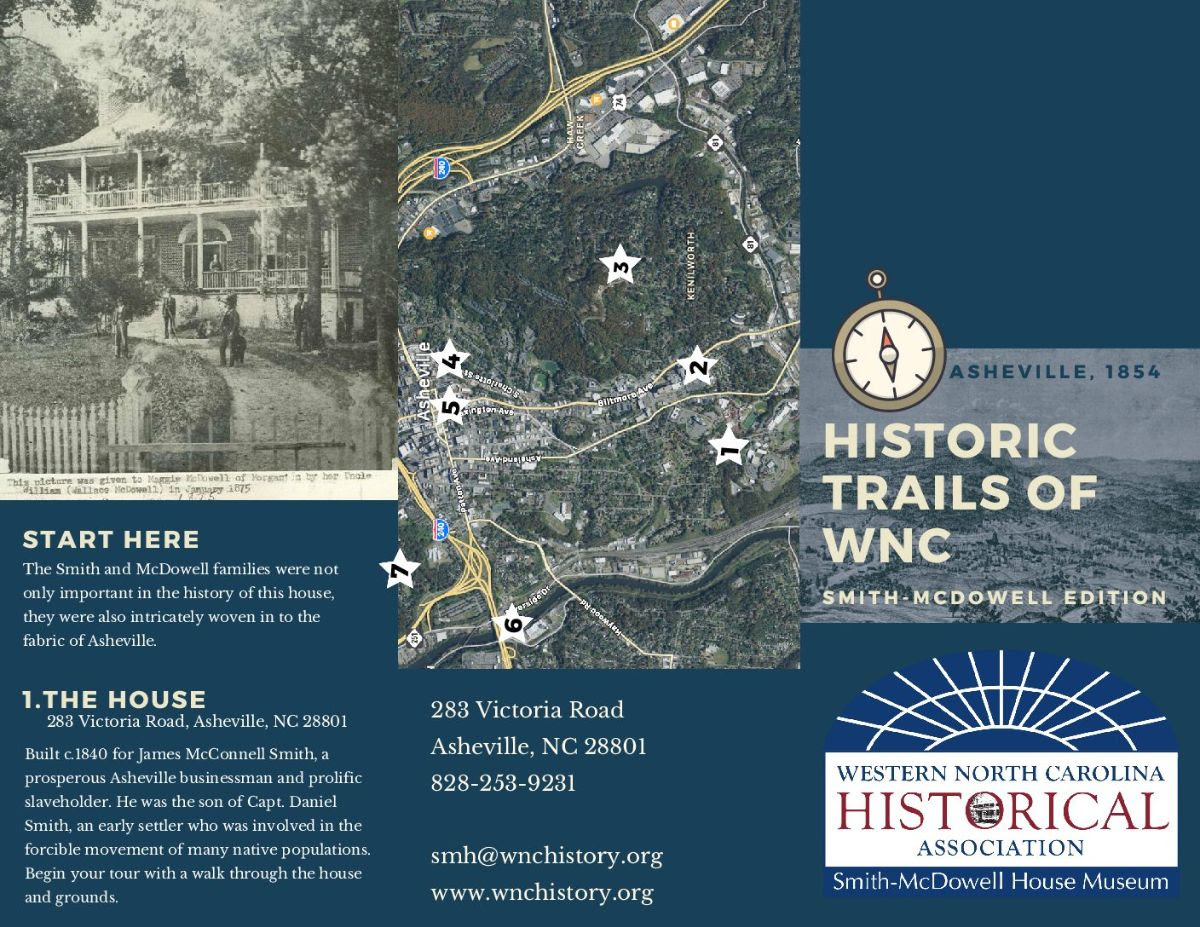
The residents of the Smith-McDowell House and grounds were woven in to the fabric of Asheville.

This driving tour begins at the Smith-McDowell House Museum on the campus of A-B Tech and continues through historic sites related to early occupants of the house.

History @ Home – Visit Virtually Western North Carolina Historical Association
Dec 10 all-day
online w/ Western North Carolina Historical Association
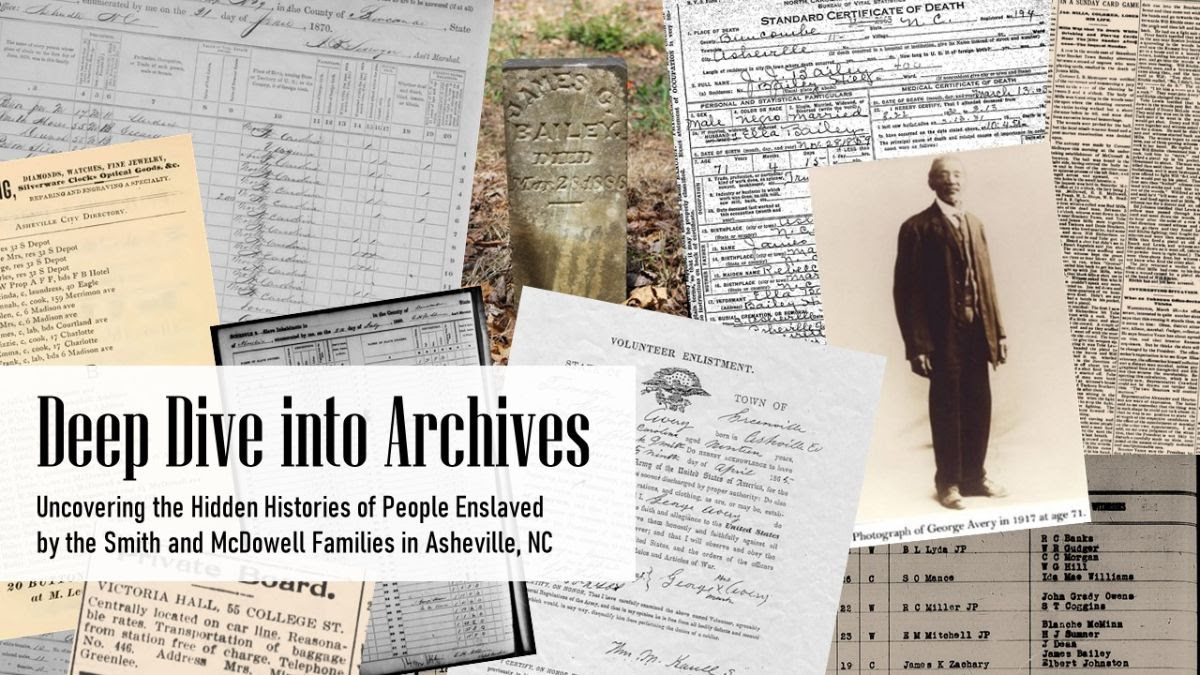
Deep Dive into Archives is a living exhibit shining a light on the individuals who were once enslaved at the Smith-McDowell House through primary documentation.


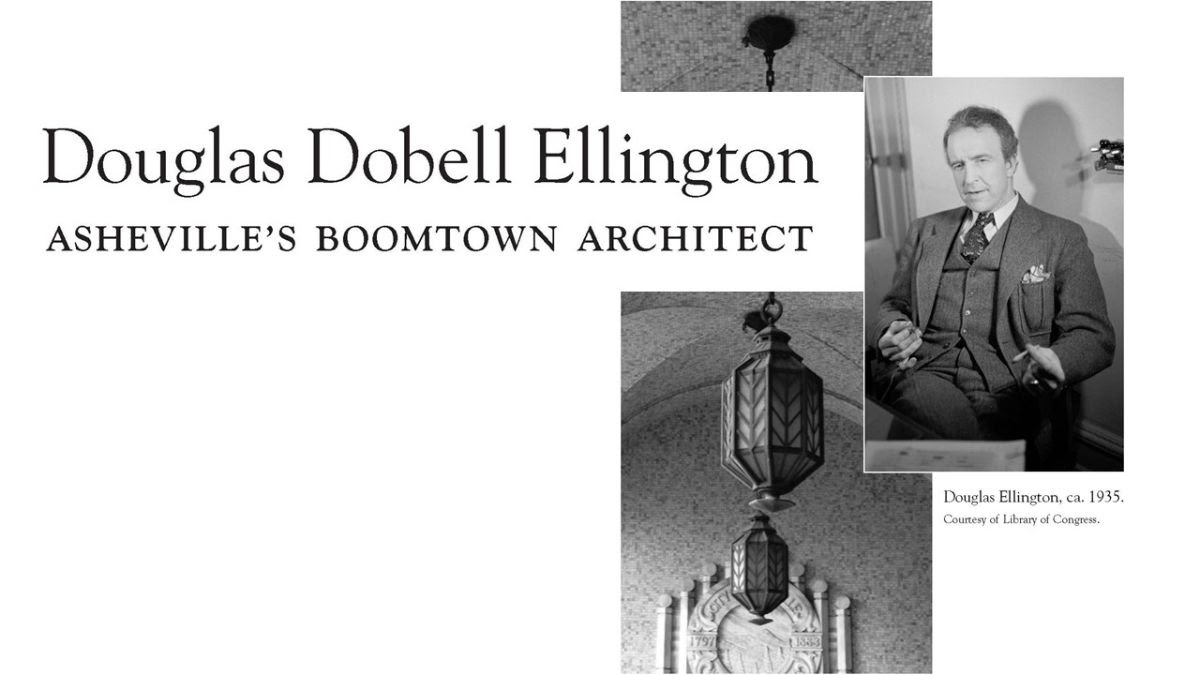
Douglas Ellington: Asheville’s Boomtown Architect presents a look at Ellington’s iconic Asheville creations along with other buildings he completed throughout his career in other cities.
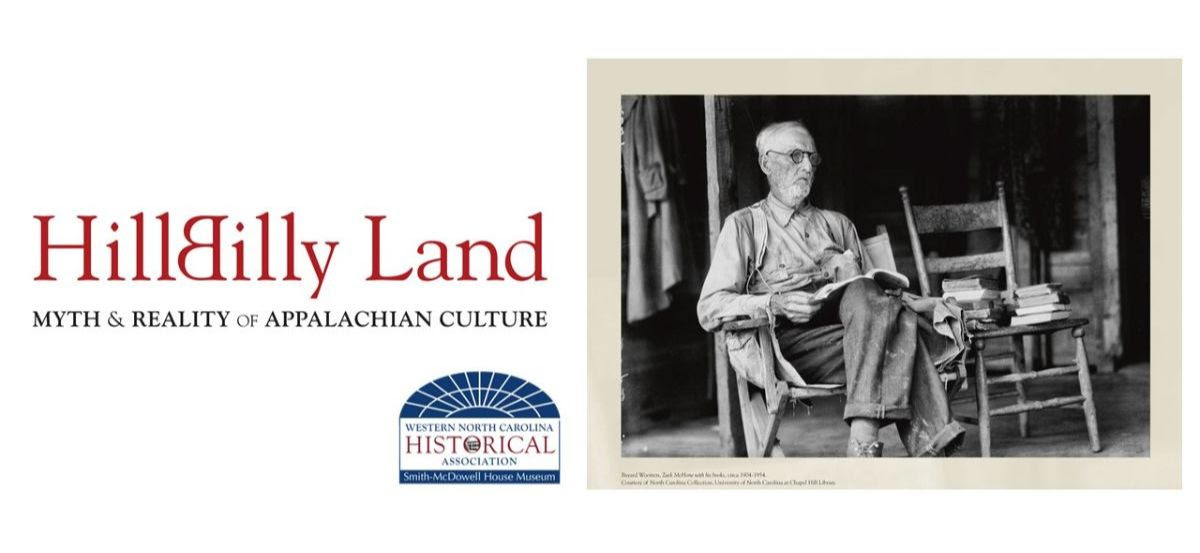
HillBilly Land explores the power, prevalence, and persistence of the hillbilly stereotype from the days of its beginnings in the late 19th century to the present day.
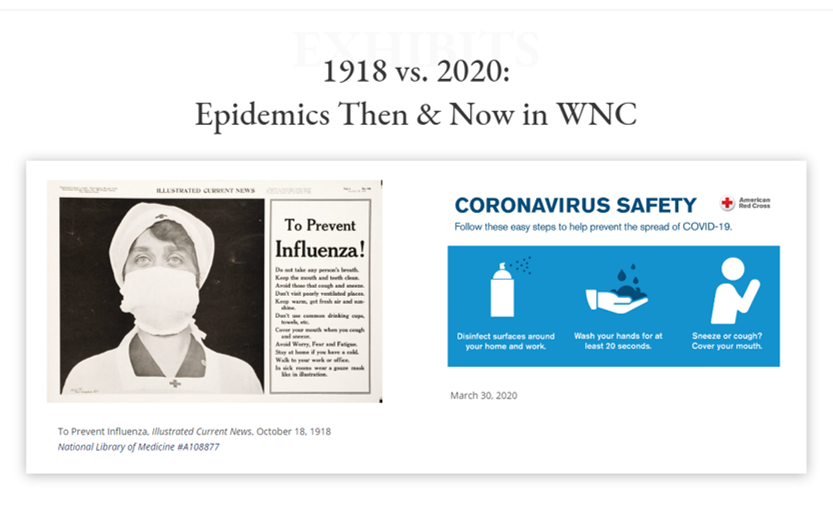
In 1918 vs 2020, we take an in-depth look at the 1918 influenza epidemic in Western North Carolina through newspaper clippings, advertisements, ephemera, photographs, and oral history and place the events of 1918 into context with our present-day response to the coronavirus pandemic.
Regional Resources: Historical Research
Dec 10 all-day
Online w/ Western North Carolina Historical Association (WNCHA)

Western North Carolina has a rich assortment of county historical societies, archives, and museums. The Western North Carolina Historical Association seeks to help researchers, historians, genealogists, and the general public take full advantage of these resources.


Sustainability Consulting Organic Growers School
Dec 10 all-day
Organic Growers School

Need help with your farm, garden, or homestead? We offer a wide variety of one-on-one consulting services— hourly follow-up support and reduced fees available.

Contact us for a free 20 minute call helping you to identify your needs and goals and assess which service might be right for you. We offer a wide variety of consulting services—with hourly follow-up support and reduced fees available—including:

  • Assessment of land that you own or want to purchase.
  • Sustainability systems on your farm, garden, or homestead.
  • Guidance for your land-based project.

How the process works:

Step 1: We talk on the phone to identify your goals and needs.
Step 2: We select a service and price that best meets your needs.
Step 3: We set up a time for an in-person site visit or video call
Step 4: We coach you through a self-assessment process.
Step 5: We have our virtual or in-person site visit.
Step 6: We invoice you.
Step 7: We followup with you with next steps, referrals, report, etc.

Get Started  Dance can be life-changing: The Academy at Terpsicorps Studios
Dec 10 @ 9:00 am – 5:00 pm
The Academy at Terpsicorps Studios

Get Started

 Dance can be life-changing. We want to show you how.  Come try two weeks of classes for just $29.99

Fall/Winter Schedule 2021/2022

Additional Information

ATTD New Fall 2021-2022 Class Schedule – August 22, 2021- May 27, 2022

*Note that ages serve only as a guideline.  Below represents our Curriculum based ballet programs.  Look for additional class offerings of Int/Adv Tap, Jazz & Hip- Hop TBA. Combo I – Elementary II placement is based on age.  Level 1 and above are skill based placement.  All schedules are subject to change.

Combo I : Pre- Ballet/Pre- Tap Curriculum (Age 3-4 )

Monday 4:00-5:00

OR
Wednesday 5:00-6:00

OR
Saturday 9:45-10:45

OR

Saturday11:00-12:00

Combo II : Ballet/Tap Curriculum Age (5-6)

Monday 4:00-5:00

OR

Wednesday 5:00-6:00

OR

Saturday  9:45-10:45

OR

Saturday 11:00-12:00

Elementary I : Introduction to Classical Technique w/Tap & Jazz (Age 6-7)

Monday 5:00-5:45 Ballet: Section A

5:45-6:30 Tap & Jazz : Section A

Wednesday 5:00-5:45 Ballet: Section B

5:45-6:30 Tap & Jazz : Section B
Elementary II: Introduction to Classical Technique w/ Tap, Jazz & Repertoire(Age 7-8)

Monday 5:00-5:45 Ballet:
5:45-6:30 Tap / Jazz
Thursday 5:00-6:15 Ballet
6:15-7:00 Repertoire

Boys Class:
Wednesday 6:00-6:45 w/Mr. Merz Elementary I- Level II

Level I : Classical Ballet Technique, with Repertoire and one enrichment class (Age 8-10 placement required)

Tuesday 4:30-5:30 Conditioning w/ Jazz Contemporary

5:30-6:30 Ballet Technique

Thursday 5:00-6:15 Ballet

6:15-7:00 Repertoire

Level II : Classical Ballet Technique, w/ Repertoire and 2 enrichment classes (Age 9-11 placement required)

Tuesday 4:30-5:30 Conditioning w/ Jazz Contemporary

5:30-6:30 Ballet Technique
Thursday 5:00-6:15 Ballet
Friday 4:00-5:30 Ballet Technique

5:30-6:30 Repertoire

Level III : Classical Ballet Technique w/Repertoire, pre-pointe, conditioning, specialty classes (Age 10-12 placement required)

Monday 5:00-6:30 Ballet Technique
6:30-7:15 Pre- Pointe/Variations
Tuesday 4:30-5:30 Conditioning w/ Jazz Contemporary

5:30-6:30 Ballet Technique
Friday 4:30-5:30 Ballet Technique
5:30-6:15 Repertoire

Level IV/V : Classical Ballet Technique w/ Repertoire, pointe, conditioning, specialty classes ( Placement required)

Monday 4:30-6:00 Ballet Technique

6:00-7:00 Repertoire

Tuesday 4:30-6:00 Ballet Technique

6:00-7:00 Modern
Wednesday 4:30-6:00 Ballet Technique

6:00-7:00 Pointe/Conditioning

Thursday 4:30-6:00 Ballet Technique

6:00-6:45 Pointe

*Saturday 11:00-12:15 Warm-up Technique **ONLY WHEN CALLED**

12:30-2pm Rehearsal **ONLY WHEN CALLED**

PreProfessional Day Program : Vocational Ballet Training ( Age 14- audition required)

Monday: 2:00-3:30 Ballet Technique

3:30-4:30 Pointe-Conditioning/Pointe

4:30-6:00 2nd Technique barre en pointe

Tuesday  2:00-3:30 Ballet Technique center en pointe

3:30-4:30 Modern

4:30-6:00 2nd Technique barre en pointe

Wednesday 2:00-3:30 Ballet Technique

3:30-4:30 Pointe/Repertoire

4:30-6:00 2nd Technique

Thursday 2:00-3:30 Ballet Technique

3:30-4:30 Pointe Variations

4:30-6:00 2nd Technique

Friday 2:00-3:30 Ballet Technique

3:30-4:30 Pas de Deux

*Saturday 11:00-12:15 Warm-up Technique

12:30-2pm Rehearsal
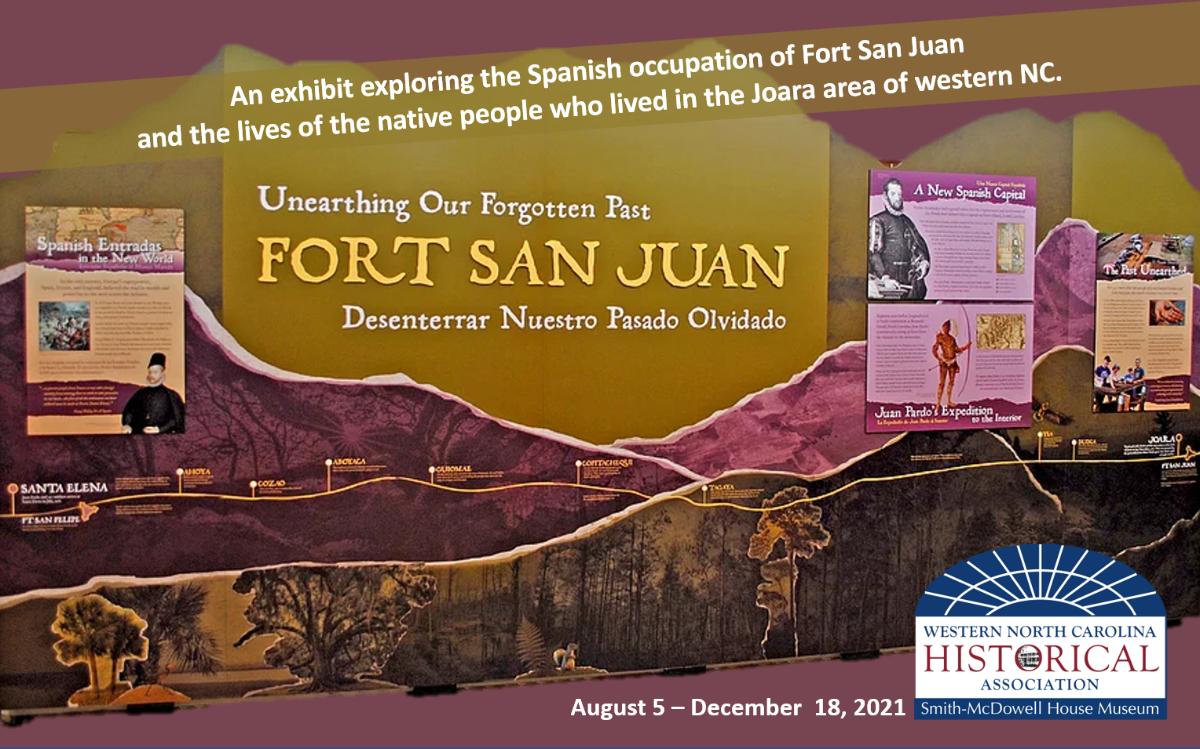
Unearthing Our Forgotten Past
Dec 10 @ 10:30 am – 4:00 pm
Smith-McDowell House Museum

The exhibit was developed as part of the celebration of the 450th anniversary of the Juan Pardo expeditions. Several years ago, archaeologists identified a site near Morganton as the location of Joara, one of the largest Native American towns in what is today Western North Carolina.

Joara was occupied from approximately 1400-1600 A.D. Two Spanish expeditions led respectively by Hernando de Soto and Juan Pardo visited the town in the 1500s. The Pardo expedition was part of a larger effort to establish a string of forts from the coast of present-day South Carolina all the way to Mexico. In 2013, archaeologists confirmed that Joara was also the site of Fort San Juan, established by Pardo in 1567, nearly 20 years before the English settlement at Roanoke on the coast of North Carolina and 40 years before the settlement at Jamestown.

Through various artifacts uncovered by the archaeology, the exhibit showcases the Spanish occupation of Fort San Juan and the lives of the native people who lived in the Joara area.

The exhibit is on loan from the Exploring Joara Foundation Inc. Exploring Joara engages the public in archaeology in the Carolinas, and emphasizes the discovery of the Native American town of Joara and Fort San Juan. The exhibit will be on display at the Western North Carolina Historical Association’s gallery inside the Smith-McDowell House through December 15.

The gallery is open for visitation Thursday, Friday, and Saturday between 10:30am and 4:00pm. Reservations are recommended.
COLLEGE STUDY HALL
Dec 10 @ 2:00 pm – 5:00 pm
Grind Coffee House

 Mon-Fri from 2-5pm. You have access to high speed internet, work space and HALF-OFF pastries when you present your college ID.

Geminids Meteor Shower Experience
Dec 10 @ 4:00 pm – Dec 11 @ 10:00 am
The Pisgah Astronomical Research Institute

Have you ever wished upon a star? If not NOW is your chance! Enjoy an evening under the stars observing the Geminids Meteor Shower at our historic, mountaintop, Internationally Certified Dark Sky Park! The Geminids meteors are often bold, white, and bright. On a dark night, you can often catch 50 or more meteors per hour in a dark, moonless sky. The greatest number of meteors typically fall in the wee hours after midnight. Astronomers and telescopes will also be available earlier in the evening to view the dark skies.

PARI is offering two ticket options to this event. The first is an EVENING TICKET to enjoy observing the meteor shower and the night sky through PARI telescopes. The second option is the OVERNIGHT CABIN PACKAGE for two people that includes dinner, a tour, sunset hike, observing the meteors, night sky observing, an overnight stay in a cabin quarter, and breakfast.

The overnight cabin package is a rain or shine event. No refunds will be given unless PARI cancels the event.
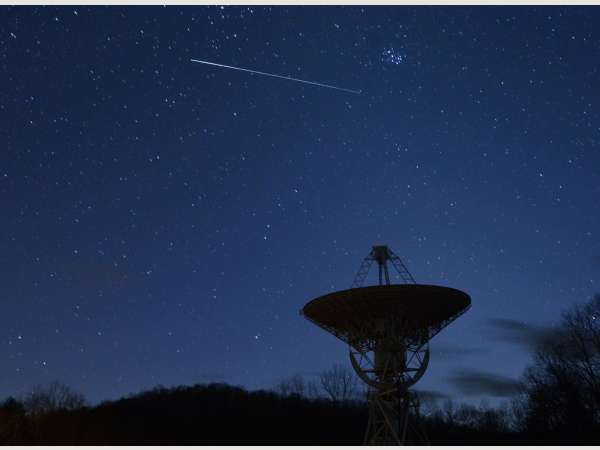
Geminids Meteor Shower Experience
Dec 10 @ 4:00 pm – 10:00 pm
The Pisgah Astronomical Research Institute

Enjoy an evening under the stars observing the Geminids Meteor Shower at our historic, mountaintop, Internationally Certified Dark Sky Park! The Geminids meteors are often bold, white and bright. On a dark night, you can often catch 50 or more meteors per hour in a dark, moonless sky. The greatest number of meteors typically fall in the wee hours after midnight. Astronomers and telescopes will also be available earlier in the evening to view the dark skies. Registration is Required!

The Local Kitchen: A Virtual Workshop with Sunil Patel
Dec 10 @ 5:00 pm – 6:30 pm
online

May be an image of 1 person and text that says 'Setting The Local Kitchen Virtual Workshop with Sunil Patel youself and your kitchen up to be as local and seasonal as possible What Topics: the mindset and approachto eating local and seasonal home? Strategies and make Local Home Kitchen How affe social and food systems change through your home kitchen December 10th at 5pm find virtual link below no rsvp necessary mo Bountiful Cities'

Join us for our next free educational workshop focusing on ways to set yourself and your kitchen up to be as local and seasonal as possible.

Topics:
What is the mindset and approach to
eating local and seasonal at home? Strategies and tips to make an
efficient Local Home Kitchen.
How to affect social and food systems change through your home kitchen.

Saturday, December 11, 2021
Dolly Parton’s Imagination Library
Dec 11 all-day
online

Driving Tour with Smith-McDowell House
Dec 11 all-day
Online w/ Western North Carolina Historical Association
The residents of the Smith-McDowell House and grounds were woven in to the fabric of Asheville.

This driving tour begins at the Smith-McDowell House Museum on the campus of A-B Tech and continues through historic sites related to early occupants of the house.

History @ Home – Visit Virtually Western North Carolina Historical Association
Dec 11 all-day
online w/ Western North Carolina Historical Association
Deep Dive into Archives is a living exhibit shining a light on the individuals who were once enslaved at the Smith-McDowell House through primary documentation.


Douglas Ellington: Asheville’s Boomtown Architect presents a look at Ellington’s iconic Asheville creations along with other buildings he completed throughout his career in other cities.
HillBilly Land explores the power, prevalence, and persistence of the hillbilly stereotype from the days of its beginnings in the late 19th century to the present day.
In 1918 vs 2020, we take an in-depth look at the 1918 influenza epidemic in Western North Carolina through newspaper clippings, advertisements, ephemera, photographs, and oral history and place the events of 1918 into context with our present-day response to the coronavirus pandemic.
On this Day in WNC History Tidbit
Dec 11 all-day
online
On this Day in WNC History Tidbit
Do you follow us on social media? If not, you’ve missed our new 2021 series –
On This Day in WNC History!

Every week we explore the headlines and overlooked events that happened
on a particular day in Western North Carolina history.

Follow us on social media for more!

Facebook
Instagram
Twitter
ON THIS DAY in WNC history: On October 2, 1929, deputies fired into a crowd of striking workers in Marion, NC. Six were killed and even more wounded at the Marion Manufacturing Company in one of the deadliest acts of strike busting in the South.

This year marked an apogee of strikes and labor organization in southern textile mills. Eight years prior, over 100 miners were killed at the Battle of Blair Mountain in West Virginia in a period of coal clashes and unionization attempts. Later in the 1920s, many textile workers reacting to grueling and dirty work conditions under the “stretch-out” system, along with a reduction of their pay in company scrip, began organizing and demanding better conditions. Spearheaded by the National Textile Workers Union (an organization supported by the Communist Party), concurrent strikes began early in 1929 at the Bemberg-Glanzstoff Rayon Corporation in Elizabethton, Tennessee and at Loray Mills in Gastonia, North Carolina. Female employees were key to the organization of both strikes, and the latter is most famously remembered for the death of Ella May Wiggins. National Guard members, local police, and union-busting mobs were called to both of these events.

The Marion strikes (which occurred at the neighboring Clinchfield Mill as well) began July 11. Workers struck without official union support, resisting involvement by communist organizers. After frequent violence and threats, with two National Guard units present, workers returned to these mills September 11, with no raise in pay and a mandated 55-hour workweek. Marion Manufacturing Mill refused to rehire 114 of the strikers, leading to further anger. Workers struck again on October 2, and deputies were dispatched by the local sheriff. Though some details are murky, deputies shot into a crowd of strikers, killing four on site, wounding at least fifteen, with two others dying later. Nearby hospitals refused medical care to strikers, and churches of the mill village refused to administer their funerals. Eight deputies were charged, but acquitted in December. They contended the strikers were armed, but no guns were found, and the New York Times reported those killed were shot in the back.

The memory of these events will be examined in our upcoming event, Marion Mill Massacre in Memory, on Thursday, Oct 14.

Image: Raleigh News and Observer, Oct. 4, 1929

Facebook
Instagram
Twitter
RAIL: The Railroad and Incarcerated Laborer Memorial Project
Dec 11 all-day
Online w/ Western North Carolina Historical Association (WNCHA)

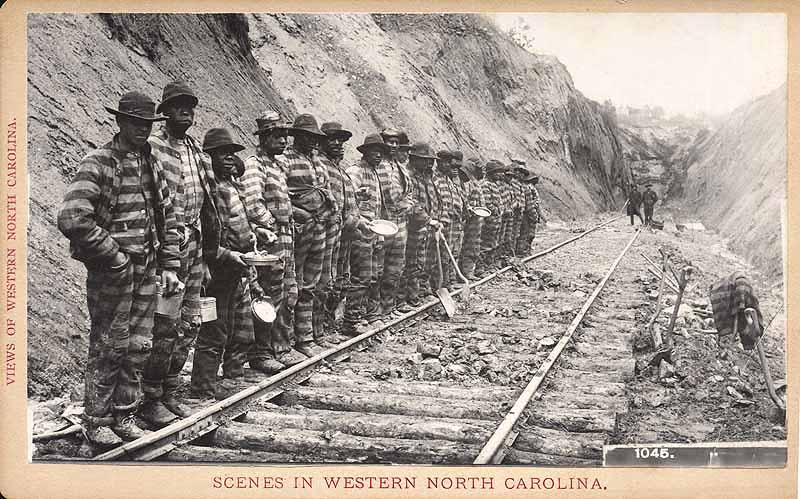
The construction of the Mountain Division of the Western North Carolina Railroad is widely considered one of the greatest human accomplishments in regards to both engineering and construction ever undertaken at the time it occurred. The project took place over a period of several years in the late 1800s. Many people are aware that the railroad provided the first dependable access to and from much of Western North Carolina for the rest of the state as well as much of the nation. Many also know the names of some of those who were instrumental in seeing through the completion of this ambitious project. Names such as Colonel Alexander Boyd Andrews, of Andrews’ Geyser fame. However, what most people are unaware of is that at least 95% of the labor which built the railroad across the Blue Ridge Escarpment was completed by inmates from the North Carolina State Penitentiary… and approximately 98% of those inmates were African American men… the majority of whom were unjustly imprisoned…

This project was created to share the true story behind this human endeavor and to honor the memory of those who labored and those who died here.

Regional Resources: Historical Research
Dec 11 all-day
Online w/ Western North Carolina Historical Association (WNCHA)

Western North Carolina has a rich assortment of county historical societies, archives, and museums. The Western North Carolina Historical Association seeks to help researchers, historians, genealogists, and the general public take full advantage of these resources.


Sustainability Consulting Organic Growers School
Dec 11 all-day
Organic Growers School

Need help with your farm, garden, or homestead? We offer a wide variety of one-on-one consulting services— hourly follow-up support and reduced fees available.

Contact us for a free 20 minute call helping you to identify your needs and goals and assess which service might be right for you. We offer a wide variety of consulting services—with hourly follow-up support and reduced fees available—including:

  • Assessment of land that you own or want to purchase.
  • Sustainability systems on your farm, garden, or homestead.
  • Guidance for your land-based project.

How the process works:

Step 1: We talk on the phone to identify your goals and needs.
Step 2: We select a service and price that best meets your needs.
Step 3: We set up a time for an in-person site visit or video call
Step 4: We coach you through a self-assessment process.
Step 5: We have our virtual or in-person site visit.
Step 6: We invoice you.
Step 7: We followup with you with next steps, referrals, report, etc.

Get Started  Dance can be life-changing: The Academy at Terpsicorps Studios
Dec 11 @ 9:00 am – 5:00 pm
The Academy at Terpsicorps Studios

Get Started

 Dance can be life-changing. We want to show you how.  Come try two weeks of classes for just $29.99

Fall/Winter Schedule 2021/2022

Additional Information

ATTD New Fall 2021-2022 Class Schedule – August 22, 2021- May 27, 2022

*Note that ages serve only as a guideline.  Below represents our Curriculum based ballet programs.  Look for additional class offerings of Int/Adv Tap, Jazz & Hip- Hop TBA. Combo I – Elementary II placement is based on age.  Level 1 and above are skill based placement.  All schedules are subject to change.

Combo I : Pre- Ballet/Pre- Tap Curriculum (Age 3-4 )

Monday 4:00-5:00

OR
Wednesday 5:00-6:00

OR
Saturday 9:45-10:45

OR

Saturday11:00-12:00

Combo II : Ballet/Tap Curriculum Age (5-6)

Monday 4:00-5:00

OR

Wednesday 5:00-6:00

OR

Saturday  9:45-10:45

OR

Saturday 11:00-12:00

Elementary I : Introduction to Classical Technique w/Tap & Jazz (Age 6-7)

Monday 5:00-5:45 Ballet: Section A

5:45-6:30 Tap & Jazz : Section A

Wednesday 5:00-5:45 Ballet: Section B

5:45-6:30 Tap & Jazz : Section B
Elementary II: Introduction to Classical Technique w/ Tap, Jazz & Repertoire(Age 7-8)

Monday 5:00-5:45 Ballet:
5:45-6:30 Tap / Jazz
Thursday 5:00-6:15 Ballet
6:15-7:00 Repertoire

Boys Class:
Wednesday 6:00-6:45 w/Mr. Merz Elementary I- Level II

Level I : Classical Ballet Technique, with Repertoire and one enrichment class (Age 8-10 placement required)

Tuesday 4:30-5:30 Conditioning w/ Jazz Contemporary

5:30-6:30 Ballet Technique

Thursday 5:00-6:15 Ballet

6:15-7:00 Repertoire

Level II : Classical Ballet Technique, w/ Repertoire and 2 enrichment classes (Age 9-11 placement required)

Tuesday 4:30-5:30 Conditioning w/ Jazz Contemporary

5:30-6:30 Ballet Technique
Thursday 5:00-6:15 Ballet
Friday 4:00-5:30 Ballet Technique

5:30-6:30 Repertoire

Level III : Classical Ballet Technique w/Repertoire, pre-pointe, conditioning, specialty classes (Age 10-12 placement required)

Monday 5:00-6:30 Ballet Technique
6:30-7:15 Pre- Pointe/Variations
Tuesday 4:30-5:30 Conditioning w/ Jazz Contemporary

5:30-6:30 Ballet Technique
Friday 4:30-5:30 Ballet Technique
5:30-6:15 Repertoire

Level IV/V : Classical Ballet Technique w/ Repertoire, pointe, conditioning, specialty classes ( Placement required)

Monday 4:30-6:00 Ballet Technique

6:00-7:00 Repertoire

Tuesday 4:30-6:00 Ballet Technique

6:00-7:00 Modern
Wednesday 4:30-6:00 Ballet Technique

6:00-7:00 Pointe/Conditioning

Thursday 4:30-6:00 Ballet Technique

6:00-6:45 Pointe

*Saturday 11:00-12:15 Warm-up Technique **ONLY WHEN CALLED**

12:30-2pm Rehearsal **ONLY WHEN CALLED**

PreProfessional Day Program : Vocational Ballet Training ( Age 14- audition required)

Monday: 2:00-3:30 Ballet Technique

3:30-4:30 Pointe-Conditioning/Pointe

4:30-6:00 2nd Technique barre en pointe

Tuesday  2:00-3:30 Ballet Technique center en pointe

3:30-4:30 Modern

4:30-6:00 2nd Technique barre en pointe

Wednesday 2:00-3:30 Ballet Technique

3:30-4:30 Pointe/Repertoire

4:30-6:00 2nd Technique

Thursday 2:00-3:30 Ballet Technique

3:30-4:30 Pointe Variations

4:30-6:00 2nd Technique

Friday 2:00-3:30 Ballet Technique

3:30-4:30 Pas de Deux

*Saturday 11:00-12:15 Warm-up Technique

12:30-2pm Rehearsal

Unearthing Our Forgotten Past
Dec 11 @ 10:30 am – 4:00 pm
Smith-McDowell House Museum

The exhibit was developed as part of the celebration of the 450th anniversary of the Juan Pardo expeditions. Several years ago, archaeologists identified a site near Morganton as the location of Joara, one of the largest Native American towns in what is today Western North Carolina.

Joara was occupied from approximately 1400-1600 A.D. Two Spanish expeditions led respectively by Hernando de Soto and Juan Pardo visited the town in the 1500s. The Pardo expedition was part of a larger effort to establish a string of forts from the coast of present-day South Carolina all the way to Mexico. In 2013, archaeologists confirmed that Joara was also the site of Fort San Juan, established by Pardo in 1567, nearly 20 years before the English settlement at Roanoke on the coast of North Carolina and 40 years before the settlement at Jamestown.

Through various artifacts uncovered by the archaeology, the exhibit showcases the Spanish occupation of Fort San Juan and the lives of the native people who lived in the Joara area.

The exhibit is on loan from the Exploring Joara Foundation Inc. Exploring Joara engages the public in archaeology in the Carolinas, and emphasizes the discovery of the Native American town of Joara and Fort San Juan. The exhibit will be on display at the Western North Carolina Historical Association’s gallery inside the Smith-McDowell House through December 15.

The gallery is open for visitation Thursday, Friday, and Saturday between 10:30am and 4:00pm. Reservations are recommended.

Geminids Meteor Shower Experience
Dec 11 @ 4:00 pm – 10:00 pm
The Pisgah Astronomical Research Institute

Enjoy an evening under the stars observing the Geminids Meteor Shower at our historic, mountaintop, Internationally Certified Dark Sky Park! The Geminids meteors are often bold, white and bright. On a dark night, you can often catch 50 or more meteors per hour in a dark, moonless sky. The greatest number of meteors typically fall in the wee hours after midnight. Astronomers and telescopes will also be available earlier in the evening to view the dark skies. Registration is Required!

Sunday, December 12, 2021
Dolly Parton’s Imagination Library
Dec 12 all-day
online

Driving Tour with Smith-McDowell House
Dec 12 all-day
Online w/ Western North Carolina Historical Association
The residents of the Smith-McDowell House and grounds were woven in to the fabric of Asheville.

This driving tour begins at the Smith-McDowell House Museum on the campus of A-B Tech and continues through historic sites related to early occupants of the house.

History @ Home – Visit Virtually Western North Carolina Historical Association
Dec 12 all-day
online w/ Western North Carolina Historical Association
Deep Dive into Archives is a living exhibit shining a light on the individuals who were once enslaved at the Smith-McDowell House through primary documentation.


Douglas Ellington: Asheville’s Boomtown Architect presents a look at Ellington’s iconic Asheville creations along with other buildings he completed throughout his career in other cities.
HillBilly Land explores the power, prevalence, and persistence of the hillbilly stereotype from the days of its beginnings in the late 19th century to the present day.
In 1918 vs 2020, we take an in-depth look at the 1918 influenza epidemic in Western North Carolina through newspaper clippings, advertisements, ephemera, photographs, and oral history and place the events of 1918 into context with our present-day response to the coronavirus pandemic.
On this Day in WNC History Tidbit
Dec 12 all-day
online
On this Day in WNC History Tidbit
Do you follow us on social media? If not, you’ve missed our new 2021 series –
On This Day in WNC History!

Every week we explore the headlines and overlooked events that happened
on a particular day in Western North Carolina history.

Follow us on social media for more!

Facebook
Instagram
Twitter
ON THIS DAY in WNC history: On October 2, 1929, deputies fired into a crowd of striking workers in Marion, NC. Six were killed and even more wounded at the Marion Manufacturing Company in one of the deadliest acts of strike busting in the South.

This year marked an apogee of strikes and labor organization in southern textile mills. Eight years prior, over 100 miners were killed at the Battle of Blair Mountain in West Virginia in a period of coal clashes and unionization attempts. Later in the 1920s, many textile workers reacting to grueling and dirty work conditions under the “stretch-out” system, along with a reduction of their pay in company scrip, began organizing and demanding better conditions. Spearheaded by the National Textile Workers Union (an organization supported by the Communist Party), concurrent strikes began early in 1929 at the Bemberg-Glanzstoff Rayon Corporation in Elizabethton, Tennessee and at Loray Mills in Gastonia, North Carolina. Female employees were key to the organization of both strikes, and the latter is most famously remembered for the death of Ella May Wiggins. National Guard members, local police, and union-busting mobs were called to both of these events.

The Marion strikes (which occurred at the neighboring Clinchfield Mill as well) began July 11. Workers struck without official union support, resisting involvement by communist organizers. After frequent violence and threats, with two National Guard units present, workers returned to these mills September 11, with no raise in pay and a mandated 55-hour workweek. Marion Manufacturing Mill refused to rehire 114 of the strikers, leading to further anger. Workers struck again on October 2, and deputies were dispatched by the local sheriff. Though some details are murky, deputies shot into a crowd of strikers, killing four on site, wounding at least fifteen, with two others dying later. Nearby hospitals refused medical care to strikers, and churches of the mill village refused to administer their funerals. Eight deputies were charged, but acquitted in December. They contended the strikers were armed, but no guns were found, and the New York Times reported those killed were shot in the back.

The memory of these events will be examined in our upcoming event, Marion Mill Massacre in Memory, on Thursday, Oct 14.

Image: Raleigh News and Observer, Oct. 4, 1929

Facebook
Instagram
Twitter
RAIL: The Railroad and Incarcerated Laborer Memorial Project
Dec 12 all-day
Online w/ Western North Carolina Historical Association (WNCHA)

The construction of the Mountain Division of the Western North Carolina Railroad is widely considered one of the greatest human accomplishments in regards to both engineering and construction ever undertaken at the time it occurred. The project took place over a period of several years in the late 1800s. Many people are aware that the railroad provided the first dependable access to and from much of Western North Carolina for the rest of the state as well as much of the nation. Many also know the names of some of those who were instrumental in seeing through the completion of this ambitious project. Names such as Colonel Alexander Boyd Andrews, of Andrews’ Geyser fame. However, what most people are unaware of is that at least 95% of the labor which built the railroad across the Blue Ridge Escarpment was completed by inmates from the North Carolina State Penitentiary… and approximately 98% of those inmates were African American men… the majority of whom were unjustly imprisoned…

This project was created to share the true story behind this human endeavor and to honor the memory of those who labored and those who died here.

Regional Resources: Historical Research
Dec 12 all-day
Online w/ Western North Carolina Historical Association (WNCHA)

Western North Carolina has a rich assortment of county historical societies, archives, and museums. The Western North Carolina Historical Association seeks to help researchers, historians, genealogists, and the general public take full advantage of these resources.


Sustainability Consulting Organic Growers School
Dec 12 all-day
Organic Growers School

Need help with your farm, garden, or homestead? We offer a wide variety of one-on-one consulting services— hourly follow-up support and reduced fees available.

Contact us for a free 20 minute call helping you to identify your needs and goals and assess which service might be right for you. We offer a wide variety of consulting services—with hourly follow-up support and reduced fees available—including:

  • Assessment of land that you own or want to purchase.
  • Sustainability systems on your farm, garden, or homestead.
  • Guidance for your land-based project.

How the process works:

Step 1: We talk on the phone to identify your goals and needs.
Step 2: We select a service and price that best meets your needs.
Step 3: We set up a time for an in-person site visit or video call
Step 4: We coach you through a self-assessment process.
Step 5: We have our virtual or in-person site visit.
Step 6: We invoice you.
Step 7: We followup with you with next steps, referrals, report, etc.